What a new HVAC system costs in Ross
In Ross, most homes were built long before 1980, and about three-quarters are owner-occupied (U.S. Census Bureau, ACS 2024). This means the typical project is a retrofit or replacement, not new construction. The reality of pre-1960 construction dominates: ductwork can be narrow, sometimes leaky, and electrical panels may lack extra capacity. If your house hasn’t had a major systems overhaul since your parents moved in, odds are high your next HVAC decision will have to work within those old constraints.
Our winters use far more energy than our summers, with 5,600 heating degree days and only 1,050 cooling degree days. This heating bias should guide your spending: most homes in Ross burn more energy staying warm than getting cool. For the average single-family house, central AC and furnace replacement or a switch to a ducted heat pump are the main scenarios, but many older homes end up with ductless or partial solutions due to tight spaces or absent ductwork.
| System |
Best for |
Efficiency |
Price range (installed) |
| Central AC replacement (existing ducts) |
homes with sound ductwork |
16–20 SEER2 |
$5,100–$12,500 |
| Air source heat pump (ducted) |
year-round heating and cooling |
8–10 HSPF2 |
$8,200–$17,500 |
| Cold-climate heat pump (ducted) |
heat pump as primary heat |
9–11 HSPF2 |
$13,500–$17,500 |
| Ductless mini-split (single zone) |
additions, rooms without ducts |
20–30 SEER2 |
$3,300–$7,200 |
| Full duct system installation |
homes with no existing ducts |
— |
$9,200–$18,500 |
Installed estimates for a typical Ross home. Equipment tonnage, duct condition and electrical capacity move these more than brand.
Why your ducts may be the real problem in Ross
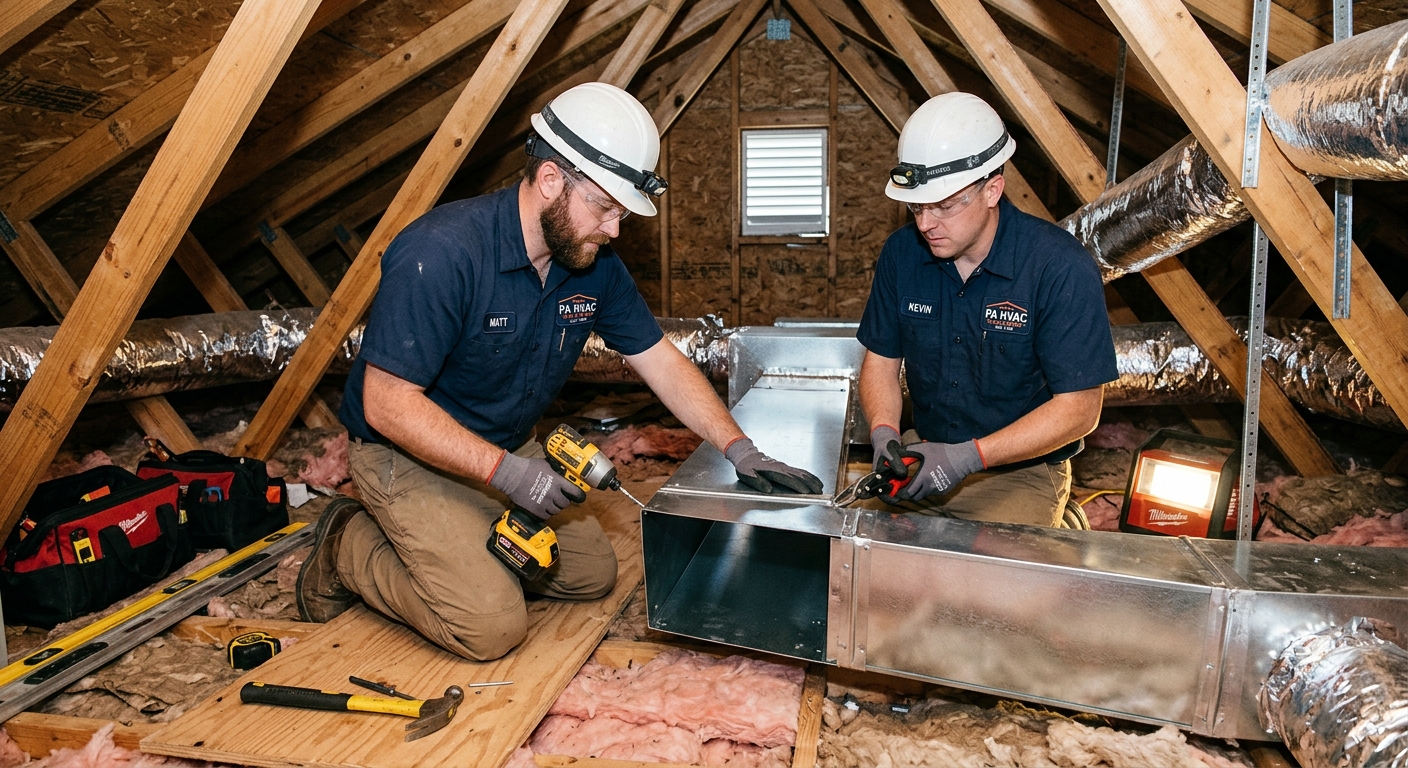
With so many Ross homes built before 1960, most ductwork was never designed for today’s high-efficiency systems, or perhaps sealed at all. Duct leakage in older houses can send 20–40% of your heated or cooled air into attics, crawlspaces or wall cavities, wasting energy and causing uneven heating or cooling. The duct blaster test—a pressure test—reveals exactly how much air is escaping, and sometimes the results are sobering when stacked up against your utility bills.
Retrofits in Ross often run into ducts too small for efficient air movement, especially returns sized only for a small furnace. This starves the new system, causing noise, wear, and rooms that just won’t stay comfortable. You may also find ducts running through unconditioned areas with no insulation; all the efficiency in the world won’t matter if your supply runs are baking or freezing through half the year.
Replacement isn’t always the answer—duct sealing (using mastic, not just metal tape) and adding insulation can dramatically cut losses. But, if returns are badly undersized or the existing system was cobbled together for heating only, section-by-section replacement or redesign may be called for. The honest recommendation in Ross is simple: test your ducts before you commit to new equipment. Fixing the distribution side first gives you the real gains and ensures your system lives up to its specs once installed.
Permits, licensing and inspections in Ross
In Pennsylvania, residential HVAC work—including in Ross—is not governed by a statewide HVAC license. The Pennsylvania Uniform Construction Code (UCC), based on the IRC, sets the baseline, but actual permitting and inspection is managed locally: municipalities enforce the rules unless they’ve opted out, in which case the state may step in. For Ross, this means your installer must pull a mechanical permit and arrange for inspection with the municipality.
Contractors working on projects valued over $500 must be registered as Home Improvement Contractors (HIC) with the Pennsylvania Office of Attorney General. Before you sign, you can verify this registration at hic.attorneygeneral.gov. The law also requires every employer (even small outfits) to carry workers' compensation coverage, which you can check via the state’s WCAIS system (wcais.pa.gov)—important if a worker is injured on your property.
While there’s no state HVAC-specific license, federal EPA Section 608 certification is required for anyone handling refrigerant during installation, replacement or service. Electrical and plumbing specialties are locally licensed as well, so complex projects with panel changes or tied-in humidifiers may require additional municipal sign-offs. Whatever you’re quoted, the permit and inspection should be listed, and never omitted or “forgotten.”
Refrigerant rules and your existing system
The HVAC industry’s transition away from high-global warming potential HFC refrigerants is now well underway. New residential air conditioners and heat pumps are increasingly shipped with lower-GWP refrigerants like R-454B and R-32, but if your Ross home has a system using R-410A, it’s still legal and serviceable.
Here’s what matters: R-410A is being phased down in new equipment, and its price is likely to climb as supplies tighten. For a homeowner with a functioning system, this means you can have service performed—including recharging after a leak—but repair costs tied to refrigerant are rising. If your older system springs a leak, you may find the repair versus replacement question swings quicker toward replacement, simply due to refrigerant cost. Still, there’s no requirement to replace a working R-410A unit, and it remains lawful to operate and service it as long as parts and refrigerant are available.
The change affects only new equipment and, in practice, the long-run economics of keeping an aging system alive. Your existing system won’t be “illegal,” but if repair bills start stacking up—especially for leaks—factor the new refrigerant prices into your decision.
What a real HVAC quote contains
A solid HVAC quote in Ross spells out every major variable. It will list the exact model numbers for both the indoor and outdoor units (no “mystery matchups” that rob you of published efficiency), the system tonnage, and include a copy or summary of the load calculation. Look for a clear note on whether the refrigerant line set will be replaced or reused, confirmation of your electrical panel’s capacity, and whether any upgrades are included. The quote should specify a new thermostat, handling of condensate (especially in basements or older homes), municipal permit, and a summary commissioning report once installed. Warranty terms need to be clearly split between equipment and labor. If you only get a brand and a price, you’ve learned almost nothing you can actually compare.
| Line item |
What to look for |
Red flag if… |
| Equipment |
model numbers, indoor and outdoor matched |
brand name only |
| Sizing |
load calculation attached |
matched to the old nameplate |
| Ductwork |
condition assessed, sealing scoped |
not mentioned |
| Electrical |
circuit and panel capacity confirmed |
assumed adequate |
| Line set |
replaced or documented as reused |
silent |
| Commissioning |
measured airflow and charge, documented |
no startup report |
| Warranty |
labour years stated separately |
manufacturer only |
| Permit |
included and priced |
'not needed' |
What each system actually costs to run in Ross
Ross winters are long (5,600 heating degree days) and summers relatively short (1,050 cooling degree days), so what you choose for heating will define your annual utility costs. Duquesne Light Company handles the electricity here, and your actual rate per kWh is listed on your monthly bill—no one-size-fits-all number applies.
To estimate operating costs, start with efficiency: a furnace lists its AFUE, a heat pump lists HSPF2, and an AC lists SEER2. The more heating or cooling degree days your house faces, the more these ratings matter. The method: determine your home’s seasonal load (as a rule of thumb, about 20–25 BTUs per square foot times the number of degree days), divide by the system efficiency, and multiply by your utility’s rate. For cooling, do the same with SEER2 and the shorter cooling season.
Example: If you heat with a ducted heat pump rated 9 HSPF2, and your house uses 18,000 kWh per year for heating, you’d multiply that by your Duquesne rate. The same logic applies for AC; a system at 18 SEER2 will use less per hour than one at 14, but with our mild summers, the difference is modest. Leaky or uninsulated ducts can easily wipe out the theoretical savings—a high-efficiency system installed on poor ducts will underperform a basic one on tight, insulated ducts. When comparing options, take last year’s bills, adjust for the efficiencies, and remember: the best upgrade is only as good as the weakest link in your house’s envelope and distribution.
SEER2, HSPF2 and AFUE decoded
SEER2 measures air conditioning efficiency—the higher, the less electricity is used for a set amount of cooling. HSPF2 rates heat pumps on the heating side, showing how many British Thermal Units (BTUs) you get per watt-hour. AFUE is for furnaces, measuring what fraction of fuel is turned into usable heat instead of waste.
For Allegheny County’s 5,600 heating degree days, HSPF2 directly impacts your bills more than SEER2. Investing in top-tier SEER2 (above 18 or 20) delivers small payback, since our summers are mild and short. The efficiency premium for SEER2 pays back slowly here. By contrast, moving from an 8 to a 10 HSPF2 heat pump can substantially trim winter costs. Similarly, on the furnace side, stepping up from 80% to 96% AFUE makes sense if you plan to stay long-term—but don’t pay extra for a “Cadillac” furnace if the ducts and envelope are leaky.
Note: in 2023, SEER switched to SEER2 and HSPF to HSPF2. Old (SEER/HSPF) ratings aren’t apples-to-apples with the current (SEER2/HSPF2) ones you’ll see on new equipment specs. Compare apples to apples, and match your spending to where the climate actually hits your wallet.
Frequently asked questions — HVAC installation in Ross
Is a high-efficiency system worth the extra cost here?
In Ross, with our long heating season and fairly modest cooling needs, spending for very high air conditioning efficiency (SEER2 above 18) usually doesn’t pay back quickly. The running cost difference for AC is minor across our 1,050 cooling degree days. Where efficiency does pay is in heating: if you’re considering a heat pump or furnace replacement, bumping up to an HSPF2 of 10 or an AFUE of 96% makes sense, especially if you plan to stay in your home. For example, a central AC replacement will run $5,100–$12,500, while a ducted cold-climate heat pump is $13,500–$17,500, a higher up-front cost with more winter savings. Make the decision based on your own gas and electric rates, not just efficiency badges.
Do I need ENERGY STAR equipment to qualify for incentives?
In Pennsylvania, most utility and state-based incentives require the system to meet or exceed certain ENERGY STAR criteria. For Ross homeowners, you’ll typically see rebates for systems like ductless mini-splits at $3,300–$7,200 if they hold the proper efficiency ratings. However, not every high-efficiency system is automatically ENERGY STAR—verify model numbers. Applying for incentives always requires documenting installation by a registered contractor and a valid permit. Read the fine print for the specific rebate you’re targeting, and don’t let a salesperson push less efficient (or non-qualifying) equipment as “rebate eligible” without evidence.
Do I need a permit to replace HVAC in Ross?
Yes, you need a mechanical permit for new or replacement HVAC systems in Ross. Allegheny County municipalities handle permitting individually, and Ross follows the rules set out by the Pennsylvania Uniform Construction Code (UCC). Reputable contractors should include the cost for permitting in their quotes—don’t let anyone talk you out of it. Permit costs are small compared to the overall job and are required for replacements as well as new installs, even if you’re just doing a standard central AC replacement (which typically costs $5,100–$12,500). Permitting ensures safe work and proper inspections. If the quote says “no permit needed,” that’s a red flag.
When is the best time of year to replace HVAC in Ross?
The best time is late winter into early spring, or early fall before the first hard freeze. That’s when demand drops, and you may get quicker turnarounds and better pricing—especially before everyone’s system conks out on the same week in July or January. Contractors are less booked and may have more flexibility. For reference, a heat pump installation in Ross runs $8,200–$17,500; you’ll get more attention to detail on scheduling and commissioning if you avoid peak-season emergencies. If your system is limping by in late fall, spring is your golden window for thoughtful, less stressful replacement.
Should I repair or replace my HVAC system in Ross?
It depends on system age, frequency (and cost) of repairs, and the cost of refrigerant or parts—especially as R-410A prices rise for older systems. For an older unit facing a refrigerant leak in Ross, the repair may edge up toward $3,300–$7,200, the same as a new ductless mini-split. If your existing equipment is over 12–15 years old, has poor efficiency, or your ducts are questionable, a full or partial replacement may pay back quicker, especially with our long heating seasons. However, a newer, well-maintained system with a simple fix is often worth repairing. Get a clear diagnosis and compare the numbers—don’t just go by age alone.
How cold does it get in Ross and does that affect heat pumps?
Ross winter design temperatures run as low as 8 °F, and we see about 5,600 heating degree days per year. This means heat pumps must be sized correctly—standard versions can struggle or need backup resistance heat during the coldest days. Cold-climate heat pumps, which cost $13,500–$17,500, are engineered to handle low temperatures better and may qualify for extra incentives. If you’re considering a heat pump, discuss backup heating strategies and don’t undersize the system for our real-world cold snaps. Proper installation, duct sizing, and commissioning matter just as much to consistent winter performance.
What size HVAC system does my Ross home need?
There’s no one-size-fits-all answer in Ross, since our housing stock is mostly pre-1980 construction with a wide range of insulation levels, duct quality, and window types. As a starting point, contractors should base sizing on a load calculation, not just square footage or the old equipment tag. A typical single-family Ross home could need a ducted heat pump in the $8,200–$17,500 range, but square footage isn’t enough: air leakage, insulation, and window orientation all affect the correct tonnage. Insist that your quote shows the load calculation—oversized or undersized systems both lead to comfort and operating cost problems here.
What does a heat pump cost installed in Ross?
A ducted air source heat pump installation in Ross runs from $8,200–$17,500, with cold-climate models coming in at the higher end ($13,500–$17,500). Costs depend on ductwork condition, whether electrical upgrades are needed, house size, and whether you qualify for incentives. Ductless single-zone mini-splits, sometimes used for additions or older homes without central ducts, are less expensive at $3,300–$7,200. The main price drivers are system capacity (tonnage), controls, and site conditions—brand is less important than sizing and installation quality.
How long should an HVAC system last in Ross?
With proper maintenance and installation, most HVAC systems in Ross should last 12 to 20 years. The actual lifespan will depend on how well the system matches your home’s needs, ductwork quality, and how much the equipment had to “fight” the local environment—leaky or undersized ducts, neglected filters, or deferred repairs will all cut lifespan short. With a typical central AC replacement costing $5,100–$12,500, investing in good installation and annual checkups pays for itself by extending system life. Once an older system hits frequent repairs or hard-to-source parts, replacement becomes the lower-risk, lower-headache option.