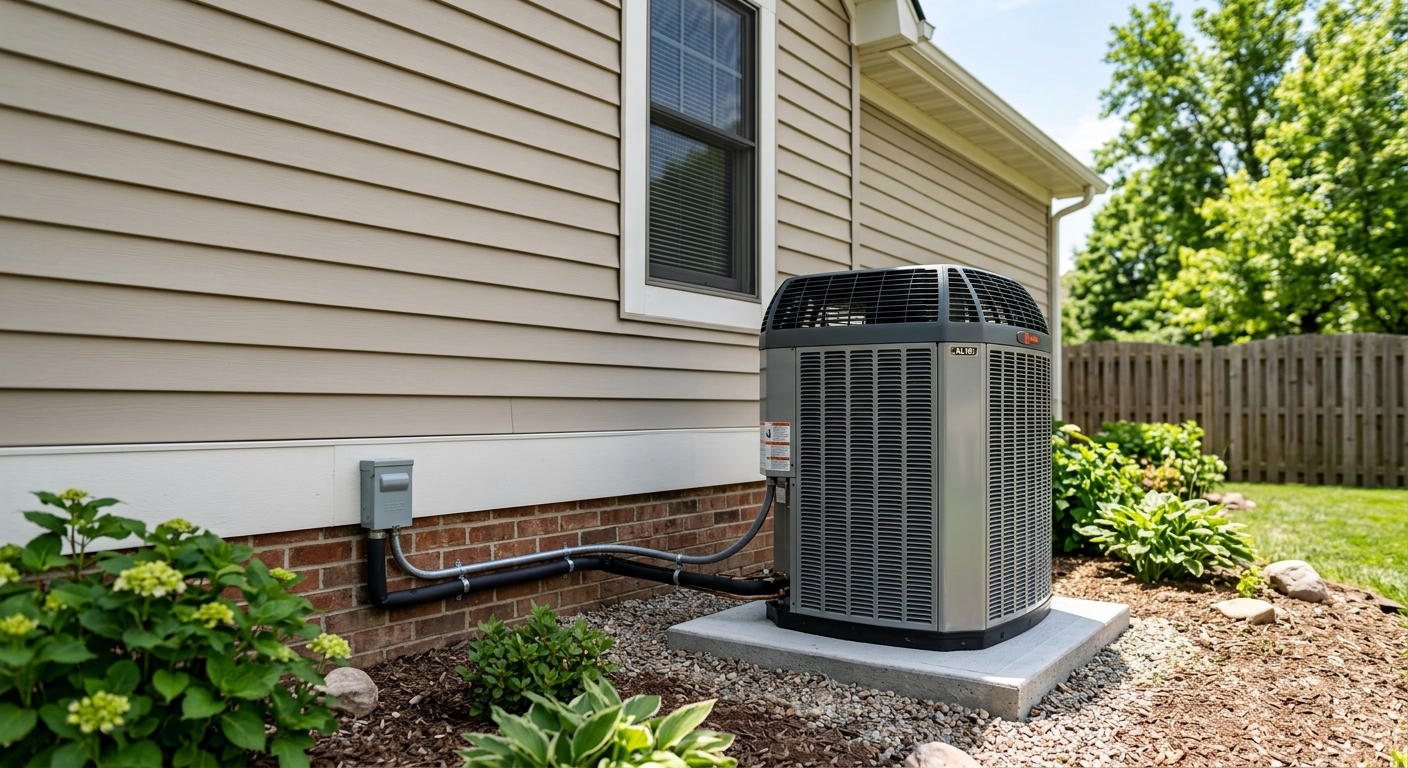
HVAC costs in Lower Macungie — 2026
Lower Macungie has a high homeownership rate and much of its housing stock was built before 1980 (U.S. Census Bureau, ACS 2024). That means most local installations are system replacements or retrofits, not first-time installs. If your house is like many in Lower Macungie or neighboring South and Upper Macungie, odds are there's an existing duct system that may now need ductwork repairs or upgrades along with your new system. Those big suburban tracts built from 1960–1990 drive a steady demand for central AC replacements and, especially for homes where the ducts haven't been touched in decades, full duct reworks.
This region is unmistakably a heating climate: with 6,100 heating degree days versus just 850 for cooling, your furnace or heat pump sees far more use than your air conditioner. Sizing, efficiency upgrades, and equipment choice should all be made with cold weather as the main concern and cooling as a secondary, but not negligible, need. The design temperature of 4 °F means a system must keep up even during winter cold snaps. If you already have ducts in decent condition, central AC or a ducted heat pump can be a good fit. If not, mini-splits or a new duct system may be necessary.
| System |
Best for |
Efficiency |
Price range (installed) |
| Central AC replacement (existing ducts) |
homes with sound ductwork |
16–20 SEER2 |
$5,600–$13,500 |
| Air source heat pump (ducted) |
year-round heating and cooling |
8–10 HSPF2 |
$8,900–$19,000 |
| Cold-climate heat pump (ducted) |
heat pump as primary heat |
9–11 HSPF2 |
$14,500–$19,000 |
| Ductless mini-split (single zone) |
additions, rooms without ducts |
20–30 SEER2 |
$3,600–$7,800 |
| Full duct system installation |
homes with no existing ducts |
— |
$10,000–$20,000 |
Installed estimates for a typical Lower Macungie home. Equipment tonnage, duct condition and electrical capacity move these more than brand.
What you can actually claim on a heat pump here
If you're installing a ducted or ductless heat pump in Lower Macungie, three possible incentives may apply: federal tax credits, utility rebates, and the occasional state-run program. The federal tax credit, like the Energy Efficient Home Improvement Credit, can reduce the tax you owe when you file next year—but it doesn't cut your bill at installation. A rebate is more immediate, taking money off your invoice or arriving as a check. The difference is timing: with a rebate, you save up front; with a tax credit, you see the benefit the following tax year.
PPL Electric Utilities and UGI Utilities both serve Lower Macungie and the wider Allentown area. Their energy efficiency rebate programs change annually, so current amounts and eligibility can shift from what you see on any website. For the latest, check your utility's efficiency program page directly, and also use the ENERGY STAR rebate finder online for federal and manufacturer incentive details. There is no statewide Pennsylvania-specific HVAC rebate listed; offers can differ sharply even between neighboring utilities. Always verify with PPL Electric Utilities and UGI Utilities for what’s current the month you buy.
Don’t make decisions off articles quoting last year’s rebate amounts—these can and do change with annual utility filings and program budgets. Start with your utility company’s own rebate portal and the ENERGY STAR rebate finder. Plan your budget based on the actual price band for installed heat pumps—typically $8,900–$19,000 in Lower Macungie—then treat any rebate or incentive as a bonus rather than a guarantee.
Running the numbers on Lower Macungie's climate
Lower Macungie gets hammered by cold: 6,100 heating degree days a year and winter design temps down to 4 °F. For air conditioning, there's just 850 cooling degree days—so heating drives your bills. To figure year-round cost, start with your HVAC unit’s efficiency rating. For a furnace, that's AFUE; for a heat pump, HSPF2; and for central AC, SEER2. The higher the efficiency, the less energy you use for each BTU of heat or cooling delivered.
Degree days are how we “score” how much heating or cooling you’ll actually need each year. Multiply your annual degree days by your home’s heat loss rate (often from a load calculation), divide by your system’s efficiency, then multiply by your actual utility rate. PPL Electric Utilities, the main electric utility here, posts your actual rate on the monthly bill—check for supply and delivery, since both count.
For example, let’s say you have a home losing 40,000 BTUs/hr on the coldest nights. With 6,100 heating degree days, you’d multiply out the season’s BTU load, adjust for your equipment’s HSPF2 or AFUE, then see how many kilowatt-hours or therms that adds up to. Multiply by your current PPL kWh rate, and that’s your real heating cost. This math only works if the ducts are reasonably tight—if your 1975 ductwork leaks 25% into the attic or crawl, all bets are off.
The truth in Lower Macungie is that a proper duct seal and insulation job can save as much as upgrading to a high-efficiency system, for a lot less money. Numbers are only as reliable as your ductwork; a high SEER2 unit on leaky ducts can use more energy than a lower-rated system on tight ducts. Always check both your equipment and your delivery system before expecting savings from an efficiency upgrade.
Comparing HVAC estimates in Lower Macungie
No two quotes are truly alike unless you dig beyond brand and bottom line. A complete Lower Macungie HVAC estimate should break out: the actual equipment (with both indoor and outdoor model numbers), equipment sizing with the load calculation, whether you get a new lineset or reuse the old, all required electrical work (including panel upgrades if needed), condensate drainage, thermostat details, permit cost, what commissioning (testing and tuning) is included, and a separate breakdown of labor and equipment warranties. A boilerplate quote that lists only a brand and a price isn’t comparable to anything—it's gambling on what’s omitted.
What matters most: model numbers (so you aren't getting “a Trane” but a specific system), written load calculation (to confirm proper sizing), and whether the quote covers necessary code and mechanical permits for Lower Macungie. Always ask if ductwork will be checked or repaired—it rarely is unless specified, and that can affect both performance and warranty.
| Line item |
What to look for |
Red flag if… |
| Equipment |
model numbers, indoor and outdoor matched |
brand name only |
| Sizing |
load calculation attached |
matched to the old nameplate |
| Ductwork |
condition assessed, sealing scoped |
not mentioned |
| Electrical |
circuit and panel capacity confirmed |
assumed adequate |
| Line set |
replaced or documented as reused |
silent |
| Commissioning |
measured airflow and charge, documented |
no startup report |
| Warranty |
labour years stated separately |
manufacturer only |
| Permit |
included and priced |
'not needed' |
Sizing: why bigger is worse
In HVAC, bigger is rarely better—especially in Lower Macungie’s heating-dominated climate. Too large a system will short cycle: it slams on, blows a big blast of air, then shuts off before it’s done removing humidity or evenly heating your home. This leads to uneven temperatures, sticky air in summer, cold corners in winter, and equipment that wears out years early because it’s constantly starting and stopping.
The right way to size a new system is a Manual J load calculation. That’s a detailed heat loss and gain analysis based on your actual house—windows, insulation, orientation, and air leakage. Old-school rules of thumb based on square footage routinely oversize, especially in established Lower Macungie neighborhoods with a mix of insulation levels and window types. Always ask, “Did you run a Manual J load calculation, and can I see it?” If your installer is matching the capacity to the system being removed, they’re copying a decades-old guess forward—errors compound that way.
The local winter design temperature is 4 °F, so that’s the point your system must reliably heat to, without limping by or relying on inefficient backup. A correctly sized system will run longer, quieter cycles, fully removing humidity in summer and delivering steady, comfortable heat in winter. In this climate, right-sized beats oversized every time—for comfort, bill savings, and long-term durability.
Filtration, humidification and ventilation
Northeastern Pennsylvania’s winters are long and dry, while summer brings plenty of humidity—so local homes in Lower Macungie face both ends of the comfort spectrum. Oversized cooling equipment is a common culprit when summer feels muggy indoors; short-cycling units don’t run long enough to remove moisture. Sizing is the starting point for humidity control.
Whole-house humidifiers are often recommended for winter here, but beware the maintenance—water panels need regular replacement and the system itself can breed mold if not cleaned. For indoor air quality, higher MERV filters get billed as “hospital grade,” but going too high can choke airflow if your blower isn’t sized for it. For most homes, a MERV 8–11 filter handles common particulates without overloading your air handler.
Ventilation matters most in newer, tighter homes. Mechanical ventilation (like an ERV or HRV) can help bring in fresh air without losing heat, but most older Lower Macungie homes don’t need complex gear—opening a window occasionally may do the job as well as a $2,000 add-on. UV lights, portable air cleaners, and duct boosters are rarely worth it unless you have a specific allergy, respiratory need, or unique floor plan. In this region, size and seal right before you buy extras.
Mechanical permits for HVAC work in Lower Macungie
Pennsylvania does not issue a statewide HVAC trade license. For residential HVAC work in Lower Macungie, your contractor needs Home Improvement Contractor (HIC) registration from the Office of Attorney General, which is required for all contracts over $500, not just for HVAC. Always verify registration at hic.attorneygeneral.gov. Residential mechanical permits—meaning the official permission to do central AC, heat pump or furnace replacements—are enforced by municipalities like Lower Macungie, and a permit is usually required for any system install or major change-out. Minor thermostat swaps, on the other hand, are typically done without permits in local townships.
A system isn’t truly finished without an inspection, which checks that all work meets the Pennsylvania Uniform Construction Code (UCC) based on the IRC. For systems involving refrigerant—the case for every central AC or heat pump—your installer must also carry federal EPA Section 608 certification. Always ask to see this.
Verifying insurance is non-negotiable. Workers’ compensation is mandatory for any employer here, and you can check current coverage status via WCAIS (wcais.pa.gov). For older homes built before 1978, anyone disturbing lead paint must also be certified under the federal EPA Lead RRP Rule. Permits, proof of HIC registration, and documentation of insurance are part of staying protected—and staying legal—when you hire.
Frequently asked questions — HVAC installation in Lower Macungie
What does a ductless mini-split cost in Lower Macungie?
Ductless mini-split systems are often used in Lower Macungie for additions, sunrooms, and rooms where running new ducts doesn’t make sense. For a single zone (one indoor unit, one outdoor condenser), expect to pay $3,600–$7,800 installed. Most homes here fall on the middle to upper end, especially if you need lines cored through brick or extensive electrical work. Factors moving the cost include the brand, efficiency rating (higher SEER2 drives price up), installation complexity, and any additional wall or electrical upgrades. Before you commit, insist that your contractor lists out both model numbers and the specifics of what’s included—some quotes skip important accessories or low-voltage wiring, which adds hidden cost later. In Lower Macungie, it pays to get two or three quotes to compare, because labor rates and installation quality do vary from one installer to the next.
Why do HVAC quotes in Lower Macungie vary so much?
HVAC quotes in Lower Macungie vary for a few reasons. Some contractors use only name-brand equipment and provide full commissioning, others cut corners on labor or leave out critical pieces like duct sealing or permit costs. The age and type of your home also play a part; a retrofit in a 1970s home with aging ductwork can be costlier than a simple swap in a newer tract house. Equipment efficiency—measured in SEER2 for cooling or HSPF2 for heat pumps—moves the price as well. For instance, a central AC replacement may run anywhere from $5,600–$13,500. Always ask for a detailed breakdown and confirm that electrical and permit work are included. If a quote skips a load calculation or just matches equipment to your old system, you’re not getting an apples-to-apples comparison.
Do I need dual fuel in northeastern Pennsylvania?
Dual fuel systems—combining a heat pump with a gas furnace—are sometimes installed in Lower Macungie, but they’re not a must for every home. With a winter design temperature of 4 °F and 6,100 heating degree days, Lower Macungie is definitely a heating climate. Cold-climate heat pumps are better than ever and can now handle most winter days solo, but gas remains less expensive for deep cold or when electricity costs spike. If your house already has gas and ducts, dual fuel gives you flexibility to control bills and comfort, but it does add to installation cost. For many homes, a properly sized ducted heat pump in the $8,900–$19,000 range does the job—with or without backup gas. Your contractor should price and compare both paths for you.
What is SEER2 and how is it different from SEER?
SEER2 is the updated efficiency standard for air conditioners and heat pumps, reflecting different test procedures set in 2023. If you’re getting a new AC or heat pump in Lower Macungie, every quote you see will be based on SEER2 rather than July’s “old” SEER numbers. SEER2 uses more realistic conditions—including higher system pressures and the effect of ductwork—to represent what you’ll see in an actual installation. Typical central ACs now come rated 16–20 SEER2; ductless mini-splits can reach 20–30 SEER2. If you’re comparing quotes, make sure it’s SEER2-to-SEER2—don’t let anyone confuse the numbers. Efficiency ratings partly explain the range in system prices— for example, a ductless mini-split can run $3,600–$7,800 depending on how efficient it is.
How far ahead should I schedule in Lower Macungie?
In Lower Macungie, the best contractors can book out several weeks—especially in early summer or right ahead of winter. If you’re planning for a central AC replacement or ducted heat pump, aim to schedule two to four weeks in advance whenever possible. During heatwaves or the first cold snap, demand spikes and turnaround can stretch out. Emergency jobs cost more, and during peak season, even higher—central AC projects typically range $5,600–$13,500. For full duct installations or anything involving major electrical or code upgrades, add extra lead time for township permits and inspections. The earlier you get estimates and make your equipment choice, the better your shot at a timely, smooth install.
Do I need ENERGY STAR equipment to qualify for incentives?
ENERGY STAR certification can help but is not always required for heat pump or AC rebates in Pennsylvania—requirements depend on the specific utility program active that year. In Lower Macungie, check PPL Electric Utilities’ website for their current residential rebates, as qualifying models often must meet or exceed ENERGY STAR efficiency but can shift with new standards. The same goes for federal tax credits, where the exact SEER2 or HSPF2 levels needed are set by the IRS and updated. Before you commit, get the qualifying criteria in writing from the utility or incentive authority. Whether you choose a standard or premium model—say, a ducted heat pump in the $8,900–$19,000 bracket—eligibility may depend on tech specs, not the ENERGY STAR sticker alone.
How cold does it get in Lower Macungie and does that affect heat pumps?
Lower Macungie’s winter design temperature is just 4 °F, and with 6,100 heating degree days, we get more cold spells than southern Pennsylvania. Modern cold-climate heat pumps are designed to keep up even when outdoor temps plunge, but their efficiency drops under 20 °F. If you’re looking at a ducted or ductless system for all your heat, make sure it’s rated for cold climate operation—those typically start above $14,500 for a whole-house system. In older homes with baseboard backup or gas, a dual fuel setup can make sense for those deep freezes. Your contractor should run a load calculation using real temperatures to ensure you don’t end up cold on design days.
Why does my system short cycle?
Short cycling—where your HVAC turns on and off rapidly—can be a real problem in Lower Macungie’s long heating and steamy cooling seasons. Most often, it’s caused by oversized equipment. If your contractor sized a system to the old unit without a Manual J calculation, or used a rule-of-thumb based on square footage, that’s a warning sign. Oversized systems never run long enough to distribute air evenly or dehumidify, leading to comfort complaints and wasted money. Central ACs, for instance, should run sustained cycles even on mild days, and a replacement job here runs $5,600–$13,500. Other causes: faulty thermostats, dirty air filters (especially with high-MERV upgrades), or failing blower motors. Always have a pro inspect both the equipment and the ductwork before assuming you need a new unit.
Do I need a permit to replace HVAC in Lower Macungie?
Yes, a permit is usually required for any central HVAC replacement or installation in Lower Macungie. Local township code offices, not the state, enforce these rules—so permit requirements can differ at the township level. Most nearby towns require a mechanical permit for any major HVAC job, and that cost is usually included in your contractor’s quote. Thermostat replacements fall under minor work and generally do not need a permit. If a contractor says no permit is needed for a full system install, that’s a red flag. A typical permit and inspection cost is bundled into the typical system price of $8,900–$19,000. Always ask to see a copy of the filed permit paperwork before any work begins.