Penn heating and cooling prices by system type — 2026
In Penn, where the homeownership rate stands at 74.0% and 20.5% of homes were built before 1980 (U.S. Census Bureau, ACS 2024), many residences are now at the age where major HVAC replacement becomes necessary. Much of Chester County's housing stock came up between 1970 and 2000, which means most homes already have forced-air ducts in place. For these households, central air conditioning or heat pump replacement, rather than new installations, remains the dominant service call.
Chester County is a heating-dominated climate: with roughly 4,800 heating degree days versus just 1,450 cooling degree days, your system will be sized and selected with more concern for winter reliability than summer extremes. Efficient heating performance—and not overspending on ultra-high SEER cooling—should drive decisions here.
If your ductwork is solid, a central AC replacement typically lands between $5,500–$13,000—much more affordable than adding a full duct system, which costs $9,900–$20,000. Ductless mini-splits and heat pumps come in at different price points depending on what’s existing in your home. See how these choices stack up below.
| System |
Best for |
Efficiency |
Price range (installed) |
| Central AC replacement (existing ducts) |
homes with sound ductwork |
16–20 SEER2 |
$5,500–$13,000 |
| Air source heat pump (ducted) |
year-round heating and cooling |
8–10 HSPF2 |
$8,800–$18,500 |
| Cold-climate heat pump (ducted) |
heat pump as primary heat |
9–11 HSPF2 |
$14,500–$18,500 |
| Ductless mini-split (single zone) |
additions, rooms without ducts |
20–30 SEER2 |
$3,500–$7,700 |
| Full duct system installation |
homes with no existing ducts |
— |
$9,900–$20,000 |
Installed estimates for a typical Penn home. Equipment tonnage, duct condition and electrical capacity move these more than brand.
What a Pennsylvania HVAC contractor must hold
In Pennsylvania, HVAC contractors are not licensed by the state for residential work. Instead, contractors working on your Penn home must hold a Home Improvement Contractor registration if the contract is over $500, which is issued by the Pennsylvania Office of Attorney General. Always verify this registration at hic.attorneygeneral.gov before signing anything.
Municipalities—including Chester County townships and West Chester Borough—enforce their own mechanical permit requirements, inspections, and often run their own code offices. When replacing or installing central HVAC systems, a mechanical permit is nearly always required in West Chester Borough and most surrounding townships. Minor work like a thermostat swap within existing wires may not need a permit, but larger jobs will.
No matter where you live in Penn, EPA Section 608 certification is mandatory for anyone handling refrigerants—this is a federal rule, not just a state or local issue. Any technician adding or recovering refrigerant on your property must be certified.
All HVAC employers in Pennsylvania must carry workers' compensation—check proof of coverage yourself at the WCAIS system (wcais.pa.gov) before work begins. This protects you as the homeowner if a worker is injured on your project. Written contracts are required for jobs over $500, and you have three business days to cancel.
When an HVAC repair stops being worth it
Not every old system needs to be thrown away, and in Penn’s climate, repair often makes sense before your system is 12–15 years old. Here’s a reliable approach: small repairs (motors, capacitors, relays) on a system under 10 years old are almost always worth doing. If the repair is less than a third of the price of replacement, and the rest of the equipment is solid, repair is likely your best bet.
Replacement becomes a real consideration if your system is 10–15 years old and repair costs start to climb above that one-third threshold. Pay special attention if the breakdown involves a compressor, or the heat exchanger in a furnace—that’s when the cost and safety risks rise quickly. In southeastern Pennsylvania, efficiency upgrades don’t always pay back fast unless the system is truly undersized or the ducts are in rough shape, due to our moderate cooling needs.
There are two situations where you have no choice but to replace: a cracked heat exchanger (carbon monoxide risk), and a compressor failure on an older unit. Both mean the system is either unsafe or uneconomical to repair.
| Situation |
Recommendation |
Typical cost |
Reasoning |
| Under 10 years, single component failure |
Repair |
$300–$1,200 |
Most components are replaceable, and the system has years left. |
| 10–15 years, repair over a third of replacement |
Consider replacing |
$5,500–$13,000 |
Close to end-of-life; expensive repairs may not be worth it. |
| 15+ years, any major failure |
Replace |
$5,500–$13,000 |
Newer systems are more reliable and efficient. |
| Cracked heat exchanger, any age |
Replace immediately |
$5,500–$13,000 |
Safety hazard—carbon monoxide risk. |
| Compressor failure past warranty |
Replace |
$8,800–$18,500 |
Repair cost rivals new system; other parts near end of life. |
| Working system, high bills |
Test ducts and envelope first |
$300–$800 |
Air leaks and insulation often the real cause—not equipment. |
Choosing an installer in Chester County
In Chester County, installation quality matters more than equipment brand—a well-installed standard system will outperform a poorly installed “premium” unit every time. Before hiring, confirm that your contractor holds a valid Home Improvement Contractor registration via hic.attorneygeneral.gov. For refrigerant-handling work, ask for proof of EPA Section 608 certification for the lead technician.
The best contractors perform a Manual J load calculation, not just a “rule of thumb” guess. Your quote should list actual model numbers (not just tonnage), and the proposal should cover test and balance—measured airflow, refrigerant charge, and a commissioning report at startup.
- Verify Home Improvement Contractor registration (hic.attorneygeneral.gov)
- Demand EPA Section 608 certification for refrigerant work
- Check proof of workers’ compensation in WCAIS (wcais.pa.gov)
- Written contract required over $500
- Ask about municipal permitting and inspection
- Request a Manual J (heat load) calculation
- Quote should list model numbers and efficiency ratings
- Commissioning: ask for startup performance data
- Clarify warranty terms in writing
- Check company address and local references
- Review contract for your right to cancel within 3 business days
- Ensure protections for pre-1978 homes (lead safety certification)
In Penn’s dense and competitive HVAC market, be wary of quotes far below the others—these often skip key steps or use day labor. A seasoned local installer is rarely the cheapest, but you’ll see the difference a few winters down the road.
Service plans: worth it or not?
You don’t need to buy every “maintenance plan” that comes your way in Penn, but some level of professional maintenance does matter. Even with newer equipment, regular filter changes—at the correct MERV rating for your system—are essential to protect the blower and keep efficiency up. In Chester County’s humid summers and snowy winters, dirty coils, clogged condensate lines, and sneaky duct leaks can sneak up quickly.
A good maintenance call should include: confirming refrigerant charge (not just adding more—that means there’s a leak), cleaning indoor and outdoor coils, checking safety switches, and verifying tight electrical connections. Service plans can be worth it for peace of mind, but watch out for auto-renewals, exclusions, and plans that simply offer a “discounted” visit with little actual work.
Schedule your annual maintenance during the shoulder seasons—fall or early spring—when contractors have more availability and you aren’t competing with emergency no-heat or no-cool calls.
Reading the yellow label
When you see the yellow EnergyGuide label, look for SEER2 and HSPF2 numbers. SEER2 rates central AC and ductless systems for cooling efficiency; HSPF2 applies to heat pumps’ heating performance. (Both replaced older SEER and HSPF scales—so don’t directly compare numbers from earlier articles.) Furnace labels show AFUE (annual fuel use efficiency) instead.
For Chester County’s heating-driven climate (4,800 heating degree days, 1,450 cooling degree days), you’ll get more payback from higher HSPF2 than pushing for the very highest SEER2. The cooling season is moderate—going above 18 SEER2 rarely makes sense cost-wise. In heating, targeting HSPF2 of 9 or a little higher on a primary heat pump is enough for sound efficiency without a huge premium.
Top-of-the-line efficiency labels are great marketing, but in Penn, those extra points only pay off if you use the system heavily year-round. Most homeowners in this area reach the sweet spot for payback in the 16–18 SEER2 and 8–10 HSPF2 bands—beyond this, the price jump outpaces the utility savings.
Duct condition, leakage and sealing
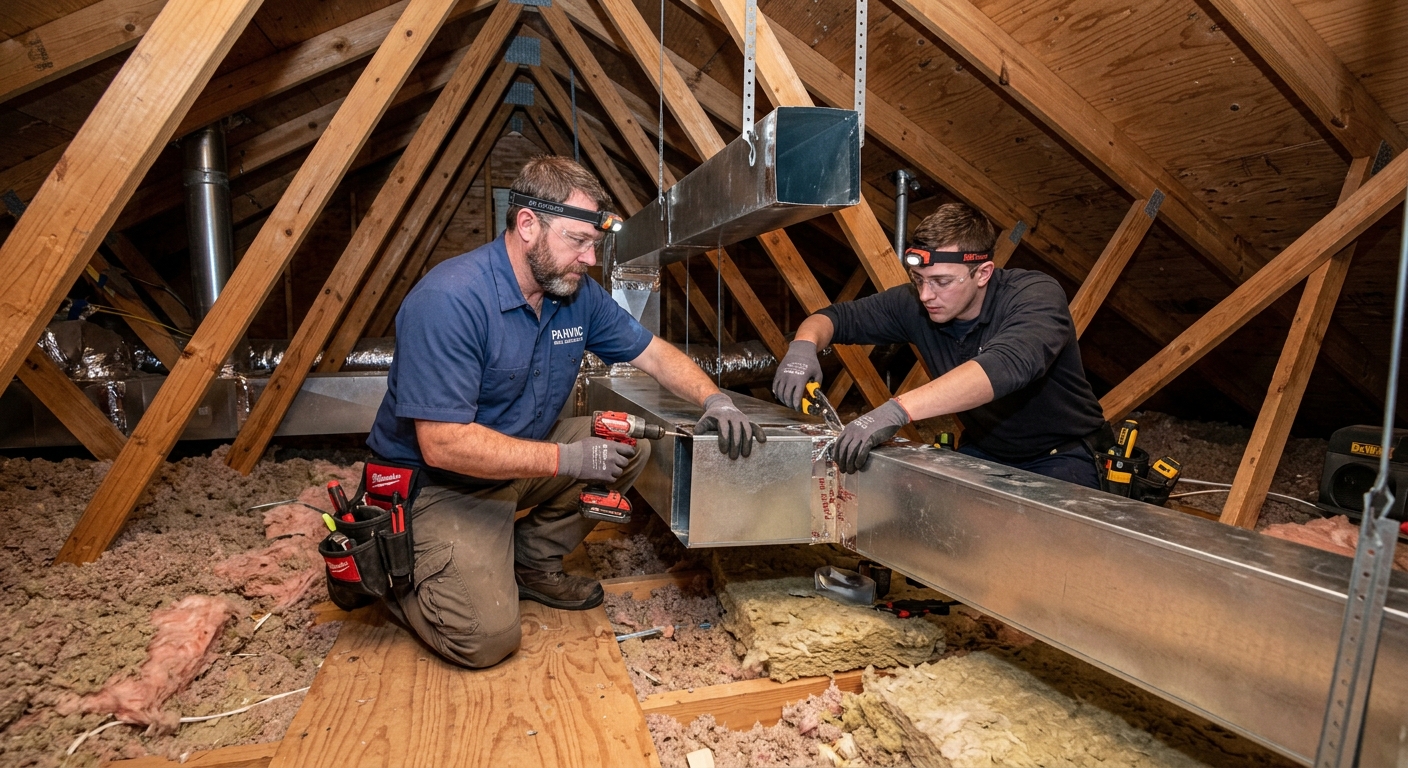
In Penn’s older homes—especially those built 1970–2000—duct leakage is a real issue that undercuts the best HVAC equipment. Leaky or undersized ducts can waste 20% or more of your heating and cooling, and it’s often the system in the attic or crawlspace doing the worst damage. A duct blaster test depressurizes your ductwork and measures exactly how much air escapes before it reaches your living space.
Sealing—using mastic or aerosolized products—usually delivers the biggest return, unless your ductwork is already rusted out or badly undersized. Returns are often too small; this is chronic in Penn homes built for furnaces, not high-output heat pumps. If your ducts run through unconditioned attics or crawlspaces, they also need insulation.
Most homes in Chester County already have some kind of duct system, but many were barely sealed or never sized for new high-efficiency equipment. Before you invest in an expensive replacement system, insist on a duct leakage test and basic measurement of duct sizes and runs. Don’t let anyone pressure you into replacing equipment without making sure your air can actually get where it’s supposed to go.
Frequently asked questions — HVAC installation in Penn
Should I replace the furnace and AC at the same time?
Yes—sometimes. In Penn, if both your furnace and AC are over 15 years old and either one fails, replacing both together makes sense from both a cost and performance standpoint. Combo units are often discounted when installed together, and modern communicating systems work best when matched. However, if one unit is under 10 years old and working well, there’s little reason to toss it. If you only need a new central AC, expect $5,500–$13,000 for replacement using existing ducts. Always ask your contractor to price both options so you can make an informed decision. In some Penn homes, matching new equipment with tired old ductwork can limit the efficiency gains, so a full audit is smart before making the leap.
Why do HVAC quotes in Penn vary so much?
In Penn and across Chester County, price differences come from several sources—labor quality, equipment brands, actual scope of work, and how well the installer plans to commission the system. With market saturation here, expect a wide range from basic replacements up to premium, high-efficiency gear. For instance, installing a ducted air source heat pump can range from $8,800–$18,500 depending on the complexity and existing duct condition. Some quotes leave out critical steps like load calculations or don’t include duct modifications or permits. The lowest prices usually mean shortcuts, while the highest may include features or guarantees you don’t need. Always request a detailed breakdown and don’t be afraid to ask what each line item covers.
Do I need to be home during installation?
For most Penn jobs, it’s best if you’re home at the start and at final walkthrough, even though the crew can complete most installation work unattended. Being there day one lets you confirm access points, answer questions about thermostat or equipment location, and address any surprises inside your utility area. Final walkthrough is critical: you’ll want to see startup and get a basic lesson on filter changes and controls. For a standard central AC swap, which costs $5,500–$13,000 here, installation takes one to two days. Coordinate with your installer so you’re available for permitting inspections as required by your township or borough.
How is a tax credit different from a rebate?
A tax credit in Pennsylvania reduces the income tax you owe—generally claimed when you file your taxes the following year. Federal credits apply to things like cold-climate heat pumps, which in Penn cost $14,500–$18,500 installed. A rebate, by contrast, is a direct payment or discount usually processed by your local utility or directly by the installer. In Chester County, PECO Energy sometimes offers rebates for energy efficiency upgrades apart from any tax credits. Credits happen later, rebates lower your costs right now. Always confirm eligibility with your installer so you don’t leave money on the table.
Does Pennsylvania license HVAC contractors?
Pennsylvania does not license HVAC contractors at the state level for residential work. Instead, contractors must register as Home Improvement Contractors for jobs over $500, a rule that absolutely applies in Penn and all of Chester County. The presence of a registration number verifies insurance and other basics—but does not test technical skill. Mechanical permits and actual hands-on inspections are enforced by each municipality, so you may see differing requirements moving from West Chester Borough to outlying townships. Always verify registration at hic.attorneygeneral.gov before signing a contract, and remember this protects you under Pennsylvania’s consumer protection laws.
How does southeastern Pennsylvania's climate affect system sizing?
Penn sits within a heating-dominated part of Pennsylvania, with about 4,800 heating degree days and only 1,450 cooling degree days annually. That means your HVAC system must be sized with extra attention to heating load, not just cooling. Oversizing for AC here can lead to humidity problems, while undersizing for winter is a recipe for discomfort. When installing a ducted heat pump or furnace (costing $8,800–$18,500 or so), an accurate Manual J load calculation is what separates quality contractors from the rest. Never accept a bid based only on your square footage—climate, insulation, and solar exposure all matter in Penn.
What does a ductless mini-split cost in Penn?
Ductless mini-splits make a lot of sense in Penn for finished basements, additions, or older homes with no ducts. For a single-zone system, expect prices in the $3,500–$7,700 band, including installation. Factors moving the number: electrical upgrades, line set length, and the specific unit’s efficiency. Multi-zone systems will naturally run higher. While these systems are highly efficient (often 20–30 SEER2), they may not heat efficiently below certain outdoor temperatures—something to discuss if you plan to use them year-round in Penn. Always check for local rebates, especially if your install displaces electric baseboard or window units.
Why are my Penn energy bills high with a new system?
High bills after a new install often trace back to leaky or undersized ductwork, incorrect system sizing, or a lack of commissioning during setup. Even high-efficiency equipment won’t perform if half your heated or cooled air escapes to the attic or crawlspace. In Chester County, a full duct system upgrade can run $9,900–$20,000, but many homeowners get away with targeted duct sealing or insulation for far less. Don’t blame the equipment until you’ve had your installer measure duct leakage and verify correct refrigerant charge. Smart thermostats and filter changes won’t save much if the air never gets where it’s needed.
Can I service my R-410A system after the refrigerant change?
Yes—homeowners in Penn can still maintain and repair R-410A systems after the transition to newer refrigerants. R-410A is expected to remain available for years; only newly manufactured equipment is switching refrigerants. If your system needs a recharge, any technician working in Pennsylvania must hold EPA Section 608 certification, and refrigerant recovery is still required by law. Typical refrigerant-related service calls cost in the $300–$1,200 range if it’s just a minor issue. There’s no need to rush out and replace a working R-410A system solely due to the regulatory change—repair and recharge are legal and practical for the foreseeable future in Penn.