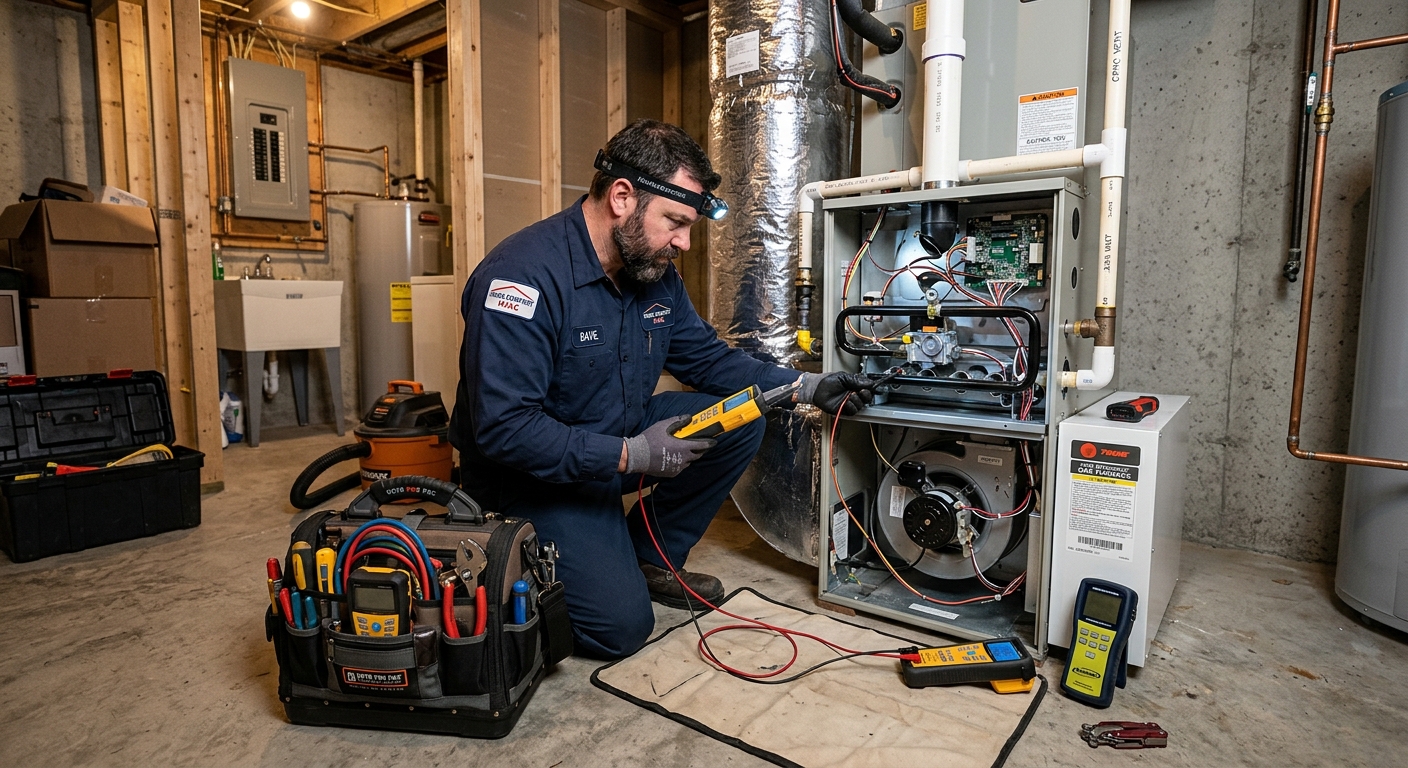
Titusville heating and cooling prices by system type — 2026
Titusville’s HVAC decisions are shaped by two local realities: a homeownership rate of 57.1% and housing built before 1980 making up 86.9% of homes (U.S. Census Bureau, ACS 2024). This means most jobs are replacement or retrofits, not new installs, and your house likely has older ductwork—if it has any at all. In practical terms, that means ducted system options can face complications, and ductless systems fill in where ductwork can’t reach or isn’t worth adding.
You’re living in a climate that demands more from a heating system than from air conditioning. Northwestern Pennsylvania sees around 6,200 heating degree days and just 800 cooling (from regional code data). In short: heating is the bigger bill, the more important system, and the one that pays for upgrades the fastest. This flips many national recommendations—where AC is the headline and heating an afterthought—on their ear. Reliable, efficient heating is simply not optional in Titusville. Cooling is still needed, but you’ll save more money and get more comfort from addressing your heating source and envelope first.
| System |
Best for |
Efficiency |
Price range (installed) |
| Central AC replacement (existing ducts) |
homes with sound ductwork |
16–20 SEER2 |
$4,300–$10,500 |
| Air source heat pump (ducted) |
year-round heating and cooling |
8–10 HSPF2 |
$6,900–$15,000 |
| Cold-climate heat pump (ducted) |
heat pump as primary heat |
9–11 HSPF2 |
$11,500–$15,000 |
| Ductless mini-split (single zone) |
additions, rooms without ducts |
20–30 SEER2 |
$2,800–$6,100 |
| Full duct system installation |
homes with no existing ducts |
— |
$7,800–$15,500 |
Installed estimates for a typical Titusville home. Equipment tonnage, duct condition and electrical capacity move these more than brand.
What you can actually claim on a heat pump here
If you’re considering a heat pump in Titusville, there are three potential ways to help pay for your installation: federal tax credits, utility rebates, and occasional state-level programs. The most stable is the federal tax credit—currently available for qualifying high-efficiency heat pumps—which is taken off your taxes owed when you file the following year. That’s not the same as a rebate: rebates put cash in your hand sooner, either as a check from your utility or a discount off the invoice. The tax credit, by contrast, helps next spring, not at installation.
Most homeowners in Titusville are served by Penelec for electricity and National Fuel Gas for natural gas. Both utilities may offer efficiency programs or rebates, but these are updated annually and change in name, amount, and eligibility. Instead of relying on a static figure from any website, go directly to your utility’s efficiency or rebate program website before planning your budget. The ENERGY STAR rebate finder is another solid place to check for current federal and utility-backed offers.
State-wide incentives and programs change frequently, and the eligibility is strict—eligibility for manufactured homes, rentals, or certain income levels can exclude more projects than you might think. No offer is guaranteed until you get written confirmation. Treat any incentive you see online as guidance, not gospel, and always confirm at the actual program source before making a decision.
Repair or replace your Titusville system?
The decision to repair or replace your heating or cooling system in Titusville comes down to a handful of clear factors—don’t let anyone oversell you. First, weigh the age of your system against its expected life (typically 15-20 years for furnaces and ACs). If your system is under ten years old and the quoted repair is a few hundred dollars, repair is almost always the smarter choice.
If the system is 10–15 years old and the repair is approaching one-third the cost of a new install, a replacement deserves serious consideration. Beyond 15 years, any major failure—like compressor or heat exchanger problems—tilts the math toward replacement, especially since older systems often run on obsolete refrigerants that are expensive and may already be phased out.
Efficiency upgrades rarely “pay back” in energy savings alone in this area’s mild summers and long but stable winters. Jumping to the latest and greatest can make sense for comfort or resale, not just lower bills. But absolutely replace if you face a cracked heat exchanger (carbon monoxide risk) or a compressor failure on an out-of-warranty system—those are non-negotiable.
| Situation |
Recommendation |
Typical cost |
Reasoning |
| Under 10 years, single component failure |
Repair |
$300–$1,200 |
Most parts are still available, lower labor cost, system has years left |
| 10–15 years, repair over a third of replacement |
Consider replacing |
$4,300–$10,500 |
At this age, large repairs aren’t worth risking more failures |
| 15+ years, any major failure |
Replace |
$4,300–$10,500 |
Systems this old run inefficiently, repairs may not be cost-effective |
| Cracked heat exchanger, any age |
Replace immediately |
$4,300–$10,500 |
Safety hazard—carbon monoxide risk, not repairable |
| Compressor failure past warranty |
Replace |
$6,900–$15,000 |
Replacing the compressor makes no sense as systems age |
| Working system, high bills |
Test ducts and envelope first |
$300–$800 |
Leakage and insulation problems drive bills more than equipment in Crawford County |
Heat pump or furnace: what makes sense in Titusville
Titusville’s winters get cold—the region has a winter design temperature of 5 °F and 6,200 heating degree days. That puts heating at the top of the priority list for any local HVAC project. The thinking on heat pumps has changed: modern cold-climate heat pumps will work effectively down into the single digits, provided they’re sized and installed carefully. The old idea that you can’t use a heat pump here is outdated.
Still, as outdoor temperatures drop below zero, heat pump output drops too, just when your house needs it most. That’s why some homeowners go “dual fuel”—a heat pump for most of the year, with a gas furnace as a backup for shots of real cold. This is more relevant in Titusville proper, where National Fuel Gas is available. If you live outside town and only have propane or oil, a heat pump compares much better on the operating cost side.
A traditional gas furnace is still the answer if you have gas on site, your ducts are good, and you expect to see regular subzero temperatures. Otherwise, a well-chosen heat pump—especially a cold-climate model—can run efficiently and comfortably all year, with savings on routine maintenance and fuel delivery headaches for rural homes.
| Option |
Installed cost |
Operating cost here |
Best when |
Incentive eligible |
| Gas furnace + central AC |
$4,300–$10,500 |
existing gas service, coldest zones |
Reliable, lowest upfront and running cost where gas is available |
sometimes |
| Ducted heat pump (cold climate) |
$6,900–$15,000 |
good envelope, all-electric goal |
Best for homes without gas and those wanting to move off delivered fuels |
yes |
| Dual fuel (heat pump + gas backup) |
$11,500–$15,000 |
gas on site, deep cold spells |
Covers both mild and extreme weather; good for Titusville proper |
yes |
| Ductless multi-zone |
$7,800–$15,500 |
no ductwork, zone control |
Excellent for additions or homes with old/no ducts |
yes |
Manual J and the tonnage question
The most common—and costly—mistake in Titusville HVAC replacements is oversizing. Bigger is not better; an oversized system will short cycle, fail to dehumidify properly in summer, create temperature swings, and wear out faster. The “safe margin” approach is decades out of date.
Instead, a proper Manual J heat load calculation is the industry standard, and especially important in our climate where your system must perform reliably at a winter design temperature of 5 °F. Manual J isn’t just a guess based on square footage; it considers window area, insulation, air leakage, duct location, and even sun exposure. This is the only way to get tonnage right.
If your contractor suggests matching the old system’s size, that’s a red flag. Ask them to show you their Manual J results. Cutting corners here can undermine even the most expensive new equipment. In old Crawford County homes, where upgrades to insulation or windows may have changed your heat loss profile over the years, this calculation is essential.
Permits, licensing and inspections in Titusville
Pennsylvania does not issue a statewide HVAC contractor license for residential work—regulation happens at the municipal level. In Titusville, the local authority handles permits for mechanical work, including HVAC replacements. Every installation requiring a contract over $500 must be handled by a contractor registered with the Pennsylvania Office of Attorney General, which you can check at hic.attorneygeneral.gov.
EPA Section 608 certification is required for anyone handling refrigerants, so every installer should have that, whether or not your municipality asks to see it. Beyond licensing, mechanical permits and a city inspection are usually necessary in Titusville. Always confirm that your contractor will pull the required permits and provide a written contract as required by the Home Improvement Consumer Protection Act.
To check for workers’ compensation insurance, you can verify coverage through Pennsylvania’s WCAIS system (wcais.pa.gov). Don’t rely on what’s written on an invoice—a legitimate company can prove they’re properly insured, protecting you from legal risk if anyone is hurt on site.
Keeping a Titusville system running
Home maintenance here is about the basics, not expensive lock-in service contracts. In Titusville’s heating-dominated climate, filter changes are the single most effective bit of routine care you can DIY—choose a filter that matches your system’s blower and your needs (usually MERV 8 to 11).
Annual coil cleaning and clearing the condensate line stops the most common inefficiency and overflow issues. Refrigerant should never just be “topped up”; any loss means there’s a leak, which should be found and fixed, not ignored. Routine “maintenance” should include checking charge, amp draws, and air temperature split, but avoid paying for repetitive, surface-level “tunes” if your system has fresh filters and clean coils.
Most annual service plans in Titusville are worth it if they reduce the cost of emergency calls and include real checks, not just a visit and filter swap. Avoid plans that require full up-front payment without clear terms. Schedule pre-season—late spring for AC, early fall for heating—so you’re not stuck waiting during the mid-winter and midsummer peaks when contractors are busiest with breakdown calls.
Frequently asked questions — HVAC installation in Titusville
How is a tax credit different from a rebate?
In Titusville, if you install a qualifying heat pump or HVAC system, you might be eligible for both a tax credit and a utility rebate—but they’re not the same thing. A tax credit reduces what you owe the IRS when you file your taxes next year. For example, if you claim a federal credit of $2,000 for a system in the $6,900–$15,000 range, you’ll see that benefit at tax time, not on your contractor’s invoice. A rebate, by contrast, is money paid to you either as a check or a direct discount shortly after the work is completed, usually by your utility. The main difference is timing: rebates reduce what you pay up front, while tax credits help later. Plan your cash flow accordingly, and never count on a rebate until your application is approved, since local programs change each year.
Do I need dual fuel in northwestern Pennsylvania?
Dual fuel systems (a heat pump with a gas furnace backup) are popular in areas like Titusville because our winter design temperature is 5 °F and we rack up around 6,200 heating degree days. Heat pumps are now capable down to the teens, but if you want peace of mind during deep cold snaps—or just want the cheapest operating costs where natural gas is on tap—dual fuel makes sense. It’s especially practical in Titusville or Meadville where National Fuel Gas runs service lines. Expect a total install price of $11,500–$15,000 for a properly engineered dual fuel setup. If you don’t have gas on site, though, running a full dual fuel system is usually not worth the added cost compared to a cold-climate heat pump by itself.
What MERV filter rating should I use?
In most Titusville homes, a MERV 8 or MERV 11 filter is the right pick—anything higher may restrict airflow and strain older blower motors common in pre-1980 homes. The right filter keeps your system clean and your indoor air healthier without reducing efficiency. Only go above MERV 11 if a contractor has verified your blower can handle it, or if severe allergies or asthma are at play. Higher ratings aren’t always better, particularly in towns like Titusville where so many houses have older, less powerful fans. Replacing filters before they clog is key, and a year’s worth of filters typically costs much less than a single service call—well under $300–$800 for a whole year’s supply, well below a repair bill.
How much does a furnace replacement cost in Titusville?
For most Titusville homeowners with existing ductwork and gas service, expect to pay $4,300–$10,500 for a standard furnace replacement, fully installed and inspected. The range depends on efficiency, brand, and whether electrical or venting upgrades are needed—old homes often need both. If your current ducts are in poor shape or need repairs, add that separately (see the ductwork question below). Demand fluctuates with the seasons—late fall and midwinter pricing can run higher due to emergency call volume, while off-peak installs are often more affordable.
Do I need a permit to replace HVAC in Titusville?
Yes, for most HVAC replacements in Titusville—including furnaces, heat pumps, and central air installs—a mechanical permit is required, and the city will schedule an inspection to ensure your new system meets Pennsylvania Uniform Construction Code requirements. Permitting is managed at the local level, not statewide. You should confirm that your contractor is registered with the Pennsylvania Office of Attorney General for home improvements over $500 and carries workers’ compensation insurance, which you can verify using WCAIS. Permit costs are a fraction of the install price (typically well under $300–$800), and skipping this step can cause inspection and resale problems down the road.
Why are my Titusville energy bills high with a new system?
High energy bills after a new install are usually driven by duct leaks, insulation gaps, or an oversized system—not just old equipment. Many Titusville homes, especially those built before 1980, have leaky ducts or poor insulation that negates the efficiency gains from modern systems. If your bills remain high after spending $6,900–$15,000 on a new heat pump, have a contractor test your ductwork and audit your home’s air sealing. Sometimes, a minor air leak or disconnected duct can cost you more than a whole filter change or tune-up. It pays to solve building problems before blaming the equipment.
How much does ductwork add to an HVAC installation?
Adding a full duct system to a home in Titusville that doesn’t already have usable ducts typically costs in the $7,800–$15,500 range, on top of the equipment price. The old 1920s and 1930s homes common in Crawford County rarely have modern duct runs that can handle new airflow or zoning needs, so full replacement is often required. Small repairs or duct sealing cost much less—usually under $800 per job. If your quote doesn’t break out duct costs separately, ask for an itemized bid so you can see the real impact on your budget.
Is natural gas available throughout Crawford County?
Natural gas is common in Titusville and Meadville—if you’re in town, you probably have National Fuel Gas service. Step outside city limits, though, and most rural parts of Crawford County rely on propane or fuel oil. That makes a big difference in your HVAC choices and running costs: a heat pump can be much more cost-effective than running on delivered fuels, and rebates are sometimes larger for all-electric upgrades in non-gas areas. Always check with your local utility office to confirm availability before planning a new furnace or heat pump install in a rural property. Furnace installs in gas serviced areas usually run $4,300–$10,500, but propane systems can cost more to operate.
How far ahead should I schedule in Titusville?
HVAC contractors in and around Titusville tend to book up early, especially with the thin rural contractor market and travel surcharges in Crawford County. For routine replacements or planned upgrades, try to schedule at least 4–6 weeks ahead, especially in early fall before heating calls spike, or in late spring if you’re doing AC. Emergency breakdowns might get same-week attention, but you’ll pay a premium. If you wait until everyone else’s system fails in midwinter, expect delays and higher rates—sometimes toward the top end of the $4,300–$10,500 range, even for standard equipment. Off-peak appointments give you more flexibility and a better shot at finding a reputable, local tech who won’t have to travel from Meadville or beyond.