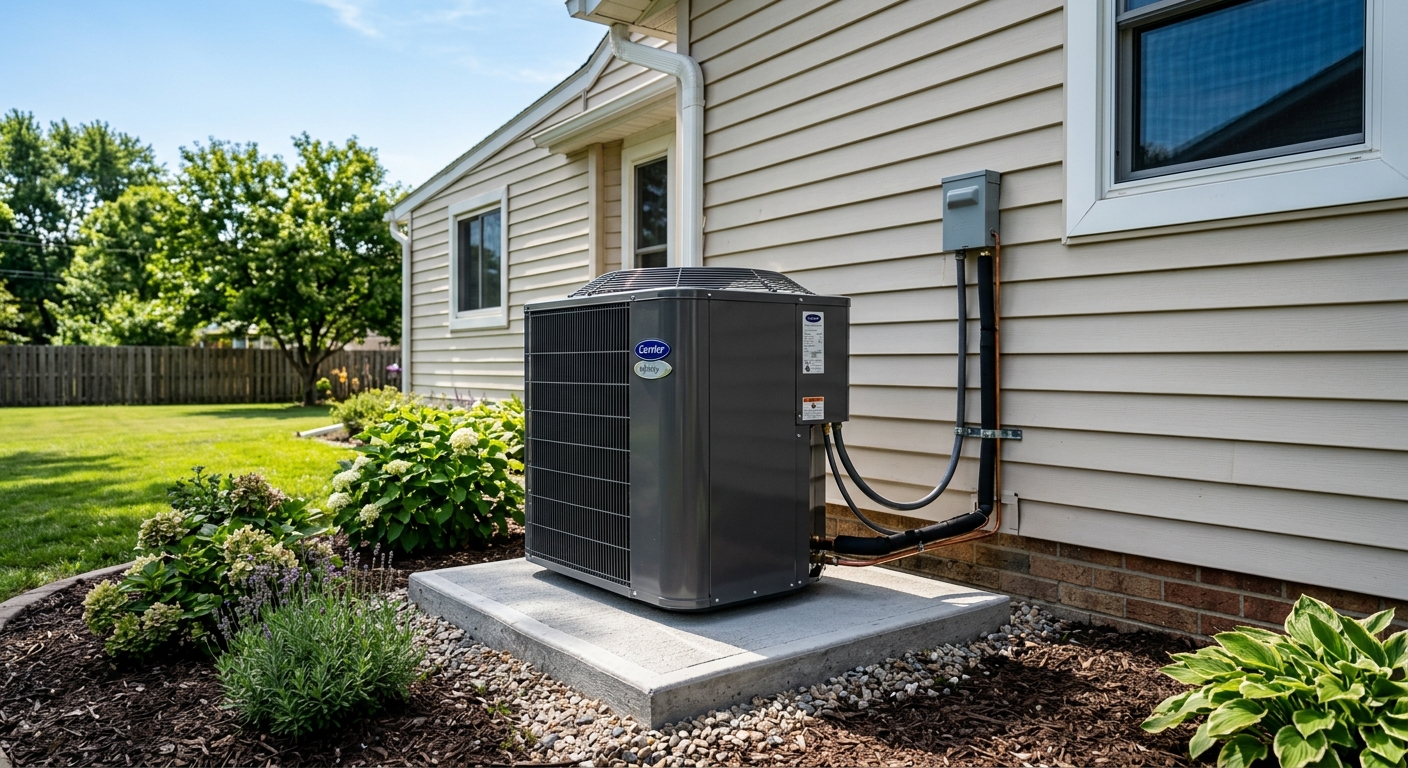
What a new HVAC system costs in Maxatawny
In Maxatawny, most homes are single-family and owner-occupied, with a homeownership rate of 75.0% and nearly 60% built before 1980 (U.S. Census Bureau, ACS 2024). This makes Maxatawny a retrofit-heavy market—system replacements, upgrades, and sometimes full ductwork jobs are more common than untouched new-install scenarios. Reading and older boroughs like Hamburg have plenty of pre-1940 housing, which often means aging or poorly designed ductwork, so duct renovations or complete new runs are not rare during HVAC replacement.
This part of Berks County is a heating-dominated market. We get around 5,200 heating degree days but only about 1,250 cooling degree days each year, so decisions around HVAC focus more on reliable, efficient heating than beating the summer heat. Heat pump installations are becoming more popular, especially in homes without easy gas access, but standard furnaces and AC combinations still make sense where natural gas is available. Ductless mini-split systems are well-suited for additions or rooms where running new ducts would be a pain or cost-prohibitive.
| System |
Best for |
Efficiency |
Price range (installed) |
| Central AC replacement (existing ducts) |
homes with sound ductwork |
16–20 SEER2 |
$4,900–$11,500 |
| Air source heat pump (ducted) |
year-round heating and cooling |
8–10 HSPF2 |
$7,800–$16,500 |
| Cold-climate heat pump (ducted) |
heat pump as primary heat |
9–11 HSPF2 |
$12,500–$16,500 |
| Ductless mini-split (single zone) |
additions, rooms without ducts |
20–30 SEER2 |
$3,100–$6,800 |
| Full duct system installation |
homes with no existing ducts |
— |
$8,700–$17,500 |
Installed estimates for a typical Maxatawny home. Equipment tonnage, duct condition and electrical capacity move these more than brand.
Permits, licensing and inspections in Maxatawny
Pennsylvania does not issue a statewide HVAC trade license for residential work. For your Maxatawny home, the regulation happens locally: mechanical permits are required and code enforcement is handled by each municipality (Reading runs its own permitting office; surrounding Berks County townships handle theirs separately). So, the contractor you hire must be familiar with your township’s process—and you should expect some variation in requirements from one town to the next. The Pennsylvania Uniform Construction Code (UCC) is based on the International Residential Code, so your installation will be inspected for compliance with modern building and safety standards.
Your HVAC contractor must be registered as a Home Improvement Contractor (HIC) with the Pennsylvania Attorney General for jobs over $500—check their registration at hic.attorneygeneral.gov. By law, larger jobs require a written contract and a clear right to cancel. Workers' compensation insurance is mandatory for all employers and can be checked at wcais.pa.gov.
When refrigerant will be handled (virtually every AC and heat pump job), ask to see the technician’s EPA Section 608 certification—this is required by federal law, not just Pennsylvania. Double-check that your contractor has both the proper insurance coverage and registration before signing off on the work. For homes built before 1978, the EPA Lead RRP Rule applies—ensure your contractor is certified for work in those scenarios.
Reading the yellow label
Every new HVAC unit comes with an efficiency "yellow label" showing SEER2 (cooling efficiency) or HSPF2 (heating efficiency for heat pumps). SEER2 is the updated version of SEER; HSPF2 replaces HSPF. In both cases, higher numbers mean greater energy efficiency, but new ratings are stricter—expect lower values compared to older literature even for similar equipment.
In a county like Berks, with 5,200 heating degree days versus 1,250 cooling degree days, heating dominates your annual energy spend. If you’re considering a heat pump, prioritize HSPF2 ratings. For air conditioners or mini-splits, SEER2 matters—but only up to a point. There’s typically a payback for better efficiency until about 18 SEER2. Jumping up to that 20+ mark adds a lot of cost, but you won't see enough energy savings in our relatively short cooling season to justify it unless you run your AC constantly from May through September.
For heat pumps, aim for at least 9 HSPF2 if you plan to heat with electricity most of the winter. Top-end HSPF2 units deliver diminishing returns unless you have exceptional insulation or want to go as green as possible. Bottom line: in this region, it makes sense to pay for better-than-minimum efficiency, but not to chase the absolute highest number—especially on the AC side.
Choosing an installer in Berks County
Whomever you pick, the quality of the installation will drive system life, comfort, and your utility bill far more than brand. In Berks County, with its mix of suburban and rural work, it's easy to focus on bigger equipment names or cheaper bids—but the same unit, done right and done wrong, can mean the difference between 20 trouble-free years or a system that limps along for ten. Always verify your installer's Home Improvement Contractor registration at hic.attorneygeneral.gov. For the technician handling refrigerant (all ACs and heat pumps), EPA Section 608 certification is federal law—ask to see their card. A real professional will not hesitate.
Your quote should specify all included work: demand a Manual J load calculation, listed model numbers—not just "3-ton," but actual make and model, and confirmation that they’ll measure airflow and refrigerant charge at startup (“commissioning”). With older homes and mixed code enforcement throughout Berks County, full documentation is both your proof and peace of mind.
- Check HIC registration online before signing.
- Ask to see the technician’s EPA Section 608 card for refrigerants.
- Get at least three local references from similar jobs.
- Require a Manual J load calculation in writing.
- Confirm specific model numbers on your quote, not just tonnage or brand.
- Insist on commissioning with measured airflow and refrigerant charge.
- Get a written contract for all work over $500—required by state law.
- Ask for proof of insurance and check workers’ comp at wcais.pa.gov.
- For pre-1978 homes, contractor must be EPA Lead RRP certified.
- Ask what’s included—thermostat, permits, removal of old equipment.
- Don’t be rushed—three-day cancellation right is state law.
If an installer in Berks County seems too eager to close the deal in one visit, won’t put things in writing, or refuses to discuss commissioning, be wary. Our market isn’t flooded with contractors, but volume outfits from the suburbs do pass through and sometimes cut corners on older homes.
Keeping a Maxatawny system running
You need three things to keep your HVAC system reliable in Maxatawny winters and muggy August days: regular filter changes, clean coils, and a clear condensate line. Most homes are fine with a mid-grade filter—MERV 8 to 11—changed every 1–3 months, unless you’ve got a thick filter cabinet or significant indoor allergies. Too tight a filter (over MERV 13) risks stressing blowers on older ductwork, especially in pre-1980 homes.
The outdoor and indoor coils should be cleaned every year or two—especially if you have cottonwood, mowing, or pollen-heavy seasons nearby. The condensate line should be checked for clogs every spring. As for refrigerant: your system should never need to be “topped off.” If you’re losing refrigerant, there’s a leak—that’s a repair, not routine maintenance.
Annual service plans are okay if priced at or below a typical one-time tune-up and if they spell out exactly what’s included. Skip plans that only offer “discounted” repairs or skip inspection steps like refrigerant checks and airflow measurement. Schedule maintenance in spring or early fall—before the first hot spell or hard freeze, when service companies aren’t swamped with emergencies.
Heat pump or furnace: what makes sense in Maxatawny
The decision between a heat pump and a furnace in Maxatawny is shaped by actual numbers: we see a winter design temperature of 12 °F and about 5,200 heating degree days a year. This is squarely a “real winter” market. Modern cold-climate heat pumps have come a long way—they’ll provide usable heat well below freezing, with certain models continuing to put out heat even at single digits. The old reputation—that heat pumps just can’t cut it in a Berks County winter—is mostly obsolete, especially for well-sealed homes built or renovated this side of 1970.
However, as the temperature drops, heat pump output falls, and electric resistance backup or dual fuel (gas backup) becomes necessary for the coldest nights. If your home has access to natural gas—which is typical in Reading, Muhlenberg, Exeter, and Spring—a gas furnace combined with a central AC remains efficient and reliable, especially for homes with drafty envelopes or low insulation levels. In rural parts of Berks where only propane or oil is available, the case for an all-electric, high-efficiency heat pump is much stronger: fuel prices are less predictable, systems need less maintenance, and you skip the annual oil/LP service visits.
A furnace is still the right call for homes with easy gas access, poor insulation, or owners who want maximum peace of mind in ice-storm conditions. Dual fuel systems—which automatically switch from heat pump to gas below a set temperature—can split the difference for homes on the gas grid wanting both efficiency and deep-winter backup.
| Option |
Installed cost |
Operating cost here |
Best when |
Incentive eligible |
| Gas furnace + central AC |
$4,900–$11,500 |
lower than electric if natural gas at house |
existing gas service, coldest zones |
limited; some programs for high-efficiency units |
| Ducted heat pump (cold climate) |
$7,800–$16,500 |
lower than propane/oil, higher than gas |
good envelope, all-electric goal |
yes—state and utility rebates often available |
| Dual fuel (heat pump + gas backup) |
$12,500–$16,500 |
lowest if high use and gas available |
gas on site, deep cold spells |
yes—if heat pump portion qualifies |
| Ductless multi-zone |
$8,700–$17,500 |
lowest for additions/lower use |
no ductwork, zone control |
yes—some equipment/models |
What size system does a Maxatawny home need?
Getting the size of your new HVAC system right is the single most important factor for comfort and equipment life. Over-sizing is not a safety net—it’s a flaw. Too large a system short cycles, fails to dehumidify our humid Pennsylvania summers, creates temperature swings, and shortens compressor and blower life. In other words, bigger is not better for Berks County homes.
Every proper installation should start with a Manual J load calculation. This process accounts for the square footage, insulation, window quality, air leaks, orientation, and number of occupants—not just a one-size-fits-all rule. The old practice of sizing based on the sticker on the existing unit—especially in pre-1980 houses that may have been insulated or expanded over the decades—risks repeating the mistakes of old builders and can leave you with costly utility bills or even comfort complaints.
In Maxatawny, sizing is calculated to keep up with a design temperature of 12 °F—the coldest stretches of winter. Be sure to ask any contractor, “Did you run a Manual J, and can I see the numbers?” Without this step, every other promise about comfort or efficiency is guesswork. Don’t let anyone convince you to skip it, even if the bid comes in lower—what you save up front you pay many times over in extra energy and repairs down the line.
Frequently asked questions — HVAC installation in Maxatawny
How do I verify an HVAC contractor's insurance?
For a Maxatawny homeowner, verifying an HVAC contractor's insurance isn’t just smart—it’s required for any reputable company. All employers in Pennsylvania are required to carry workers’ compensation insurance. You should ask for a certificate of insurance, and you can verify the coverage via the state’s WCAIS database (wcais.pa.gov) as outlined in the statewide rules. This is especially important given that many homes here are older (almost 60% built before 1980) and jobs often involve electrical, structural, or ductwork changes that can mean higher risk. Checking proof of insurance shields you if a worker is injured on your property or if there’s property damage. If your HVAC installation cost is over $4,900–$11,500, a missing insurance certificate is a major red flag—walk away.
How long does HVAC installation take in Maxatawny?
Most typical HVAC installations in Maxatawny—such as replacing a central AC or furnace with existing ductwork—take 1 to 2 days once permits are approved. However, older homes built before 1980, which are common in this part of Berks County, sometimes uncover surprises: hidden asbestos, old wiring, odd framing, or failing ductwork could add a day or two. Installing a full new duct system or converting to a ducted heat pump, which can run $8,700–$17,500, often stretches into a 3- to 5-day job, especially if patching old plaster or modifying attics and basements is required. Weather, permitting, and electrical upgrades can all cause short delays, but most homeowners are without heat or AC for only a day.
Do older Maxatawny homes need ductwork replaced?
If your Maxatawny home is in the half built pre-1980—and especially among those from the pre-war era around Reading—pay close attention to the condition of your ductwork. Ducts in older homes are often undersized, leaky, uninsulated, or even located outside the conditioned space. Repair and sealing can solve minor issues, but for comfort, air quality, and efficiency, full duct replacement is sometimes the smartest choice. Adding a full new duct system for a retrofit like this typically falls in the $8,700–$17,500 range. Always have your installer inspect and pressure-test your ducts during the estimate process; sometimes a modest investment in sealing can bring old ducts close to new performance, but sometimes replacement is the only way to guarantee reliability and correct sizing.
Can I service my R-410A system after the refrigerant change?
Absolutely—your Maxatawny R-410A system can still be serviced. The phase-down of R-410A under federal law is mostly a manufacturing and import issue, not a service ban. Technicians with EPA Section 608 certification (required everywhere in Pennsylvania for refrigerant work) can continue to repair and recharge existing R-410A systems for many years. You may see higher refrigerant costs as supplies tighten, but there’s no requirement to scrap a well-running unit. If your existing system is nearing end of life (older than 12–15 years), consider the switch to a new, higher-efficiency heat pump or central AC, typically in the $4,900–$11,500 range for AC, which will run on the latest refrigerants.
Do I need ENERGY STAR equipment to qualify for incentives?
In Maxatawny and across Pennsylvania, most utility and state rebate programs require you to install qualifying high-efficiency systems—often but not always ENERGY STAR® certified. For central AC or heat pump installations, that often means meeting or exceeding specific SEER2 and HSPF2 levels. A typical ducted heat pump eligible for incentives might run $7,800–$16,500 installed. Equipment that only barely meets the federal minimum may not get you a rebate, but ENERGY STAR is not the only threshold—be sure to confirm with Met-Ed or your program provider. Keep in mind that rebates or tax credits usually require paperwork be filed by you or your contractor right after installation.
What does a ductless mini-split cost in Maxatawny?
The installed cost for a single-zone ductless mini-split in Maxatawny generally falls between $3,100–$6,800. These are especially popular solutions for additions, converted attics, or bonus rooms in Berks County’s many older homes, where adding new ducts is impractical or costly. Multi-zone or larger capacity systems—serving two or more rooms—can be significantly higher, from $8,700–$17,500 based on layout and electrical capacity. Whenever possible, get quotes from a contractor who evaluates insulation and window condition as well as just square footage; poor envelope can make even a high-SEER mini-split work too hard.
Is a heat pump a good choice for Maxatawny winters?
Yes—modern cold-climate heat pumps are built to handle real Berks County winters, including design temperatures down to 12 °F. Many can deliver useful heat down to single digits before electric backup or auxiliary heat kicks in. In Maxatawny, heat pumps make special sense in areas without natural gas, where the alternative is expensive propane or fuel oil. A cold-climate heat pump installation averages $12,500–$16,500. For drafty, poorly insulated homes, discuss your upgrade options first: better insulation stretches the real-world savings of a heat pump and may qualify you for additional utility rebates.
Should I close vents in unused rooms?
In most Maxatawny homes—especially those with aging or marginally sized ductwork—closing vents is not a good idea. It can increase static pressure in your ducts and strain blowers, sometimes causing leaks or even premature system failure. Better options are a ductless mini-split (at $3,100–$6,800 for a basic install) or a zoned system upgrade, both designed for real room-by-room control. An open vent doesn't waste energy nearly as much as an unsealed duct in an attic or basement. If comfort is truly uneven, ask your contractor to check for duct leakage or balancing issues during your next service call.
How much does a new HVAC system cost in Maxatawny?
The cost of a new HVAC system in Maxatawny depends on both system type and the condition of your home’s ductwork. A central AC replacement with sound ducts runs $4,900–$11,500, with the typical price around $7,800. Heat pump installations range from $7,800–$16,500 for most ducted systems. Full new ductwork—needed in older or previously unconditioned homes—adds another $8,700–$17,500. The price depends more on home layout, insulation level, and electrical upgrades than on the sticker brand. Always get multiple itemized quotes from contractors who actually inspect your house—guessing from square footage often misses what drives comfort and cost here in Berks County.