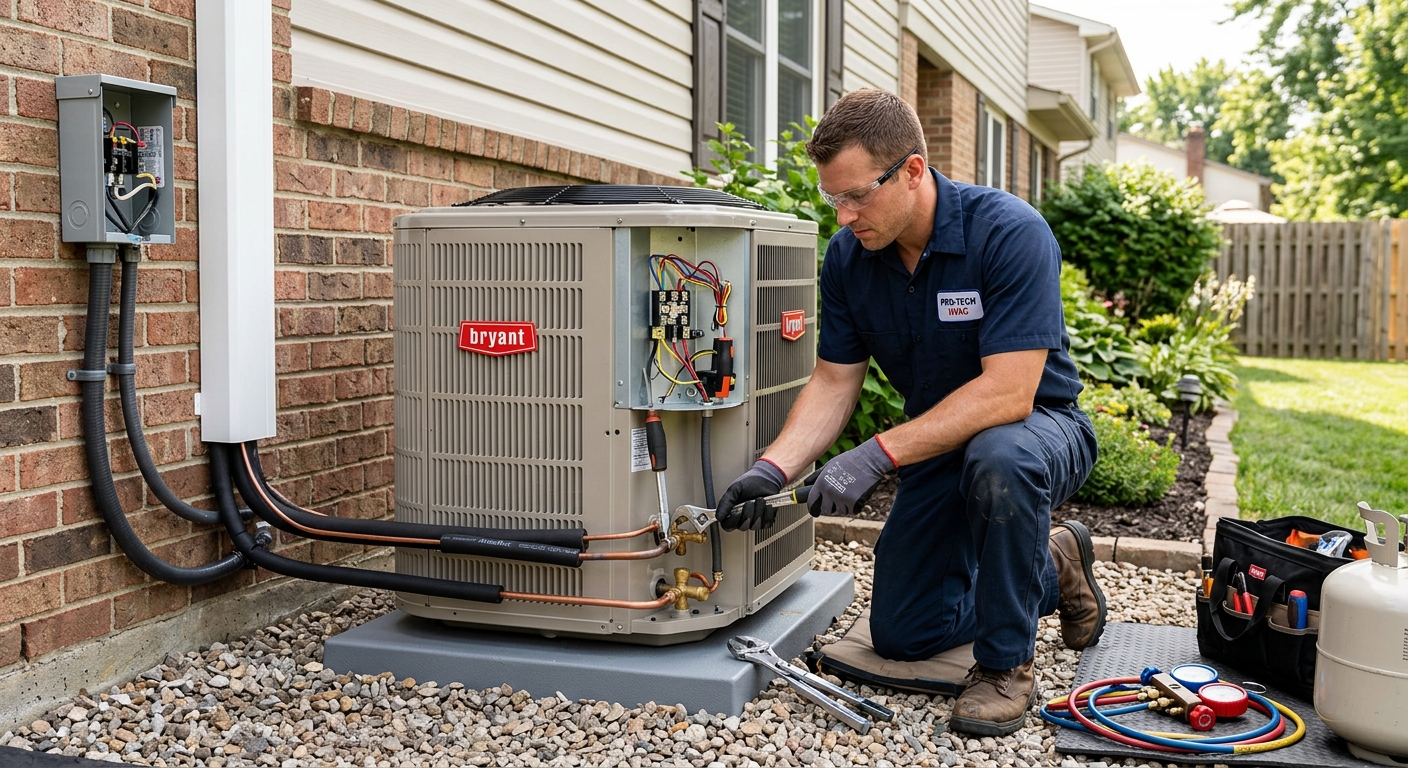
What a new HVAC system costs in West Hazleton
West Hazleton’s HVAC costs reflect both the area’s high homeownership rate and its aging housing stock. With 65.5% of homes owner-occupied and over 86% built before 1980 (U.S. Census Bureau, ACS 2024), most HVAC work here involves either replacing worn-out systems or converting old boiler setups to modern forced air. Luzerne County housing is heavily 1900–1940 coal-era stock, meaning many homes still have radiators and may lack central ductwork altogether—if you’re facing a full conversion, the cost and complexity increase.
Northeastern Pennsylvania is solidly a heating-dominated climate, with around 6,100 heating degree days compared to just 850 cooling degree days. This swings the priority from cooling system size to heating performance, especially with our winter design temperatures hitting 4 °F. If you need both heating and cooling, a heat pump may be worth the investment, but not all systems that run well in warmer states are suited to our winters.
If your home already has sound ductwork, replacing just the AC or furnace keeps cost down. But if you’re starting with radiators or electric baseboard heat, you’re likely looking at a full ducted system or a mix of ductless mini-splits—each with very different installation costs. Below, you’ll find what typical installed prices run in West Hazleton for each system type:
| System |
Best for |
Efficiency |
Price range (installed) |
| Central AC replacement (existing ducts) |
homes with sound ductwork |
16–20 SEER2 |
$4,400–$10,500 |
| Air source heat pump (ducted) |
year-round heating and cooling |
8–10 HSPF2 |
$7,000–$15,000 |
| Cold-climate heat pump (ducted) |
heat pump as primary heat |
9–11 HSPF2 |
$11,500–$15,000 |
| Ductless mini-split (single zone) |
additions, rooms without ducts |
20–30 SEER2 |
$2,800–$6,100 |
| Full duct system installation |
homes with no existing ducts |
— |
$7,800–$15,500 |
Installed estimates for a typical West Hazleton home. Equipment tonnage, duct condition and electrical capacity move these more than brand.
What a Pennsylvania HVAC contractor must hold
Pennsylvania does not license HVAC contractors at the state level for residential work. Instead, residential HVAC is regulated locally—meaning cities, boroughs, or townships like Wilkes-Barre or Hazleton issue and enforce permits for installation and replacement. For you as a homeowner, this means that hiring someone “state licensed” as an HVAC contractor is meaningless here, because no statewide HVAC license exists for residential installation. Local permits and inspections, however, do apply. For example, in Wilkes-Barre, mechanical permits are required for central system replacement or installation.
Residential HVAC contractors in Pennsylvania must register as a Home Improvement Contractor (HIC) with the Office of Attorney General when contracting for jobs over $500. You can—and absolutely should—verify a contractor’s HIC registration at hic.attorneygeneral.gov before signing anything or paying a deposit. Written contracts are required for these jobs, and you have a three-business-day right to cancel under the Home Improvement Consumer Protection Act. Waiving your insurance deductible is illegal under this law.
Anyone who handles refrigerants must hold a federal EPA Section 608 certification, which is not specific to Pennsylvania and applies nationwide. This ensures that installers are qualified to safely handle and dispose of refrigerants, especially with newer refrigerant types entering the market.
For companies with employees, workers' compensation coverage is also mandatory and can be verified through the WCAIS portal (wcais.pa.gov). If a contractor cannot show active workers’ compensation or HIC registration, keep looking—those protections matter.
Keeping a West Hazleton system running
For West Hazleton homeowners, regular HVAC maintenance comes down to what genuinely impacts performance and reliability—not what’s pushed as an upsell. Changing your system’s air filter is the most essential step: stick to the blower’s recommended MERV rating (often MERV 8–11 for typical forced-air systems) and change it every 1–3 months, or sooner with pets or coal dust from older basements. A too-high MERV can choke airflow in older ductwork.
Coil cleaning—both indoor (evaporator) and outdoor (condenser)—keeps efficiency up and can usually be handled during a scheduled service. Clearing the condensate drain line is vital to prevent water damage, especially in our humid but cooling-light climate. And if a system is low on refrigerant, don’t let anyone “top it off.” Loss means a leak, and maintenance is finding and repairing it, not just adding more gas.
Annual maintenance plans are common, but only pay if the contract states what’s actually included—look for real inspection and cleaning, not just a checklist and filter swap. Avoid plans that require you to pay extra for every normal part or push costly “priority” fees. Schedule maintenance in spring or early fall, before the first heat or AC rush, to avoid delays when everyone else calls in with emergencies.
Reading an installation proposal
Comparing HVAC bids in West Hazleton takes more than just lining up prices. Start with model numbers—every proposal should list both the indoor and outdoor units. An unmatched pair won’t deliver its rated efficiency or may void a warranty. Tonnage—or how much heating/cooling your home needs—should come with a documented load calculation specific to your house, not just “matched to existing.” If your ductwork is being reused, the proposal should show it’s been inspected and whether sealing or resizing is included.
Look for whether the contractor includes replacing the refrigerant line set, or if they plan to reuse it—a crucial call, especially if old lines harbor leaks or incompatible oil. Electrical work needs to spell out whether your panel is adequate or if a new circuit is needed. A new thermostat is often standard, but confirm it’s included. The quote should state whether permitting is handled and priced in. Final commissioning (a documented report showing airflow and refrigerant charge are correct) sets quality jobs apart.
A one-sheet “Brand-X, 3 ton, $9,000 installed” quote cannot be compared meaningfully. Here’s what to check for:
| Line item |
What to look for |
Red flag if… |
| Equipment |
model numbers, indoor and outdoor matched |
brand name only |
| Sizing |
load calculation attached |
matched to the old nameplate |
| Ductwork |
condition assessed, sealing scoped |
not mentioned |
| Electrical |
circuit and panel capacity confirmed |
assumed adequate |
| Line set |
replaced or documented as reused |
silent |
| Commissioning |
measured airflow and charge, documented |
no startup report |
| Warranty |
labour years stated separately |
manufacturer only |
| Permit |
included and priced |
'not needed' |
How to vet an HVAC contractor in West Hazleton
The installer matters more than the brand. You can buy the most expensive equipment on the market, but in West Hazleton’s saturated HVAC market, a poor installation will still leave you with comfort and reliability issues. In this area, it’s not hard to find several contractors bidding on the same job—your challenge is filtering who actually does it right.
Start with verification: Look up the contractor’s Home Improvement Contractor registration at hic.attorneygeneral.gov. Confirm they have active workers’ compensation via the WCAIS system if they employ anyone. EPA Section 608 certification is a must for anyone handling refrigerants; ask to see this on-site. Professional contractors should include a room-by-room load calculation with your quote and spell out full model numbers, not just tonnage or SEER ratings.
The best quotes detail commissioning—that is, measuring and documenting airflow and refrigerant charge. Beware those who dodge these questions or treat permits as optional. Here’s a solid checklist for contractor vetting in West Hazleton:
- Verify HIC registration (hic.attorneygeneral.gov)
- Check workers' compensation coverage (wcais.pa.gov)
- Ask to see EPA Section 608 certification
- Demand a room-by-room load calculation (not just tonnage guessed from square footage)
- Require full model numbers on quoted equipment
- Check for matched indoor and outdoor units in the proposal
- See that ductwork condition and sealing are specifically addressed
- Review whether electrical panel and circuit adequacy are included
- Insist on a commissioning report after install
- Get a clear breakdown of parts, labor, permits, and warranties
- Ensure compliance with permit requirements for your municipality
- Ask about the experience level of the installers, not just the salesperson
Red flags include contractors who refuse to document registrations, push you to sign on the spot, or offer suspiciously low bids. In a crowded Luzerne County market with many companies, these are usually not the folks you want opening up your walls or ductwork.
Duct condition, leakage and sealing
In West Hazleton’s older homes, ductwork can be the weakest link in your comfort and energy bills. Many Luzerne County houses built between 1900 and 1940 started with steam or hot-water radiators; forced-air ducts were often added decades later and rarely engineered for tightness or proper airflow. That means you might have duct leakage wasting 20% or more of your heated (or cooled) air—money and comfort out the window.
A duct blaster test is the gold standard for measuring how much air escapes from your ductwork. This diagnostic tells you where sealing leaks will make a real difference, and in some cases, whether repair is even worth it versus replacement. Chronic undersized return ducts are extremely common in converted homes—these quietly suffocate system performance, even if the rest of the install is decent.
If your ducts run through unconditioned attics or crawlspaces (common in older Luzerne houses), you lose even more to temperature swings. Sealing and insulating these ducts is far less expensive than replacing them, but if sections are corroded, collapsed, or just wrong-sized, replacement may be needed for comfort or equipment warranty reasons.
Bottom line: Before installing any new furnace or central AC, have the ductwork tested and evaluated first. Too many homeowners replace equipment in West Hazleton only to find out the distribution system is the real source of hot and cold spots—or sky-high utility bills. Test before investing in new machinery.
R-410A phase-down: repair or replace?
Starting in 2025, new residential systems are switching away from R-410A refrigerant to newer, lower global-warming-potential choices like R-454B and R-32—part of a national phase-down. But for West Hazleton homeowners with older R-410A systems, there’s no need to panic. It’s still legal to service existing R-410A equipment, and technicians can still source R-410A for repairs. The main change is the gradually rising cost of R-410A as supply shrinks and new systems no longer use it.
In practical terms, you should consider replacing rather than repairing an older R-410A system only if you have an expensive leak or major component failure. A minor repair is still reasonable, but with both the price of R-410A and the age of most systems (many installed during the last housing boom), a high repair estimate might tip the scales toward replacement. New systems—whether central AC or heat pumps—are using new refrigerants and higher-efficiency standards across the board, but there’s no requirement to replace safe, working equipment just because the refrigerant is out of favor.
Bottom line: R-410A won’t become illegal overnight. Service will simply get pricier as supplies dwindle. Focus on a system’s total repair cost and age when deciding to repair or replace.
Frequently asked questions — HVAC installation in West Hazleton
What is commissioning and why does it matter?
Commissioning is the startup and testing process performed after your new HVAC system is installed. In West Hazleton, true commissioning should include checking and documenting airflow, refrigerant charge, and verifying the thermostat controls the system as intended. It’s one thing for a contractor to install a $7,000 system, but if they don’t calibrate it to your house, you could face sky-high utility bills, uneven heating/cooling, and premature equipment failures. A full commissioning ensures the system runs as efficiently and reliably as the manufacturer designed, tailored to your actual ductwork and electrical setup. Always ask your contractor if commissioning (with a written report) is included in the quoted price. It’s the difference between “working” and “working right.”
Why do HVAC quotes in West Hazleton vary so much?
HVAC quotes in West Hazleton can range widely, and it’s rarely just about brand names. The biggest factors are the condition and size of your home’s existing ductwork, how much electrical upgrade is needed, and whether the contractor is including (or skipping) essentials like permits or commissioning. For example, a central AC replacement here can run from $4,400–$10,500, depending on whether you need duct modifications, a new panel, or premium features. Lower quotes might cut corners on duct sealing, skip permits, or simply re-use old line sets without checking. Always compare the scopes of work, not just the sticker price, and be wary of bids that seem “too good” for the work described.
What does a ductless mini-split cost in West Hazleton?
In West Hazleton, installing a single-zone ductless mini-split typically runs between $2,800–$6,100 fully installed. The actual price depends on the size of the space, whether it’s a finished room or an unconditioned addition, and if extra electrical work is needed. These systems are popular in Luzerne County’s older homes that were never built with ducts—for example, to add AC to a bedroom or finished attic, or heat and cool a sunroom. Installation is minimally invasive compared to running new ducts, making ductless mini-splits a cost-effective option for spot comfort. Just make sure your installer includes refrigerant line set protection and checks the circuit’s adequacy.
How does northeastern Pennsylvania's climate affect system sizing?
System sizing in northeastern Pennsylvania—especially in West Hazleton—leans heavily toward heating needs rather than cooling. With about 6,100 heating degree days a year and winter design temperatures dipping to 4 °F, undersizing the heat source results in constant cycling and poor comfort. Conversely, oversizing a system can drive up operating costs and cause excessive short-cycling, especially of air conditioners or heat pumps that face only 850 cooling degree days. An experienced contractor should perform a full load calculation for your specific house, factoring in insulation, windows, and the condition of your ductwork before specifying equipment—no guessing based on square footage. For example, a properly sized ducted heat pump may cost $7,000–$15,000 installed, but delivers true year-round comfort.
Is an annual maintenance plan worth it?
Annual maintenance plans are common in West Hazleton, but the value depends on what’s actually included. Some are little more than a quick filter change and a checkbox list—not worth what you pay, especially if you already handle simple tasks. You want a plan that covers a real inspection, cleaning of coils and condensate lines, and checks refrigerant charge only as a diagnostic, not a refill. Labor and parts discounts are a nice add-on, but beware contracts that push big upcharges for every normal wear item. With a new system (such as a $4,400–$10,500 central AC), maintenance mainly preserves warranty and efficiency—just be sure what’s promised matches what’s delivered.
What is EPA Section 608 certification?
EPA Section 608 certification is a federal requirement for anyone who installs, services, or disposes of equipment that could release refrigerants into the atmosphere. In Pennsylvania and West Hazleton, it’s the law for all technicians swapping central AC or heat pump refrigerants—even for a simple service call or repair. The certification ensures the technician knows how to handle refrigerant safely, prevent leaks, and comply with environmental rules. Before any system (like your $11,500–$15,000 cold-climate heat pump) is worked on, always ask to see your technician’s EPA card—true professionals expect this question and can show you on the spot.
Does my utility offer a heat pump rebate in West Hazleton?
In West Hazleton, your utility is PPL Electric Utilities. Recent years have seen time-limited rebates for qualified high-efficiency heat pumps, but these programs change frequently. When considering a ducted heat pump install (typical price $7,000–$15,000), it’s wise to check PPL’s website or call them directly for up-to-date offers. Most rebates are tied to efficiency ratings—look for HSPF2 and SEER2 numbers—and require installation by a registered contractor and documentation of the commissioning process. Getting a quote without mentioning available utility incentives could mean you’re missing out or the equipment doesn’t actually qualify.
What does HSPF2 measure?
HSPF2 stands for Heating Seasonal Performance Factor version 2. It’s the latest standard measuring the average efficiency of a heat pump’s heating function over an entire season, using updated colder-weather testing. In West Hazleton’s climate, where heating demand is far higher than cooling, a ducted heat pump’s HSPF2 rating (for instance, 9–11 HSPF2 for a $11,500–$15,000 cold-climate model) gives you a realistic sense of winter efficiency. Higher HSPF2 means lower electric bills for the same output, but don’t pay extra for ultra-high HSPF2 if your ductwork or house isn’t tight—ask your contractor for the right balance of cost and rating for your home.
Should I repair or replace my HVAC system in West Hazleton?
Deciding whether to repair or replace depends on age, the nature of the problem, and the current cost of parts or refrigerant. In West Hazleton, many systems are older and may rely on R-410A, which is still legal, but seeing rising service prices as the refrigerant phases down. For a minor, affordable issue—like a capacitor or a contactor—repairs make sense. But if you’re quoted a major fix on a system more than 10–15 years old, or facing a refrigerant leak that’s expensive to refill, you could be into the territory where a new system (ranging from $4,400–$15,000 depending on type) makes more financial sense. Always get a detailed repair quote and a breakdown of what’s included in a replacement before you decide.