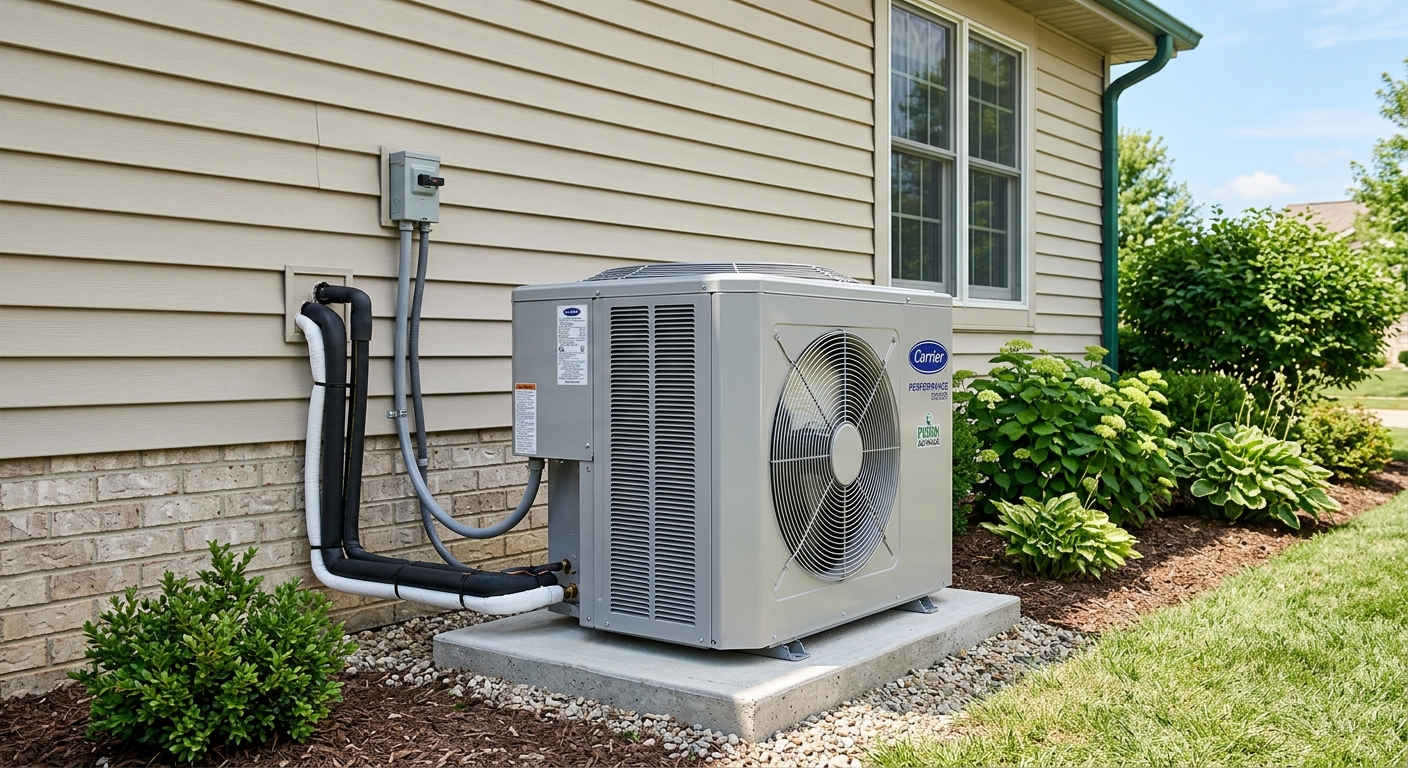
Taylor heating and cooling prices by system type — 2026
Taylor homeowners are working with a market shaped by its housing stock—over 76% of homes were built before 1980, and more than half are single-family (U.S. Census Bureau, ACS 2024). That means most existing HVAC installations are either older systems ripe for replacement or custom retrofits, especially in parts of nearby Scranton and Old Forge with extensive pre-1940 rowhouses and duplexes. These homes often have tight, oddly configured spaces, making new ductwork a challenge and, in many cases, pushing the cost of traditional installations higher.
Our region sees 6,100 heating degree days compared to just 850 cooling degree days, making this a heating-dominated climate. In most Taylor homes, heating costs drive the utility bill, not air conditioning. Homeowners tend to focus on equipment reliability and efficient heat delivery rather than just SEER numbers.
For homes with newer or working ductwork, central AC and air-source heat pumps appeal for their familiar operation. But, if you’re dealing with no ducts or poorly placed registers (common in those older homes), ductless solutions are often more practical. A full duct system can be installed, but expect custom work and a corresponding increase in price. Below are typical 2026 installation price ranges for the most common setups in a Taylor home:
| System |
Best for |
Efficiency |
Price range (installed) |
| Central AC replacement (existing ducts) |
homes with sound ductwork |
16–20 SEER2 |
$4,600–$11,000 |
| Air source heat pump (ducted) |
year-round heating and cooling |
8–10 HSPF2 |
$7,300–$15,500 |
| Cold-climate heat pump (ducted) |
heat pump as primary heat |
9–11 HSPF2 |
$12,000–$15,500 |
| Ductless mini-split (single zone) |
additions, rooms without ducts |
20–30 SEER2 |
$2,900–$6,400 |
| Full duct system installation |
homes with no existing ducts |
— |
$8,200–$16,500 |
Installed estimates for a typical Taylor home. Equipment tonnage, duct condition and electrical capacity move these more than brand.
The decision point on an aging system
If you're facing a big repair bill on your Taylor HVAC system, don't let anyone rush you into replacement. The two most important factors are the age of your equipment and the cost of fixing it versus replacing it. If your system is under 10 years old and the failure is a single part—like a capacitor, contactor, or fan motor—repair is almost always in your best interest. If the system is 12–15 years old and the cost to repair hits a third or more of a full replacement (think $4,600–$11,000 for a furnace/AC combo), then it’s time to weigh your options more seriously.
There are two cases where replacement is absolutely not optional: a cracked heat exchanger (a carbon monoxide risk), and a failed compressor in an older AC or heat pump, especially if it uses outdated refrigerant. In both scenarios, it simply doesn’t make sense to sink money into a system at or past its service life. On the other hand, minor repairs and maintenance are nearly always worthwhile up to the 10-year mark.
Before replacing a working but inefficient system, it's wise to test your ductwork for leaks or consider an energy audit. In a heating-dominated climate like ours, small efficiency gains often don't recoup the full cost unless your current system is really worn out or seriously mismatched for your home.
| Situation |
Recommendation |
Typical cost |
Reasoning |
| Under 10 years, single component failure |
Repair |
$300–$1,200 |
Modern systems rarely fail as a whole early on; parts are replaceable and labor is reasonable. |
| 10–15 years, repair over a third of replacement |
Consider replacing |
$4,600–$11,000 |
Big repairs at this age mean you’re likely to face more soon; replacement is usually more cost effective. |
| 15+ years, any major failure |
Replace |
$4,600–$11,000 |
Service life is ending; not worth extending the old system with costly repairs. |
| Cracked heat exchanger, any age |
Replace immediately |
$4,600–$11,000 |
Carbon monoxide risk; cannot be safely repaired. |
| Compressor failure past warranty |
Replace |
$7,300–$15,500 |
Compressor is half to two-thirds the cost of a new system. |
| Working system, high bills |
Test ducts and envelope first |
$300–$800 |
Leaky ducts and insulation waste more energy than moderately lower system efficiency. |
Mini-splits and zoning in Taylor homes
In Taylor and the surrounding area, ductless mini-split systems are often the most sensible solution for older homes and add-ons—anywhere it's tough or too expensive to run new ductwork. This plays right into the hands of Taylor’s and Old Forge’s large pre-1940 rowhouse and duplex stock, where dropping ducts in would mean serious disruption to finished plaster and trim. These homes were simply not designed for central air, making ductless options more practical.
Mini-splits offer single-zone setups (one indoor "head" per outdoor unit) or multi-zone (multiple heads on one outdoor unit). Single-zone systems are efficient and simple—ideal for a finished attic, converted basement, or an addition—while multi-zone configurations let you heat or cool several rooms without adding ductwork throughout. However, a multi-zone unit driving several heads can underperform compared to separate single-zone systems, both in efficiency and comfort, especially if room sizes and usage differ. Placement of indoor heads is always a consideration, and while manufacturers make sleeker models, not everyone is happy with the look. Condensate drainage is another detail: properly routed lines are unobtrusive, but rushed installs can leave you with visible lines or leaks.
If your home doesn’t already have ducts, or you’re renovating just part of the house, mini-splits almost always win on cost, comfort zoning, and ability to install with minimal disturbance. Given Taylor’s housing mix and aging stock, ductless is as much a necessity as a choice in many projects.
The comfort problem that isn't temperature
In Taylor's climate—with cold winters and humid summers—comfort is just as much about controlling humidity and air quality as hitting the right temperature. Our long heating season dries out homes, while summer can bring muggy nights with a few weeks of sticky discomfort. Oversized AC units, something I run into often in older Taylor homes, tend to short-cycle and fail at dehumidifying, so you end up cooler but still clammy.
If whole-house humidifiers are on your mind, be sure you understand the maintenance—neglected units create scale and mold problems. For air filtration, boosting MERV ratings (the standard for filter effectiveness) seems attractive, but if you push beyond what your system’s blower can handle, airflow drops and performance suffers. Balancing efficiency with adequate airflow is key. In new builds or recent gut renovations where the envelope is tightly sealed, mechanical ventilation (like an HRV or ERV) matters, but in most Taylor homes—that 76% built before 1980—the natural leakage is enough that add-on ventilation rarely justifies the price.
The most commonly oversold add-ons in our area? Ultraviolet lights (for nearly all homes) and high-dollar air scrubbers. Most Taylor homeowners will see more impact simply by maintaining their filters, tuning their equipment, and using a portable dehumidifier or humidifier where needed, rather than chasing every gadget.
Efficiency ratings and what they mean for your bill
Efficiency labels—SEER2 for cooling, HSPF2 for heat pumps, AFUE for furnaces—tell you how much heating or cooling you get per unit of energy, under standardized test conditions. The new SEER2 and HSPF2 ratings are updated versions—values are not directly comparable to the old SEER or HSPF numbers you’ll find in earlier articles.
Here in Lackawanna County, with 6,100 heating degree days to just 850 cooling degree days, it makes far more sense to prioritize HSPF2 (the heating efficiency measure for heat pumps) than SEER2 (for AC). Unless you’re running your AC for months at a stretch, jumping from a 16 SEER2 to 20 SEER2 unit won’t pay for itself quickly—especially given our short cooling season. High-efficiency, cold-climate heat pumps in the 9–11 HSPF2 range offer real savings, especially if you don’t have access to natural gas. For most Taylor homes, the “top shelf” SEER2 numbers are a poor use of dollars; you’re better off with solid, mid-range efficiency and putting leftover budget toward insulation or air sealing.
In short: don’t spend for the highest efficiency ratings unless your house is already buttoned up and you plan to stay long term. Heating costs dominate your yearly electric bill here, so choose accordingly.
Mechanical permits for HVAC work in Taylor
Pennsylvania does not issue an HVAC “license” at the state level for residential work. Instead, contractors must have a Home Improvement Contractor (HIC) registration from the Pennsylvania Office of Attorney General for any job contracted at over $500—you can and should verify this at hic.attorneygeneral.gov. Mechanical permits are issued and enforced locally by Taylor and nearby municipalities. The rules and inspections come from the Pennsylvania Uniform Construction Code, which is based on the IRC, but run by each borough or township in the county.
If refrigerant is involved—air conditioners, heat pumps, mini-splits—the installer is required by federal law to hold an EPA Section 608 certification. Always ask to see it.
Insurance and workers' compensation are your other protections: every contractor employing help is mandated to carry workers’ comp, and you can verify that through Pennsylvania’s WCAIS portal at wcais.pa.gov. Don’t accept just a verbal “yes”—anyone reputable has a certificate of insurance available on request. If the job involves electrical service, electrical licensing (where required) is also done by the municipality. The only universal paperwork for residential HVAC is HIC registration and the municipal permit.
Heat pump or furnace: what makes sense in Taylor
When it comes to choosing between a furnace and a heat pump in Taylor, the numbers tilt the answer. With a winter design temperature of 4 °F and 6,100 heating degree days, heating is the big expense, not cooling. Modern cold-climate heat pumps deliver reliable heat well down to 0°F—and will keep running even in the single digits, though they do lose efficiency and capacity as it gets colder. The lowest design temperature isn’t just a number; it’s a stress test. That’s why dual fuel (heat pump with gas backup) systems exist, automatically switching to the furnace when it’s most economical.
If you’re in Scranton or most of the valley, with access to UGI natural gas, a gas furnace remains a cost-effective and easy-to-maintain option—especially for big single-family homes or older houses with solid ductwork. Out in Taylor’s rural northern townships, though, natural gas isn’t always available. That means your options are heat pump, propane, or oil, and here the scales often tip toward a cold-climate heat pump—propane and oil are both volatile and generally pricier long term. A ductless system makes sense for retrofit jobs without existing ductwork, particularly in older Taylor homes.
If your house is poorly insulated, heat pumps can struggle in severe cold, making a furnace—or at least a dual-fuel setup—a safer bet. But for an average Taylor home with a bit of weatherization, heat pumps can cover 95% of the season without help.
| Option |
Installed cost |
Operating cost here |
Best when |
Incentive eligible |
| Gas furnace + central AC |
$4,600–$11,000 |
lowest with gas service |
existing gas service, coldest zones |
occasionally (utility rebates) |
| Ducted heat pump (cold climate) |
$7,300–$15,500 |
lower than oil/propane, efficient electric |
good envelope, all-electric goal |
yes (federal and state) |
| Dual fuel (heat pump + gas backup) |
$12,000–$15,500 |
lowest with expensive gas or deep cold spells |
gas on site, deep cold spells |
yes (some programs) |
| Ductless multi-zone |
$8,200–$16,500 |
lowest for spot zoning, moderate homes |
no ductwork, zone control |
yes (rebates and credits) |
Frequently asked questions — HVAC installation in Taylor
Should I replace the furnace and AC at the same time?
If your furnace and air conditioner are both over 12–15 years old in Taylor, it often makes sense to do them together, especially if the airflow and control systems are shared. This can save labor costs and avoid compatibility headaches. However, if one system is less than 10 years old and running well, don’t let anyone talk you into replacing it “just because.” For example, if your AC compressor fails at 15+ years but your furnace is only 7 years old, replace the AC for $4,600–$11,000 and keep the furnace. Labor overlap only yields real savings when both are aged out together.
What HVAC tax credits are available to Taylor homeowners?
Taylor homeowners may be eligible for federal tax credits for installing a high-efficiency heat pump or qualifying ductless system. These credits are usually capped and subject to income limits. In addition, Pennsylvania utilities sometimes offer rebates for efficient equipment, though these programs change from year to year. For a typical cold-climate ducted heat pump installed at $12,000–$15,500, you could expect a federal tax credit of up to 30% of the installation cost, subject to certain caps and eligibility criteria. Always check the most current program details.
Should I close vents in unused rooms?
In Taylor homes—especially older ones with ductwork designed for open flow—closing supply vents is rarely a good idea. It raises static pressure in the system, can lead to duct leaks, and may actually decrease energy efficiency. Modern variable-speed systems tolerate this better, but most of the housing stock here is built pre-1980 and wasn’t designed for adjustable zoning. Instead of closing vents, consider investing in a single-zone ductless mini-split, which can efficiently condition a room for $2,900–$6,400 without negatively affecting your central system.
How far ahead should I schedule in Taylor?
For HVAC installation in Taylor, booking 2–4 weeks ahead is wise, especially during peak spring and fall rushes. The Scranton–Wilkes-Barre market is saturated with contractors, but quality crews book up early for large projects like a full duct system ($8,200–$16,500). Emergency replacements can sometimes be squeezed in faster, but planning ahead gives you a better choice of contractor and equipment. Expect possible delays for custom ductwork in older houses with unique layouts.
Which utility serves Taylor?
Taylor’s electric utility is PPL Electric Utilities. Natural gas is served by UGI Utilities for most valley communities, including Taylor. If you’re outside the main gas grid, homes are often heated with propane or fuel oil. For an air-source heat pump installed in a typical Taylor home ($7,300–$15,500), your fuel choice will determine your operational cost and eligibility for utility rebates.
What does a ductless mini-split cost in Taylor?
Installed cost for a single-zone ductless mini-split in Taylor ranges from $2,900–$6,400 in 2026. This covers equipment, labor, and basic electrical connections for one indoor head and one outdoor unit. Add more zones or complex line sets, and the price rises. For an older Taylor home with no existing ducts or for a finished attic addition, mini-splits are usually the least invasive and most cost-effective path to reliable cooling and heating.
What does a heat pump cost installed in Taylor?
A ducted air-source heat pump system—including installation—falls in the $7,300–$15,500 range for a typical Taylor home in 2026. Prices skew higher for cold-climate models or if your electrical system needs upgrading. Re-using sound ductwork saves thousands compared to a full retrofit. Rural Taylor homes without natural gas see the best long-term payback, since heat pumps undercut the cost of propane or oil heating.
Who inspects HVAC work in Taylor?
HVAC work in Taylor is inspected by the municipal code office, not the state. All installations must comply with the Pennsylvania Uniform Construction Code (UCC), enforced by Taylor’s own inspectors or the local borough office. Mechanical permits are required, and a written contract is mandatory for projects over $500. Always ask for documentation—a reputable contractor won’t hesitate. EPA Section 608 certification is required for anyone handling refrigerants.
What is a Manual J load calculation?
A Manual J load calculation is the process used to size HVAC systems for your specific Taylor home. It considers your home’s size, layout, insulation, windows, and orientation to determine how much heating or cooling is actually needed. This prevents oversizing—common in older homes here—which can waste money and cause comfort problems. A proper Manual J is required under the Pennsylvania Uniform Construction Code for most permitted installations, and running one usually costs $300–$800 as part of a comprehensive estimate.