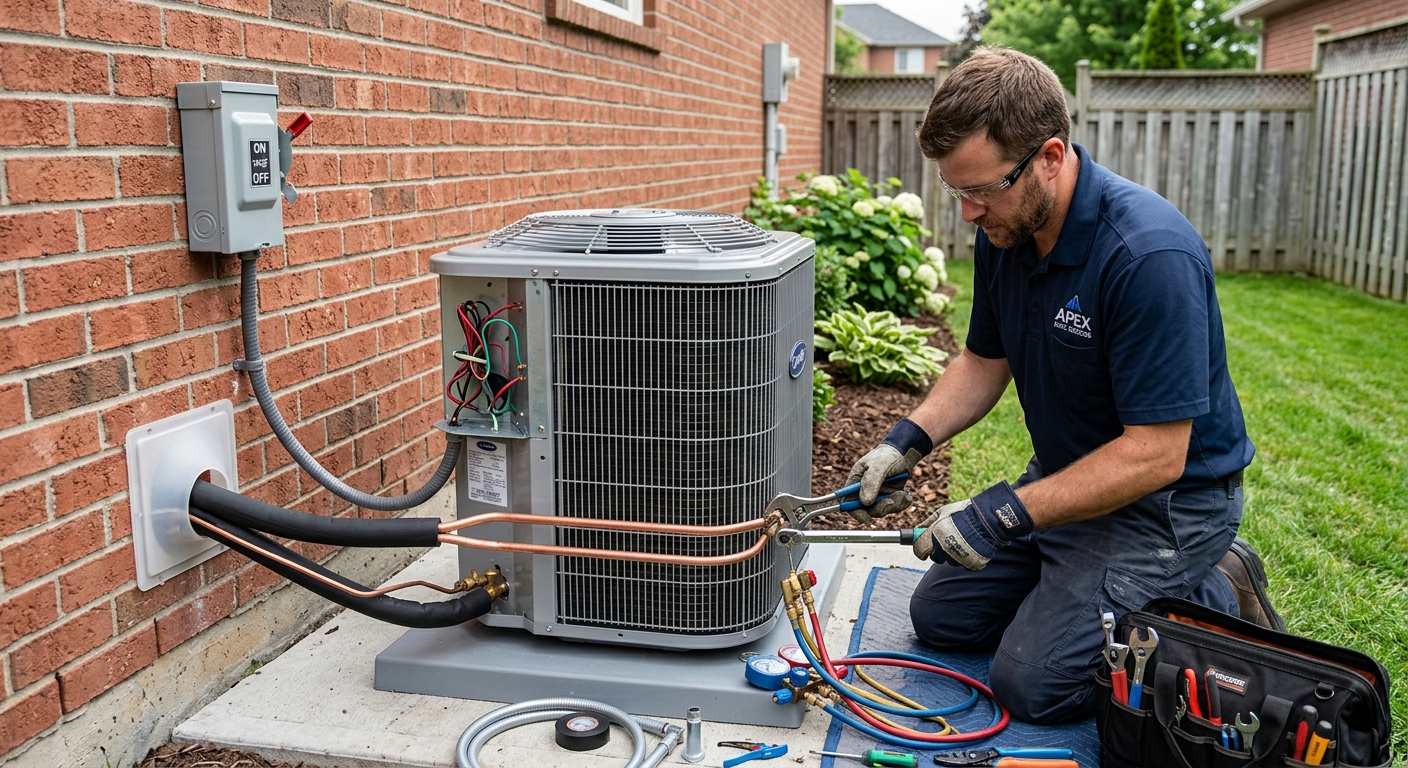
What a new HVAC system costs in Franklin
Franklin’s HVAC market is shaped by two factors: a high homeownership rate of 81.7% and more than a third of homes built before 1980 (U.S. Census Bureau, ACS 2024). This means most folks are living in single-family homes, and many systems are at or nearing replacement age. Though York City, just to the northeast, has many pre‑1940 rowhomes that push demand for ductless and high‑velocity retrofits, Franklin’s mix skews a bit newer—so you’ll find both ducted and ductless systems, but there’s often some sort of ductwork in place for standard replacements.
Our climate calls for 5,200 heating degree days and only 1,250 cooling degree days annually. This makes Franklin a heating-dominated market. Any new or replacement system you’re considering should put cold-weather comfort and reliability front and center, since your winter use and bills will always outpace what you rack up in those muggy July weeks. Many homeowners here lean toward air source heat pumps for year-round performance, but choosing between a furnace, heat pump, or both still depends on electricity and gas service in your neighborhood.
| System |
Best for |
Efficiency |
Price range (installed) |
| Central AC replacement (existing ducts) |
homes with sound ductwork |
16–20 SEER2 |
$4,900–$11,500 |
| Air source heat pump (ducted) |
year-round heating and cooling |
8–10 HSPF2 |
$7,800–$16,500 |
| Cold-climate heat pump (ducted) |
heat pump as primary heat |
9–11 HSPF2 |
$12,500–$16,500 |
| Ductless mini-split (single zone) |
additions, rooms without ducts |
20–30 SEER2 |
$3,100–$6,800 |
| Full duct system installation |
homes with no existing ducts |
— |
$8,800–$17,500 |
Installed estimates for a typical Franklin home. Equipment tonnage, duct condition and electrical capacity move these more than brand.
Mechanical permits for HVAC work in Franklin
There’s no statewide HVAC trade license in Pennsylvania—what matters is local regulation. For residential jobs in Franklin, the Pennsylvania Uniform Construction Code (UCC) sets the rules, but it’s enforced by your local code office, not a Harrisburg agency. That means what triggers a permit can shift as you cross from Franklin into another township or head toward York proper. Within the City of York, you’ll need a mechanical permit for any HVAC installation or replacement, while smaller Franklin projects—like swapping out a thermostat—may not require one if you’re outside city limits.
Contractor registration is handled through the Home Improvement Contractor (HIC) system. Any HVAC company working on contracts over $500 must be registered with the Pennsylvania Office of Attorney General. If you want to check that status, use the hic.attorneygeneral.gov lookup. For refrigerant work—no matter where you are in the state—EPA Section 608 certification is mandatory for whoever’s handling your AC or heat pump charge.
Before hiring, verify workers’ compensation coverage (required for all employers) via the state’s WCAIS system at wcais.pa.gov. Franklin homeowners should expect a written contract for any job over $500, as required by the Home Improvement Consumer Protection Act. You also have a three-business-day right to cancel after signing. While the system isn’t foolproof, these checks move you a lot closer to a job done safely, legally, and with real recourse if something goes sideways.
The decision point on an aging system
In Franklin’s older housing stock, deciding whether to patch up an old system or invest in a full replacement is about numbers, not just age. First, look at the system’s age against expected service life: most central AC units and heat pumps last 12–15 years, while furnaces can run 15–20 if maintained. If your system’s under 10 years old and the failure is a single component—say, a control board or fan—it’s almost always cheapest to repair, especially if the cost is less than a third of replacement. When repair bills creep up toward half or more of a new system, pause and reassess.
Cracked heat exchangers (on furnaces) and dead compressors (on heat pumps or central ACs over 10 years) are the two major red lines—these aren’t safe or practical to fix. The refrigerant your system uses matters, too. Systems running on phased-out refrigerants (like R-22) become prohibitively expensive to repair and source parts for. As for efficiency, Franklin’s climate sees enough heating hours that upgrading to a modern, high-efficiency system can pay off in utility savings, but only if your house is reasonably tight and your ducts aren’t leaking.
| Situation |
Recommendation |
Typical cost |
Reasoning |
| Under 10 years, single component failure |
Repair |
$300–$1,200 |
Still within typical lifespan, likely covered by manufacturer parts warranty |
| 10–15 years, repair over a third of replacement |
Consider replacing |
$4,900–$11,500 |
Approaching end of service life; likely to need more repairs soon |
| 15+ years, any major failure |
Replace |
$4,900–$11,500 |
Inefficient, repair costs aren't justified by remaining service life |
| Cracked heat exchanger, any age |
Replace immediately |
$4,900–$11,500 |
Carbon monoxide risk—do not run system |
| Compressor failure past warranty |
Replace |
$7,800–$16,500 |
Compressor is the heart of the system; cost to repair rarely worth it after warranty |
| Working system, high bills |
Test ducts and envelope first |
$300–$800 |
Improper ductwork or air leaks often cause high utility usage in Franklin homes |
Separating installers from equipment sellers
In Franklin—and anywhere in York County—the best HVAC system is only as good as the technician installing it. There’s little value in paying for premium equipment if the installer doesn’t size, charge, and balance it properly. This market has no shortage of contractors, but not everyone quoting is technically qualified, or even registered as required.
Before signing any contract, confirm the firm’s HIC registration using hic.attorneygeneral.gov. The individual handling refrigerant must hold EPA 608 certification. A real professional will include a Manual J load calculation, not just “rule-of-thumb” tonnage. You should see equipment model numbers—down to the last digit—on your quote. For ducted systems, ask about measured airflow and refrigerant charge at startup; this commissioning process ensures efficient, reliable operation and is often skipped by volume sellers.
- Verify HIC registration at the state website
- Ask for the lead installer's EPA Section 608 certification
- Insist on a Manual J load calculation—not just square footage
- Review the contract for model and serial numbers
- Request written scope of work (including all materials and labor)
- Check for proof of workers’ compensation insurance (WCAIS lookup)
- Get at least two references for similar work in Franklin or York County
- Ensure the price includes permits and final inspection (where required)
- Ask what commissioning data (airflow, refrigerant charge) you’ll get at startup
- Be clear who is responsible if asbestos or lead paint is uncovered mid-job
- Confirm written warranty terms and who honors them locally
- Do not accept vague “system tune-up” or “installation as specified by manufacturer”—ask for details
Red flag: In a dense market like York County’s, volume “dealers” can underbid by skipping load calculations, subbing out labor, or ignoring duct issues. Cutting corners is common—don’t pick solely by price.
Gas, electric or both in south-central Pennsylvania
With winter design temperatures at 12 °F and 5,200 heating degree days per year, Franklin’s climate is serious about heating. Modern cold-climate heat pumps now work reliably well below freezing and are finally a realistic year-round option—even in south-central Pennsylvania. The “heat pumps don’t work here” objection doesn’t hold water anymore, though at the design temperature you may still see a dip in capacity, especially in drafty or poorly insulated homes.
If you’re on Columbia Gas of Pennsylvania service—common in York, Springettsbury, and West Manchester—a gas furnace is still the lowest hassle and often best value in deep cold. Rural Franklin homeowners, however, may be stuck with propane or fuel oil. In those cases, a high-efficiency cold-climate heat pump often comes out ahead: lower operating costs, no fuel delivery, and one system doing both heating and cooling. Dual-fuel systems (heat pump plus gas backup) let you optimize for comfort and cost, using electric heat until the coldest nights, then firing up the furnace.
A straight gas furnace still wins if you already have good ductwork, a reliable gas utility connection, and aren’t planning to electrify. Where ductwork is missing, ductless systems provide targeted comfort but at a higher installed cost. Pick the technology based on fuel access, current utility rates, and home envelope, not national trends.
| Option |
Installed cost |
Operating cost here |
Best when |
Incentive eligible |
| Gas furnace + central AC |
$4,900–$11,500 |
lowest in established gas service areas |
existing gas service, coldest zones |
sometimes |
| Ducted heat pump (cold climate) |
$7,800–$16,500 |
cheaper than oil/propane, good envelope improves payoff |
good envelope, all-electric goal |
yes |
| Dual fuel (heat pump + gas backup) |
$12,500–$16,500 |
optimized; uses gas only below freezing |
gas on site, deep cold spells |
yes |
| Ductless multi-zone |
$8,800–$17,500 |
higher upfront, but efficient and zoned |
no ductwork, zone control |
yes |
Filtration, humidification and ventilation
Franklin’s winters are long and dry, while summers bring real humidity—so it’s common to think about both humidification and dehumidification when updating a system. In months when heating dominates, indoor air often drops below 30% humidity, leading to static shocks and cracked woodwork. Whole-house humidifiers help, but carry a maintenance burden. If not cleaned, they can become mold sources, so don’t install one unless you’ll keep up with seasonal maintenance.
Come summer, don’t assume that a bigger air conditioner means better humidity control. In fact, oversized ACs short cycle, barely running long enough to wring moisture out of the air. For many Franklin homes, the best move is right-sized equipment matched to your ductwork and home volume. On filtration, make sure your blower can actually handle the resistance of a MERV 11–13 filter—slapping in the highest MERV rating often starves older systems of airflow and shortens the blower’s life.
If your house was built more recently (or tightly sealed during upgrades), mechanical ventilation—supply-only, exhaust-only, or balanced—can keep indoor air fresh. Just be wary of “air cleaning” add-ons like UV lights and ionizers; most are sold well beyond their actual benefit for most Franklin homeowners.
Ductwork: the part nobody quotes properly
Duct leakage and undersized returns are the silent killers of efficient heating and cooling in Franklin’s older homes. Especially in houses built before 1980, it’s common for up to 30% of your heated or cooled air to vanish into spaces you never use—attics, crawlspaces, or wall chases. That means you might be throwing away more money through your duct system than you’re saving with a high-efficiency furnace or heat pump.
A duct blaster test pinpoints leakage rates, showing you with hard numbers whether sealing or total replacement is justified. In many Franklin homes, sealing is the smart first step, particularly if the ducts are in otherwise decent shape but were never properly sealed (as was typical decades ago). But don’t forget about undersized or blocked returns—a frequent headache in older layouts that can starve systems for air and shorten equipment life.
York City’s pre‑1940 rowhomes frequently have no original ductwork, which is why ductless and high-velocity systems are so common there. If your home falls into that era or style, weigh the cost of a full duct install against a ductless or high velocity option. The bottom line: Before you replace an HVAC system, insist on a duct and envelope test. Otherwise you’re guessing at the source of your discomfort and utility bills, and you’ll never get the efficiency you paid for.
Frequently asked questions — HVAC installation in Franklin
How does south-central Pennsylvania's climate affect system sizing?
In Franklin, system sizing comes down to our heating-dominated climate. With winter design temperatures hitting 12 °F and over 5,200 heating degree days, systems must carry a real heating load for long stretches. A properly sized system here will often look oversized if you’re used to specs from warmer regions—that’s not a mistake. Too-small equipment struggles in cold snaps, while oversized cooling units short cycle and leave you clammy in July’s humidity. For most homes, a ducted heat pump or gas furnace option in the $4,900–$11,500 range hits the right balance. Make sure your installer runs a Manual J calculation—the “right size” almost always differs from whatever the old system was, especially in homes built before 1980.
Why does my system short cycle?
In Franklin homes, short cycling—where your furnace or AC starts and stops too frequently—is usually caused by improper sizing, incorrect thermostat placement, or trouble with ductwork. Oversized systems reach temperature too quickly and shut off, failing to run long enough for proper dehumidification or even heating. Dirty filters, blocked vents, or undersized returns (common in pre‑1980 homes) can also provoke short cycling by starving the system for airflow. Addressing this may involve a duct test, thermostat check, or, in some cases, swapping out the equipment. Diagnostic visits typically cost $300–$800, and the fix is often easier than a full replacement—don’t let anyone sell you a new system until these basics are checked.
Do I need ENERGY STAR equipment to qualify for incentives?
In Pennsylvania—including Franklin—most federal and utility rebates require you to meet minimum efficiency standards, but they don’t always specify ENERGY STAR–branded products. Instead, eligibility often hinges on metrics like SEER2 for air conditioners and HSPF2 for heat pumps. For example, a ducted heat pump install qualifying for incentives might need to reach 15 SEER2 or better, which places your installed cost somewhere in the $7,800–$16,500 range depending on equipment and complexity. ENERGY STAR can be a shortcut to ensure compliance but ask your contractor to confirm specific regional requirements before purchasing.
What is SEER2 and how is it different from SEER?
SEER2 is the latest standard for measuring cooling efficiency, replacing the older SEER rating. For Franklin homeowners, it matters because SEER2 uses tougher, more realistic test conditions—factoring in increased system static pressure that simulates actual home ductwork. In practice, a 16 SEER2 unit delivers better “real-world” efficiency data than an older SEER 16, but using the new standard makes head-to-head comparisons fairer. When shopping systems priced between $4,900–$11,500 for a central AC replacement, make sure you’re comparing SEER2 ratings, not SEER, to judge true performance.
What does a heat pump cost installed in Franklin?
For most Franklin homes with existing ductwork, a complete air source heat pump installation runs $7,800–$16,500. The wide range comes from differences in equipment efficiency, new vs. reused ducts, electrical upgrades, and whether you need a cold-climate model for primary heating. If you’re adding a ductless mini-split in an addition or room with no prior conditioning, a single-zone setup typically runs $3,100–$6,800. Always ask whether the quoted price includes permits, commissioning, and line-set work—these hidden costs can swing the bill by thousands.
Do I need to be home during installation?
For most Franklin HVAC installations, you don’t need to hover, but access is essential—installers will need to get into your mechanical room, attic, and electrical panel. Expect someone to be home to answer questions and review work on day one, then again at project wrap-up. For systems in the $4,900–$11,500 range (like a standard furnace or AC swap), jobs run a half to full day. If permits or inspections are required in your municipality, you’ll need access for the inspector as well. For your own peace of mind, schedule a walkthrough with the installer to discuss thermostat operation and maintenance before they leave.
How do I verify an HVAC contractor's insurance?
In Franklin, responsible contractors provide proof of workers’ compensation and liability insurance up front. You can double-check workers’ comp status through Pennsylvania’s WCAIS system at wcais.pa.gov, which pulls directly from legally required employer filings. For large HVAC jobs—anything over $4,900–$11,500—this step is non-negotiable. If a contractor hesitates or refuses, move on; you don’t want to be the one holding liability if a worker is hurt in your home. General liability can be checked via their insurer or by requesting a certificate direct from the agent listed.
Is it worth switching from oil or propane to a heat pump?
In rural Franklin and across much of York County, many homes still rely on delivered propane or fuel oil for heating. In those cases, switching to a ducted cold-climate heat pump—installed for $7,800–$16,500—often slashes operating cost, especially with rising fuel delivery fees. You’ll see the biggest savings if your house is insulated and your envelope is tight. Factor in potential incentives for “fuel switching” as well. However, if your system of ducts is ancient or you need major electrical upgrades, weigh those added costs before moving forward. The payoff is real, but only if the house and system match.
How much does a furnace replacement cost in Franklin?
For a straightforward gas furnace replacement in Franklin—using existing, functional ducts—the full installed price generally falls in the $4,900–$11,500 range. The spread is mostly about equipment efficiency, scope of duct modifications, and whether the existing flue/chimney is up to code. If you’re adding central air at the same time, bundled pricing often brings better value than piecemeal upgrades. Always look for a quote that lists both the model number and scope of work, and check that it includes all necessary permits and inspection, as is required for most installations in York County municipalities.