Pine heating and cooling prices by system type — 2026
Pine is a community where most residents own their homes and the housing stock is newer, with 83.9% homeownership and only 18.7% built before 1980 (U.S. Census Bureau, ACS 2024). This means HVAC work here is usually about upgrading or replacing existing systems, not initial installs. Still, those with pre-1960 homes often face tight ducts or outdated wiring—retrofits demand careful planning and sometimes more invasive work.
Southwestern Pennsylvania is a heating-dominated market: with 5,600 heating degree days and only 1,050 cooling degree days, systems here need to handle more hours of cold than heat. For most Pine homeowners, that makes furnace or heat pump performance and fuel choices more central than cooling capacity. Ductwork is commonly present, but may be sized or routed for older, heating-only equipment, a factor to consider in any upgrade—especially if central air wasn’t the original intent.
| System |
Best for |
Efficiency |
Price range (installed) |
| Central AC replacement (existing ducts) |
homes with sound ductwork |
16–20 SEER2 |
$5,500–$13,000 |
| Air source heat pump (ducted) |
year-round heating and cooling |
8–10 HSPF2 |
$8,800–$18,500 |
| Cold-climate heat pump (ducted) |
heat pump as primary heat |
9–11 HSPF2 |
$14,500–$18,500 |
| Ductless mini-split (single zone) |
additions, rooms without ducts |
20–30 SEER2 |
$3,500–$7,700 |
| Full duct system installation |
homes with no existing ducts |
— |
$9,900–$20,000 |
Installed estimates for a typical Pine home. Equipment tonnage, duct condition and electrical capacity move these more than brand.
Efficiency ratings and what they mean for your bill
HVAC systems in Pine are rated for efficiency using SEER2 for cooling, and HSPF2 for heat pumps. SEER2 (Seasonal Energy Efficiency Ratio 2) measures cooling output per watt consumed, but only relates to air conditioners and the cooling side of heat pumps. HSPF2 (Heating Seasonal Performance Factor 2) does the same for heating mode in heat pumps—a higher HSPF2 means more heat delivered per unit of electricity.
Because Pine and most of Allegheny County see 5,600 heating degree days versus just 1,050 cooling degree days, heat matters more than air conditioning. That means HSPF2 carries more real-world weight here; those high SEER2 numbers often advertised for air conditioners don’t mean much for your annual energy bill. For most Pine homeowners, upgrading beyond mid-range SEER2 is unlikely to pay back—unless you’re extremely sensitive to summer electricity bills or run the AC for many more hours than your neighbors. For HSPF2, however, a ducted heat pump closer to 10 or 11 saves noticeably more over its life than an 8 HSPF2 unit, and can justify a modest upfront premium.
Note: SEER2 and HSPF2 are new, more accurate test standards, so don’t compare older SEER or HSPF numbers directly to today’s labels—the newer ratings look lower but reflect real-world conditions better.
R-410A phase-down: repair or replace?
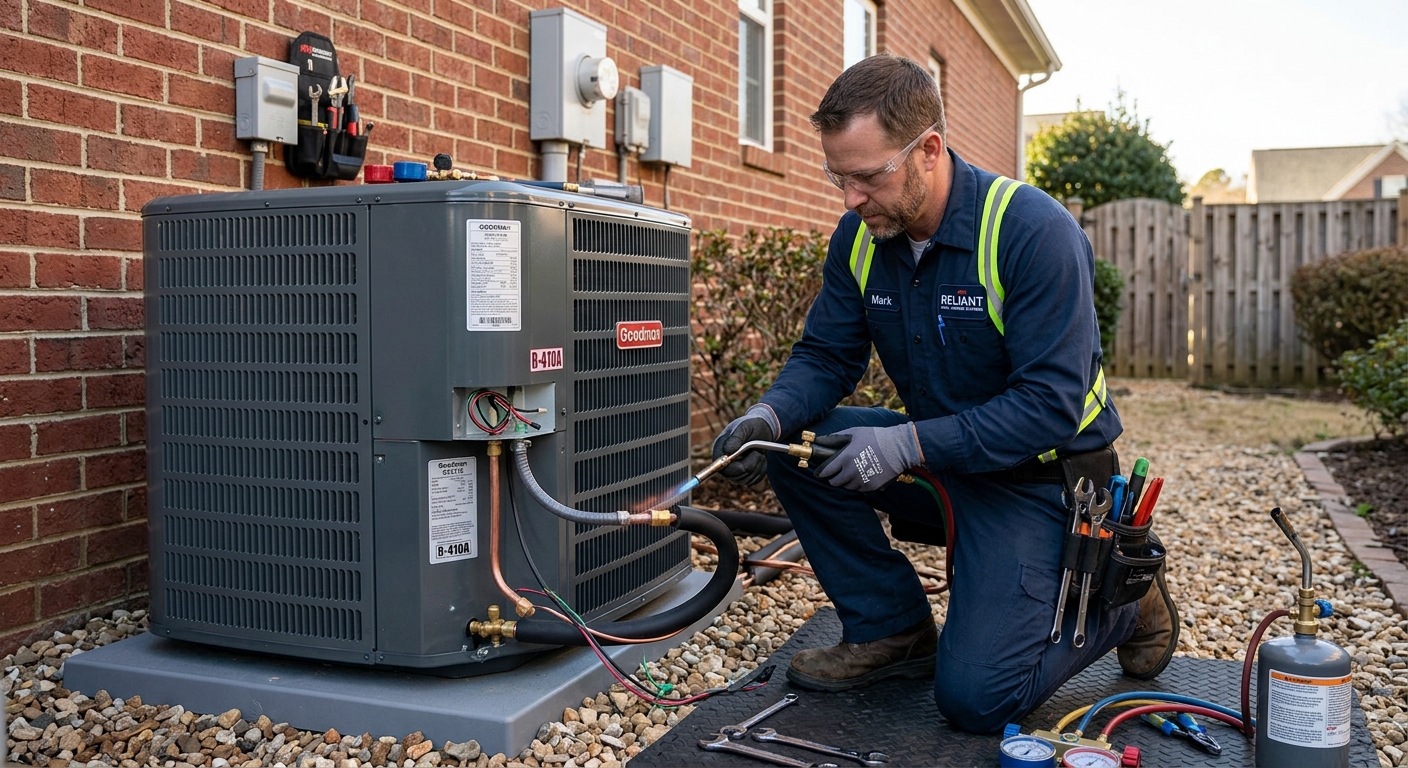
If your Pine home’s current HVAC system uses R-410A, you’re not required to replace it—servicing R-410A units is still legal and parts are available. The recent phase-down under federal rules simply means that new residential equipment is switching to lower-impact refrigerants like R-454B and R-32. These are harder to retrofit into existing systems, but they don’t affect your day-to-day operation if your system is working well.
The practical change for homeowners is around repair economics. As supply of R-410A dwindles, its price rises—so if you develop a refrigerant leak, topping up or charging your system becomes significantly more expensive. On a newer system or a minor repair, it’s usually still worth fixing. But if a leak hits a system that’s already older, out of warranty, or facing major repairs, the phase-down tips the balance toward replacement. Still, there’s no law or code forcing you to drop a functional R-410A unit before its end of life. Upgrading only makes sense if the cost to keep your old system running starts to approach the cost of a replacement, especially given the improved efficiency and future-proofing of new systems.
The main takeaway: there’s no rush to replace for regulatory reasons, but repair thresholds get stricter as refrigerant prices climb and as your unit ages.
What a Pennsylvania HVAC contractor must hold
Pennsylvania does not issue a statewide HVAC trade license for residential work. Instead, contractors must register for Home Improvement Contractor (HIC) status for jobs over $500; you can verify a contractor at hic.attorneygeneral.gov as required by state law. Actual mechanical permits and code inspections are done by local municipalities—there’s no single state office that handles them for all of Allegheny County, which includes Pine.
All contractors who work on refrigerant lines must hold federal EPA Section 608 certification, regardless of what the state or town requires. This protects you by making sure only trained techs handle refrigerants safely and legally. For any new installation, a mechanical permit is required in Pittsburgh, and in Pine it’s municipal code that governs inspections and approvals. Insurance is another must: every HVAC employer is required to have workers’ compensation coverage, and you can confirm this directly through the WCAIS database (wcais.pa.gov).
If you’re comparing bids, always verify HIC registration, confirm workers’ comp, and ask for proof of relevant certifications. In this market, legitimate contractors won’t hesitate to provide it.
What construction era means for your system
In Pine, about 18.7% of homes were built before 1980 (U.S. Census Bureau, ACS 2024), making most properties newer suburban builds—but there is still enough older housing to affect how systems are chosen and upgraded. Homes built before the 1960s often have ductwork added later or designed solely for heating, leading to smaller or poorly routed runs that limit AC airflow and sometimes make high SEER2 central replacements impractical. Outdated insulation and windows common in older homes can also strain sizing calculations for both heating and cooling.
Electric panel capacity is another factor—older homes may only have 100A service or less, which can complicate all-electric heat pump retrofits or require a panel upgrade before installation. Gas furnace replacements are less likely to need major electrical work but might face flue and chimney issues, particularly with aging masonry.
For the roughly four out of five Pine homes built after 1980, builder HVAC installations are usually standard efficiency and sized with some margin. If yours is from a late-1990s development, odds are high that the original equipment is near or at the end of its useful life. When replacing, you can usually count on existing ducts and electrical service—though it pays to inspect them before finalizing a new system’s size and efficiency rating.
The comfort problem that isn't temperature
Southwestern Pennsylvania’s heavy freeze-thaw winters and humid summers mean Pine homes don’t just struggle with temperature—they wrestle with dry winter air and sticky summer humidity. Overly dry air in the heating season can cause static, dry skin, and even minor wood cracking, while summer brings the opposite problem: muggy rooms and condensation risks.
If your AC is oversized, it cools the space too quickly to properly dehumidify, robbing you of comfort. For winter dryness, a whole-house humidifier can help, but they require regular cleaning and attention to avoid mold or scale buildup. High-MERV filters are good for air quality, but go too high and you’ll tax the blower, cutting airflow in older, lower-static systems—so evaluate your blower’s ability before pushing up filtration levels.
For tight, newer homes, mechanical ventilation (like an ERV or HRV) makes sense, but it’s generally oversold in older, leaky houses that already exchange plenty of outdoor air. Unless you have a sealed envelope, focus first on right-sizing your AC and maintaining your existing humidifier—skip the fancier (and pricy) gadgets that target problems you may not really have.
When an HVAC repair stops being worth it
In Pine, as in the rest of Allegheny County, the decision to repair or replace comes down to the age of your system, the type and scale of failure, cost compared to installing new equipment, and whether you’d actually gain efficiency. For a single part failure in a system less than 10 years old, a repair is nearly always the smarter move. Once the repair pushes past one-third of the price of a new system, and especially after 10–15 years of age, it’s time to weigh the numbers. Major failures—like a compressor or a cracked heat exchanger—almost always tip the balance toward replacement, particularly if the system is out of warranty or uses an older refrigerant that’s getting expensive.
Pine’s long heating season means energy efficiency mostly pays back in heating mode; if your energy bills are high and your system still runs, often the first step is testing your ductwork and insulation for leaks before considering full replacement. There are two true “no repair” scenarios: a heat exchanger crack (for safety reasons) or a compressor failure in an older system—then, replacement isn’t an option, it’s a need.
| Situation |
Recommendation |
Typical cost |
Reasoning |
| Under 10 years, single component failure |
Repair |
$300–$1,200 |
Most modern systems have years of life left and parts are readily available. |
| 10–15 years, repair over a third of replacement |
Consider replacing |
$5,500–$13,000 |
Payoff window is short; a new unit brings efficiency and warranty benefits. |
| 15+ years, any major failure |
Replace |
$5,500–$13,000 |
Systems at this age have reached the end; repairs rarely last and costs add up. |
| Cracked heat exchanger, any age |
Replace immediately |
$5,500–$13,000 |
It’s a safety issue—carbon monoxide risk is serious and can’t be patched. |
| Compressor failure past warranty |
Replace |
$8,800–$18,500 |
Major cost, high risk of other aging failures, limited remaining service life. |
| Working system, high bills |
Test ducts and envelope first |
$300–$800 |
Simple fixes can improve performance—don’t replace efficient equipment unnecessarily. |
Frequently asked questions — HVAC installation in Pine
How often should I change my filter?
For most Pine homes, changing a standard filter every three months is a reliable starting point. But if you have pets, allergies, or run your system year-round, check monthly and swap as needed. Pine’s newer, energy-efficient homes (only 18.7% are pre-1980—U.S. Census Bureau, ACS 2024) can end up with higher dust and pollen loads thanks to tight construction. If you have a higher-MERV filter for allergy or asthma needs, check your blower’s ability to move air—the wrong filter can reduce system efficiency. A neglected filter can ice coils, reduce heating efficiency, and shorten your system’s life, causing repairs that could otherwise be avoided. If you’re replacing your HVAC entirely, installation for a basic system in Pine ranges from $5,500–$13,000, and keeping up with filter changes will protect that investment.
What is EPA Section 608 certification?
EPA Section 608 certification is a federal credential required for any person who maintains, services, repairs, or disposes of equipment that could release refrigerants into the atmosphere—including all air conditioners and heat pumps. In Pennsylvania, including Pine, there’s no statewide HVAC license, but every legit contractor handling refrigerant must have this certification. Section 608 ensures your technician understands safe refrigerant handling and is equipped to properly recover and recycle refrigerants like R-410A or the new R-32 and R-454B now required by law. If your HVAC contractor can't show this proof, look elsewhere. Whether you’re paying for a repair around $300–$1,200 or a full system replacement, demand to see a tech’s 608 card before any work involving refrigerant.
How much does ductwork add to an HVAC installation?
In Pine, most homes already have some ductwork, but it’s common for older houses—especially those with additions or complicated layouts—to need retrofit or even full replacement. Installing a complete new duct system in Pine runs from $9,900–$20,000, depending on size, access, and finish requirements. If your ducts are in good shape, replacement isn’t always needed—sometimes basic sealing or a few repairs (often $300–$800) can be enough. Because most Pine homes are replacements, not brand-new builds, get the ducts inspected before agreeing to any big job—there’s no sense spending on brand-new tin unless the current system can’t meet modern needs.
Can a heat pump heat my house without backup?
Heat pumps have come a long way, and the latest cold-climate models work well down to single digits. Given Pine’s winter design temperature of 8 °F, a cold-climate ducted heat pump with HSPF2 of 9–11 will reliably heat your home most days. If your home is sealed and insulated to modern standards, you may not need backup at all. For most older Pine homes, pairing a heat pump with electric or gas backup ensures comfort during the rare deep cold snaps. Full cold-climate installations typically cost $14,500–$18,500 in Pine, but for many this is offset by lower heating bills over time—especially if your current furnace is aging or you want to get off oil or propane.
Do I need to be home during installation?
You don’t need to be present for the entire installation, but someone should be there at the start and end for access, questions, and walkthrough. In Pine, permit inspections may require you— or your contractor— to coordinate with the building inspector for access. With a typical one-day job like a ductless mini-split (from $3,500–$7,700), expect more flexibility. For full system replacements, plan for one to three days, depending on ductwork or panel upgrades. Being at home part of the time speeds up troubleshooting, avoids surprises, and ensures you’re comfortable with the new controls before the crew leaves.
How much does a new HVAC system cost in Pine?
For a straightforward replacement using existing ductwork, Pine homeowners can expect to pay $5,500–$13,000 for a new central air conditioner, and $8,800–$18,500 for a ducted heat pump system. Ductless mini-splits (for one zone) are typically in the $3,500–$7,700 range, and a full duct installation can push the total up to $20,000. Equipment size, duct condition, and any needed electric upgrades are the biggest factors in final price. Don’t choose a system purely on brand; in Pine, sizing for our long heating season pays back more than chasing the highest SEER2 rating.
What does HSPF2 measure?
HSPF2 stands for Heating Seasonal Performance Factor 2—a newer standard measuring how efficiently a heat pump converts electricity into heat over an average heating season. In Pine, heating bills matter more than cooling, and with our 5,600 heating degree days, HSPF2 is a true indicator of payback. Unlike the old HSPF measure, HSPF2 assumes more realistic external static pressure (like dirty filters and real duct losses), so newer units’ HSPF2 ratings look lower but actually reflect real-world efficiency. If you’re investing in a ducted air-source heat pump (say, $8,800–$18,500 installed), choosing a model with HSPF2 above 10 makes sense in our cold climate—especially if you want to save on electric heat.
How cold does it get in Pine and does that affect heat pumps?
Pine’s winter design temperature is 8 °F, and below-zero nights are not unheard of each year. For older heat pumps, this used to mean electric backup was mandatory—and expensive to run. The new cold-climate heat pumps are designed to hold rated capacity down to the single digits, making them a solid primary heat source for Pine’s climate. With a properly sized cold-climate model (install around $14,500–$18,500), most homeowners see reliable winter comfort with minimal use of backup heat. Make sure your installer calculates sizing based on Pine’s heating degree days rather than national or regional averages—otherwise, you risk being underpowered when you need it most.
Are duct sealing and insulation eligible for incentives?
In Pine’s mostly newer housing stock, tested duct sealing and added insulation can still cut bills and improve comfort, especially in rooms that never quite feel just right. Many incentive programs give rebates for professionally tested and sealed ducts, as well as attic or basement insulation upgrades. Often, work in the $300–$800 range qualifies, but always check current terms with your local utility before starting—the details can change year to year. For Pine homes with leaky or uninsulated ducts, investing in these improvements will usually pay back faster than a full system replacement, especially if your existing equipment is still running well but your comfort or bills aren’t meeting expectations.