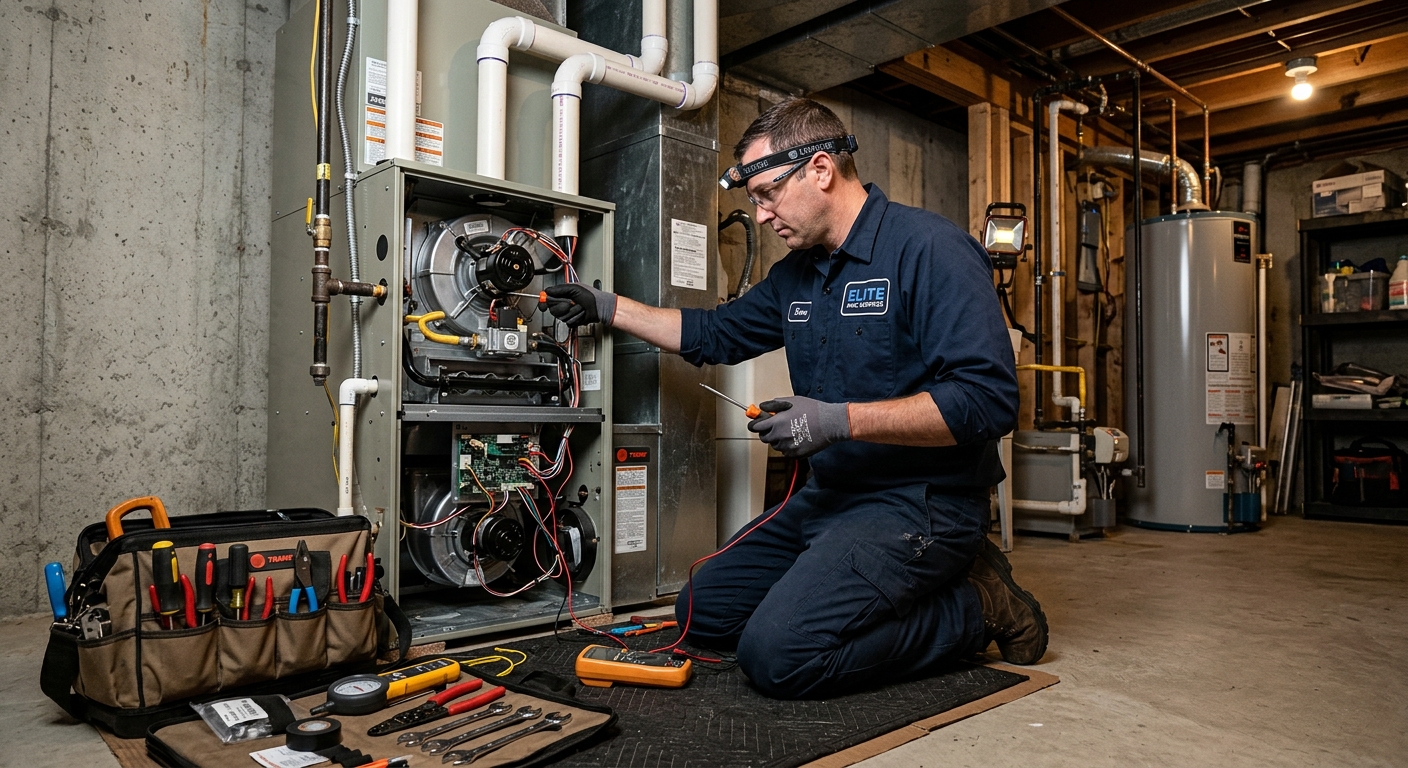
What a new HVAC system costs in Lower Providence
Lower Providence’s high homeownership rate (76.1%) and the fact that 53.5% of homes were built before 1980 (U.S. Census Bureau, ACS 2024) mean most homeowners here are dealing with replacement or major retrofit rather than first-time installation. Many houses in this area, much like the post-WWII stock seen in neighboring Abington, Cheltenham, and Upper Dublin, came with minimal original ductwork or only enough for a simple furnace, leaving new buyers and longtime owners alike contending with older, sometimes undersized or leaking, duct systems. For these homes, upgrades or duct rerouting often become as central to the job as the equipment itself.
The Greater Philadelphia region averages 4,800 heating degree days versus 1,450 cooling degree days each year. That makes this a heating-dominated climate, so the choice of system should put more weight on winter performance and less on peak air conditioning ratings. The need for reliable, efficient heat is greater here, and most homes still lean on forced-air systems—whether gas, electric, or newer heat pumps. Your costs in Lower Providence swing widely depending on whether ductwork is usable or needs overhaul, and whether you go with a standard split AC, a ducted heat pump, or mini-splits for target areas.
| System |
Best for |
Efficiency |
Price range (installed) |
| Central AC replacement (existing ducts) |
homes with sound ductwork |
16–20 SEER2 |
$5,600–$13,500 |
| Air source heat pump (ducted) |
year-round heating and cooling |
8–10 HSPF2 |
$8,900–$19,000 |
| Cold-climate heat pump (ducted) |
heat pump as primary heat |
9–11 HSPF2 |
$14,500–$19,000 |
| Ductless mini-split (single zone) |
additions, rooms without ducts |
20–30 SEER2 |
$3,600–$7,800 |
| Full duct system installation |
homes with no existing ducts |
— |
$10,000–$20,000 |
Installed estimates for a typical Lower Providence home. Equipment tonnage, duct condition and electrical capacity move these more than brand.
Keeping a Lower Providence system running
Routine HVAC upkeep in Lower Providence generally comes down to five things: changing filters, keeping coils clean, clearing the condensate line, verifying refrigerant charge, and making sure your system cycles correctly. For filter changes, it isn’t about buying the highest MERV rating on the shelf. Your blower is designed for a specific airflow, and high-MERV (11 or above) can choke older systems common in pre-1980 homes. Stick with MERV 8 unless your equipment or health needs say otherwise. Swap filters at least every 90 days, or monthly during high-use seasons.
Dirty indoor and outdoor coils hurt efficiency and shorten the life of your equipment. Annual coil cleaning prevents buildup and keeps airflow strong. Don’t ignore the condensate line, especially in our humid summers—it clogs easily, risking water damage. Refrigerant should be checked but never blindly topped off; if your system loses charge, it has a leak, and recharging without repair is a waste of money.
Annual service plans can be useful if they spell out what’s included (not just a “tune-up coupon”). Skip plans padded with vague “priority service” and focus on ones that guarantee coil cleaning, charge checks (with documentation), and clear labor rates. Schedule your service in early spring or fall, before technicians are tied up with emergency calls during summer heatwaves or January freezes.
Permits, licensing and inspections in Lower Providence
Pennsylvania does not run a statewide HVAC trade license. For residential work in Lower Providence, regulation is local—municipalities handle code enforcement and issue mechanical permits for HVAC installation, replacement, or major changes that involve new wiring or ductwork. For jobs over $500, any contractor you hire needs to be registered as a Home Improvement Contractor (HIC) through the Pennsylvania Office of Attorney General. You can and should verify this HIC registration before signing a contract.
While there’s no state-mandated HVAC trade license, anyone physically handling refrigerants—including for ACs and heat pumps—must carry federal EPA Section 608 certification. This is non-negotiable and applies to all refrigerant work regardless of other licenses. Mechanical permits are typically triggered by any installation or replacement that requires significant electrical or mechanical changes. After the work, you should expect an inspection by the local code enforcement office in Lower Providence.
Workers’ compensation coverage is required for all employers in Pennsylvania; you can confirm your contractor is properly insured by searching the WCAIS system. For any home built before 1978, federal rules require a certified lead renovator if work will disturb painted surfaces. Protect yourself further by demanding a written contract, which is required under Pennsylvania’s Home Improvement Consumer Protection Act for work over $500, and which gives you a three-day right to cancel.
Lower Providence's housing stock and its HVAC needs
Most homes in Lower Providence were built after 1945, yet more than half (53.5%) were up before 1980. This means a sizable share of local housing stock is now at the point where original mechanicals have hit or exceeded their expected lifespan. Ductwork in these houses might have been sized only for forced-air heat (likely gas or oil), not for modern central air or high-output heat pumps, so retrofitting for cooling often means upsizing or resealing ducts—or, for older homes, adding them from scratch.
Insulation levels in pre-1980s homes vary, with common shortfalls in attics, rim joists, and basements. Window quality also lags newer construction, so heat loss and summer load are real. Many homes built in the postwar boom have enough electrical service for standard systems, but an all-electric heat pump retrofit may reveal an undersized panel, especially if the house is still sporting its original 100A service.
Original chimneys or flues—if you’re replacing an older furnace—should also be evaluated, as degraded liners can make a swap to high-efficiency gas equipment more complex. In newer 1990s subdivisions, the original builder systems are now at end-of-life and were often installed as large as possible “for comfort,” which made them quick to market but can leave you with short cycling and wasted energy. Many Lower Providence owners will be looking at both duct and equipment replacement in the coming years.
Reading the yellow label
If you're comparing HVAC options in Lower Providence, you'll see ratings like SEER2 (for cooling) and HSPF2 (for heat pumps in heating). SEER2 stands for Seasonal Energy Efficiency Ratio 2, and it measures how much cooling you get per unit of energy consumed—higher is better, but returns diminish fast in a heating-dominated climate. HSPF2 (Heating Seasonal Performance Factor 2) is the winter equivalent for heat pumps, and it is far more relevant for our climate because we log about 4,800 heating degree days each year and only 1,450 cooling degree days.
What’s worth paying for? SEER2 ratings above 16 or 18 are available, but in this part of Montgomery County, the utility savings rarely pay back the premium unless you keep the system running hard all summer—or plan to live here twenty more years. Go too high and the upfront cost balloons with little gain. HSPF2, on the other hand, pays for itself faster—look for at least 9 if you're considering a cold-climate or dual-fuel heat pump.
Be aware: efficiency numbers changed in recent years, so SEER2/HSPF2 are not apples-to-apples with older SEER/HSPF labels. Don't compare new numbers to old articles. For Lower Providence, focus on above-average but not top-tier efficiency, unless you have an unusually high heating or cooling load driving the math.
Sizing: why bigger is worse
The most consequential mistake an HVAC contractor can make in Lower Providence is oversizing your equipment. Many people assume a bigger system is “safer” for covering hot spells or severe cold, but in reality, oversizing leads to short cycling (the system turns on and off rapidly), poor dehumidification in humid Montgomery County summers, uneven temperatures, and a shorter overall lifespan for your equipment. Oversized systems can also be noisier and will not save you money—quite the opposite.
Proper sizing starts with a Manual J load calculation, which factors in not just your home's square footage, but its insulation levels, window quality, orientation, duct leakage, and how much heat/coolth escapes through the shell. “Rules of thumb” based on just square footage do not work in Montgomery County's mix of pre-1980s and postwar housing, where insulation, duct and window upgrades or downgrades massively change the equation.
The gold standard: ask your contractor plainly, “Did you run an actual load calculation, and can I see the printout or report?” If someone just copies the size off your old AC or furnace, they’re repeating errors from the original builder or a prior install. The winter design temperature used for calculations in this area is 14 °F, ensuring you stay comfortable even during colder snaps. If you want comfort, efficiency, and a system that lasts, accept nothing less than a properly sized system.
Duct condition, leakage and sealing
Older homes in Lower Providence can lose a significant fraction of their heated or cooled air through leaky or undersized ductwork—sometimes as much as a third. This isn’t just a nuisance; it can make even brand-new equipment struggle, and often the biggest gains in comfort come from fixing ducts, not buying fancier equipment. The era of construction is everything: most post-1945 homes in Abington, Cheltenham, and Upper Dublin (and by extension, here in Lower Providence) were built with the bare minimum ductwork needed for a furnace and maybe a single return. Cooling was retrofit later, and rarely were ducts sealed or sized for modern central AC or heat pumps.
A duct blaster test, which pressurizes the duct system and measures how much air leaks, is the best way to quantify losses before you commit to new equipment or sealing. Many existing systems have undersized or missing return ducts, reducing air delivery and straining your blower. Ducts in unconditioned attics or crawlspaces are especially prone to loss and should be sealed (with mastic, not just tape), insulated, and sometimes replaced altogether if airflow or access is poor.
The honest advice: have your ducts leak-tested before installing any new equipment. If you don't, you risk simply swapping in new gear while invisible duct issues undermine both comfort and efficiency. Upgrades—whether sealing, resealing, adding returns, or in some cases total replacement—are often more cost-effective than jumping straight to the highest-end HVAC unit.
Frequently asked questions — HVAC installation in Lower Providence
Can I service my R-410A system after the refrigerant change?
Yes, you can still have your existing R-410A system serviced or repaired in Lower Providence, even with the phase-down of this refrigerant happening nationally. Parts and R-410A are still widely available, and skilled technicians with EPA Section 608 certification (required by federal rule) handle routine service, repairs, or top-offs. Replacements are a different story; new systems are starting to use other refrigerants, but you do not need to replace your working R-410A system until you actually want—or need—a new installation. For a typical service call, you'll be paying for diagnosis and labor, not a full replacement, so you’re not facing the central AC replacement price of $5,600–$13,500 unless your current unit fails beyond repair.
What does a heat pump cost installed in Lower Providence?
In Lower Providence, a ducted air source heat pump system runs between $8,900–$19,000 installed, with a typical job landing around $14,500. The price covers equipment, labor, and basic electrical hookup. If your home already has usable ductwork, costs stay toward the lower end. Add-ons like new ducts, electrical upgrades, or “cold-climate” high-performance models push the price higher. Homes here built before 1980 often need duct repairs or new runs for best heating and cooling performance, which adds but is usually necessary for comfort and efficiency in southeastern Pennsylvania’s heating-heavy climate.
Does my utility offer a heat pump rebate in Lower Providence?
Lower Providence is served by PECO Energy Company for both electric and natural gas in most neighborhoods. PECO has offered rebates in the past for qualifying high-efficiency heat pump systems and heat pump water heaters. The actual rebate amount and availability can change year to year, and eligibility depends on the equipment’s efficiency rating and whether you’re replacing electric resistance, oil, or an old heat pump. Rebates are usually in addition to any federal incentives. When shopping for a system that runs between $8,900–$19,000 installed, ask your contractor for current PECO rebate details—they should know, since the paperwork often goes through them.
Do I need a permit to replace HVAC in Lower Providence?
Yes, you typically need a mechanical or building permit to replace or install HVAC systems in Lower Providence if the work involves new electrical or mechanical connections (new units, major duct changes, etc.). Simple maintenance, like filter changes or thermostat battery swaps, does not require a permit in Montgomery County. This protects you by ensuring all work gets inspected for code, safety, and manufacturer requirements. Expect the permit fee to be rolled into your contractor’s price for any major job—such as a $5,600–$13,500 central AC replacement—and always get a written contract before work begins, which is required by Pennsylvania law for jobs over $500.
How far ahead should I schedule in Lower Providence?
For installation work in Lower Providence—especially central AC or heat pump replacements—it’s smart to schedule at least 3-6 weeks ahead in spring or fall. Peak seasons (first hot stretch or cold snap) fill up fast and you may end up waiting longer or paying for “emergency” labor. Contractors in Montgomery County get flooded with last-minute calls, so beat the rush by lining up your system install during the transitional months. For most ducted heat pump or central AC jobs costing between $5,600–$19,000, a quality contractor will want time to pull permits and order equipment before work starts.
Which utility serves Lower Providence?
Lower Providence is served by PECO Energy Company for both electricity and, in most areas, natural gas. This one utility setup simplifies billing and makes rebate incentives for heat pump or high-efficiency HVAC systems easier to claim, since you won’t be juggling multiple companies for documentation. When comparing energy costs for a new system, whether it’s a heat pump or a traditional furnace with AC, keep in mind that the regional price range—like $8,900–$19,000 for ducted heat pumps—reflects PECO’s rates for the area paired with system efficiency and seasonality.
How often should I change my filter?
In Lower Providence, you should check your HVAC filter every month and plan to change it every 60–90 days for standard homes. If you have pets, allergies, or new construction nearby, monthly changes are wise. The real key is sticking with a MERV 8 (not higher, unless your equipment says so) to avoid stressing the blower—especially important in local homes built before 1980 that may not have today’s high-powered systems. This quick, inexpensive step helps avoid expensive breakdowns; you definitely don’t want to be doing a full system replacement at $8,900–$19,000 just because of a neglected filter.
How much does ductwork add to an HVAC installation?
Adding a complete duct system in Lower Providence typically runs $10,000–$20,000 installed. If you’re retrofitting ducts in an older home (many built pre-1980), the cost lands toward the upper end due to access issues and finish work. For replacements or basic repairs, the expense is often lower but can still add several thousand dollars to an HVAC job. For example, pairing new ducts with a heat pump could put your total near $19,000 or more, while upgrading only leaky returns might be several hundred to a few thousand dollars. Testing your existing ducts before replacement can help prioritize what’s worth upgrading.
Do I need dual fuel in southeastern Pennsylvania?
Dual fuel—using a heat pump for milder weather and gas or propane heat for deep cold—can offer the most comfort and best bills in Lower Providence’s climate since we see about 4,800 heating degree days annually. However, thanks to modern “cold climate” heat pumps now rated 9–11 HSPF2, many homes no longer absolutely need a backup furnace. If you get a high-performance heat pump and have average insulation, you’ll likely be fine down to the regional winter design temperature of 14 °F. Still, if you’re nervous about January cold snaps or want belt-and-suspenders peace of mind, dual fuel adds some to your up-front cost (think closer to $14,500–$19,000), but can be worth it for older or draftier houses in Lower Providence.