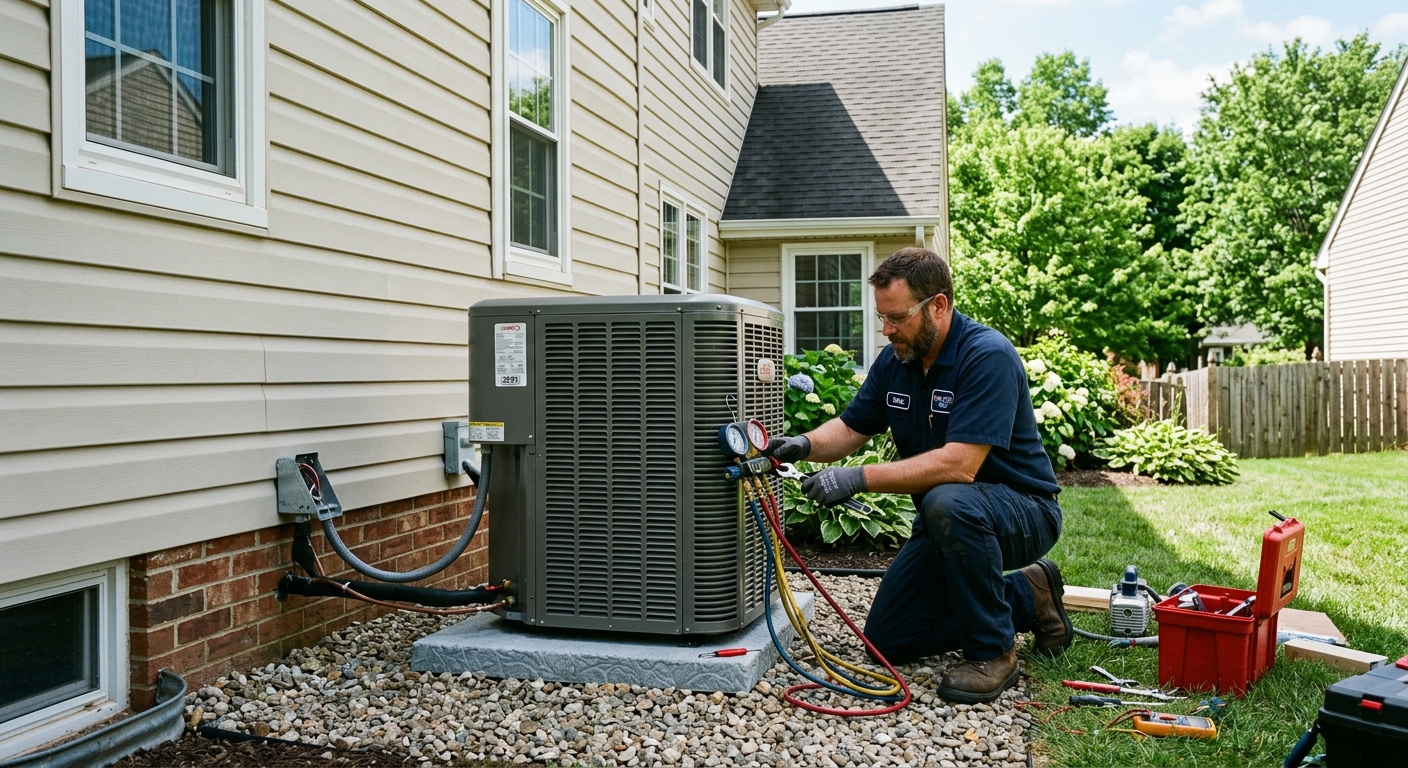
Plains heating and cooling prices by system type — 2026
In Plains, your HVAC installation options and costs are shaped by when and how your home was built. Around 72.8% of local homes were built before 1980 (U.S. Census Bureau, ACS 2024), which means most local systems are either due for replacement or have never had central air at all. The homeownership rate—70.2%—means there’s a real incentive to invest in the right system rather than just the cheapest up-front option. Because Luzerne County housing is heavily 1900–1940 coal-era stock, you’re often looking at retrofits, not easy replacements, and many homes need boiler-to-forced-air conversions with new ductwork—an extra cost you won’t have in newer tract homes.
This is a heating-dominated climate. With about 6,100 heating degree days per year, compared to only about 850 cooling degree days, furnace and heat pump sizing and efficiency matter far more to your long-term comfort and utility bills than AC alone. Proper duct sizing is also a legacy issue: most old forced-air systems weren’t built with cooling in mind, leading to airflow and dehumidification headaches unless corrected.
| System |
Best for |
Efficiency |
Price range (installed) |
| Central AC replacement (existing ducts) |
homes with sound ductwork |
16–20 SEER2 |
$4,800–$11,500 |
| Air source heat pump (ducted) |
year-round heating and cooling |
8–10 HSPF2 |
$7,700–$16,500 |
| Cold-climate heat pump (ducted) |
heat pump as primary heat |
9–11 HSPF2 |
$12,500–$16,500 |
| Ductless mini-split (single zone) |
additions, rooms without ducts |
20–30 SEER2 |
$3,100–$6,700 |
| Full duct system installation |
homes with no existing ducts |
— |
$8,600–$17,500 |
Installed estimates for a typical Plains home. Equipment tonnage, duct condition and electrical capacity move these more than brand.
Sizing: why bigger is worse
In Plains, the most expensive mistake you can make with a new HVAC system is oversizing it. It’s a common myth that going “just a bit bigger” provides a safety margin, but the truth is the opposite. An oversized furnace, heat pump, or AC will short cycle—meaning it turns on and off rapidly—which wears out parts, causes uneven temperatures and drafts, and leaves your home humid in the summer because the cooling system rarely runs long enough to dehumidify properly. It’s not a bonus; it’s a flaw arising from poor design.
Proper sizing starts with a Manual J load calculation, which is a formal assessment of your home’s insulation, window area, air leakage, sun exposure, and—crucially for Plains—its true heat loss on the coldest nights. The region’s winter design temperature of 4 °F is what a legitimate Manual J aims to address, so your system keeps you warm even during the deepest winter snap. Contractors relying on square-footage rules of thumb or the nameplate on your old equipment are only copying whoever did the last job, mistakes and all.
The question to ask any bidder is: “Did you run a Manual J load calculation, and can I see the results?” If they didn’t, walk away. In older Luzerne County homes where walls and windows vary hugely in quality, correct sizing is the difference between money well spent and money wasted for years to come.
What a Pennsylvania HVAC contractor must hold
Pennsylvania does not issue a statewide HVAC trade license for residential work. Instead, all contractors doing residential jobs worth over $500 must be registered as a Home Improvement Contractor (HIC) with the Pennsylvania Office of Attorney General—something you can and should verify before signing any agreement. In municipalities that enforce building codes themselves—like Wilkes-Barre—mechanical permits and inspections are also required for central HVAC installation and replacement. In places where the municipality has opted out, the Pennsylvania Department of Labor & Industry oversees code enforcement instead.
Anyone working with refrigerant (installing central AC or heat pumps) must also hold federal EPA Section 608 certification. That requirement is nationwide, regardless of local licensing rules, and is non-negotiable for legal refrigerant handling. Insurance and workers' compensation are required for all employers and should be verified via the state’s system before any work starts, so you’re not exposed to liability on your own property.
If a contractor can’t show current HIC registration, EPA certification, and proof of workers’ comp, move on. And always get a written contract for any job over $500—you have the right to review and cancel within three business days under Pennsylvania’s consumer law. Skipping permits or paperwork is not only risky, it’s a possible sign of corner-cutting.
Retrofit versus replacement in Plains
The older housing stock in Plains—where nearly three out of four homes were built before 1980—makes HVAC installation a true project, not just a swap. Luzerne County homes are especially heavy on 1900–1940 builds, so a lot of what gets called “replacement” is really a retrofit: adding central air or switching from a boiler (radiator heat) to a forced-air furnace or heat pump with new ducts. In those cases, there’s a good chance you’re dealing with homes that never had central AC to begin with, and any existing ductwork is often sized for heating only, not the higher airflow cooling needs. This matters for both comfort and efficiency.
Older homes like these tend toward thin insulation, single-pane windows, and sometimes lack the electrical panel capacity for an all-electric conversion without upgrades. If you’re switching from oil or coal to a heat pump, modern electrical codes may require you to upgrade your service. Likewise, chimney and flue conditions matter if you’re sticking with gas—for safety and code approval.
The bottom line: if your home in Plains is pre-1980, every system decision—size, type, venting, ductwork—needs to be examined as part of the overall retrofit, not done piecemeal.
Duct condition, leakage and sealing
In Plains, most older homes with central air or forced-air heat have ductwork added after original construction, often under the floor or through attic spaces that weren’t well-sealed. Many of these are 1900–1940 retrofits, where ducts were squeezed into whatever space could be found. Duct leakage is common and costly: air leaks at joints or in runs passing through unconditioned attics or crawlspaces dump a chunk of your heated or cooled air before it ever reaches the living space.
A duct blaster test uses a small fan and pressure sensor to measure how much air your duct system loses outside the intended rooms. In older Luzerne County homes, leakage rates can easily top 20%, meaning you could be losing more from leaky ducts than you gain by overspending on higher efficiency equipment. Undersized returns—where not enough air can circulate back to the blower—are another hidden issue; these starve the system, hurt performance, and raise energy bills.
Sealing existing ducts with mastic or aerosol systems can cut your losses dramatically if the ducts themselves are sound; total replacement is only required when they’re too rusted, damaged, or wrongly sized. Most ductwork in Plains homes was never sealed to modern standards, and some was never sized for AC at all. The only smart move: test before replacing your equipment. If you skip this step, you might install a high-end system but never get the advertised comfort—or savings.
Reading the yellow label
The EnergyGuide yellow label on every new HVAC system lists the unit’s efficiency ratings. For central air and heat pumps, look for SEER2 (cooling efficiency) and HSPF2 (heating efficiency)—these are updated metrics that replaced the older SEER and HSPF figures. For Plains homeowners, what matters most is that you compare SEER2 and HSPF2 only to other SEER2 and HSPF2 ratings, since the new test procedure is more stringent and not directly comparable to older literature.
But here’s the real question: is high efficiency worth paying for? In Luzerne County’s heating-dominated climate (6,100 heating degree days, just 850 for cooling), higher HSPF2 pays you back more quickly than chasing a top-tier SEER2 AC rating. For AC, midrange systems in the 16–18 SEER2 band will do the job without an overlong payback. But when heating is the main load, picking a heat pump at the higher end of HSPF2 (9–11) is worth the premium, especially if you heat primarily with electricity.
Bottom line: If you spot a system with stellar SEER2 but only middling HSPF2, keep looking. In Plains, there’s just not enough cooling demand to recoup the cost of extreme AC efficiency.
Service plans: worth it or not?
Not all “maintenance” is equal, and not every annual service plan in Plains is worth your money. The true essentials—regular filter changes (at the right MERV rating for your blower), cleaning the evaporator and condenser coils, flushing the condensate line, and checking the refrigerant charge—matter much more than a checklist of “visual inspections.” A system that needs a yearly top-up of refrigerant has a leak; topping off without diagnosing is not maintenance, it’s a temporary patch.
In Luzerne County, the only real penalty for neglecting maintenance is getting caught in the cold (or hot) without service when busy season hits. It’s smart to schedule your tune-up before the first fall chill or spring heat wave—long before the flood of emergency no-heat or no-cool calls in January or July. That way, you’re not competing for the technician’s attention.
As for annual plans: if they include a real inspection and priority scheduling in emergencies, they can be a worthwhile hedge for an older system. But if the contract is just filter changes and priority “sales calls,” skip it and pay for targeted service when you need it. No plan can make bad equipment or leaky ducts efficient, no matter how polished the maintenance pitch.
Frequently asked questions — HVAC installation in Plains
How long does HVAC installation take in Plains?
In Plains, the time required for HVAC installation depends on whether your home is a straightforward replacement or a retrofit. For a central AC replacement where existing ductwork is solid, most jobs wrap up in 1–2 days. If your home is part of Luzerne County’s older stock and you’re switching from radiators to forced air, or if ductwork must be added, expect 3–5 days, sometimes longer if electrical upgrades are needed. For a single-zone ductless mini-split (a common choice in older homes and additions), installation is typically finished in a single day. These are market norms for Plains and are factored into typical price bands: a single-zone ductless mini can run $3,100–$6,700, and a full ducted system might reach $8,600–$17,500 including labor.
How much does ductwork add to an HVAC installation?
In Plains, many homes were built before central air was common, so the need to install or replace ductwork significantly increases both cost and timeline. If your house already has serviceable ducts, a central AC or heat pump job lands in the neighborhood of $4,800–$11,500. If new, full-coverage ductwork must be installed—which is common in Luzerne County’s older homes—the additional cost is $8,600–$17,500 depending on the size and complexity of the layout. Keep in mind that quality of ductwork matters as much as the equipment for comfort and efficiency, so it’s not a place where you want to cut corners to save money if your current ducts are failing or missing altogether.
Which utility serves Plains?
Plains is served electrically by PPL Electric Utilities, and if you have natural gas, your supplier is UGI Utilities. These are the main providers throughout Wilkes-Barre, Hazleton, and surrounding municipalities in Luzerne County. This is good to know as you plan for an HVAC upgrade, especially if you’re considering switching energy sources or need electric service upgrades for a high-capacity heat pump, which typically falls into the $7,700–$16,500 price range for a ducted unit. Knowing your utility also helps you find out about rebates or energy-saving programs relevant to Plains homeowners.
Is an annual maintenance plan worth it?
For a typical Plains homeowner, an annual maintenance plan can be worthwhile if your equipment is older or you want priority emergency service during those deep January freezes. The best plans cover real service—full inspections, coil cleanings, and not just a filter swap. If the contract promises little more than a quick visit, you’re better off paying out-of-pocket for a single tune-up—usually under $200—than locking into a plan. For homes in Luzerne County where major repairs or replacements average $4,800–$11,500 for AC, a small maintenance investment can stretch equipment life and improve reliability. But there’s no benefit to overpaying for basic service or signing a contract full of exclusions.
Does Pennsylvania license HVAC contractors?
Pennsylvania does not have a statewide trade license for HVAC contractors working on residential jobs. Instead, contractors in Plains must carry Home Improvement Contractor (HIC) registration for any work over $500, which is consumer protection rather than a trade license. Individual municipalities like Wilkes-Barre require mechanical permits and inspections for systems like ducted AC and heat pumps—installers must follow the Pennsylvania Uniform Construction Code, but licensing requirements beyond the HIC registration are set locally. Before hiring anyone for an installation that might run $7,700–$16,500, always confirm their HIC registration and permit compliance.
What does a ductless mini-split cost in Plains?
For a single zone (one indoor head and outdoor condenser), a ductless mini-split installed in Plains runs between $3,100–$6,700 as of 2026. Multi-zone systems, which can serve several rooms, cost more depending on layout complexity. Ductless systems are a popular solution in Luzerne County’s older homes because so many local houses lack central ductwork or have additions that get too hot or too cold. Compared to full ducted systems, they’re less invasive and often more efficient for targeted spaces.
What HVAC tax credits are available to Plains homeowners?
Plains homeowners can access federal tax credits for qualifying HVAC upgrades, including high-efficiency heat pumps, central AC, and certain gas furnaces. The amount depends on system efficiency and type. For example, installing a cold-climate heat pump, which in Plains falls between $12,500–$16,500, could qualify for a credit covering part of the equipment and installation cost, provided it meets IRS energy standards. Additional state- or utility-based rebates may be available from PPL Electric or UGI Utilities. Be sure to ask your contractor for the precise model numbers and proof of qualifying efficiency ratings to claim these credits.
Do I need dual fuel in northeastern Pennsylvania?
If you’re in Plains or anywhere else in northeastern Pennsylvania, dual fuel systems—where a heat pump is paired with a gas furnace as backup—are worth a serious look, particularly in drafty or poorly insulated homes. With 6,100 heating degree days per year, heat pump-only systems can struggle on subzero nights, while gas can step in to handle the extra load efficiently. Dual fuel setups cost more up front (think a total bill in the $12,500–$16,500 range with new equipment and controls), but give you both lower electric bills in the shoulder seasons and reliable performance when the deep cold hits. For many Plains homes, this is the best comfort and peace-of-mind combination.
What is a Manual J load calculation?
A Manual J load calculation is an engineering assessment your contractor should make before quoting an HVAC system for your Plains home. It considers insulation, window quality, square footage, floor plan, sun exposure, and air leakage to determine how much heating or cooling your home truly needs—unlike old-fashioned rules of thumb that lead to oversized, inefficient equipment. In Luzerne County’s climate, the calculation is calibrated to a winter design temperature of 4 °F, making it especially important that your new heat pump or furnace is sized for local conditions, not just picked off a chart. Incorrect sizing can cost more up front and in utility bills, sometimes adding thousands to your final system price—like going from a $7,700 system to one exceeding $16,500 without merit.