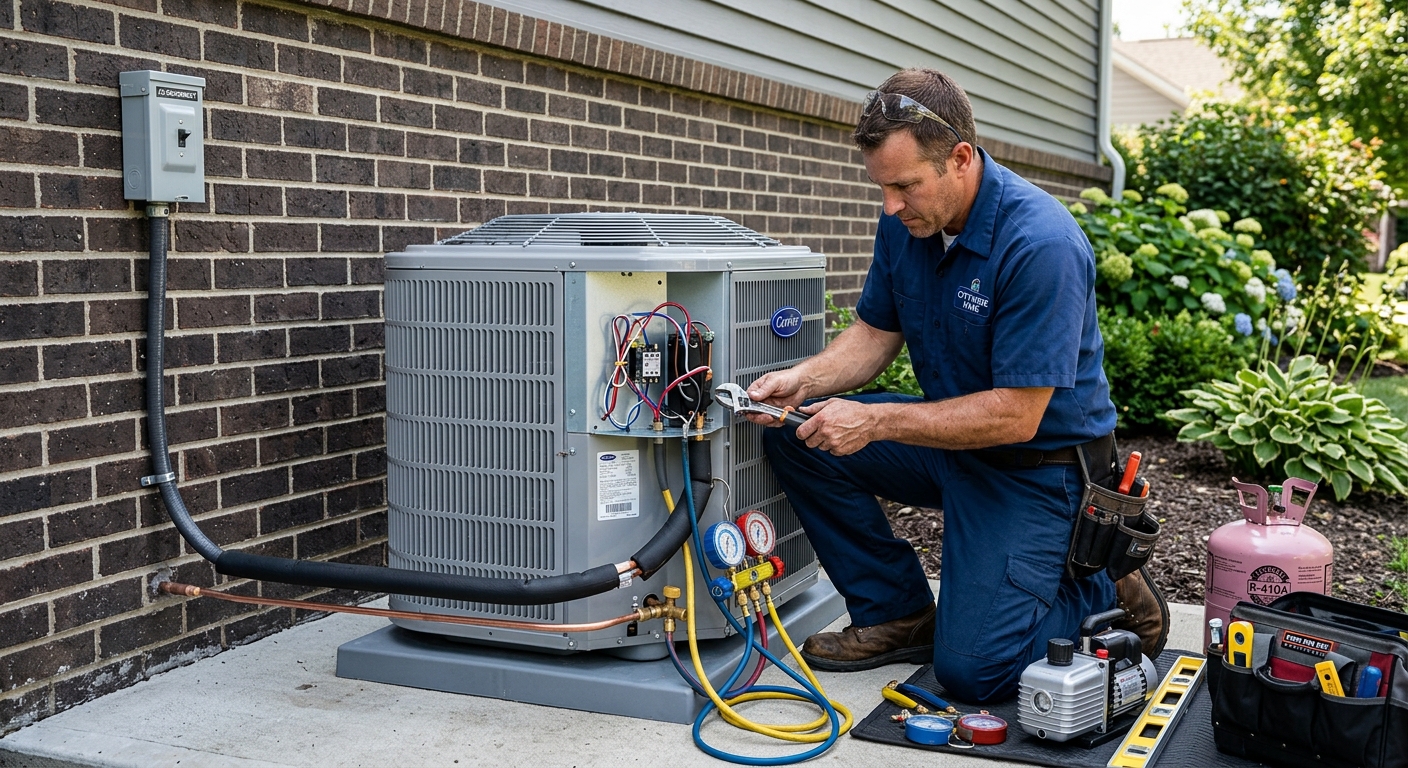
What a new HVAC system costs in Antrim
Antrim’s high rate of homeownership (87.6%) and the fact that over half of homes were built before 1980 (U.S. Census Bureau, ACS 2024) mean this is mostly a replacement market. Many homeowners here are dealing with legacy ranch and split-level layouts from the 1950–1980 housing boom, and it’s common to encounter aging ductwork that may need significant repair or modernization when replacing an HVAC system. This isn’t just an equipment swap—a lot of the total cost comes down to whether the ducts are sound, leaky, or missing entirely.
Franklin County’s south-central Pennsylvania climate is heating-dominated. We see about 5,200 heating degree days yearly, compared to just 1,250 cooling degree days, and winter design temperatures fall down to 12 °F. That puts far greater year-round load on your furnace or heat pump than your air conditioner. Upgrading just the AC may not make sense if your heating equipment is old, since those ducts and air handler almost certainly do “double-duty.”
Here’s a realistic estimate for installed HVAC systems in a typical Antrim home. The biggest cost factors: system size, ductwork condition, and whether electrical service needs updating. Manufacturer and brand play a smaller role than many assume.
| System |
Best for |
Efficiency |
Price range (installed) |
| Central AC replacement (existing ducts) |
homes with sound ductwork |
16–20 SEER2 |
$5,100–$12,000 |
| Air source heat pump (ducted) |
year-round heating and cooling |
8–10 HSPF2 |
$8,100–$17,500 |
| Cold-climate heat pump (ducted) |
heat pump as primary heat |
9–11 HSPF2 |
$13,000–$17,500 |
| Ductless mini-split (single zone) |
additions, rooms without ducts |
20–30 SEER2 |
$3,200–$7,100 |
| Full duct system installation |
homes with no existing ducts |
— |
$9,100–$18,500 |
Installed estimates for a typical Antrim home. Equipment tonnage, duct condition and electrical capacity move these more than brand.
The refrigerant change and what it means for repairs
As of 2025, all new residential HVAC systems manufactured for the U.S. use lower global-warming-potential (GWP) refrigerants—R-454B or R-32—instead of R-410A, as part of a national effort to phase down high-GWP HFCs. This has no impact on the legality or serviceability of your current R-410A system in Antrim, and there is absolutely no requirement to replace functioning equipment just because it uses an “old” refrigerant.
If you have a working R-410A heat pump or AC, you can continue to use it as long as parts and refrigerant remain available. For the foreseeable future, R-410A can still be purchased and used for servicing existing equipment. Where you’ll notice a change is in repair costs on anything with a significant refrigerant leak. As production and import of R-410A wind down, the price of recharging older systems will trend upward in Franklin County, shifting the math on whether to repair or replace if a major refrigerant-side repair is needed after 2025.
If your system is cooling or heating effectively and not leaking, there’s no economic or regulatory reason to replace it solely for refrigerant type. For installations after 2025, all new equipment will be factory-charged with the new refrigerants, requiring compatible tools and handling by certified technicians, but that’s an installer’s problem—not the homeowner’s. The bottom line: service what you have, but weigh the cost of major refrigerant repairs carefully from 2025 onward.
Gas, electric or both in south-central Pennsylvania
With a winter design temperature of 12 °F and 5,200 annual heating degree days in Franklin County, Antrim homeowners face a much stronger heating season than cooling. Old advice claimed electric heat pumps couldn't keep up, but recent cold-climate models now hold usable capacity well below freezing—though their efficiency drops as it gets colder. This means fully electric is more viable than ever, but system design must account for those rare sub-15 °F nights.
Whether it makes sense to install a heat pump, furnace, or both depends on your home’s access to fuel. In Chambersburg, Waynesboro, and Greencastle, natural gas is generally available through the local utility. In the rural parts of Antrim Township and surrounding Franklin County, propane and fuel oil are the norm. Where natural gas is absent, a heat pump looks far better: propane and oil are both expensive and fussier to maintain than a well-installed electric system.
Dual-fuel setups—pairing a high-efficiency heat pump with a gas furnace—remain a top choice where natural gas is available and deep freezes are a concern. For most homes with working gas and no ductwork problems, a furnace+AC package remains cost-effective, especially if high heating demand is coupled with aging ductwork benefitting from a full system replacement.
| Option |
Installed cost |
Operating cost here |
Best when |
Incentive eligible |
| Gas furnace + central AC |
$5,100–$12,000 |
lowest with utility gas |
existing gas service, coldest zones |
partial |
| Ducted heat pump (cold climate) |
$8,100–$17,500 |
moderate, lowest with good envelope |
good envelope, all-electric goal |
yes |
| Dual fuel (heat pump + gas backup) |
$13,000–$17,500 |
low, blends gas and electric |
gas on site, deep cold spells |
yes |
| Ductless multi-zone |
$9,100–$18,500 |
low per cooled area, highest comfort |
no ductwork, zone control |
yes |
Maintenance that actually extends system life
In Antrim’s heating-heavy climate, neglecting maintenance puts the biggest strain on equipment during deep winters and humid summers. Change your air filter every 1–3 months (or as needed) and match the MERV rating to your blower motor—too high a rating on an older blower can starve airflow and shorten system life. For most older ducted systems from the ranch and split-level era, a MERV 8–11 pleated filter balances capture and airflow.
Coil cleaning, inside and out, is worth doing every season—dust, pet hair, and Franklin County pollen all reduce heat transfer. Make sure the condensate drain is clear in spring and summer. When it comes to refrigerant, there’s no such thing as a “top-off”: if your system is low, it has a leak, and just adding refrigerant is not maintenance, it’s wasting money.
Annual service plans can be good peace of mind if they include a full cleaning, coil check, and real inspection—not just a check-up. Skip plans that only offer priority scheduling and a “quick look” for a premium. The best value comes in scheduling maintenance for early fall or mid-spring, before peak season hits and contractors in Antrim get booked out with emergency calls.
Permits, licensing and inspections in Antrim
Pennsylvania does not require a state-issued HVAC trade license for residential work. Instead, residential HVAC installation in Antrim falls under local regulation and enforcement. Contractors working on projects over $500 must carry Home Improvement Contractor (HIC) registration, which you can check online at the official state registry. You should also confirm your contractor’s workers’ compensation insurance using the WCAIS system.
The federal EPA Section 608 certification is required for any refrigerant handling, so always verify that the lead installer (not just the company owner) is certified. Municipal mechanical permits are standard for installs and replacements in most Franklin County municipalities. In the Borough of Chambersburg, a permit is almost always required for any central HVAC installation or replacement—other townships may have their own permitting processes or requirements, but all must follow the Pennsylvania Uniform Construction Code for residential work. Most simple filter changes and thermostat swaps proceed without permits outside municipal boundaries, but full system jobs do not.
After installation, a final municipal inspection ensures code compliance. When interviewing contractors in Antrim or greater Franklin County, ask exactly who pulls the permit and coordinates inspection—this question alone is a basic test of professionalism.
Running the numbers on Antrim's climate
To compare HVAC running costs in Antrim, you have to factor in Franklin County’s 5,200 heating degree days (HDD) and 1,250 cooling degree days (CDD), typical for south-central Pennsylvania where we see deep winter cold and warm, humid summers. Your actual annual expense depends on the efficiency of your equipment, your home’s insulation, and your utility’s rates—West Penn Power for electric and UGI Utilities for natural gas in many areas.
Here’s how to break it down: Each system’s efficiency rating (AFUE for furnaces, HSPF2 for heat pumps, SEER2 for AC) tells you the percent of fuel converted to heat or cooling. Multiply your home’s annual heating or cooling load (estimated using degree days, system capacity, and home size) by your local energy rate, which is found on your electric or gas bill.
For example, for heating: if your home’s heating load is 50 million BTU, with a 95% AFUE furnace, you’ll use about 52.6 million BTU of gas yearly (50 ÷ 0.95). For a heat pump with 9 HSPF2, delivering 9 BTU/watt-hour, you’d need about 5,555 kilowatt-hours yearly. Multiply by your electric rate—shown as “$/kWh” on your West Penn Power bill—to get the actual cost.
But energy cost arithmetic means little if your ductwork is leaky or undersized. A high-end heat pump strapped to 40-year-old ducts rarely outperforms a mid-grade furnace on new, tight ductwork. Operating cost math works when the distribution system and envelope aren’t sabotaging your equipment—so include duct and air sealing in your evaluation.
How to vet an HVAC contractor in Antrim
The make of your new furnace or heat pump matters less than the skill and attention to detail of the installer. In Franklin County’s moderate-density HVAC market, especially around Chambersburg and Antrim, your best bet is a contractor who documents and delivers a solid install—not just drops a box in your closet.
Here’s what to check: All residential contractors must have valid Home Improvement Contractor (HIC) registration (verify at the official portal). Confirm the company’s workers’ compensation insurance using the WCAIS database. Insist that the technician installing your equipment—not just the business owner—is EPA 608 certified for refrigerant handling. Prompt a quote that includes a load calculation (not a guess), and make sure equipment model numbers are provided, not just “3 ton, 16 SEER.” Ask about startup commissioning; you want measured airflow, checked refrigerant charge, and written test results, not just an installer’s word. Professional crews pull mechanical permits and coordinate final municipal inspections in Antrim and surrounding townships.
- Verify HIC registration at hic.attorneygeneral.gov
- Check workers' compensation insurance via WCAIS (wcais.pa.gov)
- Ask for EPA 608 certification—tech on-site, not just owner
- Require an in-home load calculation (not square footage guesswork)
- See equipment model numbers in your bid, not just system size
- Review the permit and inspection process—ask who handles paperwork
- Confirm ductwork inspection is included, if replacing the system
- Ensure refrigerant charge and airflow are measured (not just “set by feel”)
- Request a written commissioning report after install
- Get three references from local jobs (Franklin County preferred)
- Don’t pay 100% up front—schedule draws based on progress
- Look for warranty terms in writing, not just verbally promised
Red flags: a “too good to be true” low price in a market with moderate competition is rarely a bargain. Be cautious with contractors who dodge questions about load calculations, permits, or refuse to give references in or near Antrim.
Frequently asked questions — HVAC installation in Antrim
What is SEER2 and how is it different from SEER?
SEER2 is the updated efficiency standard for air conditioners and heat pumps, replacing the older SEER measurement as of 2023. Both measure how efficiently an air conditioner turns electricity into cooling, but SEER2 uses tougher, more realistic test procedures that better reflect typical ductwork and installation conditions—especially important for Antrim’s mix of older, sometimes leaky ducts. For example, a system rated at 20 SEER2 beats a 20 SEER system, because it’s tested under higher, real-world static pressure. These new standards mean equipment labeled at, say, 16–20 SEER2, such as those priced at $5,100–$12,000 for a central AC replacement here, will perform closer to published ratings in your actual Franklin County home. Bottom line: SEER2 makes “apples-to-apples” comparisons more meaningful for local buyers.
Is a high-efficiency system worth the extra cost here?
In Antrim, where our 5,200 heating degree days stack up a substantial winter load, a high-efficiency heat pump or furnace can often pay back its higher cost in fuel or electric savings. Especially if you’re upgrading from something built before 2000, new equipment with efficiency ratings like 9–11 HSPF2 or 95%+ AFUE is worth considering. Still, don’t pay top dollar if your ducts are old and leaky—a high-efficiency system strapped to bad ductwork won’t deliver savings. On average, replacing with a high-efficiency ducted heat pump runs $8,100–$17,500 installed. Whether it pencils out depends on energy prices, your home’s insulation, and getting the right size and commissioning. Ask your contractor to run actual cost comparisons based on your current energy bills—don’t buy just for the sticker stats.
Do older Antrim homes need ductwork replaced?
Over half of Antrim's homes were built before 1980, so many have decades-old ductwork that may be poorly sealed, undersized, or simply rusted out. While not all ductwork needs total replacement, a full inspection during HVAC replacement is strongly recommended. Sometimes, just resealing and minor fixes will do; in other cases, especially with systems from the 50s–70s ranch and split-level era, ducts are so corroded or inefficient that replacement makes sense. Full duct system installs typically run $9,100–$18,500 in Franklin County. Replacing or upgrading also lets you optimize for today’s equipment and airflow needs, which can lead to real energy and comfort gains.
Does my utility offer a heat pump rebate in Antrim?
West Penn Power, the primary electric utility serving Antrim, regularly runs incentives for high-efficiency heat pump installs through state energy programs, especially when replacing electric resistance, oil, or propane heat. Rebates and incentives change year by year, but recent programs have helped lower the upfront cost of systems in the $8,100–$17,500 range for ducted heat pumps or the $3,200–$7,100 range for ductless single zones. Always check both your utility’s and Pennsylvania’s statewide programs before signing a contract—your contractor should help with paperwork, but you can also check the utility’s website for “HVAC rebates” or call their customer service for the latest offers.
How often should I change my filter?
For most Antrim homes, changing your HVAC air filter every 1–3 months is the safest bet—especially in our heating-dominated climate where systems run long hours in winter. If you have pets, allergies, or live near fields (with dust or pollen blowing in), err toward monthly changes. Use a pleated filter with a MERV rating between 8 and 11 unless your installer recommends otherwise for your particular blower. A clogged filter forces your furnace or heat pump to work harder, potentially leading to breakdowns or reduced efficiency, even on equipment costing $13,000–$17,500. Mark your calendar and check during each season change—your system (and bills) will thank you.
How much does a furnace replacement cost in Antrim?
Replacing a gas furnace with matching central AC in Antrim generally runs $5,100–$12,000, depending on system size, ductwork needs, and local permitting. In rural townships without natural gas, switching to a heat pump or dual-fuel setup is more common, given the high price of propane or oil. Costs rise if your ductwork is in poor condition or needs replacing, sometimes pushing the total toward the upper end of the range. Always get a site-specific quote and ask for a breakdown of equipment, labor, ducts, and any required electrical or permit fees. A reputable local contractor will spell out each line item and tie the price to model numbers, not just a “one-size-fits-all” package.
How do I verify an HVAC contractor's insurance?
Homeowners in Antrim can—and should—verify that any HVAC contractor they hire carries up-to-date workers' compensation insurance, which is mandatory for all employers in Pennsylvania. Do this by searching the company name or policy number in the WCAIS online system (wcais.pa.gov). For bigger jobs over $500, also confirm Home Improvement Contractor (HIC) registration via hic.attorneygeneral.gov. Don’t just take verbal assurances or a paper certificate handed over at estimate time—insurance status can and does lapse, and reputable contractors will be happy to provide the documentation or links. It’s a critical check for any project, whether it’s a straightforward mini-split install at $3,200–$7,100 or a top-dollar ducted system upgrade.
Can a heat pump heat my house without backup?
In Antrim’s climate, a properly sized cold-climate heat pump can usually heat most homes for the majority of the winter, even with a design temp around 12 °F and 5,200 heating degree days per year. Modern units maintain surprisingly strong capacity down to 10–15 °F, and only drop off in the rare single-digit cold snaps. If your house is decently insulated and you select equipment with an HSPF2 rating near the top end of the scale (for example, a system in the $13,000–$17,500 range), backup heat may run only a handful of days per year. Still, most installs in Franklin County include electric strip or gas backup for peace of mind during those extremes. Don’t skip a full load calculation and envelope check when sizing for full-electric heat—it matters more than any brochure performance claim.
How far ahead should I schedule in Antrim?
Spring and fall are the best times to schedule HVAC installation or replacement in Antrim. If you call during July or January, when emergency calls spike during our hottest and coldest spells, you can easily wait weeks for reputable contractors who are already booked out. For a full central system or a ductless job in the $8,100–$17,500 range, aim for at least 2–3 weeks’ notice in off-peak months; add extra time if you’re also upgrading ducts. If you need heat in a hurry, some contractors offer emergency replacement, but you’ll have fewer choices and pay a premium. Plan ahead if you can, and you’ll have more leverage and a better outcome.