What a new HVAC system costs in Sharon
Sharon homeowners face a different HVAC landscape than newer suburbs. With nearly 95% of local homes built before 1980 and a homeownership rate just above half (U.S. Census Bureau, ACS 2024), the market here is mainly retrofit and upgrade, not new builds. That means most projects involve working around old construction and, often, outdated or undersized ductwork. Shenango Valley cities like Sharon and Farrell are known for their 1900–1950 housing stock, where ductwork may never have been installed for whole-home cooling, and what’s there likely wasn’t designed for today’s high-efficiency systems.
Heating and cooling needs swing hard to the heating side in Sharon: around 6,200 heating degree days versus just 800 for cooling. Winters matter more than summers for system selection and size. If your ductwork is in decent shape, replacing just the central AC or furnace can control cost, but many Sharon homes require duct upgrades or go ductless entirely for additions or upper floors. Costs move with the amount of retrofitting, duct repair, or electrical work your home needs.
| System |
Best for |
Efficiency |
Price range (installed) |
| Central AC replacement (existing ducts) |
homes with sound ductwork |
16–20 SEER2 |
$4,300–$10,500 |
| Air source heat pump (ducted) |
year-round heating and cooling |
8–10 HSPF2 |
$7,000–$15,000 |
| Cold-climate heat pump (ducted) |
heat pump as primary heat |
9–11 HSPF2 |
$11,500–$15,000 |
| Ductless mini-split (single zone) |
additions, rooms without ducts |
20–30 SEER2 |
$2,800–$6,100 |
| Full duct system installation |
homes with no existing ducts |
— |
$7,800–$15,500 |
Installed estimates for a typical Sharon home. Equipment tonnage, duct condition and electrical capacity move these more than brand.
Ductwork: the part nobody quotes properly
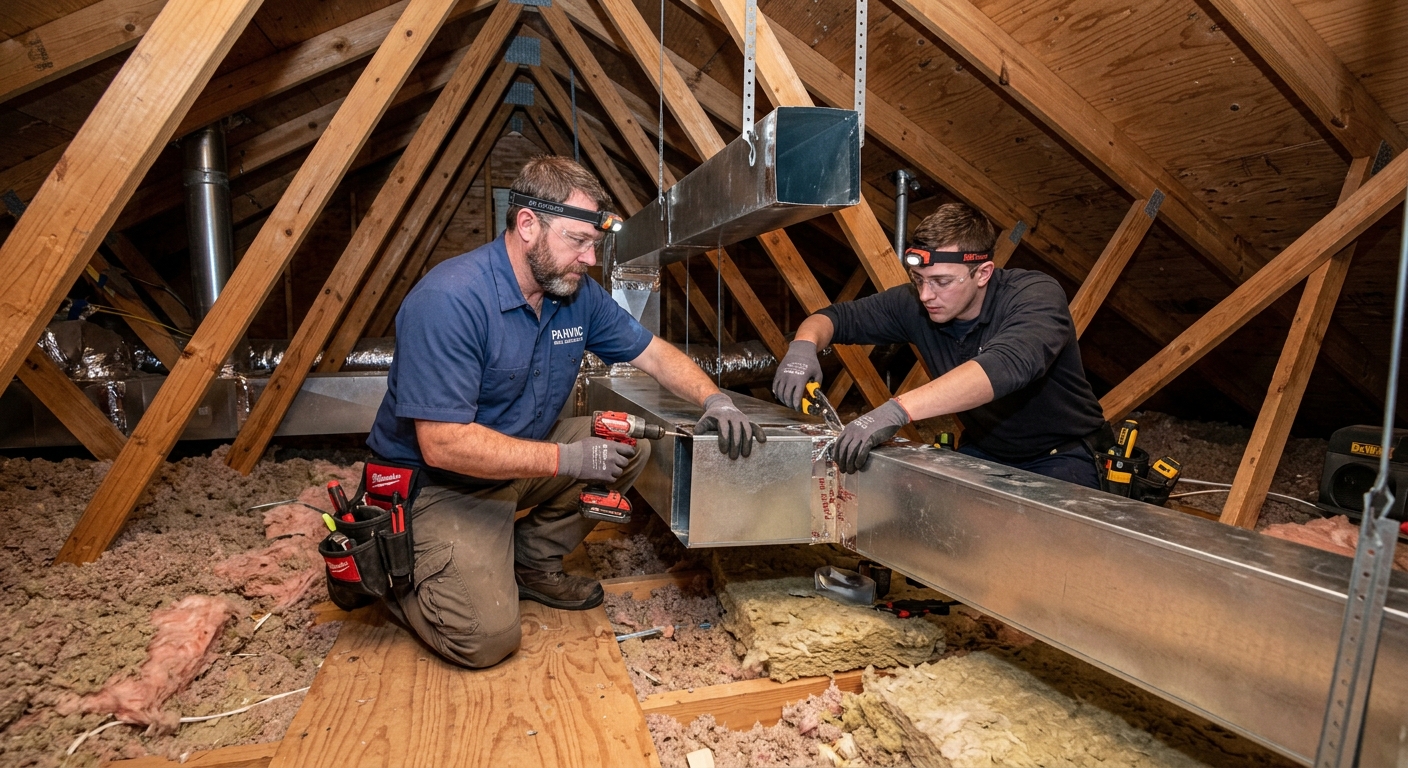
In Sharon and Farrell’s older homes, ductwork is rarely sized or sealed to modern standards. With nearly all houses built before 1980, it’s common to see supply and return ducts that were designed just for a gravity furnace or early forced-air system, or in some homes, no existing ductwork at all. Even where ducts are present, leakage is a massive hidden problem—field tests with a duct blaster often reveal 20–40% of conditioned air lost to the basement, attic, or crawlspace.
A duct blaster test measures exactly how leaky your duct system is using calibrated pressure. In Sharon’s housing stock, expect some combination of age, poorly joined segments, and unsealed grilles letting your heated or cooled air escape before reaching living spaces. Sealing with mastic or Aeroseal can close gaps, but crushed or undersized returns—common where systems were retrofitted—may need full replacement to fix airflow.
Duct runs through unconditioned spaces, like uninsulated attics and crawlspaces, are especially costly in the Shenango Valley climate. Cold winters turn these ducts into heat sinks, forcing your furnace or heat pump to work much harder.
Bottom line in Sharon: always test and assess your ducts before replacing equipment. Upgrading the system without addressing leaky or inadequate ductwork wastes your investment; you won’t get the comfort or efficiency you’re paying for. Test before you replace, not after.
The decision point on an aging system
Most of Sharon’s installed HVAC equipment serves well past the decade mark, thanks to the conservative approach many homeowners take. Whether you repair or replace should be a calculation, not a sales pitch. Start with age—if the system is under 10 years and the failure is a single part, repair almost always wins out. For systems 10–15 years old, if the repair cost approaches a third of a full replacement, look at the bigger picture: you may be pouring money into a unit with limited life left.
Efficiency claims pay back slowly here; Sharon’s heating-dominated climate means a 1–2 SEER efficiency gain on cooling alone rarely justifies replacement unless your system is ancient or runs constantly. Major repairs like a compressor or a cracked heat exchanger are the cutoffs: a failed compressor out of warranty or a heat exchanger crack means replace, not repair, for safety and cost reasons. For high bills on a working system, test your ducts and air sealing first—leakage is usually the culprit in our older homes.
| Situation |
Recommendation |
Typical cost |
Reasoning |
| Under 10 years, single component failure |
Repair |
$300–$1,200 |
Most parts are worth fixing; remaining life justifies the expense. |
| 10–15 years, repair over a third of replacement |
Consider replacing |
$4,300–$10,500 |
Costly repairs may not stretch system life far enough to be worth it. |
| 15+ years, any major failure |
Replace |
$4,300–$10,500 |
Replacement delivers better comfort and lower risk at this age. |
| Cracked heat exchanger, any age |
Replace immediately |
$4,300–$10,500 |
Dangerous: cannot be safely repaired, carbon monoxide risk. |
| Compressor failure past warranty |
Replace |
$7,000–$15,000 |
Main system engine failed; cost compares to full replacement. |
| Working system, high bills |
Test ducts and envelope first |
$300–$800 |
Leakage and insulation issues are common before equipment failure. |
What a real HVAC quote contains
If a contractor in Sharon hands you a quote that’s just a brand and a price, you can’t compare it to anything. A real HVAC proposal spells out exactly what’s included, line by line. Start with full model numbers for both the indoor (air handler or furnace) and outdoor unit—mismatched pairs won’t deliver their rated efficiency. The tonnage should be matched to a load calculation specific to your house, not just the size of your old system.
Details matter: does the quote include replacement or reuse of the line set? Has someone actually checked your electrical panel and circuits for code-compliant sizing? Is a new thermostat included? Labor warranty and factory warranty are not the same thing—look for both, stated in writing. In Sharon and Hermitage, a permit’s needed for central system replacement and should be priced in. Finally, commissioning: you should get a startup report showing pressures, measured airflow, and confirmation the system works as designed.
| Line item |
What to look for |
Red flag if… |
| Equipment |
model numbers, indoor and outdoor matched |
brand name only |
| Sizing |
load calculation attached |
matched to the old nameplate |
| Ductwork |
condition assessed, sealing scoped |
not mentioned |
| Electrical |
circuit and panel capacity confirmed |
assumed adequate |
| Line set |
replaced or documented as reused |
silent |
| Commissioning |
measured airflow and charge, documented |
no startup report |
| Warranty |
labour years stated separately |
manufacturer only |
| Permit |
included and priced |
'not needed' |
The refrigerant change and what it means for repairs
In Sharon, most residential air conditioning and heat pump systems installed over the past 15 years use R-410A refrigerant. New equipment is moving to lower global warming potential blends such as R-454B and R-32 with the federal phase-down of older HFCs. For homeowners, this means that while new systems now come with different refrigerants, your existing R-410A equipment can still be serviced—there’s no “ban” on use or repair.
R-410A supply will slowly tighten, pushing up refrigerant costs for repairs. If your system develops a major leak, the rising price of R-410A can tilt the balance toward replacement—especially if your system is already older. While top-offs and leak repairs remain legal and available, costs for significant recharge work will rise year by year.
Having a working R-410A system does not force you to replace your equipment. The phase-down changes only affect new systems and the future cost of repairs involving refrigerant, not the legality or safety of what’s in your home now.
Choosing an installer in Mercer County
In Mercer County, installation quality is what separates good HVAC outcomes from the expensive headaches—not brand. Even the best equipment performs poorly and is more prone to problems if it’s not installed and commissioned precisely. Don’t let a sales pitch about a nameplate sway you; focus on the company’s process and documentation.
Ask for their Pennsylvania Home Improvement Contractor (HIC) registration and look it up yourself. Only give the contract to an installer who can prove their techs hold EPA Section 608 certification for refrigerant handling. Load calculations, matched model numbers, and documented commissioning are all minimum requirements. Don’t be shy about asking for copies of their workers’ comp insurance from WCAIS.
- Verify Home Improvement Contractor (HIC) registration at hic.attorneygeneral.gov
- Check EPA 608 certification for techs doing refrigerant work
- Request proof of workers’ compensation via WCAIS (wcais.pa.gov)
- Quote must show equipment model numbers (not just tonnage or brand)
- Complete load calculation specific to your house
- Ductwork inspection and leakage testing documented
- Electrical panel and circuits checked for capacity
- Line set replacement addressed in writing
- Permit included for central system replacement
- Startup commissioning documented: measured airflow and charge
- Separate labor warranty period in writing
- Full written contract per HICPA for projects over $500
Red flags in the Shenango Valley market? If you get a one-page quote with only a brand, model, and price—and nothing on duct condition, panel sizing, or labor warranty—keep shopping. Moderate market density in areas like Sharon means you have options and shouldn’t settle.
Permits, licensing and inspections in Sharon
Pennsylvania doesn’t issue statewide trade licenses for HVAC contractors. Instead, contractors working on residential systems must have a Home Improvement Contractor (HIC) registration from the Pennsylvania Office of Attorney General for jobs over $500. There’s no statewide HVAC license; registration plus a mechanical permit and inspection through your local municipality (such as Sharon, Hermitage, or another township code office) are what’s required for installs and replacements.
Anyone handling refrigerant is required—across all of Pennsylvania—to hold EPA Section 608 certification. That’s a federal requirement and has nothing to do with local licensing. For central system installation in Hermitage, a mechanical permit must be pulled. In Sharon, minor thermostat replacements or filter changes don’t require a permit, but anything beyond that likely does.
Contractors must carry workers’ compensation insurance for all employees. Pennsylvania’s system for verification is WCAIS (wcais.pa.gov), and it’s fair to ask to see documentation. Homeowners also benefit from the written contract and cancellation protections under the state’s Home Improvement Consumer Protection Act (HICPA)—this makes your sale enforceable and safe.
Frequently asked questions — HVAC installation in Sharon
What does HSPF2 measure?
HSPF2 stands for "Heating Seasonal Performance Factor 2" and it’s a rating that tells you how efficiently a heat pump provides heat over an entire heating season. In northwestern Pennsylvania, including Sharon, this matters because we have around 6,200 heating degree days, so the system is working under heavy load. Higher HSPF2 means you’ll use less electricity for the same amount of heat. Most air-source heat pumps sold here fall in the 8–11 HSPF2 range. Keep in mind, a ducted air-source heat pump installation in Sharon typically runs $7,000–$15,000, and higher efficiency units may cost a bit more up front but do better during our cold winters. If you’re weighing heat pumps, ask which HSPF2 rating you’re actually getting before you sign.
What is EPA Section 608 certification?
EPA Section 608 certification is a federal credential required for anyone who installs, repairs, or services HVAC equipment that could release refrigerants into the atmosphere. In Sharon and throughout Pennsylvania, no state trade license exists for HVAC, but the tech swapping your AC or heat pump must have Section 608 for refrigerant handling. This protects both homeowners and the environment, since leaking refrigerant is harmful and illegal. Always ask if the tech on your project—not just the company owner—holds an active 608. A responsible installer in Sharon will have no trouble showing it. You’re paying good money (often $4,300–$10,500 just for a central AC upgrade) so make sure it’s done legally.
Do I need dual fuel in northwestern Pennsylvania?
Dual fuel means combining a heat pump with a furnace, letting each system operate when it’s most efficient. Sharon sees winter design temperatures down to 5°F and is firmly a heating climate, so a dual-fuel setup often makes sense if you have existing gas service (natural gas is widely available in Shenango Valley cities). Cold-climate heat pumps do well now, but most still lose efficiency below 15–20°F. A dual fuel system is pricier up front (upwards of $11,500–$15,000 installed if you’re replacing everything), but can trim bills on the coldest nights. If you’re all-electric or without gas, a standalone heat pump is the next best fit, but double-check its capacity at low temperatures.
Does my utility offer a heat pump rebate in Sharon?
Sharon is served by Penn Power, part of FirstEnergy’s utilities, but available rebates and program details change often. As of now, most rebates in Pennsylvania are run seasonally or through state programs. Some deals may be available for high-efficiency heat pumps (usually 15 SEER2 and above) and ductless mini-splits. Keep documentation of your system’s model number and efficiency ratings, and have your contractor fill out all the paperwork. The best rebates seldom pay back more than a small slice of your total install bill—a typical ductless mini-split, for example, is $2,800–$6,100 installed, and rebates might cut off a few hundred dollars. Always check with Penn Power directly or the state before buying based on rebate promises.
How much does a furnace replacement cost in Sharon?
Furnace-only replacements are common in Sharon's older homes—especially those with ductwork that was sized for a standard forced-air system. What moves the cost most is the condition of your ducts, the efficiency of the furnace, and any electrical or venting upgrades needed. For a full central HVAC replacement (which often includes a furnace and new AC or coil), you’re generally looking at $4,300–$10,500 installed. A basic furnace-only swap is at the lower end, unless there are major code or venting issues in your home. Always get a detailed quote so you aren’t surprised by extra cost for duct or electrical fixes.
Is an annual maintenance plan worth it?
For most Sharon homeowners, signing up for an annual HVAC maintenance plan can be a good value—especially given our severe winters. Old systems, which are common here with nearly 95% of homes built before 1980, benefit from pre-season checks for safe ignition, airflow, and refrigerant charge. A typical maintenance plan often runs under $300–$800 per year and may save you from much costlier repairs down the road. And for the many local homes with older or leaky ductwork, routine tune-ups can catch and address airflow problems before they balloon. Look for a plan that covers both heating and cooling seasons, and ask if emergency visits are included.
What is commissioning and why does it matter?
Commissioning means the installer doesn’t just drop in a new HVAC system and hope it works—they actually measure performed airflow, refrigerant charge, and system start-up to verify everything matches the manufacturer spec. In Sharon’s older, leaky houses, this step is even more important—if the installer skips commissioning, low airflow or botched refrigerant levels can sabotage comfort and waste your investment. A real commissioning report holds the installer accountable and is particularly important when you’re spending $7,000–$15,000 on a new heat pump or central system. Don’t sign off unless you receive this documentation.
How much does a new HVAC system cost in Sharon?
Total system prices in Sharon move with home age and ductwork. For a typical central air conditioner replacement using your home’s existing ducts, expect $4,300–$10,500 installed. If you add a full duct system (common with Sharon’s older homes that lack any ductwork) or go with a ducted heat pump, installed costs can reach up to $15,500. Ductless mini-split solutions run lower per zone but add up for multiple rooms. The biggest cost drivers here are patching or replacing ductwork in 1900–1950 era homes, plus anything electrical. Get several site visits and written quotes before choosing.
Is natural gas available throughout Mercer County?
Not everywhere, but it is widespread in urban Sharon and neighboring Shenango Valley towns like Hermitage and Farrell. The main local gas provider is Columbia Gas of Pennsylvania. If you live in the core cities, you likely have service; if you’re in one of Mercer County’s more rural townships, propane or oil is a lot more common. The widespread availability of natural gas in Sharon keeps installation costs for dual fuel and gas furnace systems down, making replacements (often $4,300–$10,500 installed) more straightforward. If you’re not sure about your address, call the utility before planning a new HVAC project.