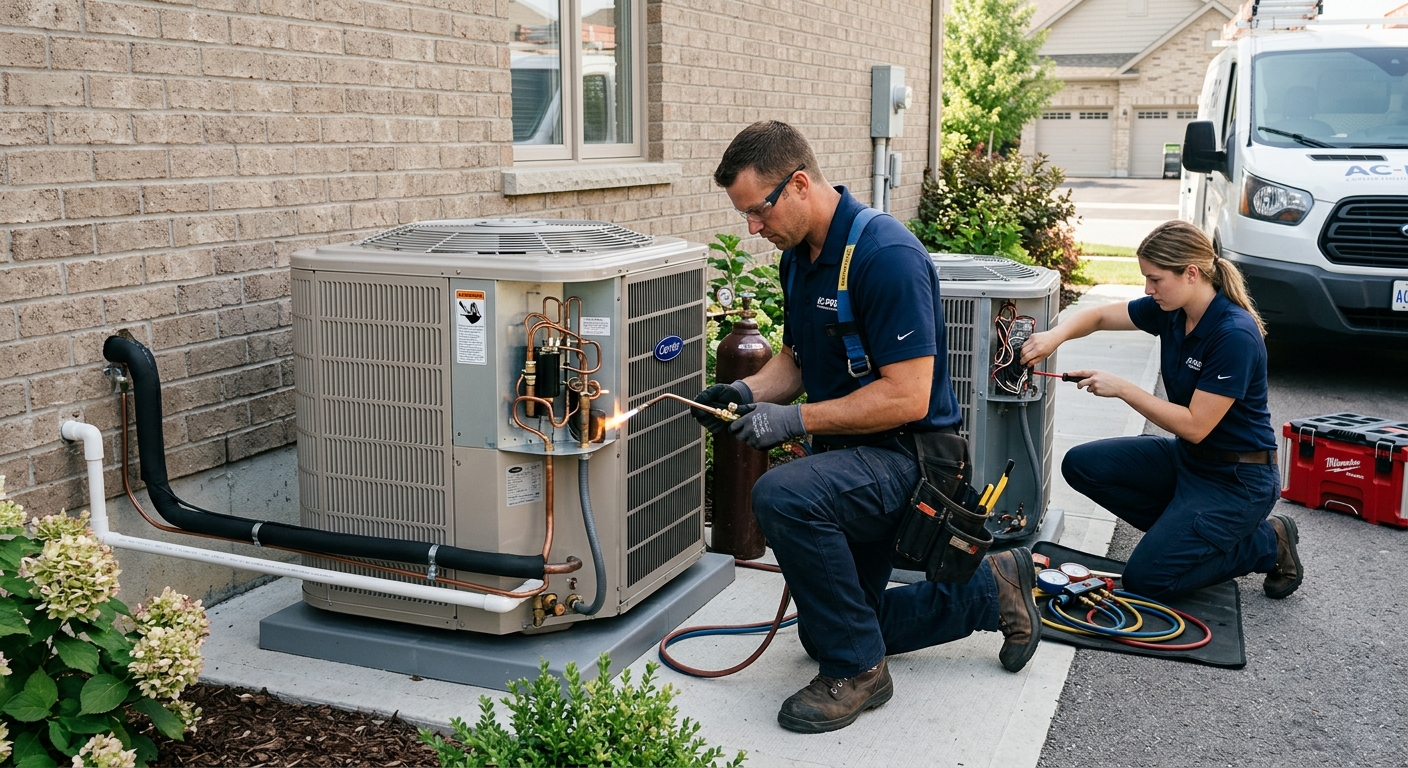
Tredyffrin heating and cooling prices by system type — 2026
Tredyffrin is squarely in a replacement market for HVAC systems. With a homeownership rate of 74.7% and 63.4% of homes built before 1980 (U.S. Census Bureau, ACS 2024), most homes here already have forced-air central systems that are now reaching the end of their service life—especially in large Tredyffrin subdivisions built between the 1970s and 2000s. As a result, the most common projects involve replacing aging central air conditioners or updating older furnaces and heat pumps, often reusing existing ductwork if it's still sound.
This part of Chester County experiences about 4,800 heating degree days versus only 1,450 cooling degree days a year. That means heating equipment does the lion’s share of the work, so efficiency and system sizing for winter matter more here than in places where AC runs for half the year. However, with humid summers, reliable, efficient cooling still matters.
| System |
Best for |
Efficiency |
Price range (installed) |
| Central AC replacement (existing ducts) |
homes with sound ductwork |
16–20 SEER2 |
$6,200–$15,000 |
| Air source heat pump (ducted) |
year-round heating and cooling |
8–10 HSPF2 |
$9,900–$21,000 |
| Cold-climate heat pump (ducted) |
heat pump as primary heat |
9–11 HSPF2 |
$16,000–$21,000 |
| Ductless mini-split (single zone) |
additions, rooms without ducts |
20–30 SEER2 |
$3,900–$8,600 |
| Full duct system installation |
homes with no existing ducts |
— |
$11,000–$22,000 |
Installed estimates for a typical Tredyffrin home. Equipment tonnage, duct condition and electrical capacity move these more than brand.
Operating cost, not sticker price
The sticker price of a new HVAC unit only tells half the story. In a climate like Tredyffrin’s—with 4,800 heating degree days and a winter design temperature of 14 °F—your ongoing utility bills matter even more. Here’s how you actually compare operating costs:
First, efficiency ratings (like SEER2 for cooling or HSPF2 for heat pumps) tell you how much energy your unit uses to produce heating or cooling. Next, you take Chester County’s climate data—the number of degree days—to estimate how much heating or cooling your house will need in a typical year. The bigger the gap between outdoor and indoor temperatures, the more your system runs.
Finally, multiply the expected kilowatt-hours (for electric heat pumps or AC) or therms (for gas furnaces) by your actual utility rate. In Tredyffrin, PECO Energy provides both electric and natural gas service in most neighborhoods. You’ll find your specific $/kWh or $/therm clearly listed on your utility bill.
For example, let’s say a 3-ton heat pump with 9 HSPF2 is rated to deliver 24,000 BTUs per hour. If your home needs 32,000,000 BTUs over a winter (using the 4,800 heating degree days and a sizing calculation), you’d divide annual load by efficiency to estimate the kWh usage. Then multiply by your PECO rate.
But here’s the catch: if your ductwork leaks, is poorly insulated, or sized incorrectly, even the most efficient unit wastes energy. Duct leakage can easily cancel out the gains from a more efficient system. Don’t upgrade equipment without addressing the ducts—you’ll pay for the sticker, but not get the savings.
Reducing the net cost of a Tredyffrin installation
The price tag on a new HVAC system isn’t always what you actually pay. For Tredyffrin homeowners, incentives can make a noticeable difference if you know where to look, but they work in layers and most change yearly.
First, federal tax credits for high-efficiency heating and cooling equipment let you claim a portion of your cost as a direct credit on your IRS return the following year. This means you pay the full invoice upfront and then reduce your tax owed later.
Second, utility rebates—often offered by PECO Energy for both electric and natural gas customers—reduce your out-of-pocket costs at the time of purchase or shortly after installation. Unlike tax credits, rebates typically arrive as a check or bill credit within weeks or months.
Third, some state-level efficiency incentives may apply, depending on the year. Because there’s no single, permanent Pennsylvania program named in the facts above, the best step is to check PECO’s current energy efficiency offerings on their own website and use the ENERGY STAR rebate finder for up-to-date national and local deals.
Be aware: these programs can change from year to year, and any figure in an article is only a ballpark. Always verify rebate or tax credit details directly before signing a contract—there’s no harm in asking your contractor for written details, but the final approval comes from the program, not your installer.
What a Pennsylvania HVAC contractor must hold
Pennsylvania does not issue a statewide HVAC trade license for residential jobs. Instead, HVAC contractors must hold a Home Improvement Contractor (HIC) registration for projects over $500. This is managed at the state level by the Office of Attorney General—but enforcement, and any extra licensing beyond this, is handled locally by each municipality. In Chester County, towns like Tredyffrin and West Chester run their own mechanical permit programs when you install or replace central HVAC systems.
No matter what, any technician working with refrigerant must have EPA Section 608 certification. This is a federal requirement and applies to all contractors, regardless of local rules.
Permits for HVAC replacement or new installation are usually handled by the code office in your specific municipality. Inspections focus on energy code compliance and safety.
You should verify a contractor’s HIC registration at hic.attorneygeneral.gov before you sign a contract. For insurance, ask for their certificate of insurance and check workers’ compensation status via the WCAIS system (wcais.pa.gov). Never work with anyone who can’t provide these verifications up front, regardless of referral or reputation.
Maintenance that actually extends system life
Most HVAC service contracts bundle in things you could do yourself, then up-sell “tune-ups” you might not need. Here’s what actually pays off for Tredyffrin systems:
First: change your filter regularly, using the right MERV rating. Too restrictive a filter can choke airflow in older systems, so don’t just buy the highest MERV you see—check your blower’s specs. For most homes, every 2–3 months is right, but check monthly in seasons of heavy use.
Second: ensure annual coil cleaning and that the condensate line flows freely. Dirt buildup on indoor or outdoor coils lowers efficiency—and in our humid summers, a clogged condensate drain can mean water backups.
Third: check refrigerant charge. Don’t let anyone top up “just because.” A system that’s low has a leak, and adding refrigerant without fixing the leak is not maintenance—it’s papering over a real problem.
Service plans are worth it only if they actually include priority scheduling, verified cleaning, and a documented check—not just a filter swap. Avoid paying for “plans” that only add up to a phone reminder. Schedule maintenance in early spring or early fall, ahead of the peak heating and cooling rush in Tredyffrin, so you aren’t stuck waiting during emergencies.
Manual J and the tonnage question
If a contractor gets one thing wrong on your Tredyffrin HVAC install, it’s usually sizing. Oversized systems short-cycle, fail to dehumidify in our humid summers, and wear out early. An oversized unit is not “safer” or “better”—it just means more breakdown calls and uncomfortable rooms.
The right way to size is by running a Manual J load calculation, which accounts for wall construction, windows, insulation, orientation, and those critical climate numbers—like our winter design temperature of 14 °F. This calculates the actual BTU demand so the system matches your house, not a rule of thumb.
Simply swapping in whatever size is on your old nameplate just forwards someone else’s mistake. And square-footage rules (like 1 ton per 500 sq ft) aren’t good enough for Chester County’s housing stock, where insulation and envelope tightness can vary a lot even in homes built the same year.
The question to ask any bidder: “Did you do a Manual J load calculation, and can I see it?” A real pro will show their work. Don’t settle for guesswork—it’s the difference between comfort (and lower energy bills) and years of frustration.
How to vet an HVAC contractor in Tredyffrin
Installation quality matters much more than equipment brand for a Tredyffrin home. Given the suburban Philadelphia market’s density, you’ll have no shortage of bids, but the right checks make all the difference in performance and longevity.
Always verify a contractor’s Home Improvement Contractor (HIC) registration at the Attorney General’s website and insurance, including workers’ comp, at WCAIS. The technician handling refrigerant must have EPA 608 certification. Good firms include a Manual J load calculation, list exact model numbers on their quote, and commission the system—meaning they test and document airflow and refrigerant charge after installation.
- Check HIC registration at hic.attorneygeneral.gov
- Verify insurance and workers’ compensation via WCAIS (wcais.pa.gov)
- Ask if the installer is EPA 608 certified
- Request a Manual J load calculation in writing
- Ensure all equipment model numbers are listed in the proposal
- Review warranty terms (parts and labor, not just equipment)
- Ask about permitting and code compliance for your Tredyffrin municipality
- Confirm a duct inspection or pressure test (not just a visual check)
- Get detailed commissioning documentation (airflow, charge, static pressure)
- Read recent reviews from Tredyffrin or Chester County customers
- Require written contract—avoid handshake deals over $500
- Don’t pay large deposits up front—10% or less is standard for reputable firms
Red flags: In the densely competitive Chester County market, anyone who pushes a specific brand without considering your home’s needs, can’t show licensing or insurance, or gives an instant “same-day” tonnage quote has likely cut corners elsewhere. Invest time here up front—it pays off in years of comfort.
Frequently asked questions — HVAC installation in Tredyffrin
How do I verify an HVAC contractor's insurance?
You can verify a Tredyffrin HVAC contractor’s insurance in two steps. First, always ask for a current certificate of insurance, which should list both liability and workers’ compensation coverage. Don’t just look at a copy—contact the insurer directly and confirm the policy is still active for the coverage period that includes your project. Second, Pennsylvania provides an extra layer of insurance verification for workers’ compensation: check the contractor’s status using the WCAIS website (wcais.pa.gov). Any legitimate HVAC contractor working on installations—especially those that cost upwards of $6,200–$21,000—should have this available and encourage you to check. Never hire a contractor unwilling to provide proof or who hesitates when you ask for verification; in a competitive area like Chester County, you have other options.
Is a heat pump a good choice for Tredyffrin winters?
Heat pumps are increasingly popular in Tredyffrin because modern models—especially cold-climate versions—can handle our winter design temperature of 14 °F. The balance is always about efficiency versus performance on the coldest days. A well-sized, properly installed cold-climate heat pump can provide year-round comfort with operating costs that often beat resistance electric or fuel oil. That said, if your home is older and loses heat quickly, or if existing ducts are poorly insulated, you’ll lose efficiency gains. Expect a quality heat pump installation to run $16,000–$21,000 for a cold-climate, ducted system. Confirm your ductwork’s condition and expect your contractor to perform a Manual J calculation before making the switch.
Is an annual maintenance plan worth it?
In Tredyffrin, an annual maintenance plan can be worth it—but only if the plan includes actual preventive work: filter replacement, coil cleaning, and a full check on refrigerant pressures and airflow. Programs that only remind you when it’s time for a checkup, or exclude emergency diagnostics, don’t add much value for the typical installation that falls in the $6,200–$21,000 range. Instead, look for a plan that clearly lists covered services and discounts on repairs, and locks in pricing. Skip plans that promise “priority” but bury necessary cleaning behind extra upcharges. In our climate, scheduling maintenance in early spring or early fall maximizes value—otherwise, you’re paying to wait in line when service call volume spikes.
Why do HVAC quotes in Tredyffrin vary so much?
HVAC quotes in Tredyffrin can seem all over the map—ranging from about $3,900 for a single-zone mini-split up to $22,000 for a full new duct system installation. Several factors drive this: the condition and layout of your existing ductwork, the need for electrical upgrades, system size (tonnage), and how much actual commissioning/adjustment is included post-installation. Some contractors skip crucial steps like proper load calculations or duct sealing, which makes their bid look cheaper but costs you in the long run. Brand matters less than workmanship and follow-through. Always compare apples to apples—a lower price may mean corners are being cut.
Can I service my R-410A system after the refrigerant change?
Yes, Tredyffrin homeowners with R-410A systems can still have service and repairs done after recent federal refrigerant changes. Technicians with EPA 608 certification are allowed to service and recharge R-410A equipment; supplies remain available even as new systems transition to lower-GWP refrigerants. Upgrades or replacements may be needed as the refrigerant rules evolve, but don’t let anyone pressure you into a new system “because your old one can’t be serviced.” Normal repair and maintenance costs—the kind associated with systems installed in the $6,200–$8,600 range for mini-splits, for example—should remain stable for several years yet.
When is the best time of year to replace HVAC in Tredyffrin?
For Tredyffrin homeowners, the sweet spot for HVAC replacement runs from March to early May, or September to early November. Contractors aren’t swamped with emergency calls, and you’ll find faster scheduling and sometimes better pricing—for instance, a well-timed central AC replacement (using existing ducts) at $6,200–$15,000 can mean less downtime. Fall installs let you get heating set for winter before the first freeze triggers a service rush, while spring lets you prepare for our humid summers. Avoid peak demand periods—if you wait until a heat wave or cold snap, schedules fill up and prices can creep up too.
Which utility serves Tredyffrin?
Most of Tredyffrin, along with the majority of Chester County, is served by PECO Energy for both electricity and natural gas. That means any new HVAC install—whether a heat pump, air conditioner, or gas furnace—will use their delivery and billing network. This is important for rebates and rate calculations; PECO’s efficiency programs also affect the net price (say $9,900–$21,000 for ducted heat pumps) and can sometimes nudge you toward more efficient models. If you’re in a rural section of the outer county, propane or heating oil may still be the default, but in Tredyffrin proper, PECO covers both utilities.
Are duct sealing and insulation eligible for incentives?
Duct sealing and insulation improvements frequently qualify for both utility rebates and federal tax credits—but the exact amount changes year by year and by utility. For example, Tredyffrin homes with older, leaky ductwork may bring in rebates when these upgrades are paired with a system replacement in the $11,000–$22,000 band for new duct installations. Your best bet is to visit PECO Energy’s efficiency program webpage and the ENERGY STAR rebate finder for program details before work begins. These improvements are among the best investments for comfort and bill reduction in Chester County’s 1970s–2000s housing stock, so ask your contractor for documentation and include this paperwork in your rebate claim.
How much does a new HVAC system cost in Tredyffrin?
The price for a new HVAC system in Tredyffrin varies widely by scope. Replacement of a central AC unit using existing ductwork will typically run $6,200–$15,000, while a full ducted air source heat pump is in the $9,900–$21,000 range. A single-zone ductless mini-split starts at $3,900, making it cost-effective for additions or problem rooms. If you’re installing a whole new duct system in a previously unducted older home, expect $11,000–$22,000. Prices move up or down based on system size (tonnage), the condition of your ductwork, and any needed electrical upgrades—not just equipment brand.