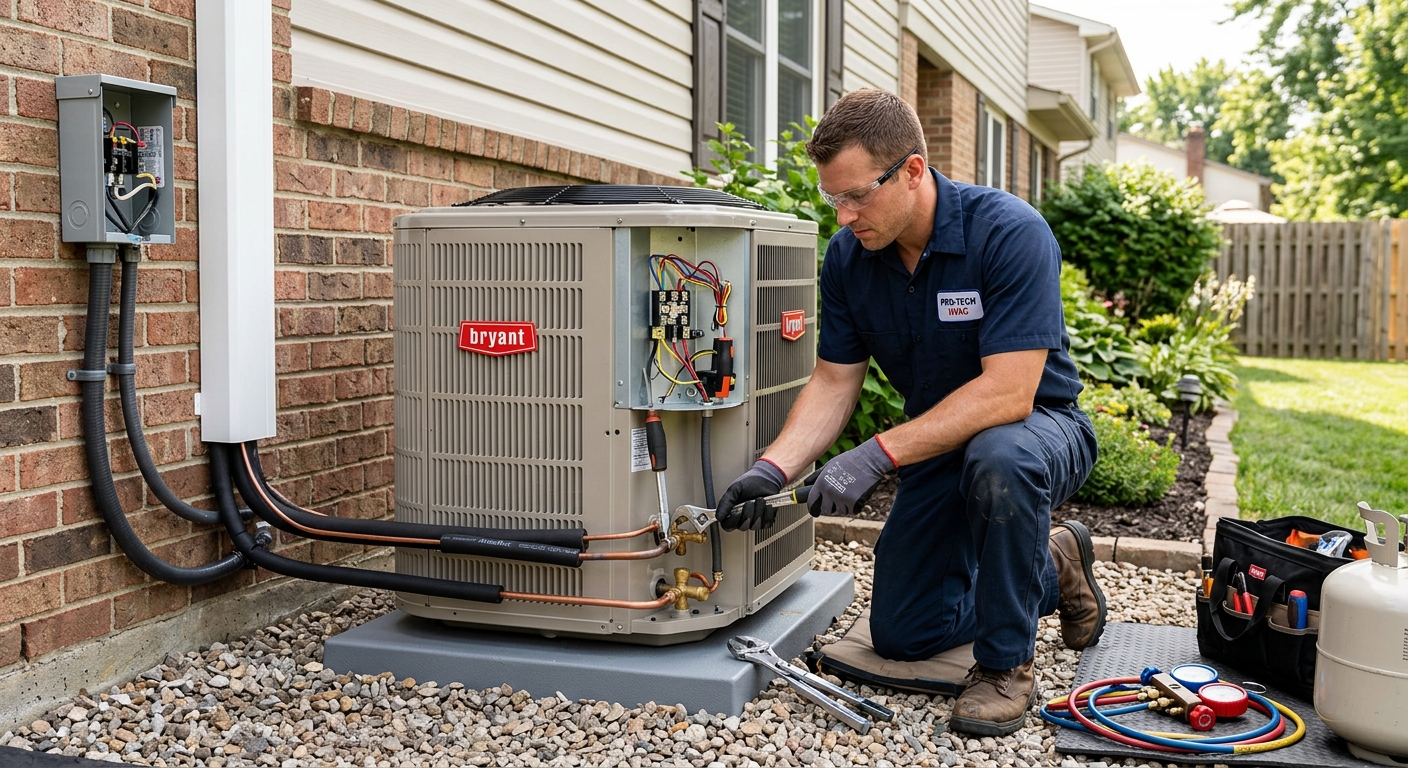
West Manheim heating and cooling prices by system type — 2026
West Manheim’s homeowners are mostly living in single-family properties, with a homeownership rate over 90% and nearly 29% of the area’s houses built before 1980 (U.S. Census Bureau, ACS 2024). That’s telling: most homes here have existing central systems ready for replacement, but a healthy share were built before modern ductwork was standard. While many suburban homes have ducts suitable for new high-efficiency central AC or heat pumps, some older properties—especially those without full basements or with tighter framing—may need new ductwork or benefit from ductless mini-splits. If you’ve got older ductwork, it often wasn’t sized for air conditioning, so comfort and efficiency can suffer when simply swapping equipment.
With 5,200 heating degree days and only 1,250 cooling degree days in south-central Pennsylvania, this is a heating-driven market. Heating capacity and reliability matter far more here than in states south of the Mason–Dixon line. Cooling is essential during our muggy summers, but your payback on high-end cooling efficiency will never match what heating improvements can return in the winter. In York City, older pre‑1940 rowhomes often can’t accept new ducts, which is why ductless and high-velocity retrofits are popular for modern cooling there.
| System |
Best for |
Efficiency |
Price range (installed) |
| Central AC replacement (existing ducts) |
homes with sound ductwork |
16–20 SEER2 |
$5,200–$12,500 |
| Air source heat pump (ducted) |
year-round heating and cooling |
8–10 HSPF2 |
$8,300–$17,500 |
| Cold-climate heat pump (ducted) |
heat pump as primary heat |
9–11 HSPF2 |
$13,500–$17,500 |
| Ductless mini-split (single zone) |
additions, rooms without ducts |
20–30 SEER2 |
$3,300–$7,300 |
| Full duct system installation |
homes with no existing ducts |
— |
$9,300–$18,500 |
Installed estimates for a typical West Manheim home. Equipment tonnage, duct condition and electrical capacity move these more than brand.
Service plans: worth it or not?
In West Manheim, the value of a service plan depends on what’s actually included versus what gets pitched. Don’t pay extra for a plan if you or a trusted local tech are already on top of the basics: changing filters at the proper interval (typically every 60–90 days for standard systems, more often if you have pets or allergies), using the right MERV rating for your blower, keeping both the indoor and outdoor coils clean, and ensuring the condensate line isn’t blocked. Annual coil cleaning and checking the drain may cost less in the long run than a subscription if your system is accessible and in good shape.
Any service plan worth the money should include a test of refrigerant charge—never just a “top off.” If your system needs more refrigerant, you have a leak that needs repair, not a fill-up. Plans that push unnecessary “tune-ups,” upsell duct cleaning, or require long contracts often aren’t a wise use of money.
Our busiest seasons for HVAC emergencies are the first hot spell of May and right before Thanksgiving. Schedule maintenance in early spring or early fall so you’re not stuck waiting behind emergency repairs when summer or winter hits. For most homeowners, a careful one-time inspection by a seasoned contractor is better than locking into a plan that covers what you can do yourself.
Permits, licensing and inspections in West Manheim
Pennsylvania does not have a statewide HVAC license for residential contractors. Instead, West Manheim—as part of York County—follows the Pennsylvania Uniform Construction Code (UCC) for residential HVAC work, with code enforcement handled directly by the township or city where you live. That means contractors only need to register as Home Improvement Contractors (HIC) with the Pennsylvania Office of Attorney General for jobs over $500, not hold a trade license. You can and should verify a contractor’s HIC registration at hic.attorneygeneral.gov before signing a contract.
Anyone handling refrigerant must hold federal EPA Section 608 certification, which applies no matter what Pennsylvania law says. Local governments in York County typically require mechanical permits (and inspections) for installing or replacing central HVAC equipment—but minor changes like swapping a thermostat or window AC don’t usually require a permit. Call your township code office to check for sure.
Insurance and workers’ compensation can be verified through WCAIS at wcais.pa.gov. Proof of workers’ comp is mandatory for any employer in this market, not just for some trades. Don’t settle for a handshake—always request proof.
Rebates and tax credits for West Manheim homeowners
There are three major ways to reduce the out-of-pocket cost of a new HVAC system in West Manheim: federal tax credits, utility rebates, and periodic state or manufacturer initiatives. Here’s how each works:
- Federal tax credits lower your income tax due the following year by a set amount for qualifying energy-efficient upgrades, such as high-efficiency heat pumps or advanced central air. You’ll pay up front and see the benefit when you file taxes.
- Utility rebates—primarily through Met‑Ed for electricity and Columbia Gas of Pennsylvania for gas—can lower your invoice at the point of sale or through a check in the mail. These typically require the equipment to meet efficiency standards and be installed by a qualifying contractor.
- State and manufacturer programs exist, but they change annually; don’t bank on a specific rebate being available for months at a time.
Because rebate names, qualifying equipment, and amounts change regularly, your best sources are your utility’s energy efficiency program webpage and the ENERGY STAR rebate finder. Don’t trust any article for an up-to-date dollar amount—it’s a moving target. Always confirm offers directly at the time you’re ready to buy, and remember: a rebate comes off the invoice, a tax credit comes off next year’s taxes.
Separating installers from equipment sellers
In West Manheim, installation quality matters more than brand. The same equipment can run quietly and efficiently for decades—or rack up repair bills in its first year—depending on the care and skill of the crew doing the install. Here’s how to separate real pros from just “box swappers” or product pushers:
- Check HIC registration at the state site (hic.attorneygeneral.gov).
- Verify the technician handling refrigerants holds EPA Section 608 certification.
- Get written proof of insurance and workers’ compensation (WCAIS).
- Ask if a Manual J load calculation is included, not just a rule-of-thumb sizing based on square footage.
- See if equipment model numbers—not just tonnage—are on your quote.
- Demand a written scope: includes permits, disposal, system commissioning, new drain lines, and test/final inspection.
- Expect start-up: measured airflow and refrigerant levels documented, not just “starts and runs.”
- Look for clear, up-front warranty terms covering both equipment and workmanship.
- Require a Home Improvement Contract in writing for jobs over $500; this is law.
- If your home is pre-1978, ask about compliance with the EPA Lead RRP Rule.
- Check references in York County—never just online reviews.
- Clarify scheduling and how weather delays are handled.
Red flags in West Manheim: crews rushing jobs to chase volume, “too good to be true” quotes from out-of-town sales operations, or contractors who can’t list local projects. With the York–Hanover area being saturated with HVAC contractors, take time—there’s no need to rush into the first offer.
What construction era means for your system
West Manheim’s housing stock skews toward newer suburban construction, but nearly 29% of homes were built before 1980 (U.S. Census Bureau, ACS 2024). If you’re in an older home, your ductwork may only have been originally sized for a furnace, not for modern air conditioning airflow and filtration needs. That means retrofitting is about more than plugging in a new piece of equipment—you might face undersized ducts, low insulation levels in walls and attics, and drafty windows that force your system to work harder.
Many of the subdivisions from the late 1990s have their original HVAC systems—often builder-grade units that are now pushing the end of their expected 20–25 year lifespan. First replacements in these homes should include a close look at duct sealing, possible electrical panel upgrades to handle a heat pump, and testing insulation and air leaks. Chimneys or flues for gas equipment in older homes should be checked before reusing with any new appliance. In the newer stretches, replacements might be more straightforward, but don’t assume your original ductwork is up to today’s efficiency or comfort standards.
Repair or replace your West Manheim system?
When facing a broken HVAC system in West Manheim, don’t rush to replace: if the system is less than 10 years old and the failure is a standard part—like a capacitor, control board, or fan motor—repair almost always makes sense, often costing between $300–$1,200. Consider the age and the cost of repair relative to full replacement. If a repair runs over one-third the price of a new system, especially for equipment over 10 years old, it’s worth considering replacement—your money may be better spent on a system with a new warranty and higher efficiency.
Mandatory replacement is non-negotiable in two cases: a cracked heat exchanger (a safety hazard for gas systems) or a failed compressor after warranty expiration on an old heat pump or AC. Otherwise, consider system efficiency, refrigerant type (anything running R-22 is already obsolete), and whether duct sealing or window upgrades could lower your bills more than simply swapping the HVAC. Given our climate—winter heating dominates bills—ultra-high cooling efficiency upsizing rarely pays back here.
| Situation |
Recommendation |
Typical cost |
Reasoning |
| Under 10 years, single component failure |
Repair |
$300–$1,200 |
Most parts are affordable and covered by warranty; system has useful life left. |
| 10–15 years, repair over a third of replacement |
Consider replacing |
$5,200–$12,500 |
Costly repair on older equipment is often not justifiable compared to new warranty and efficiency. |
| 15+ years, any major failure |
Replace |
$5,200–$12,500 |
End of service life, repair dollars are better put into full replacement. |
| Cracked heat exchanger, any age |
Replace immediately |
$5,200–$12,500 |
Safety hazard—risk of CO poisoning; repairing is not safe or legal. |
| Compressor failure past warranty |
Replace |
$8,300–$17,500 |
Compressor is the heart of the system; replacement is more cost-effective long term. |
| Working system, high bills |
Test ducts and envelope first |
$300–$800 |
Duct leaks or poor insulation are common culprits; fix these before replacing equipment. |
Frequently asked questions — HVAC installation in West Manheim
How often should I change my filter?
Changing your filter is more than a box to tick—it keeps your system running efficiently in West Manheim’s heating-dominated climate. Most homes in the area do well with a MERV 8 or 11 filter changed every 60 to 90 days. If you have pets, allergies, or run the fan continuously, check monthly. Our heating seasons are long and filters can clog more quickly than in purely cooling climates. Running too long with a dirty filter stresses the blower motor and can drive up bills, possibly setting you up for repairs costing $300–$1,200. Always use the filter size and MERV rating designed for your system to avoid choking airflow—higher isn’t always better. If you’ve got older, pre-1980 ductwork, sometimes even basic upgrades like properly sized filter grilles can make a big difference in system performance. For peace of mind, set a reminder to check at the start of each new season.
What HVAC tax credits are available to West Manheim homeowners?
West Manheim homeowners can apply for federal tax credits when they install qualifying energy-efficient HVAC equipment, like high-efficiency heat pumps, furnaces, or central ACs. These credits reduce the amount of federal tax you owe the following year. Unlike utility rebates—where you might see money off your invoice—tax credits don’t change your up-front costs. The IRS updates these criteria year to year, so you should check the latest details before you commit. Don’t expect every “high-efficiency” unit to qualify; proper paperwork from your contractor is key. For example, a ducted heat pump replacement typically falls in the $8,300–$17,500 installed range, and a qualifying system could earn a federal tax credit, plus possible utility incentives from Met‑Ed or Columbia Gas of Pennsylvania. Always confirm with your tax preparer and visit the ENERGY STAR rebate finder for specifics before making your purchase.
Who inspects HVAC work in West Manheim?
In West Manheim and throughout York County, it’s the local municipal code office—usually part of your township government—that inspects and approves HVAC work. Unlike some states, Pennsylvania doesn’t send state HVAC inspectors for residential jobs. If you’re replacing a central AC or heat pump or installing new ducts (work typically costing $5,200–$18,500), expect your installer to pull the mechanical permit and schedule an inspection after the job is finished. The inspector will check for code compliance, proper installation, and sometimes safety features like correct electrical disconnects and drainage. Smaller jobs—like just replacing a thermostat or window AC—normally don’t need a permit or inspection in York County townships, but it’s wise to call your office to confirm. Always ask your contractor to provide a copy of the permit and final inspection sticker before you make the final payment.
Why do HVAC quotes in West Manheim vary so much?
HVAC quotes in West Manheim can range widely, and it’s not just about brand or the size of the equipment. Factors include the experience and insurance of the contractor, the condition and accessibility of your existing ductwork (especially if it’s pre-1980), local permit fees, and the type of system you’re choosing. Additional work—like duct sealing, new wiring, or line set replacement—can add hidden costs. For example, the price tag for a central AC replacement ranges from $5,200–$12,500 depending on whether your ducts are in good shape or need overhaul. In our saturated York–Hanover contractor market, some crews underbid to keep busy but may cut corners or skip permitting, which is never worth it. Always ask for itemized quotes and check references, not just the bottom number.
Should I replace the furnace and AC at the same time?
Replacing both the furnace and central air system at once makes sense in some West Manheim homes, especially if both are 15+ years old or the new equipment will use a shared blower or control board. You’ll get matched components, often better efficiency, one installation disruption, and sometimes a package discount. However, if one unit is less than a decade old and still running well, you can usually wait—no need to toss good equipment. Just ensure the new system is compatible with what stays. Combining both jobs typically falls between $8,300–$17,500 for a ducted heat pump or gas furnace/AC combo. Always ask for separate and bundled quotes and check what local rebates or tax credits might sweeten the deal.
Do I need to be home during installation?
It’s not required, but highly recommended for at least the start and end of your HVAC install in West Manheim. The crew will need access to your equipment, electrical panel, thermostat, and possibly attic or crawl spaces. Being there for the walk-through lets you confirm the scope and catch any access issues—especially common in older pre-1980 homes with tight basements or unusual duct runs. Most standard central systems can be swapped out in a day, with some ductwork projects (running $9,300–$18,500) taking longer. At the end, you’ll want to review the completed system, get instructions, and ask questions about settings, filter changes, and warranty paperwork. If you absolutely can’t be there, arrange to have a trusted neighbor or family member present so the installers aren’t delayed and your property is secure.
How much does ductwork add to an HVAC installation?
Adding or replacing ductwork in West Manheim homes is a significant cost and can match or exceed the price of new equipment itself, especially in older homes without full basements. A full duct system installation generally runs $9,300–$18,500 on top of the cost of the furnace, heat pump, or AC. This covers materials, labor, and often minor drywall or carpentry repairs, but can go higher for multi-story homes or if there are obstacles like finished basements or historic framing. Duct sealing and basic repairs are less—but it’s important that any new duct system is properly sized and tested for the equipment you’re getting. Ductless mini-splits are sometimes a better fit in older homes that can’t be easily retrofitted without a major remodel.
Is natural gas available throughout York County?
Natural gas isn’t universal across York County. While it’s common in York, Springettsbury, and West Manchester—served by Columbia Gas of Pennsylvania—many rural or exurban areas, like portions of West Manheim or other outskirts, don’t have pipelines and rely on propane or fuel oil. This can impact your choices for heating and water heaters, as well as price. So, before budgeting for a replacement gas furnace or boiler (which typically costs $5,200–$12,500), check with Columbia Gas or your local township office to confirm whether natural gas service runs to your street. If not, consider efficient electric options like heat pumps, which are increasingly practical even for our cold winters.
What is a Manual J load calculation?
A Manual J load calculation is a detailed engineering process used to determine exactly how much heating and cooling your West Manheim home needs for comfort and efficiency. Rather than just sizing equipment based on square footage—which is outdated and unreliable—a Manual J factors in your home’s insulation, windows, duct layout, orientation, and air leakage. In areas like West Manheim, where homes range from sprawling newer builds to 1960s split-levels and pre-1980 brick colonials, a one-size-fits-all approach can mean over- or undersized systems, Comfort problems, and higher bills. A system that’s just “eyeballed” may require expensive fixes down the line—especially if you’re investing $8,300–$17,500 in a new heat pump or central AC. Always ask contractors if a Manual J will be done and request a copy of the results with your estimate.