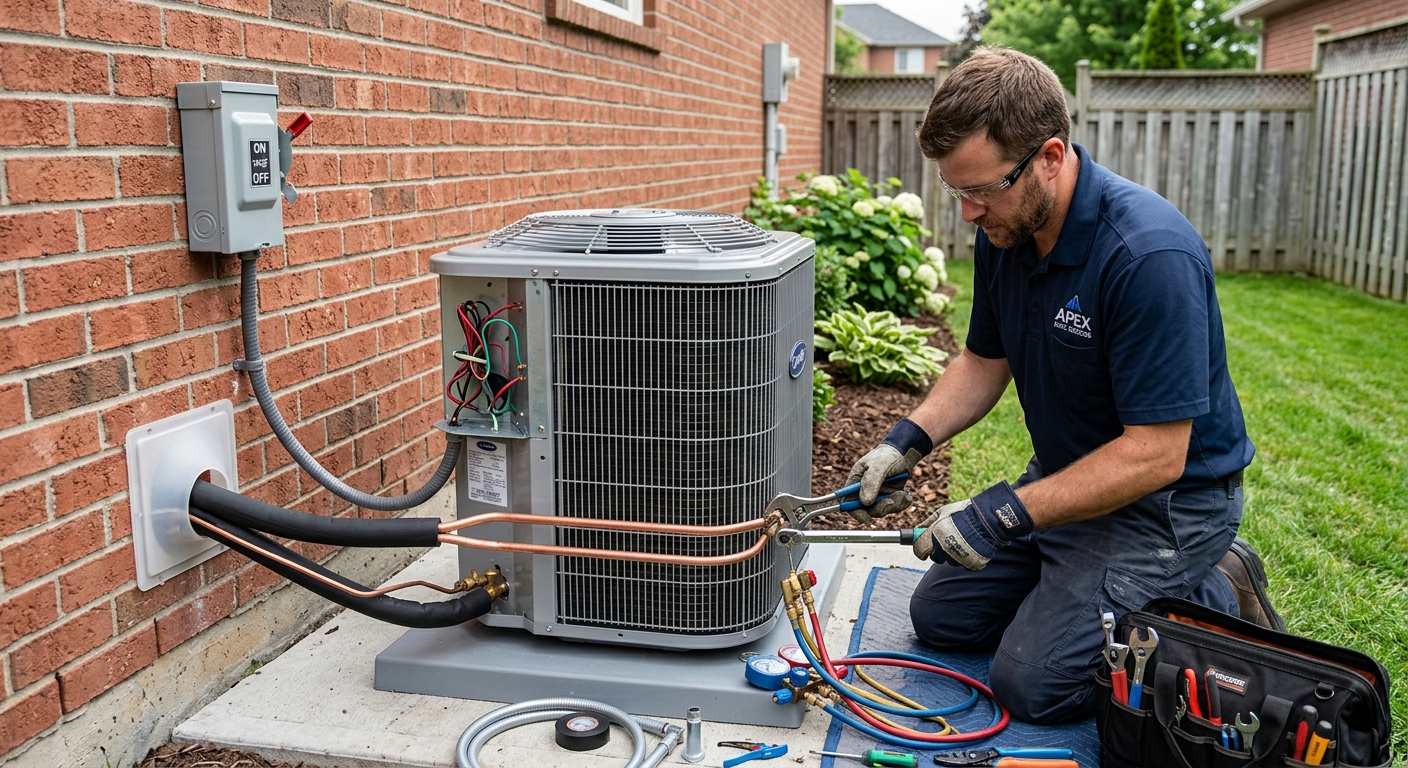
Leacock heating and cooling prices by system type — 2026
Leacock’s home heating and cooling market reflects the character of Lancaster County: solid homeownership at 65.9% and 59.9% of homes built before 1980 (U.S. Census Bureau, ACS 2024). That means most local jobs are either full replacements into homes that already have heating and cooling—often with patchy old ductwork—or retrofits for older homes with no modern ducting at all. Many older homes here, similar to Lancaster city rowhomes from the 1880s to 1930s, aren’t well-suited to traditional duct systems, so ductless mini-splits and high-velocity solutions are increasingly common.
Leacock sits squarely in a heating-dominated climate, with about 5,200 annual heating degree days versus 1,250 for cooling—so heating costs and system sizing carry more weight here than air conditioning alone. Our winters may not be Siberian, but 12°F is the winter design temperature systems need to cover. Upgrades here should center on reliable, efficient heating, with cooling as an important but smaller part of your annual energy bill.
| System |
Best for |
Efficiency |
Price range (installed) |
| Central AC replacement (existing ducts) |
homes with sound ductwork |
16–20 SEER2 |
$5,000–$12,000 |
| Air source heat pump (ducted) |
year-round heating and cooling |
8–10 HSPF2 |
$8,000–$17,000 |
| Cold-climate heat pump (ducted) |
heat pump as primary heat |
9–11 HSPF2 |
$13,000–$17,000 |
| Ductless mini-split (single zone) |
additions, rooms without ducts |
20–30 SEER2 |
$3,200–$7,000 |
| Full duct system installation |
homes with no existing ducts |
— |
$9,100–$18,000 |
Installed estimates for a typical Leacock home. Equipment tonnage, duct condition and electrical capacity move these more than brand.
Manual J and the tonnage question
Sizing your new system is the single most important—and most commonly bungled—step in an HVAC installation. In Leacock’s climate, the temptation to oversize “just to be safe” works against you. An oversized furnace or heat pump doesn’t run better; it short cycles, struggling to dehumidify in summer and causing cold and hot spots year-round. Short cycles shorten equipment life, waste energy, and pile up unnecessary repairs. It isn’t a safety margin. It’s a costly mistake.
The gold standard is a Manual J load calculation. This looks at your home’s square footage, insulation, window quality, orientation, air leaks, and even duct layout to predict how much heating and cooling you actually need. Square-foot rules of thumb—say, one ton per 500 square feet—just don’t cut it in a township like Leacock where homes built before 1980 come in every possible layout and state of repair.
Manual J is designed to handle this region’s weather extremes, anchoring its sizing on a 12°F winter design temperature rather than just average lows. When shopping, ask this: “Did you run a load calculation, and can I see it?” If a contractor sizes off your old system’s nameplate, they’re copying someone else’s guess—sometimes from decades ago, before insulation or window upgrades.
Getting this right is the difference between comfort and years of chasing problems. Demand a Manual J. You’re paying enough for the job; they have time to do it right.
Mechanical permits for HVAC work in Leacock
In Pennsylvania, there’s no statewide HVAC trade license. Instead, Leacock and other Lancaster County communities regulate residential HVAC work locally—some townships enforce the Pennsylvania Uniform Construction Code (UCC) themselves, while others may defer to state enforcement. In all cases, you need a contractor registered with the Pennsylvania Office of Attorney General for any job over $500, and a written contract is required under the Home Improvement Consumer Protection Act.
It’s the local municipality (not the county or state) that lays out mechanical permit and inspection requirements for central HVAC replacements or installations. Usually, basic tasks such as swapping a thermostat or changing furnace filters do not need a permit. But any installation or meaningful replacement of central equipment in Lancaster County—including Leacock—generally does require a mechanical permit. The process includes at least one inspection before you sign off.
Anyone handling refrigerant—installing or servicing air conditioning or heat pumps—must have federal EPA Section 608 certification. For homeowners, always verify your contractor’s insurance and workers’ compensation through official state systems: check contractor registration at hic.attorneygeneral.gov, and workers’ comp on WCAIS (wcais.pa.gov). This protects you from liability, especially for jobs involving lifts or heavy mechanical work.
What each system actually costs to run in Leacock
Running costs for heating and cooling in Leacock depend mostly on two things: how efficient your equipment is, and how much work it does. Our area averages about 5,200 heating degree days and 1,250 cooling degree days per year. To translate that into energy costs, efficiency ratings (SEER2 for cooling, HSPF2 for heat pumps, AFUE for furnaces) tell you how well your system converts the fuel or electricity it uses into heating or cooling “output.”
Here’s the core arithmetic. For cooling, take your home’s annual cooling load—proportional to degree days—divided by the equipment’s SEER2 rating to get total kWh. Heating works the same way, but with HSPF2 (for heat pumps) or AFUE/therms (for gas or oil systems) and the larger heating load. Your per-kWh or per-therm utility rate appears on your PPL Electric Utilities or UGI Utilities bill; multiply out for an annual estimate. Example: if a home requires 9,000 kWh/year for heating, and a ducted heat pump is rated at 9 HSPF2, and your electricity costs $0.15/kWh, running cost is 9,000 × $0.15 = $1,350/year.
There’s plenty of uncertainty. Your actual heat loss depends on air leaks, insulation, the quality of any ductwork, and maintenance. A high-efficiency 20 SEER2 unit running through unsealed, leaky ducts will cost more than a “good enough” 16 SEER2 unit on well-sealed, insulated ductwork. It pays to check your system as a whole before shelling out for ultra high-efficiency gear. Rates do rise—run this math with numbers off your actual utility bill for a true test.
R-410A phase-down: repair or replace?
There’s a lot of noise about refrigerant changes, but here’s what you need to know in Leacock: if your system uses R-410A, it remains fully legal to operate and service. Federal rules now require newly manufactured residential equipment to use next-generation refrigerants such as R-454B or R-32, which release less greenhouse gas if leaked. The old R-410A refrigerant itself is being gradually phased down, not banned instantly.
For homeowners, this mainly affects repair economics. If your R-410A system is running well, keep using it. If you need a spring recharge or minor service, every reputable contractor carries R-410A and will continue to do so for years. But as supply tightens and costs creep up, expensive refrigerant leaks on older equipment tilt the decision toward replacement faster than they used to. A small repair is still worth it; a big refrigerant leak in a 15-year-old system may not be.
Nothing about the refrigerant rules makes your working system illegal or unserviceable. But if your next repair involves a costly R-410A recharge, weigh the price against the age and remaining useful life of your unit before sinking money into it.
Repair or replace your Leacock system?
When your HVAC quits in Leacock, repair should still be your first question—not replacement. A healthy, under-10-year-old system with a single part failure is nearly always worth fixing, particularly with the price of replacements ranging from $5,000–$12,000 for ACs or much higher for full heat pump or ductwork jobs. The older the system, the bigger the repair, or the closer that repair cost gets to half of replacement, the more sense replacement makes—especially given the age of many local homes and the likelihood the old system was just “making do.”
If the failure is a compressor out of warranty or a cracked heat exchanger, replacement is the only recommended move, no matter the age. Other times, like high heating bills in an otherwise functional system, first test ducts and building insulation before investing in new hardware.
| Situation |
Recommendation |
Typical cost |
Reasoning |
| Under 10 years, single component failure |
Repair |
$300–$1,200 |
Most parts are still viable, and repair is much cheaper than replacing a modern unit. |
| 10–15 years, repair over a third of replacement |
Consider replacing |
$5,000–$12,000 |
Major repairs don’t pencil out late in life; replacement offers reliability and efficiency. |
| 15+ years, any major failure |
Replace |
$5,000–$12,000 |
Equipment is at or beyond normal service life; major failures signal it’s time. |
| Cracked heat exchanger, any age |
Replace immediately |
$5,000–$12,000 |
Carbon monoxide risk—code requires immediate replacement for safety. |
| Compressor failure past warranty |
Replace |
$8,000–$17,000 |
Compressor is the major cost; at end of warranty, replacement is less risky long-term. |
| Working system, high bills |
Test ducts and envelope first |
$300–$800 |
Duct leakage or poor insulation is often the source; don’t buy a new system before checking. |
Reading the yellow label
Every new furnace, air conditioner, or heat pump in Leacock comes with a yellow EnergyGuide label listing efficiency ratings: SEER2 for air conditioners and HSPF2 for heat pumps. SEER2 (Seasonal Energy Efficiency Ratio 2) shows cooling efficiency—higher numbers mean more cooling for less electricity. HSPF2 (Heating Seasonal Performance Factor 2) shows heating efficiency for heat pumps—again, higher is better. For gas furnaces, you’ll see AFUE (Annual Fuel Utilization Efficiency), expressed as a percentage.
In Lancaster County’s heating-dominated climate, HSPF2 (or AFUE) should matter more to your wallet than ultra-high SEER2. With 5,200 heating degree days, efficiency improvements in heating see more action than improvements in cooling. Investing in a high HSPF2 or efficient furnace often pays back in a few years. Ultra-high SEER2 ratings are fantastic for southern states with big cooling loads, but in Leacock, moving from 16 to 20 SEER2 adds cost that rarely pays back unless you’re running the AC around the clock. Higher is better—up to a practical point—but don’t overspend on the cooling side at our latitude.
Note: SEER2 and HSPF2 replaced the old SEER and HSPF ratings. The new standards are more realistic about real-world operation, so newer equipment ratings can’t be directly compared to numbers in older articles.
Frequently asked questions — HVAC installation in Leacock
What does a ductless mini-split cost in Leacock?
For a single-zone ductless mini-split in Leacock, expect to pay between $3,200–$7,000 installed. That range covers equipment, basic labor, and the refrigerant setup needed to serve a single room, addition, or converted space. Old homes and rowhomes are common in the area (59.9% built before 1980 per U.S. Census Bureau, ACS 2024), and often lack feasible duct runs, making mini-splits a popular retrofit choice. The lower end applies to smaller rooms with direct outdoor access, while upstairs and more complicated runs are costlier. This is a complete, turn-key price as of 2026—not just for the unit. Adding more zones or units increases cost per head.
How much does a new HVAC system cost in Leacock?
In Leacock, a full central AC replacement using existing ducts runs $5,000–$12,000, while installing a new ducted air source heat pump is in the $8,000–$17,000 range, and a cold-climate ducted system tops out at $17,000. Homes without ductwork often require a full duct system, driving costs to $9,100–$18,000 for installation and labor. Equipment size, electrical needs, and whether an entire system or just a component is being replaced shift your quote. Leacock’s mix of home ages and construction means it’s essential to get a site-specific bid rather than relying on an average.
Should I close vents in unused rooms?
In a Leacock home, closing supply vents in unused rooms seems logical for saving energy, but usually works against efficient heating and cooling. Most systems serving Leacock’s 1980s-and-earlier housing stock were sized for whole-house airflow; blocking vents actually raises static pressure, forcing your blower to work harder and risking duct leaks. Over time, this can harm the system and even increase utility bills. If comfort is poor, invest in duct sealing (about $300–$800) or talk to a contractor about zone controls—but leave supply vents open for balanced, safe airflow.
What is SEER2 and how is it different from SEER?
SEER2 is the updated federal efficiency standard for air conditioners and heat pumps, replacing SEER. It’s measured with more realistic test conditions—higher backpressure on the ductwork, better reflecting Leacock’s retrofit-heavy homes with imperfect ducts (as common in Lancaster County). Where old SEER numbers could be optimistic, SEER2 numbers reflect real-world installation. Pay attention to SEER2 when comparing new units. As of 2026, high-efficiency units in this market run from 16–20 SEER2, with cooling efficiency most valuable in homes with big summer loads. For heating-dominated Leacock, HSPF2 is just as important as SEER2.
How cold does it get in Leacock and does that affect heat pumps?
Winters in Leacock are colder than some realize: the winter design temperature is 12°F, with a typical heating season totaling about 5,200 heating degree days. Modern cold-climate heat pumps are built for these conditions, but not all units can keep pace with sub-15°F nights. When picking a heat pump, look for a model specifically rated for low-ambient operation. These start in the $13,000–$17,000 range installed. Talk to your contractor about backup heat if your home has many older windows or poor insulation—those factors matter as much as hardware when it comes to cold-weather performance.
Do I need to be home during installation?
Yes, for most of the process in Leacock, at least one adult homeowner or authorized agent should be present. Installers need access to mechanical areas, the electrical panel, and sometimes attic or crawl space for duct or line set work—especially common in homes built before 1980. At the finish, you’ll want to review the system operation and sign off on the final walkthrough. Jobs typically last from a few hours (mini-split, single head) up to two days (full duct and equipment install), depending on your setup. If you can’t stay the whole time, discuss with your contractor which key times you need to be present.
How do I verify an HVAC contractor's insurance?
In Pennsylvania—including Leacock—contractors handling $500 or more in home improvements must be registered, carry general liability insurance, and carry workers’ compensation for their employees. You can check their Home Improvement Contractor (HIC) registration status at hic.attorneygeneral.gov. For workers’ compensation, Pennsylvania’s system of record is WCAIS (wcais.pa.gov). Before signing a contract (which the law requires for jobs over $500), ask for proof of insurance and run both checks. Mechanical permits for HVAC in Leacock may also require contractors to provide insurance certificates to your municipality.
Should I repair or replace my HVAC system in Leacock?
In Leacock, repair is typically the right call for systems under 10 years old with routine failures—repairs here often run $300–$1,200, far less than the total cost of replacement. But on older units (over 15 years or with a repair bill approaching half of new equipment cost), full replacement is the safer value. Severe cases—cracked heat exchangers or out-of-warranty compressor failures—mean immediate replacement ($8,000–$17,000), no exceptions. And if energy bills seem excessive, start with a duct and air leakage test for $300–$800 before investing in major hardware.
Does my utility offer a heat pump rebate in Leacock?
Most homeowners in Leacock are served by PPL Electric Utilities, which has periodically offered rebates for high-efficiency air source and cold-climate heat pumps. Rebates can reduce the upfront cost of a qualifying installation in the $8,000–$17,000 range by hundreds of dollars, but details and availability change. Exact requirements may include certified installation, minimum HSPF2 or SEER2 ratings, and sometimes pre-approval or application after installation. Before starting your project, visit PPL Electric’s official website or call their conservation department to check current rebate offers and paperwork.