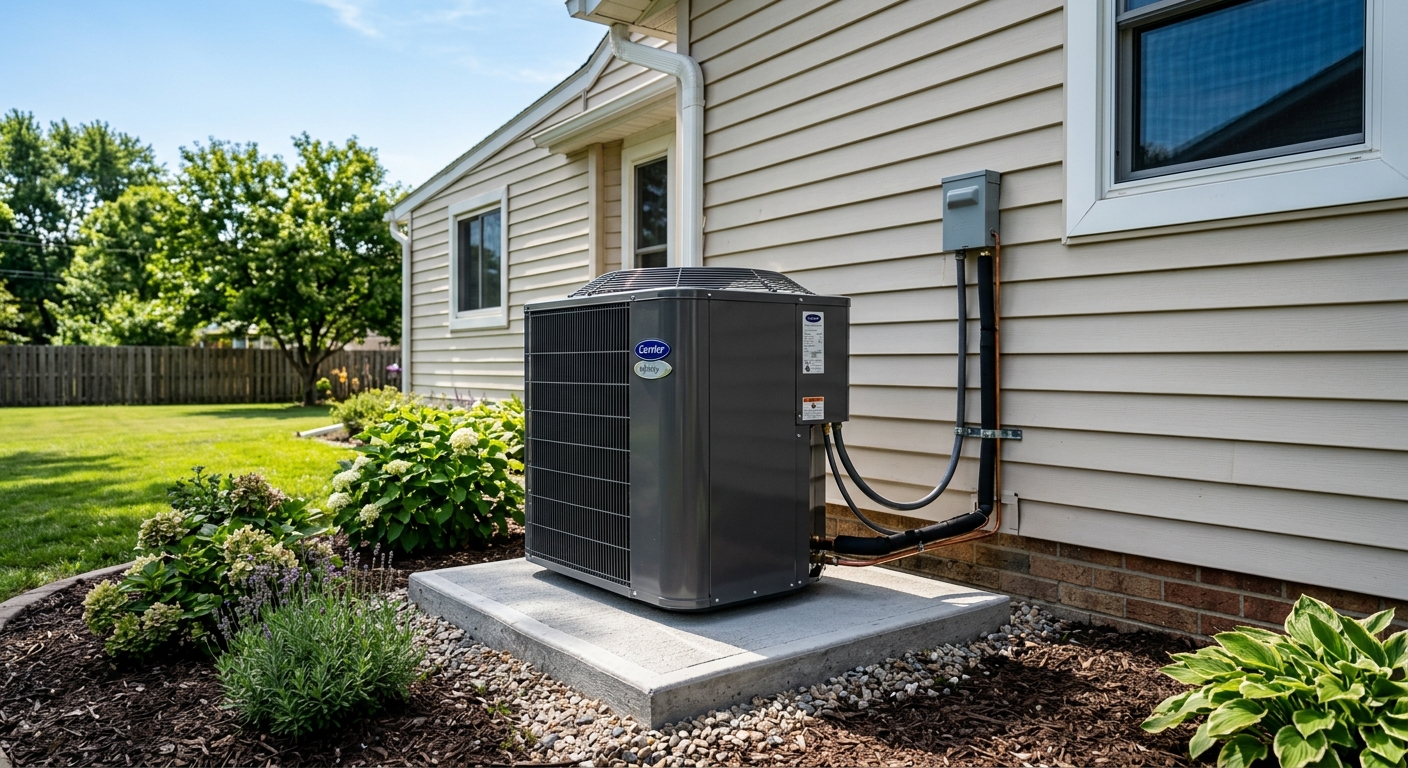
What a new HVAC system costs in Wayne
Wayne, like much of Schuylkill County, is dominated by long-term homeowners, with a homeownership rate over 90%. More than half the homes were built before 1980. In practical terms, this means most systems here are retrofits or replacements, not new builds. Many houses in Wayne still show their pre-1940 coal region roots—a construction era when ductwork was often an afterthought or absent altogether. As a result, installing or replacing central HVAC systems here often requires custom ductwork and careful routing for proper drainage, which can add complexity and cost compared to “cookie-cutter” jobs in newer suburbs.
This is a heating-dominated climate—Schuylkill County logs about 6,100 heating degree days per year compared to only 850 cooling degree days. Winters get cold, with design temperatures dropping to 4 °F. This skews local choices toward reliable heating options: heat pumps (with cold-climate capability) and gas or oil furnaces. Air conditioning is still common—you don’t want to go without it entirely—but a system that handles cold snaps and keeps utility bills in line is what most Wayne residents need. If your home has existing ductwork in fair shape, replacement costs stay at the lower end. If you’re adding or replacing ducts, prepare for a higher initial outlay.
| System |
Best for |
Efficiency |
Price range (installed) |
| Central AC replacement (existing ducts) |
homes with sound ductwork |
16–20 SEER2 |
$4,900–$12,000 |
| Air source heat pump (ducted) |
year-round heating and cooling |
8–10 HSPF2 |
$7,900–$17,000 |
| Cold-climate heat pump (ducted) |
heat pump as primary heat |
9–11 HSPF2 |
$13,000–$17,000 |
| Ductless mini-split (single zone) |
additions, rooms without ducts |
20–30 SEER2 |
$3,200–$6,900 |
| Full duct system installation |
homes with no existing ducts |
— |
$8,900–$18,000 |
Installed estimates for a typical Wayne home. Equipment tonnage, duct condition and electrical capacity move these more than brand.
What a Pennsylvania HVAC contractor must hold
Pennsylvania does not issue a statewide trade license for HVAC contractors, either residential or commercial. Instead, regulation falls to local municipalities. In Schuylkill County, each municipality, including Pottsville and its surrounding boroughs, enforces its own permit and inspection requirements under the Pennsylvania Uniform Construction Code (UCC), based on the International Residential Code. If you live in Wayne, your borough or township decides whether a mechanical permit is required for new or replacement HVAC installation—most do, especially for major work like replacing a furnace or installing a new central AC system.
Every HVAC contractor working on jobs valued above $500 must hold a Home Improvement Contractor (HIC) registration from the Pennsylvania Office of Attorney General. This is not a trade test, but a consumer protection tool. You can verify a contractor’s registration at hic.attorneygeneral.gov. Any contractor employing workers must also have workers' compensation insurance, which you can verify through the state's WCAIS system at wcais.pa.gov. If a contractor will handle refrigerant (which is almost all ducted HVAC work), they must hold a federal EPA Section 608 certification—this is required everywhere, not just Pennsylvania. Finally, state law requires a written contract for home improvement jobs over $500, and gives you a three-business-day right to cancel after signing.
Reading an installation proposal
An HVAC installation proposal in Wayne should be detailed enough that you (and any other contractor) can see exactly what you’re getting. Both the indoor and outdoor units should have model numbers—not just a series or brand—since mismatched equipment can drastically reduce system efficiency and void manufacturer warranties. The proposal should state the system’s tonnage and attach the actual load calculation (not just a guess based on square footage). For homes with existing ductwork, the quote should explain whether ducts will be reused, sealed, or modified and who inspects them. It must mention if the refrigerant line-set is being replaced or reused. Electrical requirements—especially if an upgrade to your main panel is needed—should be clear. Proper drainage is essential here: look for a specified plan for condensate. The price and type of thermostat, permit inclusion, and commissioning (verifying airflow, refrigerant charge, and that everything works as designed) must be included, as must the distinction between equipment and labor warranties. If you get a price with only a brand name and no breakdown, you have no way to judge value or compare bids.
| Line item |
What to look for |
Red flag if… |
| Equipment |
model numbers, indoor and outdoor matched |
brand name only |
| Sizing |
load calculation attached |
matched to the old nameplate |
| Ductwork |
condition assessed, sealing scoped |
not mentioned |
| Electrical |
circuit and panel capacity confirmed |
assumed adequate |
| Line set |
replaced or documented as reused |
silent |
| Commissioning |
measured airflow and charge, documented |
no startup report |
| Warranty |
labour years stated separately |
manufacturer only |
| Permit |
included and priced |
'not needed' |
Refrigerant rules and your existing system
New residential HVAC systems in Wayne are being sold with next-generation, lower-GWP refrigerants like R-454B and R-32 to comply with federal rules that phase down the use of older high-GWP HFCs such as R-410A. This shift is driven not by Pennsylvania law, but by federal and industry standards. If your home already has a system running R-410A, it remains legal and serviceable. You can continue to use and maintain it, but sourcing R-410A for major repairs or leaks is gradually getting more expensive and less convenient as supply tightens nationwide.
The bottom line: there is no law or code that makes your R-410A system obsolete or illegal in Schuylkill County. You don’t need to replace a working unit just because refrigerant rules are changing. However, if an older system has a significant refrigerant leak, the higher and rising cost of R-410A may push the economics in favor of replacement rather than repeated servicing. For most Wayne homeowners, keep your existing system running as long as it makes sense—but when replacement is needed, expect the new equipment to use one of the newer refrigerants.
Wayne's housing stock and its HVAC needs
Wayne’s housing stock tilts heavily toward older, pre-1980 construction—over half of all homes. For these houses, ductwork isn’t a given. Many were built before central air was standard, so ducts may be non-existent, or were added later for heating only. Even if present, they often lack proper sizing for AC—meaning airflow and comfort can be compromised unless custom work is done. Likewise, insulation levels and window quality in these homes tend to trail modern standards, placing more load on any new HVAC system installed. Flue or chimney condition is also a consideration for any gas or oil-fired equipment replacement.
Electrical panels in these older homes may not have spare capacity for a full electric conversion to a heat pump, especially cold-climate or multi-head systems. Before planning a full upgrade, it is wise to check your available panel amperage and circuit slots. In contrast, if your Wayne home is part of a newer subdivision, you could be looking at the original late-1990s or early-2000s builder-grade furnace or central air conditioner at the end of its design life now. These were often generously sized (sometimes too much so), and the ductwork is typically better but still prone to leaks and insufficient return air.
What size system does a Wayne home need?
The size, or capacity, of your HVAC system is the most important design decision in any Wayne installation—and also the most commonly mishandled. Oversizing the system actually causes more problems than undersizing: it leads to short cycling (constant on-off operation), poor humidity control, temperature swings, and shorter system lifespan. Bigger is not better—a system should be sized to your home’s real needs, not “just in case.”
A proper Manual J load calculation is the gold standard. This is a full assessment that considers the square footage, insulation, windows, air leakage, orientation, occupant habits, and, crucially, the local climate. For Wayne, the winter design temperature used in these calculations is 4 °F. Your home’s specific losses and gains at that temperature, not just a rule of thumb based on floor area, should determine equipment size. Make sure to ask your contractor, “Did you run a load calculation, and can I see it?” If the answer is no—or the proposed system just matches the tag on the old unit—that’s a sign of trouble and a shortcut that can cost you in comfort and bills for years.
Ductwork: the part nobody quotes properly
In Wayne’s older homes, ductwork is often the biggest unseen factor in heating and cooling performance. Duct leakage can rob 20% or more of your conditioned air, especially in pre-1940 coal region homes that have been retrofitted over the years. The age and style of construction means ducts may have been sized just for a gravity furnace, never sealed, and routed through cold attics or damp basements—never ideal.
A professional duct blaster test measures both supply and return leakage. This data tells you whether sealing (often with mastic or aerosolized sealant) can restore your system’s performance, or if replacement is needed. Undersized return ducts—too small to allow the right airflow—are especially common, and cause even brand new systems to run hot or noisy. If your ducts run through unconditioned spaces, expect heat loss in winter and heat gain in summer unless insulated. All this means a proper system upgrade in Wayne almost always starts with a duct test, not as an afterthought. Don’t skip it or let anyone swap equipment blindly: you can’t fix duct leakage with a brand-new furnace or heat pump any more than you can fix a leaky roof with new gutters.
Frequently asked questions — HVAC installation in Wayne
How do I verify an HVAC contractor's insurance?
Wayne homeowners should expect any HVAC contractor providing a quote to offer proof of current workers’ compensation insurance. In Pennsylvania, this is mandatory for all employers, and you can verify it yourself by searching the contractor’s name or business at wcais.pa.gov—the state’s official system. Asking for a printed certificate is standard practice. If your project exceeds $500, the contractor must also be registered as a Home Improvement Contractor with the Pennsylvania Office of Attorney General, and you can check this at hic.attorneygeneral.gov. Never work with an uninsured or unregistered provider, even if their price seems competitive. Insured contractors typically price jobs in the $4,900–$12,000 range for a central AC replacement, depending on scope. Saving a few dollars up front isn’t worth the exposure if something goes wrong.
Should I replace the furnace and AC at the same time?
In Wayne—and throughout Schuylkill County’s older homes—it often pays to consider replacing both furnace and air conditioner together, especially if both are 15 years or older or if the shared ductwork needs work. Combo replacement can avoid duplicated labor charges and ensures the air handler or blower matches both heating and cooling needs, which matters for comfort and efficiency. Sometimes, if funds are tight or one side is much newer, you can stagger upgrades—for example, if your furnace is still in good shape but your AC is shot. However, mismatched system parts can lead to performance problems. Many all-in-one system upgrades in Wayne (including duct modifications) run $7,900–$17,000 when a heat pump replaces both. Always have the existing duct layout and airflow assessed before deciding.
How much does ductwork add to an HVAC installation?
In Wayne’s mix of pre-1940 and post-war housing, the cost to install or replace ductwork can be almost as much as the heating or cooling equipment itself. If your home has no ducts or only old, poorly-sealed runs sized for a furnace, a full new duct system will usually add $8,900–$18,000 to the project total. This covers design, materials, fabrication (often custom, due to oddball framing in older homes), and labor. Sometimes, only modest repairs and sealing are needed, which can cost less and improve performance dramatically. Always have a duct inspection done before replacing heating or cooling equipment, since leaky or undersized ducts often cause the problems blamed on old systems.
Does my utility offer a heat pump rebate in Wayne?
Wayne is served by PPL Electric Utilities for electricity and UGI Utilities for natural gas in most of the populated boroughs. Both utilities have run heat pump rebates in the past, but program details and eligibility change year to year. Always check the utility’s website or call before starting a project—rebates for installing a qualifying air source heat pump can cut your net cost on a typical $13,000 system by several hundred dollars. Don’t count on instant discounts: rebates can take weeks to process and often require forms, proof of permit and licensed installation. Your HVAC contractor should walk you through this paperwork before work begins.
How long does HVAC installation take in Wayne?
Most residential HVAC installations in Wayne take one to three days, depending on the scope. A straight replacement of a central AC or furnace—where the ductwork, electric, and gas service are sound—can often be done in a single day. Full system replacements or ductwork installation generally run longer, especially in pre-1940 homes with difficult framing or custom routing. Major projects that include full duct system installation often reach the $8,900–$18,000 range and take several days to a week. Weather, permit inspections, and electrician availability can all affect timing. Always build in a day or two for post-install commissioning and municipal inspection if required.
Why does my system short cycle?
Short cycling—where your heating or cooling system turns on and off rapidly—is common in Wayne’s older housing, and is almost never due to just a thermostat. The most likely cause is an oversized unit: if your new system is much larger than your home’s heating or cooling needs, it will reach the set temperature too fast and shut off, leading to swings in comfort and wasted energy. Other causes include airflow restrictions (from old, leaky, or undersized ducts) or faulty controls. For context, a proper system—installed for around $4,900–$12,000 for central AC—should run steady cycles, especially during Schuylkill County’s long heating season. Insist on a load calculation and thorough duct assessment to avoid repeating the problem.
What is a Manual J load calculation?
A Manual J load calculation is a science-based estimate of your Wayne home’s actual heating and cooling requirements. It uses details like square footage, insulation, window quality, climate (here, with winter design temps of 4 °F), and occupancy. Manual J ensures your system is sized for your real needs—not just a guess or a copy of the last unit’s nameplate. This matters: proper sizing cuts down on short cycling, improves comfort, and saves money. A professional load calculation is part of any credible HVAC proposal—even for projects in the $7,900–$17,000 range. Don’t settle for rules of thumb; insist on seeing the report. It’s your insurance against expensive mistakes.
Which utility serves Wayne?
Wayne receives its electric service from PPL Electric Utilities. Natural gas is common in Pottsville and older boroughs—UGI Utilities is the main provider—but rural and outlying areas around Wayne often rely on propane or fuel oil, since the distribution grid doesn’t reach every home. This matters when choosing between gas furnaces, heat pumps (which are all-electric), and oil systems. If you’re planning on a high-efficiency system in the $13,000–$17,000 range for a cold-climate heat pump, confirm your electric panel can support it and double check with your specific utility about rates and incentives.
Is a high-efficiency system worth the extra cost here?
In Wayne’s cold climate—6,100 heating degree days per year—a high-efficiency HVAC system often pays off over time, but only if your ductwork and insulation are also up to par. For example, a top-tier cold-climate heat pump costing $13,000–$17,000 can sharply cut winter heating bills compared to old oil or baseboard electric, especially if you qualify for electric utility rebates. The flip side: if your house leaks like a sieve or your ducts are unsealed and undersized, much of that gain is wasted. Always invest in weatherization and duct sealing first—get an honest energy audit—then choose high efficiency if the structure supports it. That’s how you see a real return here in Wayne.