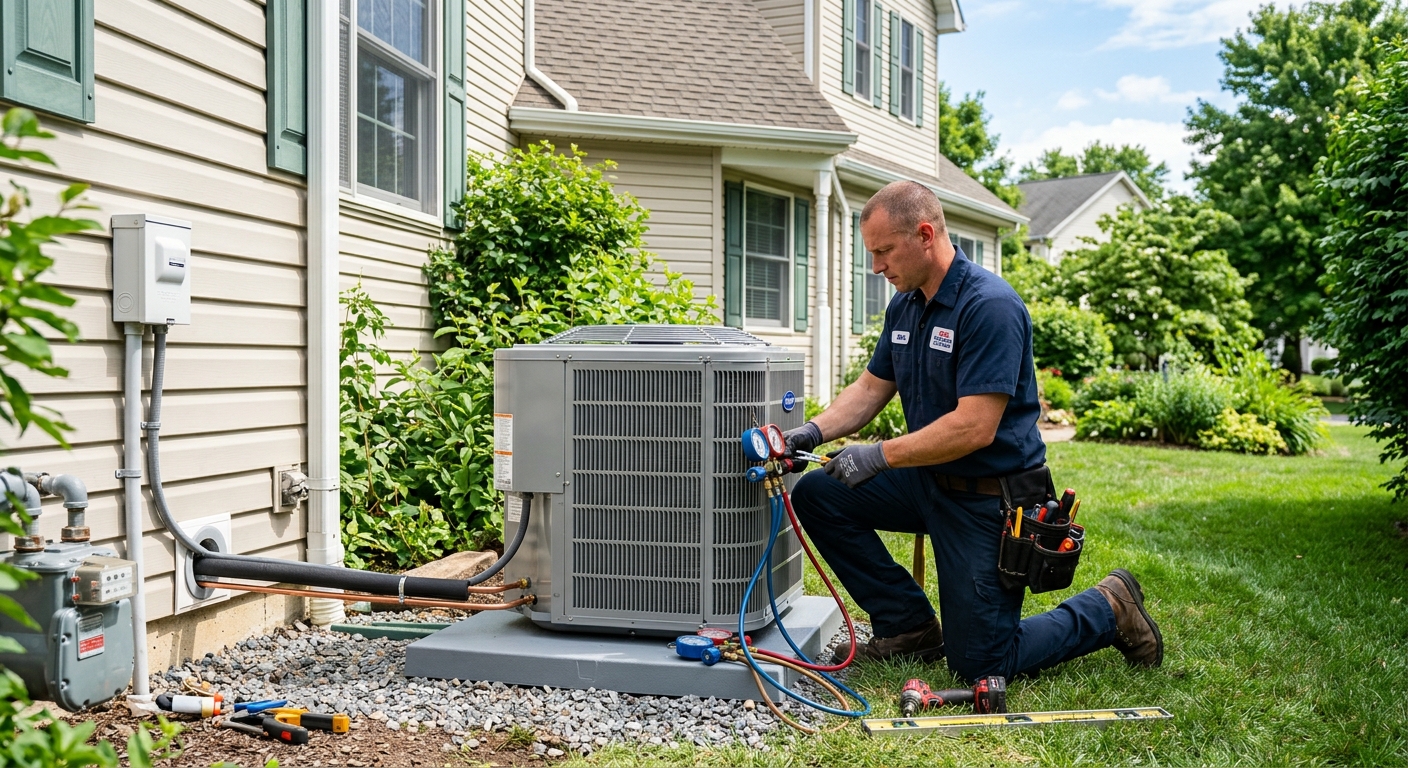
What a new HVAC system costs in Buckingham
Buckingham’s HVAC needs are pretty distinct from other suburbs in Bucks County. With a high homeownership rate of 95.5% and 28.9% of homes built before 1980, most local work targets older single-family homes — systems here are usually being replaced, not installed for the first time. Bensalem and Middletown, parts of Bucks County close to Buckingham, are classic post-1960 tract developments. This means existing ductwork is common, though often overdue for upgrades or sealing, especially if it wasn’t serviced during prior replacements.
Buckingham’s climate is what’s called heating-dominated: about 4,800 heating degree days compared to 1,450 cooling degree days per year. Winters are cold, with design temperatures reaching 14°F, and summers bring humidity but not oppressive heat. This tilts most homes toward strong heating capability rather than oversizing for cooling. You don’t want a massive air conditioner for the half-dozen hot weeks any more than you want undersized heating when January arrives.
Here’s what you can expect to pay for a system that matches actual Bucks County home conditions — not sales pitches:
| System |
Best for |
Efficiency |
Price range (installed) |
| Central AC replacement (existing ducts) |
homes with sound ductwork |
16–20 SEER2 |
$6,300–$15,000 |
| Air source heat pump (ducted) |
year-round heating and cooling |
8–10 HSPF2 |
$10,000–$21,500 |
| Cold-climate heat pump (ducted) |
heat pump as primary heat |
9–11 HSPF2 |
$16,500–$21,500 |
| Ductless mini-split (single zone) |
additions, rooms without ducts |
20–30 SEER2 |
$4,000–$8,900 |
| Full duct system installation |
homes with no existing ducts |
— |
$11,500–$23,000 |
Installed estimates for a typical Buckingham home. Equipment tonnage, duct condition and electrical capacity move these more than brand.
Maintenance that actually extends system life
Most of what keeps a Buckingham HVAC system alive isn’t expensive or flashy. Your filter should match your blower: for typical local ducted setups, that means a MERV 8 to 11 filter, swapped out every 2–4 months, more often if your home has pets or summer pollen surges. Going higher in MERV without a matching blower can actually harm airflow and efficiency.
Coil cleaning — both indoor (evaporator) and outdoor (condenser, for AC or heat pump) — is worth doing every couple of years, or annually if there’s visible buildup of dust or “cottonwood fluff.” If your system drains to a condensate line, making sure it’s clear each spring saves you the headache (and expense) of leaks through ceilings or onto furnace floors.
Refrigerant charge should only be checked, never “topped up.” If a system loses refrigerant, it has a leak, and adding more skips the repair that actually prevents future failures.
Annual service plans in Bucks County are only worth your money if they detail exactly what’s included, not just “check and inspect.” Some bundle seasonal visits and priority service, which can be worth it if you like the peace of mind, but don’t pay extra for endless “checks” or coil cleanings you don’t really need.
The off-season — early spring and early fall — is when Buckingham contractors aren’t overloaded with emergency calls, so you’ll get the best availability and attention for maintenance or tune-ups.
What each system actually costs to run in Buckingham
To compare heating and cooling costs in Buckingham, you have to look beyond just the sticker price. With about 4,800 heating degree days and 1,450 cooling degree days annually, most of your bill comes from heating, not cooling. PECO Energy Company serves electric power in the area, and if you want a truly local calculation, grab your own electric or gas bill for the rate per kWh or per therm.
Here’s how to compare. Efficiency ratings like SEER2 (for cooling) and HSPF2 (for heat pumps) measure how well a system turns electricity into cooled or heated air. The higher the rating, the less energy it takes to deliver a set amount of comfort. For heating, fossil-fuel systems use AFUE — for example, a 96% AFUE furnace turns 96% of fuel into useable heat.
Let’s say PECO bills you at “X” cents per kWh. To estimate annual cooling costs, take Buckingham’s 1,450 cooling degree days, guess your home’s base cooling load (a rough figure can be supplied by your contractor), divide annual BTU need by the SEER2/EER value, then multiply by your kWh rate. For heating, use a similar process with degree days and the HSPF2 or AFUE value for your heat source.
But that’s on paper. Real-world bills shift with weather, insulation, duct condition, and thermostat habits. If your ductwork leaks (a common issue in older suburban homes) or is poorly insulated in an unconditioned attic, even the best system will cost more to run than you expect. It’s better to invest in tight, insulated ducts than to chase the top efficiency number on a brochure.
Your actual utility rate is listed on page one of your PECO bill; every calculation starts there and ends with how your home holds onto that conditioned air.
What a Pennsylvania HVAC contractor must hold
In Pennsylvania, there’s no single statewide HVAC license for residential contractors — regulation is local. That means in Buckingham and the rest of Bucks County, you want a contractor registered as a Home Improvement Contractor (HIC) through the Pennsylvania Office of Attorney General for any job over $500. You verify that registration at hic.attorneygeneral.gov before you sign a contract.
Mechanical (HVAC) permits for installation or equipment replacement are enforced by the township you live in. For example, Bensalem runs its own building and planning department. In other Bucks County townships, local code offices oversee permits and inspections for work like furnace or central AC installation. A mechanical permit is almost always required for a full HVAC replacement and comes with an inspection.
For any system with refrigerant (all central air and heat pump work), federal law says workers must have EPA Section 608 certification — no exceptions, regardless of the state rules.
Contractors employing anyone besides the owner are required to maintain workers' compensation insurance, which can be verified via the state’s WCAIS system (wcais.pa.gov).
If you see a Pennsylvania contractor advertising licensing beyond HIC, know that for residential HVAC, it's HIC registration, township permits, and EPA certification that matter most in Buckingham.
Refrigerant rules and your existing system
If your Buckingham home has a heat pump or central air installed within the last 15 years or so, it probably runs on R-410A refrigerant. The rules are changing for new systems: as of 2024, manufacturers are moving to refrigerants like R-454B and R-32, which have much lower global warming potential. The federal phase-down of high-GWP HFCs means you won’t see R-410A in new equipment much longer.
But if your current system works, you don’t have to rush out and replace it. R-410A is still legal to buy and use for service, and technicians in Buckingham can and do continue to repair and recharge these systems. What’s changing is the economics: as fewer new systems use R-410A, the wholesale price for the refrigerant itself is likely to climb, especially if your system has a leak and needs frequent top-ups.
The upshot: a working R-410A system stays legal and serviceable, but as repair costs creep upward, you may hit a point where replacing just makes more sense — especially if the unit is older or the leak is expensive to access. There’s no mandatory “refrigerant switch” for existing Buckingham homes.
Manual J and the tonnage question
Sizing an HVAC system is where most jobs in Buckingham homes go sideways. Too many contractors size by square footage or, worse, copy the nameplate off your old system. This is risky, especially since the original unit was often oversized “just in case,” particularly in tract homes built fast in the 1960s and 1970s across Bensalem, Middletown, and similar local developments.
Oversizing means short cycling (the system shuts off before completing a full cooling or heating cycle), leading to uneven temperatures, humidity problems, and shortened equipment life. A bigger system is not a safeguard; it is a defect.
Manual J is the recognized residential load calculation — it looks at your home’s insulation, windows, orientation, air sealing, local 14°F winter design temperature, and actual occupant habits. Square-foot “rules of thumb” ignore everything that makes one home need more or less than another.
The key question for any Buckingham contractor is: “Did you run a Manual J load calculation, and can I see it?” If the answer is “no” or you get a blank stare, look elsewhere. Sizing only from the old system’s tag copies forward any mistakes made decades ago, often leading to rooms that are too hot in winter, too damp in summer, and rising utility costs.
The comfort problem that isn't temperature
Buckingham’s climate delivers both winter dryness and summer humidity, and temperature control doesn’t solve either fully. Local homes spend more time fighting dry air from forced-air heat in January than swinging open the windows for a July breeze. Oversized ACs, which are common in older tract homes, make humidity worse by shutting off before they’ve had a chance to pull moisture from the air — so “more cooling power” is not the solution for muggy bedrooms.
Whole-house humidifiers can help local homes with notably dry winter air, but only if cleaned regularly; otherwise, they become a persistent mold risk in your ductwork. MERV 8–11 filters balance dust and allergen capture against the blower’s capability. Jumping to a very high-MERV filter without a fan designed for it can actually strain the system and lower comfort.
Mechanical fresh air ventilation is helpful in newer, tightly built homes (more common in recent developments) but don’t believe every “indoor air quality” add-on is necessary; UV lights, expensive air scrubbers, and specialized duct treatments are routinely oversold in Bucks County. Good duct sealing, proper filtration, and right-sized equipment make more day-to-day difference than most add-ons.
Frequently asked questions — HVAC installation in Buckingham
What size HVAC system does my Buckingham home need?
Sizing for HVAC in Buckingham isn’t about just matching the number of bedrooms or copying the tag on the old unit — it should be done by a Manual J load calculation that accounts for the local winter design temperature (14°F), your home’s actual insulation, windows, and orientation. Most post-1960 homes here were built quickly with standard ductwork, so oversizing is a common legacy mistake that leads to wasted energy and poor dehumidification. Always ask your contractor to run and show you a Manual J report. If you have a 2,400-square-foot home, your required tonnage could range widely based on these details. Getting the size wrong swings both comfort and cost: it doesn’t add safety to go bigger than you need. If you do need a new installation, the cost for a properly sized central air system with existing ducts is typically $6,300–$15,000.
What does a heat pump cost installed in Buckingham?
For a typical Bucks County home with existing ductwork, installing a standard ducted air source heat pump — the type that serves both year-round heating and cooling — falls between $10,000–$21,500. If you opt for a cold-climate heat pump with advanced performance in deeper winter, expect the range to be $16,500–$21,500. These are installed prices and cover the kind of houses most common in local neighborhoods: single-family, built after 1960, often with ductwork that’s aging but usable. Expect higher costs if you’re also moving electrical circuits or completely reworking old ducts. Always ask whether the quoted price includes permit fees and post-installation inspection, since municipalities in Bucks County often require this.
Is natural gas available throughout Bucks County?
In southeastern Bucks County, including developed areas like Bensalem, Bristol, and Middletown right near Buckingham, natural gas is widely available, with PECO supplying most customers. However, as you move north toward more rural or less densely built parts of Bucks, many homes rely instead on propane or fuel oil because gas mains simply don’t reach everywhere. If you’re unsure about your street, PECO can confirm service directly. This gas access shapes HVAC choices and ongoing operating costs, as running a heat pump is especially cost-competitive in gas-served areas — for reference, a ducted air source heat pump installation typically runs $10,000–$21,500 locally.
Who inspects HVAC work in Buckingham?
HVAC inspections in Buckingham are handled by your township’s local code office. If you’re in a place like Bensalem, it’s their building and planning department. Each Bucks County township enforces mechanical (HVAC) permits and sends its own inspector to verify that any new furnace, heat pump, or central AC replacement is installed to code. This step isn’t optional — it protects you, making sure the work meets Pennsylvania Uniform Construction Code standards derived from the IRC. Always confirm your contractor pulls the required mechanical permit for replacements or major upgrades (which typically run $6,300–$21,500 depending on system type).
Do I need ENERGY STAR equipment to qualify for incentives?
Whether you need ENERGY STAR-rated equipment for incentives in Pennsylvania depends on the specific program or rebate — some require this label, some only ask for minimum federal efficiency. In Bucks County, contractors will know the local programs available, but don't assume every incentive applies to every brand or model. ENERGY STAR certification can be a sign of above-average efficiency, but it doesn't guarantee the equipment is right-sized or the best fit for your existing ductwork. Even without specific incentives, choosing a high-efficiency heat pump or AC (such as units in the $10,000–$21,500 installed range) often makes sense just based on lower long-term energy bills. Always check the program fine print and ask your contractor which models truly qualify.
When is the best time of year to replace HVAC in Buckingham?
In Buckingham, the sweet spot for HVAC replacement is either early spring (March–April) or early fall (September–October). Contractors are less busy between the heating and cooling extremes, meaning you can often get quicker appointments, better focus from crews, and sometimes slight price flexibility if you schedule a system like a central AC replacement (typical $6,300–$15,000). Waiting until the first true heat wave or cold snap usually means higher demand, longer wait times, and no room for scheduling mishaps. The off-season is also when it’s easiest to get permits inspected quickly, since the local code offices aren’t buried in emergencies.
How long should an HVAC system last in Buckingham?
Most central HVAC systems in Buckingham, particularly those installed after 1960 in single-family homes, last 12–20 years if properly maintained. Systems in houses built before 1980 (about 28.9% of local stock) may sit on older ductwork, so lifespan sometimes comes down to the weakest link: bad ducts or chronic leaking may force earlier replacement. Humid summers and cold winters mean equipment does real work here, with filter changes and annual coil cleaning playing a big part in longevity. Expect closer to 15 years from a typical central AC or ducted heat pump, with significant repairs often triggering a replacement decision. Full system replacements, including heat pump options, generally cost $10,000–$21,500 in this area.
How much does a new HVAC system cost in Buckingham?
A new HVAC system in Buckingham ranges widely depending on what your home needs. If you already have usable ductwork and only need a central AC or heat pump, expect installed costs from $6,300–$21,500. For many homes built in the suburban booms after 1960, duct upgrades or repairs are sometimes necessary and add to the total. If you’re installing both a new full duct system and air handler in a house that previously had none, costs rise to the $11,500–$23,000 range. It’s rarely worth overspending on brand at the expense of proper duct sealing and right-sizing — those two steps make far more difference in daily comfort and monthly bills in Bucks County homes than a flashy label.
Should I repair or replace my HVAC system in Buckingham?
This is a common question in Buckingham, given that many local systems are 10–20 years old and ductwork can be even older. If your current system needs a major part (compressor, coil, heat exchanger), weigh the repair quote against the replacement cost — for central air, that’s typically $6,300–$15,000 installed. With older R-410A systems, future refrigerant costs will only rise as supply tightens. If you have persistent leaks, uneven temperatures, or mounting repair bills, putting money into patchwork rarely pays off. On the other hand, if your system is less than 12 years old, efficient, and the repair is minor, fixing it can be the more economical choice. The right move is rarely just about age — it’s about comfort, reliability, and what future bills will look like versus a new system.