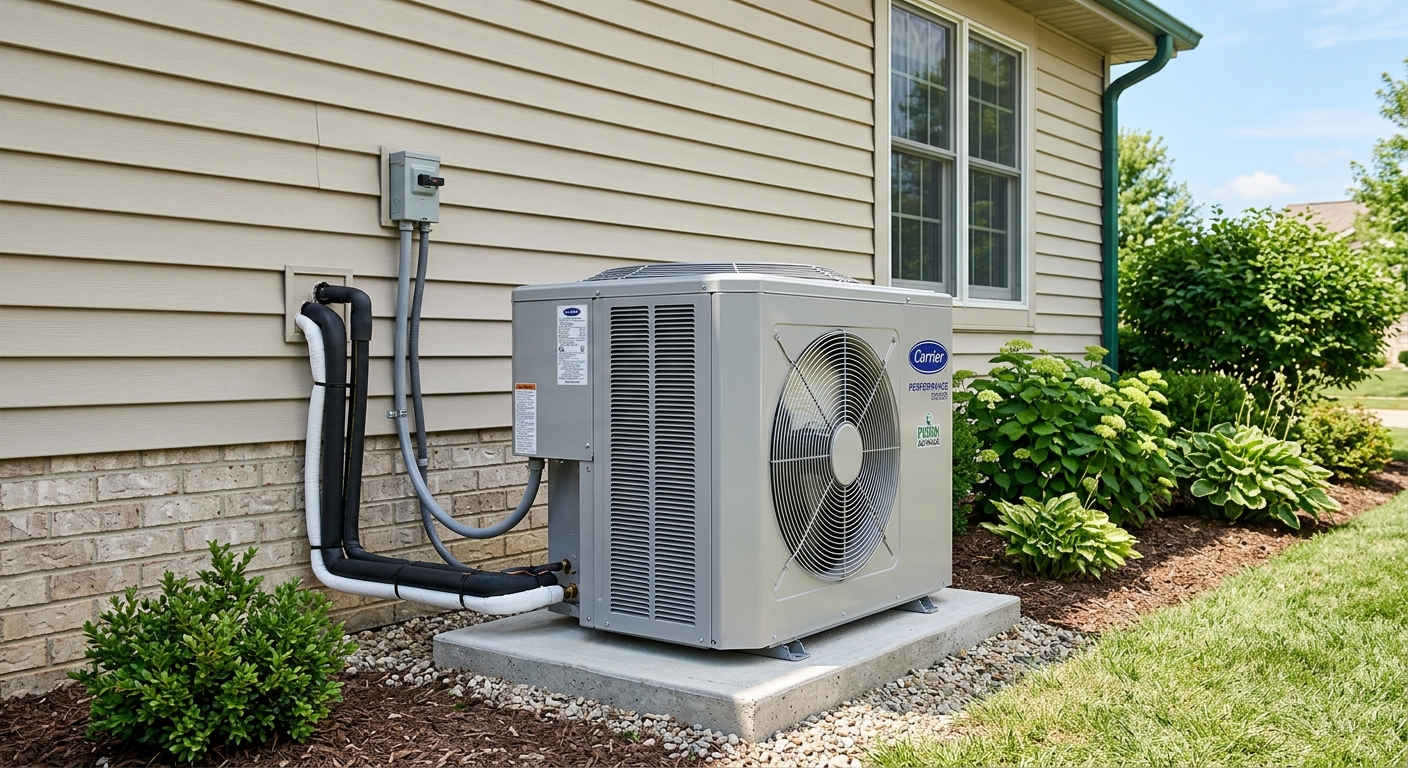
Westtown heating and cooling prices by system type — 2026
In Westtown, where the homeownership rate stands at 80.9% and almost half of homes were built before 1980 (U.S. Census Bureau, ACS 2024), most jobs I see are full HVAC replacements, not first-time installations. That’s because large tracts of Chester County homes built from 1970 to 2000 came with forced-air systems, many with aging or inefficient central AC or gas furnaces that are now at the end of their life. These homes almost always have ductwork already in place—though the quality and sizing might be questionable, the bulk of the install is retrofit, not new construction.
Westtown sits in southeastern Pennsylvania, a region with about 4,800 heating degree days and only 1,450 cooling degree days each year. That tells you everything: this is a heating-dominated market. Your system must keep up when winter drops to the 14 °F design temperature, while still delivering reliable dehumidification in muggy summers. That shapes every product and sizing decision—spending extra for extreme cooling capacity isn’t necessary, but skimping on heating performance is a mistake here.
| System |
Best for |
Efficiency |
Price range (installed) |
| Central AC replacement (existing ducts) |
homes with sound ductwork |
16–20 SEER2 |
$5,800–$14,000 |
| Air source heat pump (ducted) |
year-round heating and cooling |
8–10 HSPF2 |
$9,400–$20,000 |
| Cold-climate heat pump (ducted) |
heat pump as primary heat |
9–11 HSPF2 |
$15,000–$20,000 |
| Ductless mini-split (single zone) |
additions, rooms without ducts |
20–30 SEER2 |
$3,700–$8,200 |
| Full duct system installation |
homes with no existing ducts |
— |
$10,500–$21,000 |
Installed estimates for a typical Westtown home. Equipment tonnage, duct condition and electrical capacity move these more than brand.
R-410A phase-down: repair or replace?
If your Westtown home still runs on an R-410A system, rest easy: your equipment remains legal to service, and R-410A is not being banned. What’s changing is that new systems are shipping with next-generation refrigerants like R-454B and R-32 due to phase-down requirements targeting high global warming potential (GWP) refrigerants. For homeowners, this creates a split reality: you can get R-410A recharged or repaired as usual, but the cost of the refrigerant is gradually increasing as supply tightens. Some technicians are starting to see price spikes for R-410A itself, and I expect this to continue, especially for large or frequent top-offs.
If you’re facing a minor fix—like an electrical fault—there’s no good reason to toss out a working system just because it uses R-410A. However, if you have a major refrigerant leak or a compressor failure, high refrigerant costs might tip the math toward replacement rather than repair. It’s a judgment call that depends on the age and condition of your system, but don’t let any contractor scare you into thinking your R-410A unit is obsolete or about to become unserviceable tomorrow. The long-term trend is away from R-410A, but you aren’t forced to act unless repair costs no longer make sense.
Westtown's housing stock and its HVAC needs
Nearly 47.1% of Westtown's homes were built before 1980, but much of Chester County’s suburban wave came from 1970–2000. That translates into a housing stock where most properties already have ductwork—at least for heating—and a forced-air layout. However, insulation standards were lower in earlier decades, and windows may be single-pane or only marginally upgraded. If your home falls into the pre-1980 segment, your ducts may have been sized for a furnace, not for efficient central cooling, and sealing is usually lacking. On the other hand, the “newer” 1990s subdivisions usually got basic builder-grade HVAC systems, which are now at or slightly past the usual end-of-life window (20–25 years for most). Sizing was often generous, sometimes leading to oversizing by today’s standards.
A practical concern is electrical capacity: true all-electric conversions—a heat pump plus electric backup—might require a panel upgrade in older homes. Chimney and flue conditions can also drive furnace replacement decisions, especially if the old venting no longer meets code. Know your home’s era and layout before considering upgrades; what made sense in a 1975 two-story colonial may not work for a split-level from 1999 with different insulation, windows, and duct sizing.
Manual J and the tonnage question
One of the most common mistakes I see in Westtown is oversizing—installing a bigger system than your house really needs. It’s tempting to think that extra tonnage is a safety margin, but in our climate, it backfires: you get short cycles, poor humidity control in summer, noisy temperature swings in winter, and faster wear. For our area, which sees a winter design temperature of 14 °F, right-sizing is crucial to ensure both heating capacity and even distribution throughout the home. Manual J is the only acceptable method for calculating the actual load based on insulation, windows, floor area, orientation, and leakage—not just square footage or old rule-of-thumb charts.
Be wary: many contractors still size a new system based on the old nameplate or a rough square-foot estimate. That just copies forward decades-old mistakes—especially in Chester County homes built in a different energy era. Always ask, “Did you run a Manual J load calculation, and can I see it?” This demand weeds out shortcutters and protects your long-term costs and comfort. If the contractor can’t or won’t show you their work, take it as a red flag for the rest of the install. Get the sizing right, and nearly everything else about your new HVAC system falls into place.
What a Pennsylvania HVAC contractor must hold
Pennsylvania does not license HVAC contractors statewide for residential work. Instead, regulation and licensing occur at the municipal level—so what matters most to you is whether your township or borough requires a license or permit for installation or replacement. For example, West Chester Borough requires mechanical permits for central HVAC replacements, and other townships in Chester County typically have their own codes departments that grant these permits.
Every contractor handling refrigerant (which means every proper HVAC installer) must have an EPA Section 608 certification—this is federal and cannot be bypassed. For contracts over $500, contractors must also register as Home Improvement Contractors (HIC) with the Pennsylvania Office of Attorney General. Always verify this at hic.attorneygeneral.gov. For your protection, all employers are required to carry workers' compensation insurance—check coverage via the state’s WCAIS site. Written contracts are required for jobs over $500, and you receive a three-business-day right of cancellation by law. All of this adds up to strong consumer protection, but you still need to check paperwork before signing anything.
Mini-splits and zoning in Westtown homes
Ductless mini-split systems stand out in Westtown homes for a few clear reasons. If you have an addition, a finished attic or basement, converted sunroom, or a part of the house that was always drafty in winter or stuffy in summer, adding new ductwork can mean tearing apart finished walls, floors, or ceilings. That’s where a mini-split wins: efficient heating and cooling, no ductwork needed, and the installation is clean and minimally invasive.
Single-zone mini-splits (one outdoor, one indoor unit) deliver quiet, efficient climate control for a specific space. Multi-zone units (one outdoor, several indoor heads) offer flexibility but can compromise performance—indoor units sharing a single outdoor unit may not reach their full rated output in every mode. Placement matters: wall-mounted heads are most common, but they are visible, and some homeowners in Chester County object to the look. Condensate handling (drain lines or pumps) must be planned in, especially for attics and basements. Given the age of much local housing, and the fact that many homes have only partial or aging central systems, Westtown’s market is naturally suited to ductless solutions, even if owners hadn’t considered them until now.
Why your ducts may be the real problem in Westtown
In the Westtown area, especially in homes from the 1970–2000 construction boom, duct leakage is a quiet but costly problem. Even a well-maintained furnace or AC can’t deliver if half the conditioned air leaks out through connections, seams, or unsealed joints before reaching your living space. Duct blaster testing measures exactly how leaky your distribution system is by simulating airflow under pressure. If leakage is high, sealing with mastic or aerosol-based products can be a cost-effective remedy—much cheaper than full duct replacement.
Undersized returns are common, particularly in forced-air systems added to homes piecemeal or updated after the fact, and can silently choke airflow and efficiency. If your ducts run through unconditioned spaces, like attics or crawlspaces, any leaks or bare metal can mean lost energy and grueling rooms. Builder ductwork was often sized for furnaces only, not modern AC or heat pump airflow needs, and proper balancing is rare in original installs.
Before investing in a new HVAC unit, have your ducts tested and inspected. I see many homeowners waste money by installing high-end equipment into leaky, dated ductwork, missing out on half the potential benefit. Improvements that fix distribution problems are often cheaper and deliver more comfort than new equipment alone.
Frequently asked questions — HVAC installation in Westtown
What MERV filter rating should I use?
For most Westtown homes, a filter rated between MERV 8 and MERV 11 gives a solid balance of protection and airflow. MERV 8 captures most common household dust and pollen, while MERV 11 blocks even more fine particles (including some bacteria and smoke). Higher ratings (like MERV 13 and up) sound appealing, but many existing systems dating from the local 1970–2000 housing wave can’t handle the added airflow resistance—especially if ducts or blower motors are older. Upgrading your filter too far can cause pressure drops and even freeze coils or overwork your new $9,400–$14,000 central AC system. If you’re considering a higher-MERV filter for allergies or health reasons, have your system’s static pressure checked first. Local HVAC pros can do this as part of a standard tune-up.
How long does HVAC installation take in Westtown?
In a typical Westtown single-family home—most of which were built in the county’s suburban growth years and already have ductwork—replacing an existing central AC, furnace, or heat pump usually takes one full working day, sometimes spilling into a second for more complex jobs or electrical tweaks. Installing a ductless mini-split in one or two rooms can often be completed in half a day. However, if your project includes a full duct system replacement or installation (in homes without ducts or with major rerouting), expect two to three days, especially if drywall or patching is needed. For most homeowners, central AC replacement falls in the $5,800–$14,000 range and is straightforward in the local housing stock.
Is a high-efficiency system worth the extra cost here?
Because Westtown’s weather leans more heavily toward heating (with 4,800 heating degree days each year), you’ll see more benefit from high heating efficiency—such as ducted air source or cold-climate heat pumps—than from paying extra for the highest-end cooling SEER2 levels. Upgrading to a more efficient heat pump or furnace can absolutely pay off in the local climate, especially if you plan to stay in your home for 10 years or longer. However, the jump in cost from basic to premium models—for example, a central AC install going from $5,800 to $14,000—doesn’t always pencil out for households that cool only modestly but heat for most of the year. Discuss your actual runtime and utility rates with your contractor before making the leap.
How long should an HVAC system last in Westtown?
Most HVAC systems in Westtown last between 15 and 25 years, depending on regular maintenance and the equipment’s quality. Much of Chester County’s forced-air housing stock is now reaching the point where builder-grade systems (especially from the late 1990s wave) are at the end of their reliable service life. Heat pumps, central AC units, and gas furnaces all tend to follow a similar pattern—closer to 15 years on the low end, more on the high end for systems that have been well-cared for or had components replaced along the way. When considering replacement, factor in present-day costs—a typical central AC replacement runs $5,800–$14,000—against the headaches and high bills that come from limping a worn-out unit along.
Do I need ENERGY STAR equipment to qualify for incentives?
If you’re planning to tap incentives or rebate programs for HVAC upgrades in Westtown, you usually do not have to buy ENERGY STAR-branded equipment per se, but your system must meet specific minimum efficiency standards laid out by the relevant program or utility. For instance, PECO Energy (the main area electric utility) sometimes offers rebates on systems rated above a certain SEER2 or HSPF2 threshold. Most modern ducted air source heat pumps in the $9,400–$20,000 range will qualify, but the program language—not the sticker on your equipment—determines eligibility. Always double-check the current local requirements before signing a contract, since they change from year to year.
Do older Westtown homes need ductwork replaced?
Almost half of Westtown’s homes were built before 1980, and many still use original or patched ductwork. Replacement isn’t automatic; in some cases, professional duct sealing and adding insulation are enough to bring a system up to modern standards. A full duct system replacement, which can cost $10,500–$21,000 in Westtown, is usually only necessary if the runs are seriously undersized, rusted out, damaged beyond repair, or routed through unconditioned spaces that can’t be sealed well. In all cases, have your system tested before making a decision—replacing ducts for no reason wastes serious money and rarely delivers the payback of targeted repairs for most homes in Chester County.
How much does a new HVAC system cost in Westtown?
For a typical Westtown-area single-family home with existing ductwork in decent condition, replacing a central air conditioner runs $5,800–$14,000 installed, with most projects falling around $9,400. If you need a full ducted heat pump for both heating and cooling, expect $9,400–$20,000. Mini-split ductless systems start closer to $3,700 for a single zone but can climb if you add more rooms or zones. Full duct system installation, needed only in homes with no usable ductwork, can cost $10,500–$21,000. Prices move most for electrical upgrades, complex layouts, or high-end brands, but those bands cover almost every job seen in the area.
Should I repair or replace my HVAC system in Westtown?
The repair-versus-replace decision depends on your system’s age, service history, and what’s gone wrong. If your central AC or heat pump has a compressor or major refrigerant leak and parts are no longer warranty-covered, even basic repairs can run into the thousands—which quickly pushes you toward replacement given the installed price range of $5,800–$14,000 for a new central AC here. If your unit is sound and the issue is minor—such as a capacitor, contactor, or wire—it’s still sensible to repair, especially if the system is under 12 years old. With Westtown’s housing stock aging and refrigerant costs rising for R-410A systems, I advise getting a quote both ways before making any decision.
Do I need a permit to replace HVAC in Westtown?
In Westtown area municipalities such as West Chester Borough, a mechanical permit is required whenever you replace or install a central HVAC system—including full replacements, heat pumps, or furnace swaps. Minor changes, like replacing a thermostat within existing wiring, usually do not require a permit. Compliance with these requirements protects you as the homeowner, as the permit triggers an inspection that ensures the system meets the Pennsylvania Uniform Construction Code. Omitting the permit to save a buck can create future headaches, especially when you sell your home, as non-permitted work can trigger delays or penalties. Always ask your contractor to handle the permit and include it in your contract, which is mandatory for jobs over $500 in Pennsylvania.