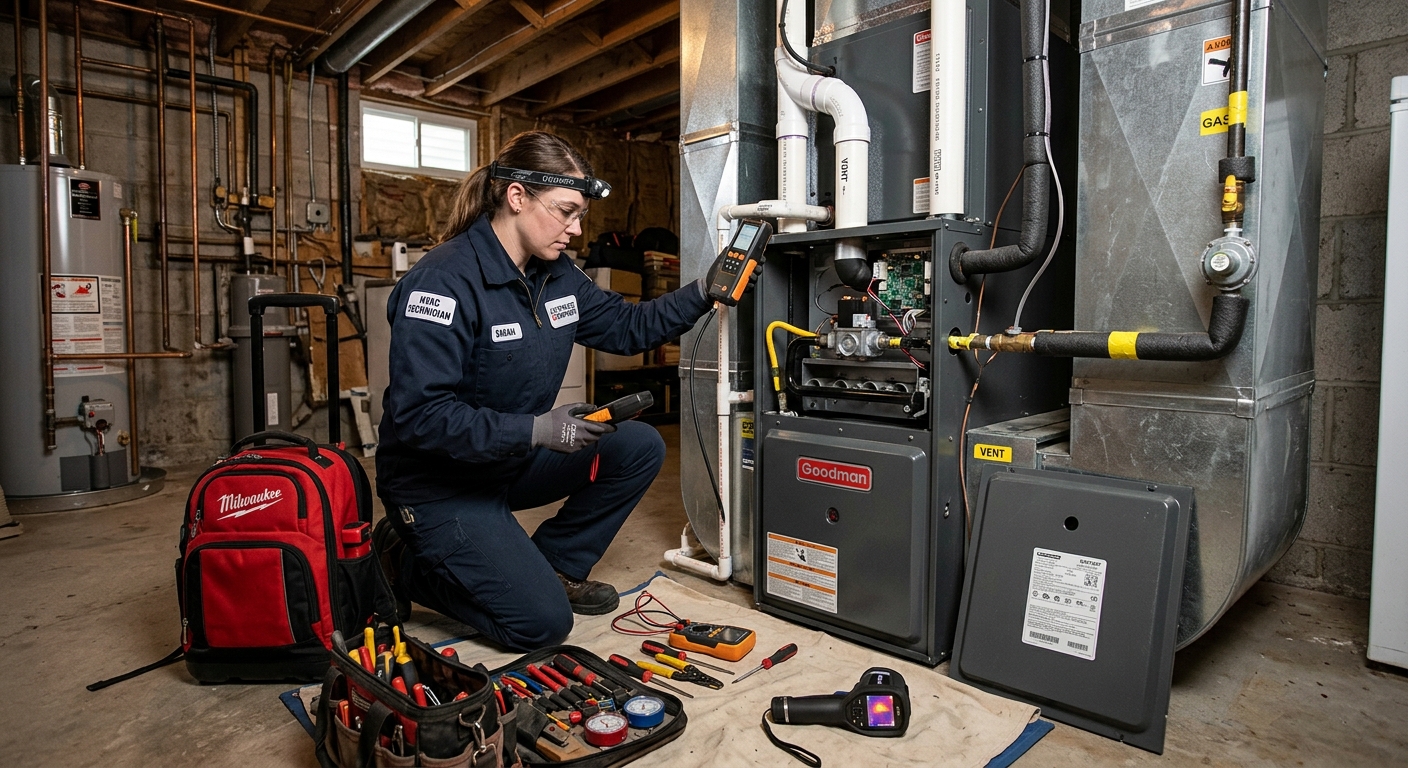
Middletown heating and cooling prices by system type — 2026
Middletown’s HVAC market is shaped by its older home stock and steady share of owner-occupied houses. With 79.7% of homes built before 1980 and only 45.2% owner-occupied (U.S. Census Bureau, ACS 2024), we see a mix: plenty of homes needing full replacements, plus some rental units still running out old equipment. Much of the post-1950 suburban tract housing around Colonial Park and Swatara Township was built with forced-air systems and basic ductwork, so most replacement projects assume ducts are already in place—though how well those old ducts are holding up is always a question. In this region, cooling degree days only reach about 1,250 per year, while heating degree days total over 5,200. That means heating dominates the annual energy bill by a wide margin, which should always steer equipment selection and efficiency choices.
Because winters bring frequent freeze-thaw cycles and winter design temperatures hit 12 °F, the best return for most homeowners comes from reliable, efficient heating. Still, older ducts and some drafty homes may need ductwork repair or sealing along with any system change. Replacement of existing split-system central air is common, but all-electric conversions and ductless mini-splits (for additions or rooms without ducts) have become bigger factors, especially as electrical upgrades become more feasible. Newer equipment offers better efficiency but at a higher upfront cost—so weighing the full install cost against realistic payback in this heating-heavy area is critical.
| System | Best for | Efficiency | Price range (installed) |
|---|
| Central AC replacement (existing ducts) | homes with sound ductwork | 16–20 SEER2 | $4,700–$11,500 |
| Air source heat pump (ducted) | year-round heating and cooling | 8–10 HSPF2 | $7,600–$16,000 |
| Cold-climate heat pump (ducted) | heat pump as primary heat | 9–11 HSPF2 | $12,500–$16,000 |
| Ductless mini-split (single zone) | additions, rooms without ducts | 20–30 SEER2 | $3,000–$6,600 |
| Full duct system installation | homes with no existing ducts | — | $8,500–$17,000 |
Installed estimates for a typical Middletown home. Equipment tonnage, duct condition and electrical capacity move these more than brand.
Middletown's housing stock and its HVAC needs
Middletown’s homes are older than the state average, with nearly 80% built before 1980 (U.S. Census Bureau, ACS 2024). Most houses in the area, especially those in post‑1950 tracts around Colonial Park and Swatara Township, came from the builder with forced-air systems and basic metal ductwork. If you own one of these, you likely have ducts sized for both cooling and heating, though many originals are now leaky, uninsulated, or restricted by later renovations. Insulation levels are typically below current standards, and windows—unless recently upgraded—tend to be single-pane or poorly sealed. That puts more strain on HVAC systems, making load calculations and duct sealing critical at replacement time.
For homebuyers in those tract neighborhoods, the first big HVAC replacement usually hits at 20–25 years. Most original systems were basic 80% furnaces paired with mid-efficiency air conditioners. Builders in the late 1990s and early 2000s sometimes upsized equipment, so your system may be one or even two sizes above what the home actually needs if insulation or windows have been updated since.
For older homes downtown, heating was often the only concern for original builders; many never had central cooling or have marginal electrical service at the panel. All-electric conversions, like a ducted heat pump or multiple mini-splits, may require a heavy-up—a panel or service upgrade. If your home still burns oil or propane, pay attention to the flue and chimney; these may need repair before safe installation of new high-efficiency gas equipment.
What a real HVAC quote contains
Getting quotes in Middletown means sorting the apples from the oranges. A real HVAC quote gives you the tools to compare one contractor’s offer to another—not just a brand, a box, and a round number. The most important items: the exact model numbers for every major component, both inside (furnace or air handler) and outside (condenser or heat pump). These must match for rated efficiency. You want to see the proposed tonnage, with a load calculation (not just copying the old system size—otherwise, past mistakes get repeated).
Your quote should spell out whether the line set (the copper tubing between indoor and outdoor units) will be replaced or reused—and why. Ductwork: is the contractor verifying its condition, proposing sealing or repairs as needed? If your electrical service may need an upgrade, that must be included up front, not hidden as a surprise. Every proposal should specify the thermostat, condensate handling (pump or gravity), and include the price of the mechanical permit. Before you make that final payment, you’re entitled to a commissioning report showing that airflow and refrigerant charge are to spec. Don’t forget to distinguish between the labour warranty (how long your installer stands behind the work) and the manufacturer’s warranty (which covers the equipment itself).
| Line item | What to look for | Red flag if… |
|---|
| Equipment | model numbers, indoor and outdoor matched | brand name only |
| Sizing | load calculation attached | matched to the old nameplate |
| Ductwork | condition assessed, sealing scoped | not mentioned |
| Electrical | circuit and panel capacity confirmed | assumed adequate |
| Line set | replaced or documented as reused | silent |
| Commissioning | measured airflow and charge, documented | no startup report |
| Warranty | labour years stated separately | manufacturer only |
| Permit | included and priced | 'not needed' |
Manual J and the tonnage question
Proper system sizing is the single most important factor for comfort and equipment life in Middletown homes. Oversizing—putting in a system too large for your house—is not a safety margin. It is a defect that causes short cycling, poor dehumidification, temperature swings, and a much shorter service life for your new unit. Yet, contractors frequently size by copying the old nameplate or using rules of thumb like “one ton per 500 square feet.” That ignores your home’s insulation, windows, air leaks, orientation, and the children or adults actually living inside.
The right place to start is a Manual J load calculation—an industry-standard method that considers your house as a whole system. Ask every contractor, “Did you run a load calculation, and can I see it?” If they only match the old equipment’s size, odds are the error is getting copied forever.
This matters all the more because Middletown’s winter design temperature is 12 °F, and the code expects systems to hold comfort on the coldest typical nights. No homeowner should accept a guess when a calculation is required by both good practice and code. The bottom line: You don’t know your system size until you see the load report for your actual, current home.
The central decision for a Middletown homeowner
For most Middletown homeowners, the real decision is not just “which AC unit?” but rather whether to invest in a gas furnace, a heat pump, or a dual-fuel setup. Here, heating wins out over cooling every year—5,200 heating degree days versus just 1,250 for cooling—which means overspending on high-SEER2 cooling rarely pays back what you spend. But it also means that a properly chosen heat pump can make a real dent in your heating bills, especially with modern cold-climate models able to provide meaningful heat at 12 °F, our local winter design temp.
That old objection that heat pumps “don’t work in cold climates” is mostly outdated. Yes, their capacity drops as the temperature dips, but the right cold-climate model will still heat effectively well below freezing. For homes with reliable natural gas service from UGI Utilities, a gas furnace paired with a central AC or as dual-fuel backup still makes sense—especially for larger, leakier homes or those counting on robust hot air during frigid spells. In the rural edges of Dauphin County, where gas lines don’t reach, the comparison shifts to heat pumps versus oil or propane, and here, heat pumps frequently win on both running cost and indoor air quality.
Older homes with no ductwork often end up using ductless mini-splits or considering a full duct install (which is a major expense). Every dollar spent on load reduction—insulation, window upgrades—makes any system you pick smaller, cheaper, and longer-lasting.
| Option | Installed cost | Operating cost here | Best when | Incentive eligible |
|---|
| Gas furnace + central AC | $4,700–$11,500 | lowest with existing gas service | existing gas service, coldest zones | often, but not always |
| Ducted heat pump (cold climate) | $7,600–$16,000 | competitive if house is tight | good envelope, all-electric goal | yes |
| Dual fuel (heat pump + gas backup) | $12,500–$16,000 | lowest at deep cold, flexible | gas on site, deep cold spells | yes |
| Ductless multi-zone | $8,500–$17,000 | mixed, depends how used | no ductwork, zone control | yes |
Mechanical permits for HVAC work in Middletown
Pennsylvania does not issue a statewide HVAC contractor license for residential work. Instead, residential permitting and code enforcement are handled at the municipal level. If you’re in Harrisburg, for example, replacing or installing central HVAC equipment nearly always requires a mechanical permit from the City Codes Administration Office. In nearby Dauphin County townships, local code offices set and enforce their own mechanical permitting rules. Always confirm with your municipality before work begins, to avoid headaches on resale. For basic homeowner maintenance (changing filters, swapping thermostat batteries), no permit is typically required in Harrisburg or most townships.
Regardless of state licensing, any contractor who handles refrigerant must carry EPA Section 608 certification—this is a federal (not state) requirement. Make sure your contractor shows you their Home Improvement Contractor (HIC) registration, which Pennsylvania requires by law for jobs over $500; verify it easily at hic.attorneygeneral.gov. Worker’s compensation insurance is also mandatory for all employers, and you can check status through the WCAIS portal. If you live in a home built before 1978, federal law requires special lead-safe renovator certification for disturbing painted surfaces—again, check documentation before work begins. Doing your homework up front saves costly code or insurance trouble later.
Reading the yellow label
When you compare new systems for your Middletown home, every yellow EnergyGuide label gives you two numbers: SEER2 (for summer efficiency) and HSPF2 (for winter). The higher the SEER2, the less electricity your system needs for cooling; HSPF2 measures heating efficiency for heat pumps. For furnaces, AFUE (Annual Fuel Utilization Efficiency) tells how well it turns gas into heat. In central Pennsylvania, with 5,200 heating degree days and just 1,250 cooling, the winter number (HSPF2 or AFUE) should matter much more to you than SEER2.
Here, investing big in a top-SEER2 (say, 20+) air conditioner usually won’t pay back; we just don’t run the AC that many hours, even in a hot summer. On the other hand, stepping up to a better-than-baseline HSPF2 heat pump or high-efficiency furnace is often worth it, especially as energy prices rise. The real cutoff for worthwhile efficiency upgrades is typically moving from base to mid-tier—for example, choosing a 17 SEER2/9.5 HSPF2 system over base minimums, but not paying thousands more for the rarest, highest numbers. Also note that SEER2 and HSPF2 ratings replaced the older SEER and HSPF in 2023, so you can’t compare old ratings directly with new equipment. Make sure you’re looking at the updated figures to compare apples to apples.
Frequently asked questions — HVAC installation in Middletown
Why do HVAC quotes in Middletown vary so much?
Quotes for HVAC replacement in Middletown can vary by several thousand dollars because local homes span over a century in age, and no two installations have identical starting points. The ductwork in a post‑1950 suburban home may still be solid, bringing a central AC replacement into the $4,700–$11,500 range, while a similar system in a pre-war house could need duct repair, asbestos abatement, or electrical upgrades, pushing the project higher. Some contractors include all code-required permits and startup, while others leave you hunting for missing steps later. Labour warranty, brand, efficiency rating, and even whether the proposal includes things like a new thermostat or replacing the line set all influence price. It's critical to get detailed quotes line by line. Seeing only a brand and a number tells you nothing about what you’re actually buying—and the cheapest bid often hides a shortcut or an upcharge later.
Do I need a permit to replace HVAC in Middletown?
In Middletown and across Dauphin County, permitting for residential HVAC installation and replacement is handled by your local municipality—not a state or county board. For example, the City of Harrisburg requires a mechanical permit whenever central HVAC equipment is installed or replaced, and most townships around Middletown do the same. This ensures work is inspected, properly sized, and code compliant—especially important with older homes in the area. Simple maintenance tasks like replacing filters or swapping thermostat batteries don't require a permit. But for a full replacement or new install, your contractor should pull the permit and either price it as a line item or bake it into the total (expect this with any quote above $500). Always ask to see your permit before work starts to avoid legal and resale headaches.
How is a tax credit different from a rebate?
In Pennsylvania, and Middletown specifically, there’s confusion on this point every year. A rebate is a direct cash-back—you buy, submit your paperwork, and if you qualify, you get money back (sometimes from the utility, sometimes from manufacturers). A tax credit, on the other hand, reduces what you owe on your next tax filing. So if you don’t owe much in taxes (retirees or low-income households), you may not fully benefit from a tax credit, but you’d still get a rebate if available. Some heat pumps and high-efficiency systems in the $7,600–$16,000 installed range qualify for both. It pays to check before you sign—some incentives stack, some don’t, and the requirements are strict about paperwork and timing.
Do I need to be home during installation?
For most HVAC installations or replacements in Middletown, the homeowner should be present at the beginning and end of the job. This lets you walk the installer through access points, confirm scope, and review any areas that need special care. Once work is underway, your presence is helpful but not strictly necessary, provided the crew has clear access, understands alarm codes or pets onsite, and can reach you by phone. At final walkthrough, you get to test the system, receive your warranty documents, and ask about filter changes or thermostat functions. If you’re having a system in the $4,700–$11,500 range installed, especially if it involves a permit inspection, being on hand for the final sign-off protects you if there’s a problem.
Do I need dual fuel in south-central Pennsylvania?
Dual fuel—meaning a heat pump paired with a gas furnace—remains a smart option for many homes in Middletown and rural parts of Dauphin County. Our winter design temperature hits 12 °F, and capacity on even the best cold-climate heat pumps drops on frigid nights. If you already have natural gas service, a dual-fuel system lets you run electric heat most days and switch to gas only when needed, optimizing both comfort and cost. In homes relying on propane or oil, a full switch to a ducted cold-climate heat pump, with a cost of $7,600–$16,000, may actually save more over time. Dual-fuel isn’t mandatory, but it lets you hedge against both fuel price spikes and extreme weather, which is worth real money in a heating-heavy region like ours.
Should I close vents in unused rooms?
In older Middletown homes, closing vents in unused rooms usually sounds like a good way to save money, but it can backfire. Forced-air HVAC systems—especially those installed decades ago—are balanced for the full duct network. Shutting off a register increases duct pressure, which often results in leaks at unsealed joints, stressing the blower motor and possibly causing freeze-ups or short cycling in both heating and cooling. Modern systems, like ductless mini-splits in the $3,000–$6,600 bracket, are zoned by design and let you control rooms individually. If you want to cut back in an unused bedroom, decrease the setpoint at the thermostat this is much safer for both system and bills.
What does a heat pump cost installed in Middletown?
For a typical Middletown home with existing ducts in reasonable shape, replacing with a ducted air-source heat pump runs between $7,600–$16,000 installed. If you need a true cold-climate model for primary heat through our 12 °F winters, expect costs to be at the upper end. Homes without ducts or with rooms needing individual zone control might go for ductless mini-splits, which are $3,000–$6,600 per zone. If you have no existing ductwork and need an all-new system, costs climb fast. A proper quote breaks down exactly what your price covers: equipment, electrical, labor, permit, and any required ductwork modifications. Always budget for contingencies in these older home installations—electrical panels and leaky ducts are common add-ons.
Which utility serves Middletown?
Middletown and most of the surrounding Dauphin County area are served by PPL Electric Utilities for electric needs. If your existing or planned HVAC system is electric-powered—like a new all-electric heat pump in the $7,600–$16,000 installed range—this is where your service, rates, and upgrade requirements will be handled. Natural gas, where available in Middletown and nearby townships like Harrisburg and Lower Paxton, comes from UGI Utilities. In parts of rural Dauphin County, gas lines don’t reach every home, so people often still rely on propane or fuel oil for their heating systems. Knowing which utility covers your address helps you plan for both upfront installation limits and ongoing energy costs.
What size HVAC system does my Middletown home need?
No two Middletown homes need quite the same HVAC size. Pre-1980 construction, older windows, insulation levels, and even how you use rooms all play a part. Square footage alone is not enough. For example, a 2,000-square-foot house in our climate could need a heat pump or AC anywhere from 2.5 to 4 tons—but only a Manual J load calculation can narrow that down. Oversize your equipment and you’ll face short cycling, humidity problems, and higher bills. A good installer will run a calculation against our local winter design temperature of 12 °F, as required by code. Ask every bidder if you’ll see the load report attached to the quote. For most homes in our area, proper sizing will point you at equipment in the $4,700–$11,500 installed band, but always let the math—not the old nameplate—be your guide.