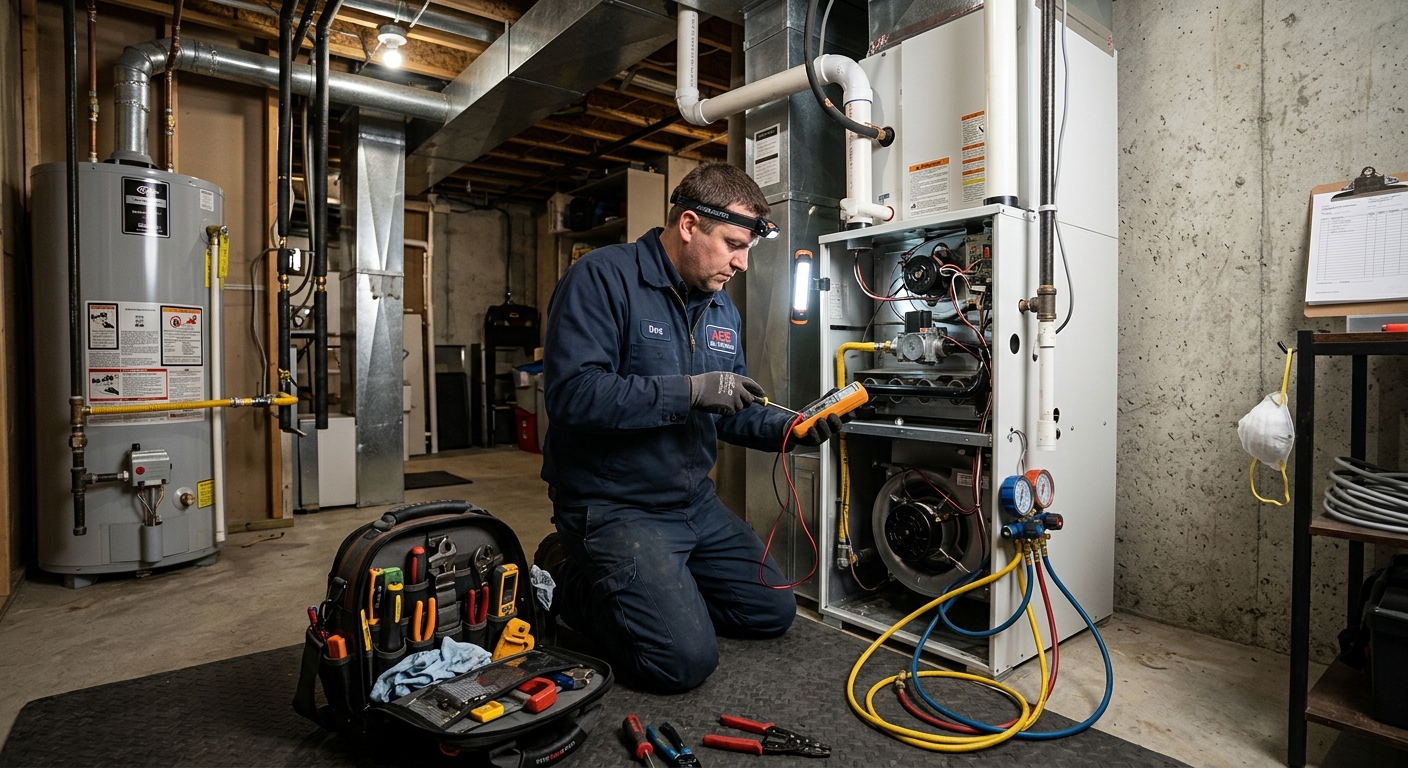
What a new HVAC system costs in Beaver Falls
Beaver Falls is an older, working-class town where most homes were built before 1980 and less than half are owner-occupied (U.S. Census Bureau, ACS 2024). That means HVAC work here is often retrofitting older houses, many with original or outdated ductwork. Both Beaver Falls and neighboring Aliquippa have heavy clusters of pre-1960 mill worker housing. Upgrading or modifying ducts is common, since older systems weren’t built for today's air conditioning or modern high-efficiency equipment. While some houses have sound ductwork, others need substantial overhaul or even an all-new duct system—the labor cost can swing totals widely.
This region is unmistakably heating-dominated, with 5,600 heating degree days and a winter design temperature of 8 °F. That means your system is sized and chosen for winter first, not summer. While summers get hot and humid enough to want good cooling and dehumidification (1,050 cooling degree days), your main investment is keeping warm in our deep cold spells. For most homeowners, sizing a new HVAC system right is vital—not just cost, but comfort and future bills depend on it.
| System |
Best for |
Efficiency |
Price range (installed) |
| Central AC replacement (existing ducts) |
homes with sound ductwork |
16–20 SEER2 |
$4,500–$11,000 |
| Air source heat pump (ducted) |
year-round heating and cooling |
8–10 HSPF2 |
$7,200–$15,500 |
| Cold-climate heat pump (ducted) |
heat pump as primary heat |
9–11 HSPF2 |
$11,500–$15,500 |
| Ductless mini-split (single zone) |
additions, rooms without ducts |
20–30 SEER2 |
$2,900–$6,300 |
| Full duct system installation |
homes with no existing ducts |
— |
$8,100–$16,500 |
Installed estimates for a typical Beaver Falls home. Equipment tonnage, duct condition and electrical capacity move these more than brand.
Gas, electric or both in southwestern Pennsylvania
In Beaver County, the heating season shapes every HVAC decision. Our 8 °F winter design temperature and 5,600 heating degree days (one of the higher counts in Pennsylvania) mean systems are picked for heat first, with cooling a clear second. Historically, many assumed that heat pumps underperform in cold climates, but cold-climate models now maintain useful heating below freezing—even into the single digits. However, their output and efficiency still diminish as the temperature drops, so the deepest cold matters. That’s where dual fuel makes sense—using a heat pump for much of the year and letting a furnace handle those single-digit nights.
If you live in Beaver, Aliquippa, or other boroughs with reliable natural gas, that’s the baseline: gas furnace and central AC or, increasingly, a cold-climate heat pump or dual-fuel setup. But in the outlying rural areas, where propane or oil is common, a heat pump often wins on running cost and convenience. For homeowners aiming to go all-electric—or those facing the high price of filling a propane tank—heat pumps are now a serious competitor.
A gas furnace is still the right choice when your home is already set up for gas, and especially if it’s older or draftier, since high-powered, fast-recovering heat is still king in deep cold. Otherwise, consider a cold-climate heat pump or a dual-fuel system for a balanced approach.
| Option |
Installed cost |
Operating cost here |
Best when |
Incentive eligible |
| Gas furnace + central AC |
$4,500–$11,000 |
moderate |
existing gas service, coldest zones |
sometimes (furnace/AC split) |
| Ducted heat pump (cold climate) |
$7,200–$15,500 |
lower if all-electric |
good envelope, all-electric goal |
often |
| Dual fuel (heat pump + gas backup) |
$11,500–$15,500 |
lower in shoulder seasons |
gas on site, deep cold spells |
possible |
| Ductless multi-zone |
$8,100–$16,500 |
lowest bills, tailored use |
no ductwork, zone control |
often |
Refrigerant rules and your existing system
Refrigerant requirements are changing, but you don’t have to replace a working system just because of a rule change. All new residential systems must now use lower global warming potential (GWP) refrigerants such as R-454B or R-32. This matters only for newly manufactured equipment. If you have a system that uses R-410A—a very common refrigerant from the past two decades—it remains legal to service and recharge it. Your system does not become illegal or require replacement simply because newer models are now different.
What does change is the cost calculus on repairs. As more manufacturers phase out R-410A, getting replacement refrigerant will become more expensive, especially if your system springs a leak. If your R-410A equipment is otherwise reliable and leak-free, you can keep using it. But a major refrigerant leak in an older system becomes a judgment call—a big recharge bill might push you to consider new equipment using the current refrigerants. R-22 systems (common before 2010) are even costlier to repair and nearly always due for replacement.
The bottom line: service your system as usual, but if facing expensive refrigerant repairs, weigh the price carefully against replacement. Equipment doesn’t become illegal overnight—this is about economics, not forced upgrades.
Reading an installation proposal
Comparing HVAC quotes in Beaver Falls is more than picking a brand and a number. A transparent proposal should include model numbers for both indoor and outdoor units—the system only performs as rated if the pair is correctly matched. The quote should reference a load calculation (Manual J) for sizing, not just a quick guess or your old unit’s specs. Ductwork condition, sealing, and the need for repairs or resizing must be addressed, especially in older local homes. Line-set replacement or reuse affects both performance and longevity, and any needed electrical work—including panel upgrades—should be called out. Do not overlook condensate drainage, thermostat inclusion, permit fees, or a commissioning/startup report. Labor warranty is separate from equipment warranty, so make sure both are listed clearly.
A proposal that only lists a brand and total price cannot be compared to one that details scope and components—you’re flying blind on value, performance, and long-term cost. Insist on line items before you sign.
| Line item |
What to look for |
Red flag if… |
| Equipment |
model numbers, indoor and outdoor matched |
brand name only |
| Sizing |
load calculation attached |
matched to the old nameplate |
| Ductwork |
condition assessed, sealing scoped |
not mentioned |
| Electrical |
circuit and panel capacity confirmed |
assumed adequate |
| Line set |
replaced or documented as reused |
silent |
| Commissioning |
measured airflow and charge, documented |
no startup report |
| Warranty |
labour years stated separately |
manufacturer only |
| Permit |
included and priced |
'not needed' |
Why your ducts may be the real problem in Beaver Falls
In Beaver Falls and Aliquippa, where pre-1960 homes dominate, what’s behind your walls matters as much as the shiny new system you’re considering. Duct leakage in older homes is often bad enough to waste a serious share of your heating and cooling—sometimes 20% or more never gets to your registers. A duct blaster test is the tool for measuring this: a fan pressurizes your ducts and quantifies the leaks so you can decide whether to seal or, in some cases, replace.
Many older homes have undersized return ducts, especially if the original design was for a gravity furnace or one much smaller and less powerful than the equipment being installed today. Poor returns make systems run noisy, short cycle, or even freeze up in cooling mode. Long duct runs through attics or crawlspaces—uncommon in new construction but common here—amplify losses, especially if those spaces aren’t conditioned or the ducts are uninsulated.
If your home has visible, accessible ducts, upgrade and seal what’s there before you even think about new equipment. And if your home never had full ductwork—or it’s all inside walls and impossible to reach—a modern ductless mini-split may be the smarter investment. Always test ducts before investing thousands in a new HVAC system. Replacing the system without fixing the ducts is putting new tires on a car with a bent axle.
Permits, licensing and inspections in Beaver Falls
In Pennsylvania, there is no statewide license for residential HVAC work—contractors must hold a Home Improvement Contractor (HIC) registration if the contract exceeds $500. Beaver Falls requires a municipal mechanical permit for any major HVAC installation or replacement, which means your project will be inspected under the Pennsylvania Uniform Construction Code (UCC), based on the International Residential Code. Each town in Beaver County may handle enforcement separately, so always ask about permitting early.
Anyone handling refrigerant—including for AC and heat pump replacement—must hold EPA Section 608 certification, which is federal law and not optional. Verifying a contractor’s HIC registration is easy at hic.attorneygeneral.gov. For workers' compensation insurance (which all employers must carry), check via the WCAIS system before any contractor starts work. Written contracts are required by law for jobs above $500, and you have a three-day right to cancel. Do not hire anyone who offers to “waive your insurance deductible”—it’s prohibited and a red flag.
Manual J and the tonnage question
The number one reason for comfort complaints and high bills in Beaver Falls is an oversized or undersized HVAC system. Many contractors are tempted to simply match the tonnage of the old unit, but that usually copies mistakes from decades ago, especially in houses built before 1960. An oversized system short cycles, runs only briefly, and leaves your house both humid and drafty—it wears out early and never quite feels right. Too small, and you’re cold on the worst days.
The right way—and the way required by code—is a Manual J load calculation. This software-driven process accounts for your home’s size, insulation, window quality, orientation, infiltration, and the actual winter design temperature here (8 °F). Rules of thumb by square footage do not account for any of these, and in this town, older single-pane windows or a recent insulation upgrade can make actual needs diverge by a ton or more.
Always ask your contractor: “Did you run a Manual J, and can I see the results?” A real professional will have this in your file and review it with you. Never accept a proposal sized from your old nameplate.
Frequently asked questions — HVAC installation in Beaver Falls
Do I need ENERGY STAR equipment to qualify for incentives?
No, you do not always need ENERGY STAR labeling to qualify for incentives in Beaver Falls. Some rebate programs and federal tax credits look at specific efficiency ratings—such as SEER2 or HSPF2 numbers—rather than the ENERGY STAR logo itself. For example, a cold-climate heat pump installation in the $11,500–$15,500 range may qualify for federal or utility rebates if it meets minimum efficiency. Always check the specific program rules before buying. In some cases, you could get an incentive for a high-efficiency system even if it’s not ENERGY STAR, as long as it meets the numerical requirements. If you’re considering upgrades, ask the contractor to document the proposed system’s ratings and help with the paperwork; experienced Beaver Falls installers are used to walking clients through this.
Does Pennsylvania license HVAC contractors?
Pennsylvania does not issue a statewide HVAC trade license for residential work. Instead, contractors working in Beaver Falls must be registered with the Home Improvement Contractor program if the contract exceeds $500. You can look them up easily at hic.attorneygeneral.gov. Some larger cities in the state license their own trades, but in Beaver County the main check for residential work is registration, proof of insurance, workers’ compensation, and a permit through the local code office. For your peace of mind, you should always verify these before signing a contract—especially with projects in the $7,200–$15,500 installed cost range. Never skip checking; this is what keeps you and your home legally protected.
Which utility serves Beaver Falls?
In Beaver Falls, your electric utility is Duquesne Light Company, while Columbia Gas of Pennsylvania supplies natural gas to most homes in town. This means you have access to both electricity and gas for home heating, cooling, water heating, and major appliances. Availability of natural gas is a major reason why gas furnaces and traditional AC units are still common in the area, keeping typical replacement costs around $4,500–$11,000. In nearby rural areas where gas might not be available, propane or even oil is more common, and that can change both what equipment you choose and the price to install or operate it. Always check your meter or call the utility if you’re unsure.
Why are my Beaver Falls energy bills high with a new system?
There are several common culprits for high bills after a new HVAC installation in Beaver Falls. First, duct leakage is a serious issue in this area’s pre-1980 housing—sometimes 20% or more of the heated or cooled air never makes it into the living space. If your new system is running with leaking or unsealed ducts, or you have an undersized return, expect bills to stay high. Second, improper sizing (especially oversizing) is common in retrofit jobs—this leads to short cycling and poor humidity control, which drives bills up. Even newer systems in the $7,200–$15,500 range won’t deliver savings if installed poorly. Ask your contractor about commissioning details and get your ducts tested or sealed if you haven’t already.
How much does ductwork add to an HVAC installation?
If your Beaver Falls home needs new ducts or major upgrades, that can add significant cost. A full duct system installed in an older home costs $8,100–$16,500, depending on layout and accessibility. Many homes in Beaver Falls and Aliquippa never had properly sized returns—and in some cases, the original ductwork is impossible to reuse with modern high-efficiency equipment. Sealing, insulating, and upsizing returns or adding new runs can sharply improve system performance and lower bills, but it’s not a minor expense. Always have your existing ducts thoroughly inspected (and tested, if possible) before investing in new equipment. Poor ductwork will eat up any efficiency gains from your new system.
How much does a furnace replacement cost in Beaver Falls?
In Beaver Falls, replacing a natural gas furnace (without major duct repairs) typically falls between $4,500–$11,000, depending on the size of your home, the efficiency of the selected unit, and how accessible your existing system is. If your installation requires significant upgrades to your ducts, returns, or venting, or if you add air conditioning at the same time, that can push the total higher. For oil or propane furnaces—which are more common in rural Beaver County—the price structure may differ, and supply for some models can be tighter. Always get a written, detailed quote so you can see exactly what’s being included, especially labor and warranty terms.
Should I replace the furnace and AC at the same time?
In many Beaver Falls homes, it does make practical and financial sense to replace both the furnace and central AC at once—most existing systems are 15–30 years old and close in age. Modern systems are engineered for specific pairings; mismatched new-and-old equipment often loses efficiency, voids warranties, and makes future service more complicated. The bundled installation cost is often slightly less than doing each job separately. A standard gas furnace and central AC combo in the area typically runs $4,500–$11,000. If budget is stretched, and your furnace is relatively new or in good condition, it’s fine to keep it—just be sure to match specs and check compatibility. Always ask your contractor for the case in your specific home.
How far ahead should I schedule in Beaver Falls?
Summer and winter are peak seasons for HVAC installation in Beaver Falls. If you want to secure your spot with a reputable contractor, aim to schedule work at least 2–6 weeks ahead, especially if you’re planning a major upgrade like a ducted heat pump in the $7,200–$15,500 range. Emergency replacements are possible, but you give up the luxury of choice and risk higher pricing or limited equipment selection. Supply chain kinks are still possible, particularly for specialized or highly efficient equipment. Shoulder seasons—spring and early fall—are less busy and sometimes offer better prices or promotions. If your old system is limping along, don’t wait for a full breakdown in the middle of a heat wave or cold snap.
What is a Manual J load calculation?
A Manual J load calculation is a detailed engineering analysis that determines exactly how much heating or cooling your Beaver Falls home needs at the coldest and hottest times of year. It’s far more precise than guessing by home size. Manual J considers insulation, window type, air leakage, the layout and orientation of your house, and the design temperature—here, 8 °F in winter. Any contractor who gives you a price or size recommendation for a major system in the $7,200–$15,500 range should be using Manual J, not rough rules of thumb or old unit sizing. This ensures you won’t end up with an HVAC system that short cycles, can’t remove humidity, or runs up your bills. Always ask to see a copy before committing.