HVAC Contractor
Pennsylvania
Furnace replacement in Brighton? Our certified technicians cover Brighton, Pennsylvania. AC systems from $4337, heat pumps available. Free estimate — call today.
Several HVAC estimates requested this week in Brighton
Brighton Housing Data — ACS 2024
Older housing stock
67%
of homes pre-1980
Homeowners
2,940
owner-occupied units
Ownership rate
90%
of households own their home
Single-family homes
93%
of housing units
Median household income
$92,930
annual (ACS estimate)
COST RANGE
Estimates based on home size, system type, efficiency rating and installation complexity
Insurance tip: Most homeowner policies cover sudden damage. Ask your contractor about documentation to maximize your claim.
* Estimates for Brighton, Pennsylvania. Final pricing after on-site assessment.
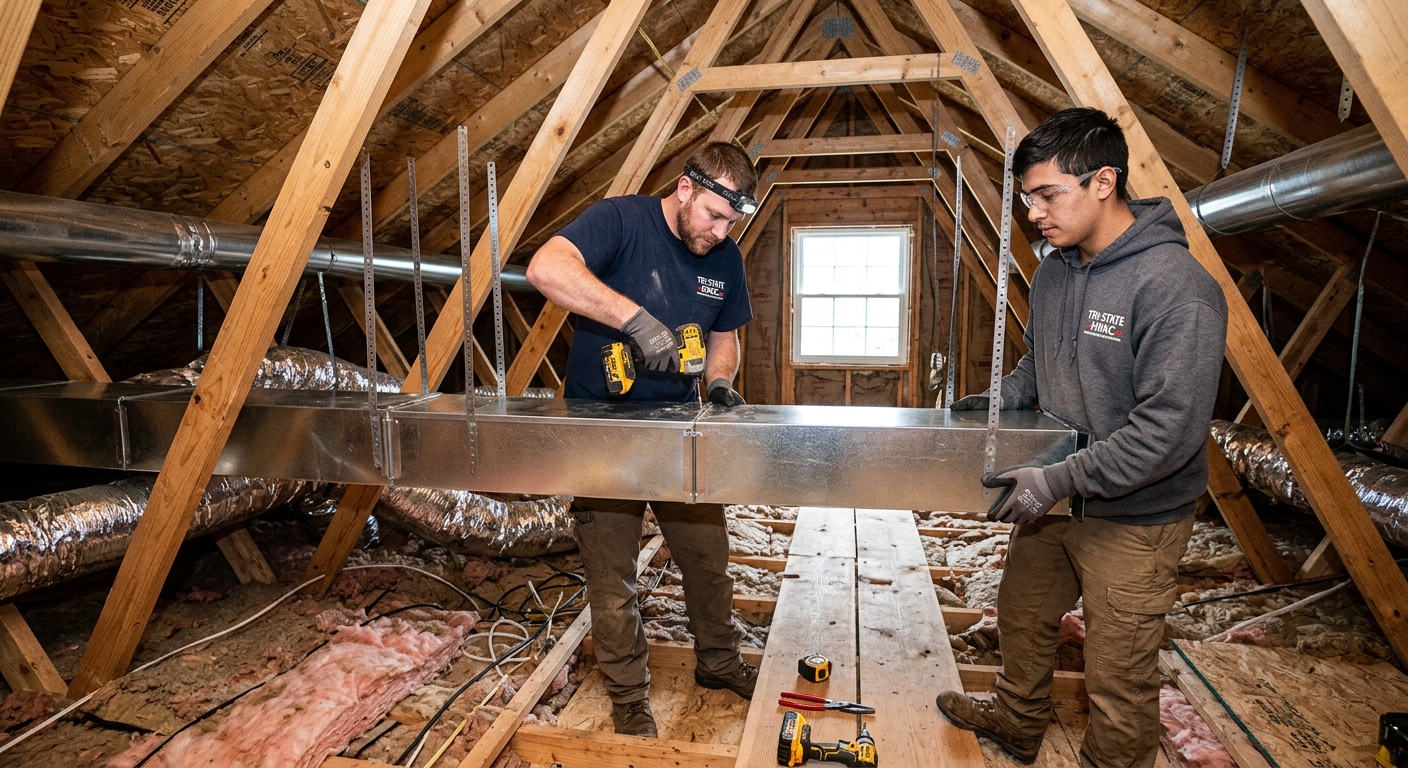
Ductwork installation, sealing and replacement by licensed Brighton HVAC contractors. Properly designed and sealed duct systems improve efficiency by 20-30% and eliminate hot/cold spots throughout your home.
Modern heat pump systems provide efficient heating and cooling for Brighton homes. Our contractors install top-brand systems with proper refrigerant charging, electrical connections and thermostat setup. Cold-climate heat pumps rated for PA winters now available.
Ductless mini-split installation for Brighton homes without existing ductwork, room additions, garages and home offices. Multi-zone systems available — heat and cool specific areas independently.
High-efficiency gas furnace replacement by licensed Brighton HVAC contractors. Proper sizing (Manual J load calculation), venting, thermostat installation and permit pulling. 96%+ AFUE models available for maximum savings on PA heating bills.
Emergency and scheduled AC repair for Brighton homeowners. Our technicians diagnose refrigerant leaks, compressor issues, thermostat failures and electrical problems. Same-day service available during heat emergencies.
Whole-home air purifiers, humidifiers, dehumidifiers and UV germicidal lights installed by licensed Brighton HVAC contractors. Improve air quality, reduce allergens and protect your HVAC equipment.
Annual HVAC tune-up and maintenance by certified Brighton technicians. AC tune-up before summer, furnace check before winter — extends equipment life, improves efficiency and catches problems before costly breakdowns.
Complete central air conditioning installation for Brighton homes. Our licensed HVAC contractors size and install the right system for your home — outdoor condenser, air handler, refrigerant lines, thermostat and ductwork connections. Most jobs completed in 1 day.
Brighton is a community where almost 90% of homes are owner-occupied and more than two-thirds were built before 1980 (U.S. Census Bureau, ACS 2024). Most HVAC work here is replacement or retrofit, not new install, and the age of the housing means you are rarely starting with ideal ductwork. In areas such as Aliquippa and Beaver Falls, you find a lot of pre-1960 homes—these often have patchwork or minimal ducting originally meant for coal or fuel oil furnaces, not properly sized for today’s AC or heat pumps. Upgrading or sealing ducts routinely costs as much as the equipment itself in these neighborhoods.
This part of Beaver County experiences about 5,600 heating degree days and just over 1,000 cooling degree days each year. That means this is unambiguously a heating-dominated climate. Winters aren’t arctic, but they’re reliably cold, so heating system capacity and reliability matter more than chasing the highest cooling efficiency. Central air or heat pumps are practical if you have ductwork in good shape, but many older homes need duct replacement or ductless systems for optimal comfort and efficiency.
| System | Best for | Efficiency | Price range (installed) |
|---|---|---|---|
| Central AC replacement (existing ducts) | homes with sound ductwork | 16–20 SEER2 | $5,300–$12,500 |
| Air source heat pump (ducted) | year-round heating and cooling | 8–10 HSPF2 | $8,400–$18,000 |
| Cold-climate heat pump (ducted) | heat pump as primary heat | 9–11 HSPF2 | $13,500–$18,000 |
| Ductless mini-split (single zone) | additions, rooms without ducts | 20–30 SEER2 | $3,400–$7,400 |
| Full duct system installation | homes with no existing ducts | — | $9,500–$19,000 |
Installed estimates for a typical Brighton home. Equipment tonnage, duct condition and electrical capacity move these more than brand.
Brighton homeowners with air conditioners or heat pumps installed over the past decade will almost certainly have systems using R-410A refrigerant. Under the federal phase-down of high-global warming potential HFCs, new residential systems are now shipping with lower-impact refrigerants like R-454B and R-32. This transition doesn’t mean you have to replace your existing R-410A unit. The current regulations do not prohibit owning or servicing R-410A systems, and parts and refrigerant remain available.
The change does affect long-term maintenance economics. As supply of R-410A tightens, the cost per pound of refrigerant tends to rise. If your system develops a leak, what was once a modest repair can become significantly more expensive just due to the price of the gas. For a Brighton system outside of warranty, particularly if it’s over 10 years old and now needs substantial refrigerant, the math tips sooner toward replacing rather than recharging. For a minor repair or small top-off, repairing still makes sense—the equipment isn’t suddenly obsolete. But on an older unit with chronic leaks, the rising price of R-410A is a real reason to weigh replacement more seriously.
In short: keep an eye on refrigerant charges and overall system age, but don’t feel pressured to upgrade solely because of the regulatory shift. Replacement only becomes the obvious move when the repair costs climb to a hefty fraction of new equipment—and only if the system is truly past its prime.
In Pennsylvania, there is no statewide HVAC technician or contractor license. Instead, all residential HVAC work is regulated at the municipal level, and contractors must hold a Home Improvement Contractor (HIC) registration issued by the Pennsylvania Office of Attorney General for any project over $500. Homeowners should always check a contractor’s HIC registration at hic.attorneygeneral.gov before signing a contract.
Brighton Township, like most of Beaver County, enforces residential building codes based on the Pennsylvania Uniform Construction Code (UCC), itself based on the International Residential Code (IRC). Mechanical permits are required for most central system replacements in municipalities including Beaver Falls; a reputable contractor will include permitting and required inspections in their proposal. Surrounding municipalities may have slightly different permit requirements—Center Township, for example, has its own enforcement office.
Anyone handling refrigerants, whether for installation or service, must hold EPA Section 608 certification—this is a federal (not state or local) standard and applies regardless of local licensing. To verify insurance and workers' compensation, use the WCAIS system at wcais.pa.gov. All Pennsylvania employers are required to carry workers’ compensation insurance, and reputable HVAC contractors will offer proof up front. Don’t skip these steps: proper permitting, insurance and EPA certification are your best basic protections as a Brighton homeowner.
Deciding whether to repair or replace in a Brighton home comes down to age, cost, the specific part that’s failed, as well as the refrigerant situation and energy efficiency. If your system is under 10 years old and needs a typical component swap—think a capacitor, contactor or small control board—repair is almost always the smarter call. When the repair climbs over a third the price of a new replacement (for instance, a major board or motor fix on a 12-year-old unit costing $5,300–$12,500 to replace), you’re at the fork in the road. At 15 years or older, especially with a big-ticket failure, replacement is the answer unless there’s a compelling reason to plug away.
There are two cases where replacement is mandatory: a cracked heat exchanger (immediate safety risk) and a failed compressor on a system that’s out of warranty. These aren’t “wait and see” repairs—they’re “start getting quotes” events. High energy bills? Don’t assume the equipment—often the problem lies in unsealed ducts or poor insulation ($300–$800 for comprehensive testing and upgrades). Efficiency upgrades only pay off if you use the system heavily enough, and in Brighton’s climate, high heating efficiency matters more than peak cooling SEER.
| Situation | Recommendation | Typical cost | Reasoning |
|---|---|---|---|
| Under 10 years, single component failure | Repair | $300–$1,200 | Well within service life, limited downside |
| 10–15 years, repair over a third of replacement | Consider replacing | $5,300–$12,500 | Repair spend adds up quickly at this age |
| 15+ years, any major failure | Replace | $5,300–$12,500 | System at end of useful life |
| Cracked heat exchanger, any age | Replace immediately | $5,300–$12,500 | Carbon monoxide risk can’t be ignored |
| Compressor failure past warranty | Replace | $8,400–$18,000 | High repair cost and new refrigerant rules |
| Working system, high bills | Test ducts and envelope first | $300–$800 | Leaky ducts and poor insulation are common culprits |
In most of Brighton’s older homes—especially those in Aliquippa and Beaver Falls built before 1960—ductwork is a weak link. It’s common to see unsealed or undersized returns, old sheet metal never tested for leaks, or runs through unconditioned attics and crawlspaces. These issues silently waste 20, 30 or even 40% of your conditioned air. Too many system replacements go in on top of flawed ductwork, so the promised efficiency and comfort never materialize.
A duct blaster test is the gold standard for measuring how much air your ducts actually lose. This device pressurizes your duct system and quantifies leakage. If your air handler is in the basement, but you feel drafts or uneven temps upstairs, this test points to leaks. Sealing can fix moderate problems ($300–$800 in this region), but systems with inaccessible, rotted or poorly sized ducts may need a full replacement—which can run $9,500–$19,000 before you even think about new equipment.
The honest advice: in Brighton’s older mill-era houses, test your ducts before committing to new HVAC. It’s almost always cheaper to fix distribution than to oversize equipment and watch your investment leak into the crawlspace or attic. If a contractor doesn’t check—either with a duct blaster or detailed inspection—that’s not a thorough proposal. Ventilation and distribution are inseparable from comfort, especially here.
A complete HVAC installation proposal spells out the details—without these, you have no basis for comparison. You want to see model numbers for both the indoor (furnace or air handler) and outdoor (condenser or heat pump) units. If they’re not matched, the stated efficiency isn’t real. Load calculations (Manual J or similar) should be attached; beware if sizing is based just on your old nameplate. Ductwork details should cover evaluation and any sealing or repairs.
The quote should state whether the line set (the piping connecting indoor and outdoor units) is being replaced or reused, and why. Electrical work matters—adding a heat pump sometimes means a panel upgrade, which is significant in older Brighton homes. Condensate removal, thermostats, permits, and a commissioning startup report should all be listed. Finally, make sure the labour warranty is spelled out separately from the equipment warranty.
If your quote only includes a brand and a price, you are looking at an apple-to-oranges comparison. Insist on detail before deciding.
| Line item | What to look for | Red flag if… |
|---|---|---|
| Equipment | model numbers, indoor and outdoor matched | brand name only |
| Sizing | load calculation attached | matched to the old nameplate |
| Ductwork | condition assessed, sealing scoped | not mentioned |
| Electrical | circuit and panel capacity confirmed | assumed adequate |
| Line set | replaced or documented as reused | silent |
| Commissioning | measured airflow and charge, documented | no startup report |
| Warranty | labour years stated separately | manufacturer only |
| Permit | included and priced | 'not needed' |
SEER2 (Seasonal Energy Efficiency Ratio 2) rates cooling performance—how much cooling output you get per unit of energy in a typical season, with updated test conditions since 2023. HSPF2 (Heating Seasonal Performance Factor 2) is the heat pump equivalent, measuring heating output versus energy used across a heating season. AFUE (Annual Fuel Utilization Efficiency) applies to furnaces and is the percent of fuel actually converted to heat for the house.
In Brighton and Beaver County, heating degree days run over 5,500 each year, with only about 1,000 cooling degree days. This means it almost always makes sense to prioritize HSPF2 in heat pumps and AFUE in furnaces—higher SEER2 is nice if you air condition constantly, but for most households, paying for top-of-the-line cooling efficiency is wasted money. Go for 16–18 SEER2, not the highest, and put your budget into higher HSPF2 or AFUE where it counts.
Older articles use SEER and HSPF ratings, but 2023 brought new test procedures (SEER2 and HSPF2) to reflect more realistic use. Don’t compare old and new ratings directly—always check you’re using SEER2/HSPF2 for system comparisons.