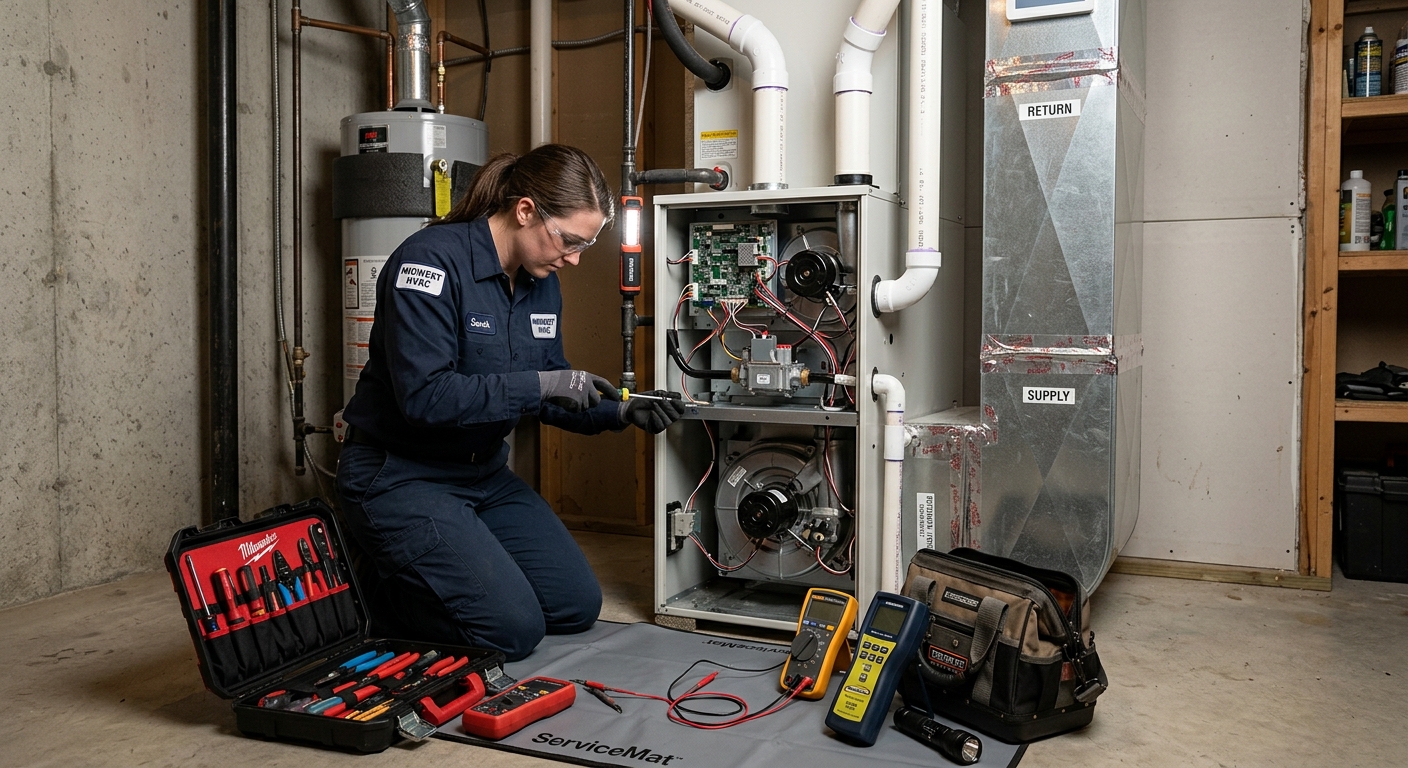
What a new HVAC system costs in Carbondale
Carbondale sits in the northern Lackawanna Valley, a market where 85.7% of homes were built before 1980 and the homeownership rate is just over half (53.0%). That makes this a retrofit-heavy market, not new construction, and most calls involve replacing or upgrading old systems in properties that were often not designed with modern air conditioning or efficient heating in mind. Scranton and Old Forge, with their pre-1940 rowhouse and duplex housing stock, mean custom ductwork solutions or full duct system installations are common—especially since many of these homes never had central AC ducting to begin with.
Northeastern Pennsylvania is a heating-dominated climate—6,100 heating degree days to just 850 cooling degree days—and winters can be severe. Even homes that want central air or heat pump cooling need a strong focus on heating, and that single fact pushes most Carbondale residents toward solutions that excel at both. If your house already has decent ducts, a conventional AC or heat pump replacement makes sense. For homes without ducts, especially older rowhouses or finished attic rooms, mini-splits or new duct systems are the way to go. The wide range in equipment costs comes from differences in configuration, ductwork condition, and size—brand is rarely the main swing factor.
| System |
Best for |
Efficiency |
Price range (installed) |
| Central AC replacement (existing ducts) |
homes with sound ductwork |
16–20 SEER2 |
$4,500–$11,000 |
| Air source heat pump (ducted) |
year-round heating and cooling |
8–10 HSPF2 |
$7,200–$15,000 |
| Cold-climate heat pump (ducted) |
heat pump as primary heat |
9–11 HSPF2 |
$11,500–$15,000 |
| Ductless mini-split (single zone) |
additions, rooms without ducts |
20–30 SEER2 |
$2,900–$6,300 |
| Full duct system installation |
homes with no existing ducts |
— |
$8,100–$16,000 |
Installed estimates for a typical Carbondale home. Equipment tonnage, duct condition and electrical capacity move these more than brand.
Humidity and air quality in Carbondale homes
With Carbondale's long, cold winters and brief humid summers, air quality concerns are seasonal. Low winter humidity is the most common complaint; it can aggravate respiratory discomfort, dry out woodwork, and make your home feel colder than it is. In summer, our 850 cooling degree days still mean sticky August nights, and older houses without proper AC or duct returns can struggle to keep rooms dry and comfortable.
An oversized air conditioner—often sold on the promise of "cooling quicker"—does the opposite of what you actually need: it cools the air fast, but doesn't run long enough to pull out humidity, leaving you with a cold, clammy house. When picking an AC or heat pump, right-sizing for Carbondale is as much about moisture as temperature.
Whole-house humidifiers can offer relief in winter, but keep in mind they require steady maintenance: standing water breeds mold and scale blocks pads fast with our mineral-heavy water. Portable solutions come with less risk, but cover just a room or two.
For air quality, a MERV 11 filter is usually a safe upper limit on existing blowers—anything higher can overwhelm the fan and drop system efficiency. Newer, tightly sealed homes sometimes need mechanical ventilation to bring in fresh air and exhaust stale air, but if your house is a drafty pre-1940 like many in the valley, you may not see enough benefit to justify the spend.
Beware of sellers pushing UV lights, pricey air purifiers, or "ionic" filter add-ons. For most Carbondale homes, a properly sized system, sealed ducts, and routine filter changes do the heavy lifting.
What size system does a Carbondale home need?
System sizing is the most common—and most costly—mistake in Carbondale HVAC installations. Too many houses around here are saddled with oversized equipment meant to "guarantee" comfort in a pinch, but what you get is short cycling: the equipment kicks on, blasts for a minute, and shuts off before it ever gets the air comfortable. That means poor dehumidification in summer, temperature swings year-round, and equipment that wears itself out fast. Oversizing isn’t a safety margin—it’s a defect.
The right way is a Manual J load calculation. That’s a math-backed assessment of your actual home: square footage, insulation, window type, foundation, air leaks, and even your zip code's winter design temperature (for Carbondale, it’s 4 °F). That difference matters—a load calc here will produce a bigger heating demand than somewhere milder, and that number is tied directly to what a system can and should do.
Forget the old “ton per 600 square feet” rule of thumb. That’s how poor fits happen. Ask every contractor: “Did you run a Manual J, and can I see the results?” If all you get is a proposal based on the nameplate of the ancient unit you’re replacing, they’re just copying whoever mis-sized it last—probably decades ago.
Right-sizing is especially crucial given our older stock, much of which was built before central air was even a thought. Custom retrofits in Scranton and Old Forge's old duplexes and Carbondale's own pre-1980 homes make formula fitting risky. Ask for the calculation; don’t pay until you see it.
Separating installers from equipment sellers
Every homeowner in Carbondale eventually asks about “the best brand,” but the difference between a long-lasting heating or cooling system and a money pit isn’t the label—it’s the installation. The same equipment, professionally installed and properly commissioned, will outlast or outperform a top-brand unit slapped in by the lowest bidder.
Start by verifying registration and qualifications. For any contract over $500, Pennsylvania requires the installer to be registered for home improvements. You can verify this at the state’s registry. Every technician who touches refrigerants like R-410A must have EPA Section 608 certification—ask to see it. Confirm coverage by checking workers’ compensation status, as required by law, and make sure the contractor’s policy is active.
A proper quote includes a Manual J load calculation, specific model numbers (not just tonnage), and a commissioning process at startup—measured airflow, confirmed refrigerant charge, and documentation of both. Anything less, and you’re gambling with your comfort for the next 15 years.
- Verify HIC registration for contracts over $500
- Check federal EPA 608 certification for refrigerant work
- Request evidence of workers’ compensation coverage
- Insist on a documented Manual J load calculation
- Get model numbers, not just generic equipment size
- Review detailed written contract, not just a work order
- Ask for commissioning data at project completion
- Look for established physical address and references
- Get warranty terms in writing
- Watch how they handle your questions—are they thorough?
- Ask about permitting process and municipal inspection
- Get multiple bids—don’t just take the lowest or highest price
Carbondale is part of a saturated HVAC market clustered around Scranton and the valley. Watch for the red flags: high-pressure one-call closers, “brand name” pitches with no details, and “special deals” if you sign today. Here, plenty of contractors chase every lead; you can afford to pick the careful ones.
Duct condition, leakage and sealing
In older Carbondale houses, especially the rowhomes and duplexes built before 1940 in Scranton and Old Forge, ductwork is often either absent, undersized, or a patchwork put together for a furnace long before air conditioning was ever considered. That means duct leakage rates can be alarmingly high—sometimes a third or more of your conditioned air escapes before it even reaches a vent. You pay to heat or cool your attic or crawlspace instead of your living room.
A duct blaster test is the only way to know for certain. This pressurizes the system and measures how much air leaks out, shining a brutally honest light on the state of your ductwork. If leaks are moderate, professional sealing (often with mastic and mesh, not just a strip of tape) can close up most problem areas at a fraction of replacement cost. But if ducts are rusty, bent, oversized, or run through freezing attics, replacement is sometimes the better investment.
Another chronic problem in Lackawanna County is undersized or nonexistent return air ducts—especially in older homes—leading to poor airflow and uneven temperatures. Duct runs routed through unconditioned spaces tend to sweat in summer and freeze in winter.
If your home doesn’t already have central ducts, or if the ducts are salvageable but leaky, don’t let anyone sell you a new system without testing first. You should have a firm handle on duct leakage and return sizing before you spend on new equipment—otherwise, even the priciest heat pump will struggle.
Mini-splits and zoning in Carbondale homes
Mini-split heat pumps have become the go-to solution in Carbondale for spaces that never had ductwork—common in the valley’s abundant pre-1940 homes. That covers finished attics, additions, enclosed porches, converted basements, and even rooms at the end of long, underpowered duct runs. Retrofitting ductwork into homes with finished plaster and narrow framing can be a destructive affair; mini-splits sidestep all that with just a small wall penetration.
Single-zone systems (one outdoor unit to one indoor head) are most efficient and simplest to troubleshoot. They suit individual problem rooms or small additions. Multi-zone systems (several indoor heads on one outdoor unit) seem convenient, but they can spread their capacity thin in extreme cold, and comfort—or efficiency—may suffer compared to running multiple single-zone units.
Head placement matters; many homeowners don’t love the look of a wall cassette in their living or dining room, but there are more discreet floor and ceiling options now. Don’t overlook condensate management—even if a head’s on an exterior wall, you need a reliable drain path, especially in a freezing valley winter.
Carbondale’s retrofit reality—homes built before central air was common—makes mini-splits a genuinely good fit, not a sales gimmick. For the right rooms, they deliver comfort and efficiency no ducted system can match, especially where ductwork would cost a fortune or destroy the home’s original features.
Permits, licensing and inspections in Carbondale
In Carbondale and surrounding Lackawanna County municipalities, residential HVAC work is regulated locally, not by any statewide trade license. The Pennsylvania Uniform Construction Code (UCC) sets the rules for the work itself, but it’s administered and enforced at the municipality level—each borough or township may have its own procedures. Statewide, there’s no dedicated HVAC license; contractors working residential jobs exceeding $500 must be registered for home improvements, which you can check directly on the state registry.
Regardless of who you hire, anyone handling refrigerant (like in an AC or heat pump job) must have federal EPA Section 608 certification—this is not optional and it’s easy to confirm. Mechanical permits are usually required for installs, and the completed job needs to pass inspection before you pay. Written contracts are mandatory over $500, and the law gives you three days to cancel—no reputable local contractor will pressure you to waive this.
Always verify insurance coverage, including workers’ compensation. In Pennsylvania, you can confirm workers' compensation status through the state’s designated system. This matters—if a worker is injured on your property and coverage lapses, the risk falls on you.
In short, picking a Carbondale installer is less about statewide credentials and more about transparent paperwork: proper registration, insurance, EPA certification, and a clear contract and permit path.
Frequently asked questions — HVAC installation in Carbondale
How does northeastern Pennsylvania's climate affect system sizing?
With 6,100 heating degree days and a winter design temperature of 4°F, Carbondale is a heating-dominated market, not a cooling one. That means your system has to be sized for reliable comfort during long, cold stretches, but not oversized to the point it short cycles and loses efficiency. Heat pumps and even traditional furnaces need careful Manual J load calculation using local conditions, not generic rules of thumb from milder regions. Compare that to our relatively short cooling season—only 850 degree days—where a right-sized system will also better control summer humidity. For reference, installing the right ducted heat pump can run about $7,200–$15,000 in our area, depending on sizing, but load calculation is what determines if your spend was worthwhile. Don’t let a contractor sell you by the ton—insist on a calculation that fits Carbondale’s true climate.
Why does my system short cycle?
In Carbondale homes, short cycling—where your furnace or AC starts and stops frequently—usually comes down to incorrect system sizing or ductwork issues common in older houses. Oversized equipment is the culprit most often; it cools or heats your home too quickly, never running long enough to dehumidify or distribute warmth evenly. This is a real problem in pre-1980 houses, since many have had new equipment installed over the years without a proper load calculation, just copying the old unit or guessing based on square footage. Besides inefficient comfort, short cycling wears out compressors and blowers fast. If you’re seeing this and know your last install was more about brand than fit, the solution isn’t repair—what you need is proper sizing, even if that means replacing an “almost new” unit. Sometimes, a professional assessment will reveal that a new ductless mini-split (at $2,900–$6,300 per zone) might serve you better in affected rooms.
How is a tax credit different from a rebate?
In Carbondale—as anywhere in Pennsylvania—a tax credit reduces your tax owed dollar for dollar, usually claimed when you file your return, and it often applies to high-efficiency upgrades like energy-saving heat pumps. A rebate, on the other hand, is cash back from a utility or manufacturer, processed soon after installation and purchase, not at tax time. For instance, if you spend $11,500 on a new heat pump, a tax credit might save you a chunk off your annual taxes next April, while a rebate from the utility could arrive as a check or bill credit a few weeks after the job wraps. The key difference is timing and eligibility—don’t count on credits and rebates to be automatic or stackable, and always document your qualifying installation with your contractor.
What is the R-410A refrigerant phase-down?
The federal government is phasing down the use of R-410A, the standard refrigerant in most Carbondale air conditioners and heat pumps, because of its high global warming potential. This means newer equipment may use alternative refrigerants soon, but for the next few years, most replacements and repairs will still involve R-410A. In practical terms, if you’re installing new HVAC now—say a central AC installation for $4,500–$11,000—your choices may include newer, more environmentally friendly options. Service for existing R-410A units isn’t going away, but you can expect rising prices over time as supply shrinks. Discuss with your contractor what refrigerant comes in your new system, and make sure they have an EPA 608-certified technician to legally handle it.
What does a heat pump cost installed in Carbondale?
In Carbondale and Lackawanna County, installing a heat pump is a good solution for both heating and cooling—especially with our long winters and brief, humid summers. For a ducted air source heat pump, you can expect to pay between $7,200–$15,000 installed, depending on the size of your home, whether you need new ducts, and equipment efficiency. While that number may seem broad, most Carbondale homeowners with existing, functional ductwork can expect the lower half of that range. Cold-climate ducted heat pumps are at the higher end for homes planning to use the heat pump as their main heater, reflecting the more powerful—and more expensive—designs needed to deliver comfort at 4°F. Always make sure sizing is backed by a local load calculation and not just a guess from the old system.
Do I need a permit to replace HVAC in Carbondale?
Yes, you do need a permit to replace HVAC equipment in Carbondale and throughout Lackawanna County. The Pennsylvania Uniform Construction Code (UCC) applies, but it’s enforced by your local municipal code office, not the state. That means every replacement—whether central air, heat pump, or new ductwork—requires a municipal mechanical permit and inspection upon completion. Written contracts are mandatory for jobs over $500, and no reputable installer should skip the permit process, since passing inspection protects you as the homeowner. Before any money changes hands, ensure your contractor explains how they’ll pull permits and what inspections are scheduled. If a bid skips this, that’s a red flag for Carbondale residents.
How much does a furnace replacement cost in Carbondale?
While furnace pricing isn’t detailed in the current 2026 price bands for Carbondale, replacement costs generally run alongside or just under entry-level heat pumps. Most homeowners budgeting for a new high-efficiency furnace should expect to spend somewhere in the lower range of a central AC replacement, or around $4,500–$11,000. Price will swing most with the condition of existing ductwork and whether any upgrades or code corrections are required to meet current PA Uniform Construction Code standards. If your home’s ducts are older or undersized, factor in possible duct repair or sealing work, as poorly sized or leaky ducts can cost more in inefficiency than the new furnace itself. Always get a full quote covering both equipment and distribution.
Should I repair or replace my HVAC system in Carbondale?
The answer depends on your system’s age, repair frequency, and efficiency—especially in Carbondale’s older houses where 85.7% were built pre-1980. If your current system is more than 12–15 years old, needs major parts, or fails to deliver comfort (like persistent humidity or cold spots), replacement is usually smarter, especially with the efficiency gains from newer equipment. For smaller, isolated issues in a system less than a decade old, a targeted repair might keep you going until a larger upgrade fits your budget. If enough repairs are adding up to over a third the cost of a new install (say, more than $1,500–$2,000 toward a system that would otherwise cost $7,200–$15,000), it’s time to look at replacement. Always demand a full assessment; don’t trust anyone who pushes replacement without checking the real problem.
How long does HVAC installation take in Carbondale?
Typical HVAC replacement—swapping out an existing central AC or furnace in Carbondale—takes one to two full days for a crew, provided ductwork and electrical are in good shape. Full ductwork replacements, retrofit installations, or adding equipment to older homes with small attics or basements, often common in our pre-1980 stock, can take three to five days. Ductless mini-split installs are faster: a single-zone system can often be up and running in a day, with multi-zone setups adding extra time per indoor head. Don’t be surprised if scheduling and inspection add a day or two—municipal code requirements and density of work crews in our competitive market mean contractors are often booked out, especially during heat waves or cold snaps. Plan at least a week from contract signing for even a relatively straightforward replacement estimated anywhere from $4,500–$16,000 installed.