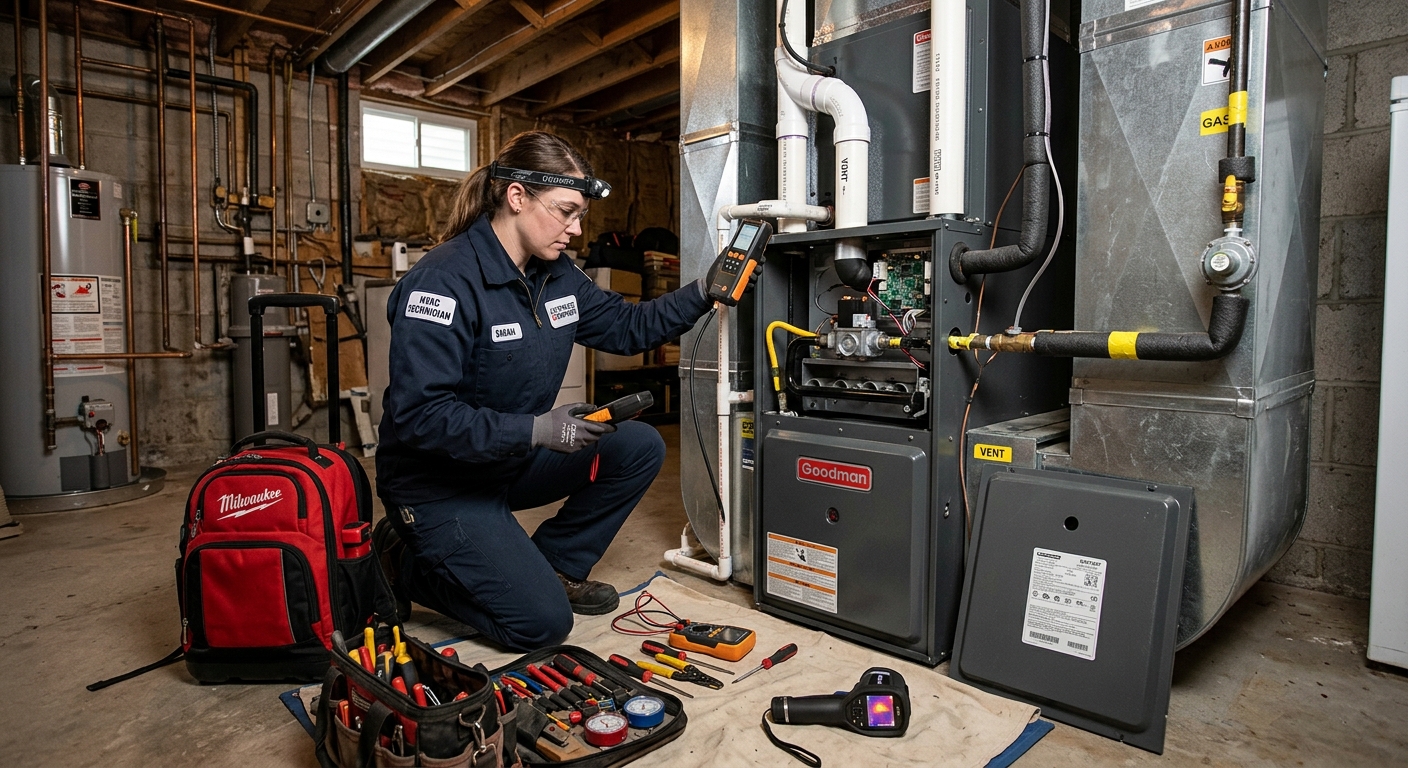
Middletown heating and cooling prices by system type — 2026
Middletown has a high homeownership rate (73.6%) and the majority of homes here were built before 1980. This makes it a market largely driven by system replacements as well as retrofits, not just new installs. With so many homes built before central air was common—especially the 1920–1950 rowhomes and twins found throughout places like Upper Darby and Haverford—existing ducts are often missing, leaky, or simply not present, which shapes both what is possible and what's most economical. Many of the upgrades here involve fitting high-velocity or ductless systems into finished homes rather than doing new construction from scratch.
Middletown sits in a heating-dominated climate: the area usually sees about 4,800 heating degree days versus only 1,450 cooling degree days each year. That means heating—whether by furnace or heat pump—matters more than cooling, and should be your primary concern when prioritizing system efficiency or upgrades. However, summer humidity and the rising expectation for whole-house air conditioning mean that AC retrofits are still common here—often requiring ductless solutions when existing ductwork is limited or absent.
| System |
Best for |
Efficiency |
Price range (installed) |
| Central AC replacement (existing ducts) |
homes with sound ductwork |
16–20 SEER2 |
$5,600–$13,500 |
| Air source heat pump (ducted) |
year-round heating and cooling |
8–10 HSPF2 |
$9,000–$19,000 |
| Cold-climate heat pump (ducted) |
heat pump as primary heat |
9–11 HSPF2 |
$14,500–$19,000 |
| Ductless mini-split (single zone) |
additions, rooms without ducts |
20–30 SEER2 |
$3,600–$7,900 |
| Full duct system installation |
homes with no existing ducts |
— |
$10,000–$20,500 |
Installed estimates for a typical Middletown home. Equipment tonnage, duct condition and electrical capacity move these more than brand.
When ductless is the right answer
Ductless mini-split systems stand out in Middletown when you’re dealing with an addition, a finished attic or basement, or any part of your house the main system never reached. They’re also invaluable in the many 1920–1950 rowhouses and twins built throughout Upper Darby and Haverford. These homes were never designed with air conditioning in mind, and running new ductwork can mean a mess of patched plaster and lost closet space. In many of these cases, tearing up the house for central AC just doesn’t make sense—ductless or high-velocity retrofits are the practical route.
For a single room, a one-to-one (single-zone) mini-split is usually the way to go—efficient, responsive, and easier to hide visually than you might expect. Multi-zone systems put several indoor heads on one outdoor unit, which sounds tidy but can leave you with less power per room and a system that sometimes struggles to keep every area as comfortable as a dedicated single-zone unit would. Head placement is a real consideration—try to put them high on the wall for best coverage, and think through how you’ll drain condensate, especially on older stone foundations where gravity drains aren’t always close by.
Some folks object to the look of indoor heads, but compared to the expense and disruption of ductwork install in these older homes, most end up seeing it as the cleaner compromise. In a housing stock that never had ducts, ductless is often the most cost-effective—and least invasive—option available, even if you have to get used to seeing the heads on the walls.
Filtration, humidification and ventilation
Southeastern Pennsylvania sees both cold, dry winters and sticky, humid summers, so most Middletown homes wrestle with dryness from November through March, and then excess humidity in July and August. The most common air quality upgrades are filtration, humidification, and—less often—whole-house dehumidification or balanced ventilation systems.
A too-big AC is a notorious problem here: if your system is oversized, it’ll cool quickly but won’t run long enough to actually dehumidify, so you’ll be left clammy no matter how cold the house gets. For winter, whole-house humidifiers can help with the cracked skin and creaky floors, but many folks neglect maintenance, so they end up growing scale and mold inside the unit. If you get one, stay on top of filter and pad changes.
Filtration matters, but chasing high MERV filters just because you saw a chart online can cripple airflow in older blowers. Stick to MERV 8 to 11 unless your installer specifically sizes the blower for higher resistance. As for mechanical ventilation (like ERVs or HRVs), it’s mostly for newer, tightly sealed homes—most older Delaware County homes already leak enough air that extra hardware isn’t needed. Of all the add-ons, high-end UV lights and air “purifiers” tend to be sold well past their proven benefit—don’t pay extra unless you have unique medical needs or specific contaminant concerns.
Comparing HVAC estimates in Middletown
When you get multiple HVAC bids in Middletown, they’re only comparable if they’re detailed. A one-line quote listing only a brand and a number doesn’t tell you what’s actually being installed or if corners will be cut. Start with model numbers—both indoor and outdoor units must match for their ratings and warranties to hold. Ask to see the sizing method: any credible quote should show a recent Manual J load calculation, not just a guess based on the old system. Ductwork must be addressed directly, since most older homes have questionable duct quality, sealing, or none at all.
Check if the quote includes new electrical work, a line set for AC systems, and specifics like a new thermostat, upgraded condensate handling, and mechanical permit costs. A commissioning report (measured airflow and refrigerant charge) is the only way to know your system was started up right—few homeowners ever get this, but you should ask. Finally, distinguish between labor and equipment warranties. “Manufacturer’s warranty” usually means parts only; it’s the labor coverage that hits your wallet if there’s trouble.
| Line item |
What to look for |
Red flag if… |
| Equipment |
model numbers, indoor and outdoor matched |
brand name only |
| Sizing |
load calculation attached |
matched to the old nameplate |
| Ductwork |
condition assessed, sealing scoped |
not mentioned |
| Electrical |
circuit and panel capacity confirmed |
assumed adequate |
| Line set |
replaced or documented as reused |
silent |
| Commissioning |
measured airflow and charge, documented |
no startup report |
| Warranty |
labour years stated separately |
manufacturer only |
| Permit |
included and priced |
'not needed' |
Service plans: worth it or not?
Annual service plans get promoted heavily, but their value in Middletown comes down to exactly what you’re getting—and what you’d do yourself. Changing filters at the right interval with a MERV rating matched to your blower (usually 8–11 for most older systems) matters more than paying for someone to change them. Coil cleaning is worth doing every couple of years; neglect leads to performance loss and expensive repairs down the line. Clearing the condensate drain each season matters too, especially with our summer humidity—no one wants an overflow on the drywall.
Refrigerant checks get oversold: topping up a system that “just needs a shot of Freon” means there’s a leak, and if the plan doesn’t address leak detection and repair, you’re throwing money away. Some service plans just add up to an annual filter swap and a quick look for way more than it’s worth. If you’re considering a plan, read the fine print—does it actually include coil cleaning or just “inspect” it? Will you pay extra for every emergency call?
The best time to schedule is spring or early fall, before peak heating and cooling calls hit. You’ll get prompt attention and avoid paying a premium when every HVAC tech is out handling no-cool emergencies in July or no-heat breakdowns in January.
Permits, licensing and inspections in Middletown
In Pennsylvania, there is no statewide HVAC license for residential work; instead, all residential jobs involving contracts over $500 require Home Improvement Contractor registration, checked through the system provided by the state Attorney General’s office. Municipalities like those in Delaware County handle their own code enforcement, including mechanical permits and inspections. For Middletown homeowners, this means the local code office—not the state—will review and inspect your HVAC installation. When a new or replacement HVAC system is installed in local towns such as Upper Darby, you’ll often need a mechanical permit, and the cost or process can differ from one municipality to another.
EPA Section 608 certification is required federally for any technician handling refrigerant, so every installer pulling a vacuum or charging your AC or heat pump must have it—this applies nationwide, regardless of state licensing. To protect yourself financially, check contractors for active workers’ compensation insurance through the system at WCAIS. Proper insurance is not optional; don't just take a contractor’s word—verify through the official portal. Finally, because of strict consumer protection laws in Pennsylvania, written contracts are required for jobs over $500 and you have a three-day cancellation window; never sign work off a handshake or oral promise.
Sizing: why bigger is worse
The temptation to install a “bigger” system is everywhere in the HVAC world, but in Middletown’s variable climate, oversizing is the worst error a contractor can make. If your furnace, AC, or heat pump is too large, it won’t run long enough to evenly heat or cool the house; instead, it cycles on and off quickly. This “short cycling” means rooms get stuffy or chilly, humidity isn’t controlled, and your equipment wears out years ahead of schedule.
A proper Manual J load calculation measures your home’s specific needs, using everything from window area to insulation to direction the house faces, and is built for our winter design temperature of 14 °F. The old practice of guessing by square footage or matching whatever the old unit was is just wrong—if the last system was oversized (common in older Delaware County homes), doing it again only makes things worse. You want steady, gentle heat or cooling, with runs long enough for even comfort. The most important question to ask any HVAC company is, “Did you run a load calculation, and can I see it?” If they only copy numbers from the existing hardware, you’re getting yesterday’s guess, not today’s engineered answer. Proper sizing is more important to your year-round comfort—and energy bills—than any feature or brand you’ll be pitched.
Frequently asked questions — HVAC installation in Middletown
How far ahead should I schedule in Middletown?
The busiest seasons for HVAC contractors in Middletown and Delaware County are right before extreme heat or cold sets in—usually late June through mid-July for cooling, and late October through early December for heating. If you want a full system replacement or new installation and would like to avoid waiting in a backlog, it’s smart to schedule three to six weeks ahead, especially for large jobs that involve permitting or ductwork. Early spring and early fall are the ideal times, since crews aren’t tied up with no-heat or no-cool calls and can spend more time on your job. For reference, a full duct system installation often takes several days and runs $10,000–$20,500 depending on the complexity, so advance planning pays off. Contractors appreciate clients who plan ahead—it increases your chances of a clean, unrushed job.
Do older Middletown homes need ductwork replaced?
Most Middletown homes—especially those built before the 1980s—were either built without forced air or have older ductwork sized for heating only. It’s very common in places like Upper Darby and Haverford for existing ducts to be poorly sealed, undersized, or full of leaks and dust. If you’re replacing your HVAC, you may not have to fully replace all ducts, but you should insist on a thorough inspection and pressure test. Properly sealed and insulated ducts can greatly improve system performance, especially in heating-dominated climates like ours. If major replacement is necessary (for instance, to run central air in a rowhouse that never had it), new ducts can add $10,000–$20,500 to the project, so careful evaluation is warranted. A reputable contractor won’t push full duct replacement if repair or high-velocity retrofits will do.
How much does ductwork add to an HVAC installation?
In Middletown, where many homes lack central ductwork or have aging, makeshift systems, adding a full new duct system is usually the largest cost beyond the equipment itself. For a typical house, full duct installation typically runs $10,000–$20,500, on top of the price for the furnace, air conditioner, or heat pump (which can be another $5,600–$19,000 depending on equipment type). If your house has partial or leaky ducts, repair and sealing are sometimes possible at much lower cost. In older rowhomes and twins, running new ducts can be impractical, so ductless or high-velocity options are often a smarter investment. Always have existing ducts pressure-tested before making a decision—you might not save much by reusing poor ductwork.
What is SEER2 and how is it different from SEER?
SEER2 is the updated federal efficiency standard for air conditioners and heat pumps, replacing the old SEER test in 2023. For Middletown homeowners, SEER2 ratings reflect real-world system performance under stricter test conditions that better represent actual ductwork and airflow resistance common in older Delaware County homes. The numbers run slightly lower than SEER for the same equipment, so a 16 SEER2 unit is roughly equivalent to a higher SEER under the old standard. When comparing bids, make sure they quote SEER2 numbers—otherwise, older or inflated SEER ratings can be misleading. For example, today’s replacement central AC systems are typically rated 16–20 SEER2 and run $5,600–$13,500 installed, with better operating costs than previous-generation systems.
Can a heat pump heat my house without backup?
In Middletown’s climate, an air source heat pump can handle most of your winter heating—especially the new cold-climate models, which are tested down to 14 °F (our local winter design temperature). For many homes, a properly sized and installed heat pump is enough to get you through the year without ever turning on backup electric strips or a gas furnace. However, in the absolute coldest snaps, backup may still kick in for maximum comfort or to speed up recovery from setbacks. The newest cold-climate heat pumps are designed specifically for our conditions and perform far better than heat pumps from even a decade ago. A full cold-climate system installation in Middletown typically costs $14,500–$19,000.
What does a heat pump cost installed in Middletown?
Installed cost for a ducted air source heat pump in Middletown runs from $9,000–$19,000, depending on home size, ductwork needs, and equipment efficiency. Cold-climate models with higher HSPF ratings for better winter performance command the top end, from $14,500–$19,000. These prices include the system, labor, and typical accessories—not major duct replacements, which are extra. Because older Middletown homes often require duct modifications or full retrofits, your actual price may vary. Upfront cost is higher than just replacing an AC, but you get year-round comfort, and in many local homes, this can mean significant utility savings by eliminating fuel oil or aging resistance-baseboard heat.
How do I verify an HVAC contractor's insurance?
In Pennsylvania, and specifically in Middletown, all residential HVAC contractors with employees are required to carry workers’ compensation insurance. Before you commit to any installation, ask the contractor for their workers’ comp policy information and then verify it directly using the WCAIS system via the state portal (see the official link from the Attorney General's office). This verification is critical because, if a worker is injured on your property and the contractor isn’t properly insured, you could be financially responsible. Don’t rely on paperwork provided by the contractor—they can become outdated or misleading. Labor coverage for your project is just as important as the manufacturer’s warranty on equipment costing $5,600–$19,000. Due diligence up front protects you from major risk later.
How often should I change my filter?
In Middletown, the standard advice is to check and change your HVAC filter every one to three months, depending on the type and your household’s habits. If you have an older system or a lot of dust from construction or pets, you’ll want to check even more often. Using a MERV 8–11 filter works well for most homes; higher ratings can restrict airflow and strain older blowers. Remember, a clogged filter raises your system’s workload and shortens its lifespan—nobody wants to pay for a heat pump or AC replacement at $9,000–$19,000 sooner than necessary. Mark your calendar, or set a phone reminder; filter changes are cheap insurance for any HVAC system, especially in houses with older ductwork.
Are duct sealing and insulation eligible for incentives?
Duct sealing and insulation upgrades have been known to qualify for rebates or tax credits through certain utility programs and federal energy incentives, though programs can change year by year. In Middletown and across Delaware County, PECO occasionally offers rebates for duct sealing as part of comprehensive efficiency upgrades, especially for homes built before 1980—of which we have many. The cost for a full duct sealing job is typically much less than new equipment—often under a thousand dollars compared to $10,000–$20,500 for a full new duct system. It’s worth asking your contractor what’s current; just be wary of any company who promises massive rebates without written proof or requires you to pay for “paperwork processing.” Always check directly with the utility or official state rebate websites for eligibility and current offers.