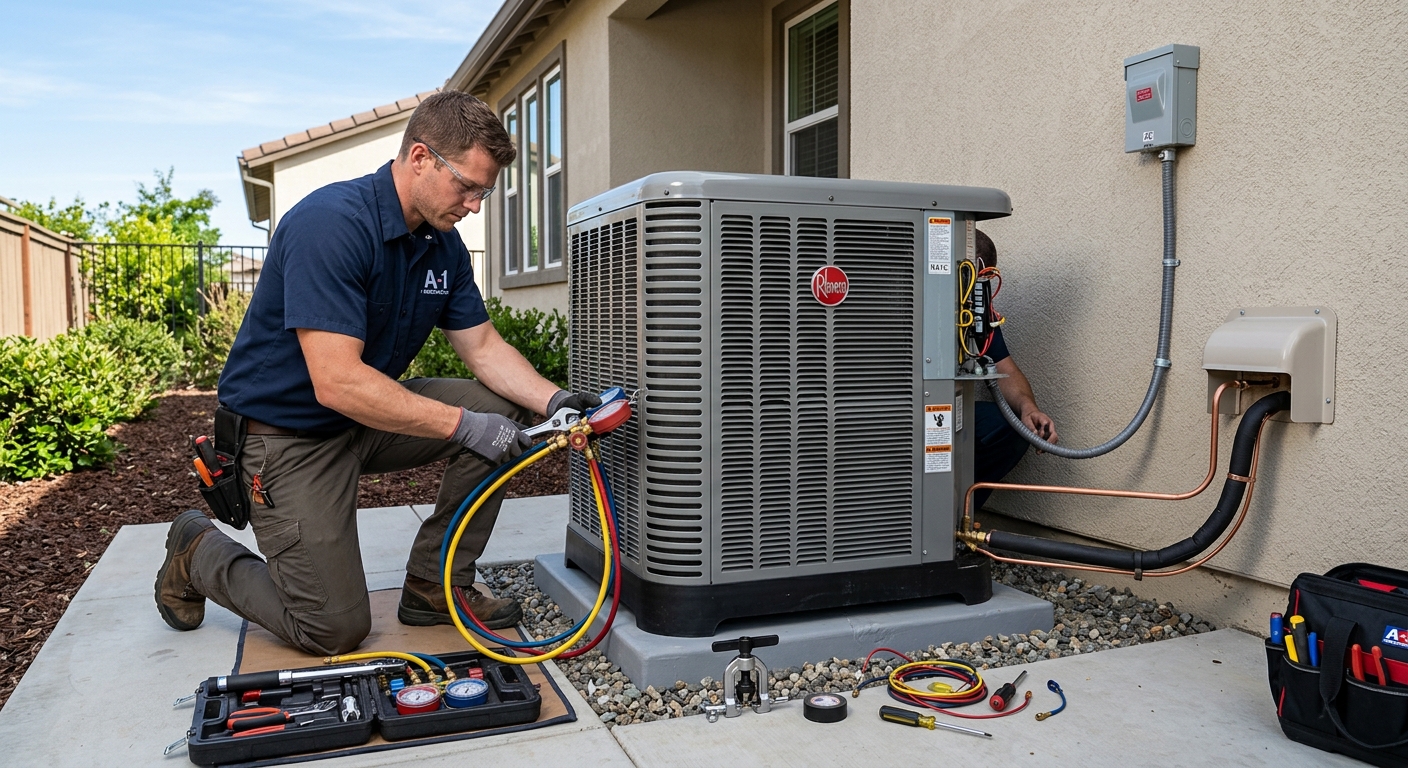
HVAC costs in Chambersburg — 2026
In Chambersburg and the surrounding Franklin County area, most homes were built between 1950 and 1980, with over 66% of the housing stock predating 1980 (U.S. Census Bureau, ACS 2024). This matters for HVAC choices: many of these older houses either lack central air ducts or have ductwork sized only for heating. Add in that just over 42% of homes are owner-occupied, and this is a replacement-heavy, retrofit-driven market—homeowners are contending with aging or poorly designed legacy systems more than they’re installing first-timers in new builds.
Our region is squarely heating-dominated, with about 5,200 annual heating degree days and just 1,250 for cooling. That means recommendations here will always give more weight to heating performance: a piece of equipment that only shines on scorching summer days doesn’t justify its cost here unless your winters are otherwise covered.
When replacing a system in a typical Chambersburg home, expect to pay more if your ducts need work—many ranch and split-level homes here require duct upgrades or full replacements. Your true total will swing less by brand and more by whether your existing ductwork is reusable, what size equipment you need, and whether your home can support high-efficiency heat pumps or mini-splits electrically.
| System |
Best for |
Efficiency |
Price range (installed) |
| Central AC replacement (existing ducts) |
homes with sound ductwork |
16–20 SEER2 |
$4,600–$11,000 |
| Air source heat pump (ducted) |
year-round heating and cooling |
8–10 HSPF2 |
$7,400–$16,000 |
| Cold-climate heat pump (ducted) |
heat pump as primary heat |
9–11 HSPF2 |
$12,000–$16,000 |
| Ductless mini-split (single zone) |
additions, rooms without ducts |
20–30 SEER2 |
$3,000–$6,500 |
| Full duct system installation |
homes with no existing ducts |
— |
$8,400–$16,500 |
Installed estimates for a typical Chambersburg home. Equipment tonnage, duct condition and electrical capacity move these more than brand.
Retrofit versus replacement in Chambersburg
Given that over two-thirds of Chambersburg’s homes were built before 1980, most replacement projects here are retrofits. If your home falls in this range, odds are it was designed for a basic furnace—with minimal or no central air provision. Ducts may exist, but they were often sized strictly for heating loads, not the larger airflow needed for AC. Insulation is usually below modern standards, and window performance may be poor-drafty, single-pane windows are typical in original homes.
If you’re looking at a full replacement, be wary of simply swapping units. Undersized ducts and inadequate insulation can undermine any new investment. In many older ranch and split-level homes, the electrical panels are also marginal by today’s standards, which can complicate a switch to all-electric systems like heat pumps. And if you’re staying with gas, chimneys and metal flues often need to be checked—or relined—because original liners might not meet current venting requirements.
For the newer homes in the suburbs around the Norland Avenue corridor, builder-grade systems from the late 1990s are now reaching end of life. Here, retrofits are a bit simpler: ducts and wiring were usually sized for both AC and heating from day one, but the original equipment is often just “good enough”—underscoring the value of careful sizing and not just picking the same size unit again.
Mechanical permits for HVAC work in Chambersburg
In Pennsylvania, there’s no statewide HVAC trade license requirement for residential work. Instead, contractors must hold Home Improvement Contractor registration from the Office of Attorney General for jobs over $500—verify at hic.attorneygeneral.gov. For residential work, like replacing your furnace or AC, regulation happens locally. In the Borough of Chambersburg itself, you’re looking at the local Code Enforcement Office for mechanical permits and inspections. Most Franklin County townships also operate their own permitting offices.
EPA Section 608 certification is federally required for anyone handling refrigerants—so whoever installs or charges your system must hold it no matter what the municipality requires. Any major replacement or installation of central HVAC equipment in Chambersburg will require a permit and usually a final inspection. In smaller township projects (like a basic filter change or thermostat swap), you rarely need a permit.
Insurance and workers’ compensation are non-negotiable for any company with employees. Check insurance documents and confirm workers’ comp coverage via the WCAIS system at wcais.pa.gov. All estimates over $500 demand a written contract under the Home Improvement Consumer Protection Act, and contractors are prohibited from waiving insurance deductibles.
Mini-splits and zoning in Chambersburg homes
Ductless mini-split systems genuinely shine in places where running new ductwork would be disruptive or cost-prohibitive. Many Chambersburg homes, especially ranches and split-levels built from the 1950s through the 1980s, fall exactly into this category. Finished attics, enclosed porches, converted basements, and additions are prime spots for mini-splits, since they were often never reached by the original ducted system—if one exists at all.
Single-zone systems (one indoor head per outdoor unit) are typically more cost-effective and efficient per room ($3,000–$6,500 for a stand-alone space). Multi-zone units may seem tidier, but running several heads off one outdoor unit often means underperformance and less ability to independently balance comfort. Placement is a real-world concern: big heads on your living room wall aren’t for everyone, and proper condensate drainage needs to be planned, not guessed at. Expect visible linesets if you’re not opening up finished walls.
Franklin County’s dominant housing era parallels the rise of ductless as the default retrofit solution: many homes never had central air, so there’s no legacy system to tie the project’s cost or the new configuration. If the room desperately needs cooling (or supplemental heat) and tearing open plaster isn’t in the budget, a ductless mini-split almost always beats the alternatives.
Why your ducts may be the real problem in Chambersburg
In Chambersburg’s older homes—largely built between 1950 and 1980—ducts are often the weakest link in heating and cooling. Duct leakage can waste 20–30% of the air your furnace or AC produces. This is money lost before it ever reaches your living space. A duct blaster test is the gold standard for measuring how much air your system actually loses to unconditioned areas, like attics or crawlspaces.
Duct sealing (using mastic or aerosolized sealant) can bring down leakage dramatically, but if your system depends on undersized returns—a common issue in this region’s ranch and split-level homes—even perfect sealing won’t solve airflow or comfort complaints. Ducts running through uninsulated attics, crawlspaces, or over garages lose heat in winter and pick up heat in summer, further dragging down your comfort and driving up bills.
Many legacy duct systems in Franklin County were sized only for furnaces, not for central AC or modern heat pumps. That means limited supply runs (the "branches") or, just as commonly, returns not big enough for the airflow that high-efficiency systems demand. If you’re considering a full HVAC replacement, don’t just focus on the shiny new box: test your ducts—don’t take guesses. A $400–$600 test and some basic repairs often save more than costly new equipment. In short, solve the distribution before replacing the producer.
Reading an installation proposal
Don’t accept a proposal that’s just a brand and a bottom-line price. A solid quote in Chambersburg will call out the model numbers for both the indoor and outdoor units—these need to be matched for you to get the efficiency claimed. You’ll want to see the load calculation that determines tonnage, not just a unit “the same size as before." Details on whether the line set is being replaced or reused matter, especially with heat pump or AC retrofits. If a panel upgrade or circuit work is required, that should be called out. Look for details about new condensate pumps, smart thermostats, and explicit mention of permit costs. After installation, a startup or commissioning report—showing measured airflow and charge—is the only honest proof the system isn’t just “wired up and running.” Labour warranty is not the same as a manufacturer's part warranty—these should be spelled out separately.
| Line item |
What to look for |
Red flag if… |
| Equipment |
model numbers, indoor and outdoor matched |
brand name only |
| Sizing |
load calculation attached |
matched to the old nameplate |
| Ductwork |
condition assessed, sealing scoped |
not mentioned |
| Electrical |
circuit and panel capacity confirmed |
assumed adequate |
| Line set |
replaced or documented as reused |
silent |
| Commissioning |
measured airflow and charge, documented |
no startup report |
| Warranty |
labour years stated separately |
manufacturer only |
| Permit |
included and priced |
'not needed' |
What each system actually costs to run in Chambersburg
Calculating operating costs starts with our climate: Chambersburg sees about 5,200 heating degree days and 1,250 cooling degree days each year. That’s a clear nudge towards prioritizing heating efficiency over cooling alone. For electricity, most of Franklin County—including Chambersburg—gets service from West Penn Power. You’ll find your actual kWh (kilowatt-hour) rate on your monthly bill—it often appears as a “price to compare” box.
Here’s the basic math for comparing systems:
- 1. Find your electricity or fuel rate on your utility bill (for West Penn Power, look for “Supply Charges” per kWh).
- 2. Find the unit’s efficiency (SEER2 for cooling, HSPF2 for heat pumps, AFUE for furnaces).
- 3. Use degree days: your annual load in BTUs depends on our winter or summer (heating dominates in our region).
- 4. Figure delivered comfort: leaky or undersized ductwork throws a wrench in all this—good ducts make average equipment shine, while bad ducts make high-end units wasteful.
Example: Say you have a 2,000 square foot house and your West Penn Power bill lists $0.16 per kWh. A typical heat pump might use 7,000 kWh/year for heating and cooling, costing 7,000 x 0.16 = $1,120 annually. A high-efficiency cold-climate heat pump could cut that by 10–20%, but not if your ducts leak. If your ducts lose 25% of the air (common in older homes here), your “savings” are on paper only.
In short: compare kWh used x actual rate, and always fix those ducts first—real-world results depend as much or more on distribution as on the shiny label on new equipment.
Frequently asked questions — HVAC installation in Chambersburg
Should I close vents in unused rooms?
Closing vents in unused rooms inside your Chambersburg home might seem like a good way to save on heating or cooling costs, but in practice, it can do more harm than good. Our older ducted systems, especially in Franklin County’s 1950–1980 homes, were designed for balanced airflow across the entire house. Shutting off vents increases back-pressure on the blower, making the system work harder. This can lead to increased wear and reduce equipment lifespan. Worse, it magnifies existing duct leakage—forcing more conditioned air out any weak seams or gaps instead of redirecting it to other spaces. If comfort or efficiency is your concern, a professionally zoned system or a ductless mini-split ($3,000–$6,500 for a single-zone unit) is a better way to control temperatures room-by-room without undermining the rest of your ducts.
How much does ductwork add to an HVAC installation?
In Chambersburg, many homes built before 1980 need ductwork upgrades when installing a new HVAC system—sometimes to add central AC or heat pumps, sometimes just to seal up old leaks. Installing a new duct system throughout a house generally runs $8,400–$16,500. If your existing ducts only need basic repairs or sealing, that cost may be far lower, but you’ll only know for sure after a thorough duct inspection or blower door test. For a typical retrofit in an older Franklin County ranch or split-level, expect ductwork to be a major fraction of the total job cost. If your existing ducts are in good condition and properly sized, a straight replacement for the equipment (say, a central air unit at $4,600–$11,000) is all you pay. Always test the ducts first so you don’t overinvest in new equipment that can’t deliver its full output.
What is SEER2 and how is it different from SEER?
SEER2 is the updated efficiency rating for air conditioners and heat pumps, replacing the older SEER system. Both are measures of seasonal energy efficiency, but SEER2 uses stricter laboratory test procedures that better reflect real-world conditions—specifically, higher external static pressure and airflow similar to what’s often found in older Chambersburg homes with aging ducts. This means a unit rated 18 SEER2 will typically perform a little better under messy, leaky house conditions than one rated the same under the old SEER method. When comparing quotes, just make sure you’re comparing SEER2 ratings with other SEER2 ratings, not mixing old with new. For example, central AC replacement for most homes here falls in the $4,600–$11,000 range, and higher SEER2 could cut your summer cooling bill—but don’t pay top dollar strictly for a number if your ducts need work first.
How does south-central Pennsylvania's climate affect system sizing?
Chambersburg’s climate is heating-dominated, with a winter design temperature dropping to 12°F and 5,200 annual heating degree days. This means your HVAC system needs to be sized first for reliable, efficient heating—cooling loads are still real (with about 1,250 cooling degree days), but take a back seat here. Oversizing for summer comfort can lead to short-cycling in winter, poor humidity removal in summer, and uneven temperatures. For many retrofits, especially heat pumps ($7,400–$16,000 installed), an accurate heating load calculation using local degree days is essential. A contractor should always make sizing decisions using these Chamberburg-specific temperature extremes, not just square footage or outdated rules of thumb.
Who inspects HVAC work in Chambersburg?
For HVAC installs and replacements inside the Borough of Chambersburg, the Borough’s own Code Enforcement Office is responsible for issuing mechanical permits and conducting final inspections—this is separate from state or federal oversight. In surrounding townships, each municipality typically manages its own permitting. Regardless of where you live in Franklin County, major work—like a central AC replacement ($4,600–$11,000) or new heat pump install—will almost always require a permit and inspection. These inspections check for code compliance, safety, and mechanical soundness. Filter swaps and most thermostat upgrades don’t need permits. Ask your contractor up front whether a permit is included in their estimate, because “no permit needed” can be a red flag.
Should I replace the furnace and AC at the same time?
In many Chambersburg homes, especially those with aging or original systems from the 1960s–1980s, replacing both furnace and AC at once can make sense—especially if your ductwork is being overhauled, or if the systems are both near end of life. Dual replacements ensure matched airflow, compatible controls, and full warranty coverage. Sometimes, however, one system is still working well, and money is tight—doing just the AC (at $4,600–$11,000 for a typical installed cost) or the furnace can buy you time. If you’re considering a shift to an all-electric option like a heat pump ($7,400–$16,000), a full swap makes electrical upgrades and duct modifications cost less per system. Always have a contractor check the current system’s age and any obvious signs of decline before deciding.
How long does HVAC installation take in Chambersburg?
Most straight HVAC replacements in a typical single-family Chambersburg home are wrapped up within one to two working days. If you’re switching fuel types (say, from oil or propane to a heat pump) or replacing all ductwork—which in older Franklin County ranches isn’t uncommon—it can stretch to three or four days, especially if electrical panels or significant drywall work is involved. Installing a single-zone ductless mini-split ($3,000–$6,500) can often be finished in a single day. More complex multi-zone or whole-home duct system installations ($8,400–$16,500) take longer, especially in finished homes where running new ductwork means accessing tight attic or crawlspace spaces. Permitting and inspections may add a day or two, depending on the borough or township’s schedule.
What does a heat pump cost installed in Chambersburg?
A ducted air-source heat pump properly installed in a Chambersburg-area home will usually run between $7,400–$16,000, depending on size, efficiency rating, and any duct upgrades needed. For older homes with limited or leaky ducts, adding or replacing ductwork can push total costs higher ($8,400–$16,500 for a full new duct system). If you’re considering a cold-climate ducted model—an increasingly smart choice due to our 12°F winter design temp—expect the total to shade toward the upper end of that band. Smaller ductless single-zone heat pumps run less ($3,000–$6,500), but won’t heat a whole house. The final number depends on labor, permits, local code requirements, and the electrical service in your home.
Do I need ENERGY STAR equipment to qualify for incentives?
In Pennsylvania, some incentives do require ENERGY STAR-rated equipment, but not all. Rebates and tax credits frequently get tied to efficiency ratings—often tied to SEER2 or HSPF2—but don’t automatically require an ENERGY STAR sticker. For a typical Chambersburg HVAC project, like a new central AC or heat pump ($4,600–$16,000 depending on size and system type), it’s worth checking directly with your local utility, such as West Penn Power, for current rebate eligibility. Make sure the quote explicitly lists the model numbers so you or your contractor can verify its status. Even if not strictly required, ENERGY STAR-rated systems usually meet or exceed the efficiency minimums for most utility or government programs, providing a good benchmark to compare.