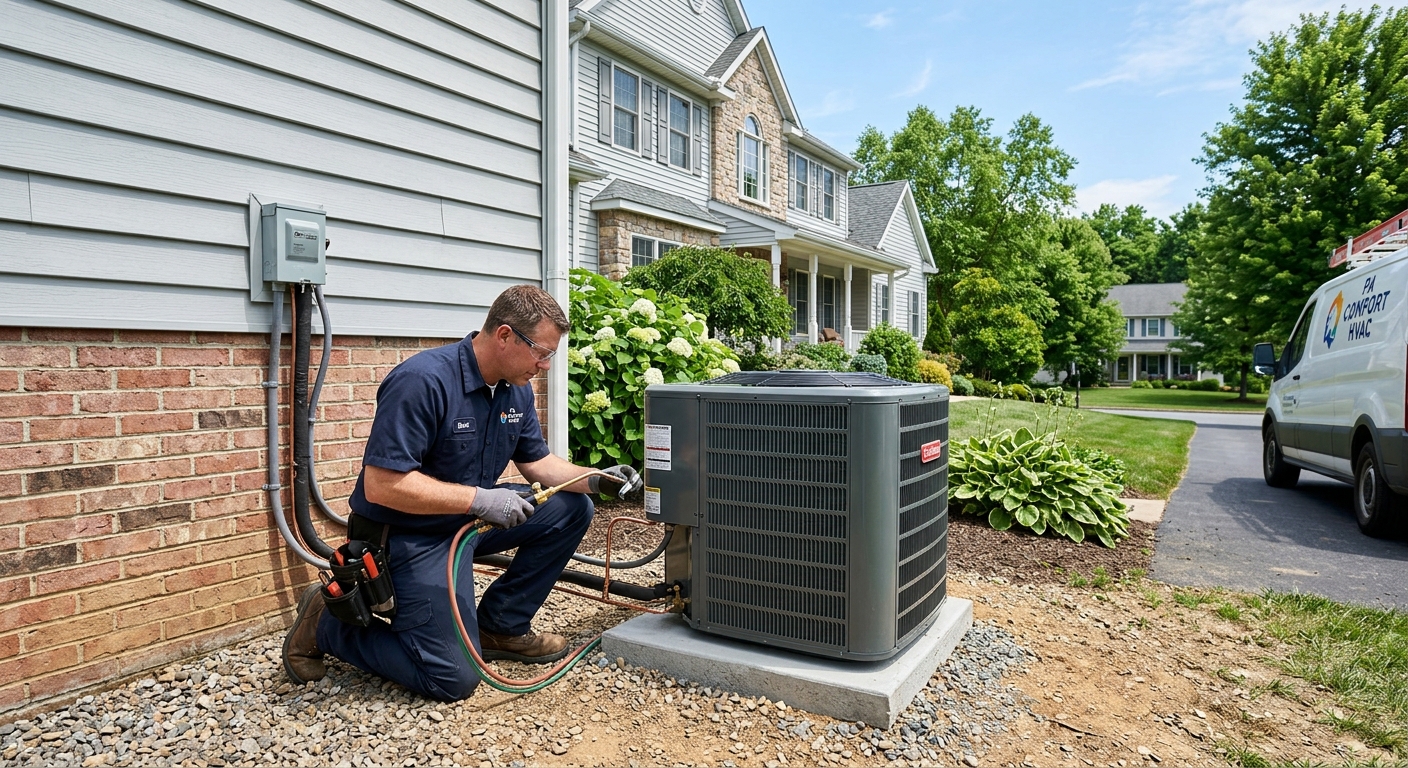
East Vincent heating and cooling prices by system type — 2026
East Vincent’s HVAC installation costs reflect the realities of a homeowner-driven, replacement-heavy market. With a homeownership rate of 85.0% and nearly 42% of properties built before 1980 (U.S. Census Bureau, ACS 2024), most residents are staring down the barrel of either a first-time system replacement or working with aging original ductwork. Large tracts of Chester County housing, especially those built from 1970 to 2000, use forced-air systems that have simply run their course—meaning this is overwhelmingly a retrofit and system replacement market where existing ducts factor heavily into the scope and cost.
This region is heating-dominated—East Vincent sees about 4,800 heating degree days each year compared to 1,450 cooling degree days. For most homes, heating capacity and efficiency—not just cooling—are the most critical drivers of comfort and long-term energy costs. That reorders product recommendations: heat pump performance and overall system sizing for winter weather matter more here than the highest possible SEER.
| System |
Best for |
Efficiency |
Price range (installed) |
| Central AC replacement (existing ducts) |
homes with sound ductwork |
16–20 SEER2 |
$6,000–$14,500 |
| Air source heat pump (ducted) |
year-round heating and cooling |
8–10 HSPF2 |
$9,500–$20,500 |
| Cold-climate heat pump (ducted) |
heat pump as primary heat |
9–11 HSPF2 |
$15,500–$20,500 |
| Ductless mini-split (single zone) |
additions, rooms without ducts |
20–30 SEER2 |
$3,800–$8,300 |
| Full duct system installation |
homes with no existing ducts |
― |
$10,500–$21,500 |
Installed estimates for a typical East Vincent home. Equipment tonnage, duct condition and electrical capacity move these more than brand.
Refrigerant rules and your existing system
If your existing HVAC equipment in East Vincent uses R-410A (the standard for about two decades), it remains completely legal and fully serviceable. The industry, by law, is moving to lower global warming potential (GWP) refrigerants such as R-454B and R-32 in new systems—driven by the national phase-down of older high-GWP HFCs. For you, the homeowner, this change does not mean your current unit becomes obsolete or illegal. You can continue to service, maintain, and operate your R-410A system for as long as it makes sense.
Where it matters: Servicing a system with an active refrigerant leak may get more expensive over time, as R-410A supply tightens and prices climb. For a well-running, leak-free system, nothing changes. If you face a major repair involving refrigerant in the next several years, keep in mind the overall age and health of your unit. Sometimes, rising refrigerant costs push the value equation towards replacement—especially if the system is nearing the end of its useful life anyhow. But there’s no requirement to leap to new technology before you’re ready. The refrigerant shift hits hardest on new sales, and on repairs of systems with known leaks; working equipment is not being forced out.
What construction era means for your system
Chester County’s housing, including much of East Vincent, saw waves of rapid development from 1970 onward, with 41.7% of homes built before 1980 (U.S. Census Bureau, ACS 2024). In post-1970 suburbs, forced-air heating with ducted distribution is almost always present. Most subdivisions built in the ‘80s and ‘90s installed builder-grade equipment and ductwork sized for cooling—even if insulation and window technology were less advanced than today.
For homeowners replacing the original system now, keep in mind that most of that ductwork was based on the standards—and budgets—of the time. You probably have enough ductwork for central AC (with all its installation cost savings), but insulation levels and leaky windows from earlier eras can push up heating and cooling loads, increasing the importance of a precise sizing calculation.
Pre-1980 houses are more likely to present duct sizing mismatches, drafty conditions, and sometimes limited electrical panel space for modern, all-electric equipment. If you are switching from fuel oil or propane to a heat pump, make sure your electric panel can handle the new demand. For gas-fired appliances, venting and chimney conditions matter—flue liners installed for yesterday’s appliances can be a weak link. Each of these factors matters more as systems reach the end of their original service life.
What you can actually claim on a heat pump here
In East Vincent, heat pump upgrades may qualify for incentives at multiple levels: federal tax credits, potential utility rebates, and state-level energy programs. Here’s what sets them apart. The federal energy-efficiency tax credit reduces the tax you owe the following year; it doesn’t put money in your pocket at installation. By contrast, rebates from your local utility typically apply as an upfront discount or post-sale check, so your actual out-of-pocket at installation is lower.
PECO Energy is the main electric and natural gas utility serving East Vincent and most of Chester County. Both their efficiency program offerings and federal programs can change yearly. To confirm what’s available, visit your utility’s efficiency program web page directly, and also check the ENERGY STAR rebate finder online. These resources will show current, local incentives you’re eligible for; there’s no single, permanent answer as program values and requirements change every year.
Don’t trust any contractor or article quoting a rebate without showing you the current program rules and application links. Take listed incentive figures as a starting point for budgeting only—you need to confirm timing, paperwork, and eligibility before counting on anything for a specific system or project.
What a Pennsylvania HVAC contractor must hold
In Pennsylvania, there’s no statewide or trade-specific HVAC license for residential work—instead, contractor registration is required for jobs over $500 in value, and mechanical permits are managed locally by each municipality. If you’re in East Vincent or greater Chester County, your contractor must carry valid Home Improvement Contractor registration, which you can verify at hic.attorneygeneral.gov. For refrigerant work, all technicians must hold federal EPA Section 608 certification; this is non-negotiable and applies in every state.
Mechanical permits for installing or replacing systems are enforced by the local township or borough code office, so your contractor needs to know the system for your municipality. In places like West Chester Borough, a mechanical permit is required for any major central HVAC installation or replacement. Minor thermostat swaps typically fly under permit radar, but anything involving system or ductwork changes is inspected.
Insurance matters too: Pennsylvania mandates workers’ compensation coverage for all employers, which you can verify using the WCAIS system (wcais.pa.gov). Always ask for current certificates before work starts—no legitimate contractor will hesitate.
Manual J and the tonnage question
Sizing an HVAC system correctly for your East Vincent home is the most consequential decision in the whole process. Oversized units seem safe, but the reality is just the opposite: too much capacity leads to short cycling (rapid on-off), poor dehumidification, temperature swings and even early system failure. Oversizing is not a precaution—it’s a defect that you’ll pay for with comfort, lifespan and dollars.
The gold standard is a Manual J load calculation. Unlike old “square-footage” rules of thumb or copying the sizing tag from your last furnace, a proper load calculation accounts for your specific house: actual insulation, window type and exposure, duct condition and number of occupants. In a climate like East Vincent’s—with a winter design temperature of 14°F and about 4,800 heating degree days—heating load isn’t just a guess, it must be matched to real cold snaps.
If your bidder can’t show you a load calculation (ask, “did you run a Manual J, and can I see it?”), you’re getting guesswork. Many houses built from the 1970s to 1990s have been getting by with oversized replacement units simply because that’s what was already there, baking in old errors. Don’t copy somebody else’s sizing mistake—demand the calculation and check their numbers.
Filtration, humidification and ventilation
East Vincent’s seasonal swings—cold, dry winters and hot, humid summers—mean indoor air quality isn’t about a single gadget. In the winter, dryness is the main complaint: whole-house humidifiers help, but they need regular cleaning and can introduce minerals or even scale into the system if overlooked. In summer, a properly sized air conditioner or heat pump should dehumidify well—but only if it runs long enough per cycle, which oversized systems won’t. That means short cycling is not just an efficiency problem, but a humidity problem too.
For air filtration, many East Vincent homes can support a MERV 8 to MERV 13 filter with normal blower capacity—go higher and you risk straining older fans unless ducts and equipment are upgraded. Do not rush to add UV lights or high-end air cleaners unless you have a specific allergy or air quality concern, as their measurable benefit for most homes is quite limited.
Finally, new or recently sealed homes may need mechanical ventilation to deal with stale air. But most East Vincent homes built before 2000 are leaky enough to get by without dedicated equipment. If you have comfort or allergy complaints, start with simple filtration and maintenance—ask before you buy costly add-ons.
Frequently asked questions — HVAC installation in East Vincent
What is commissioning and why does it matter?
Commissioning is the process where your HVAC contractor tests and adjusts your new system to confirm it actually works to manufacturer specifications in your East Vincent home. This isn’t just flipping the “on” switch—it means verifying airflow, refrigerant levels, electrical connections, thermostat function and sometimes running test cycles for both heating and cooling. Commissioning matters because most of the comfort and efficiency complaints I see—like cold or hot spots, short cycling and noisy operation—are caused by set-and-forget installs where no one checked the real numbers. Even the best equipment can’t deliver value if it isn’t dialed in for your actual ductwork and insulation. In Chester County, commissioning is your extra assurance that the $9,500–$20,500 you spend on a heat pump or the $6,000–$14,500 on a central AC replacement isn’t wasted.
Why does my system short cycle?
In East Vincent, short cycling—the system turning on and off rapidly instead of running steady cycles—is almost always the result of oversized equipment. This happens a lot here because homes built from 1970–2000 often had generously sized units that were then matched or upsized at the first replacement. Short cycling means your system comes up to temperature too quickly and shuts off before it can remove humidity or even out the temperature throughout the house. The result? Uneven comfort, higher bills, more wear-and-tear, and sometimes humidity issues indoors. Instead of solving the problem, people have sometimes paid more for oversized replacements. Don’t throw money at quick fixes—ensure a Manual J load calculation guides system sizing so you aren’t repeating the same mistake with your next $9,500–$20,500 heat pump or $6,000–$14,500 air conditioner.
How much does a new HVAC system cost in East Vincent?
A new HVAC system in East Vincent falls within a wide price band. If you have existing ductwork in good condition, replacing a central air conditioner typically costs between $6,000–$14,500. A ducted air source heat pump suitable for our winters generally lands between $9,500–$20,500, while going for a cold-climate model costs a bit more. Ductless mini-splits start at $3,800–$8,300 for a single zone—good for additions or spaces without ducts. Full ductwork installation, which is only needed in homes that never had central HVAC, adds another $10,500–$21,500 to the job. Most East Vincent homeowners are in the replacement market and can usually use their old ducts, reducing costs.
What is SEER2 and how is it different from SEER?
SEER2 is the updated efficiency rating standard for air conditioning and heat pumps, replacing the old SEER measurement. The key difference is that SEER2 uses a new test procedure with higher static pressure in the ducts—closer to the real installation conditions seen in East Vincent homes, especially those from the 1970–2000 housing boom. A SEER2 rating of 16 is not the same as the old SEER 16, so don’t try to compare them directly. Most new systems installed here are in the 16–20 SEER2 range for central AC ($6,000–$14,500 band), and your contractor should be clear about which rating they’re quoting, as incentives and code requirements are moving to SEER2 now.
Who inspects HVAC work in East Vincent?
HVAC installations in East Vincent are inspected by the local township or municipality code office, not by any state board. For residents of Chester County, mechanical permits and inspections are required for jobs like central AC or heat pump replacement. Your contractor is responsible for pulling permits and scheduling inspections, which ensure the work meets the Pennsylvania Uniform Construction Code (UCC) standards based on the IRC. For context, in West Chester Borough, the Codes Department is the authority; elsewhere it’s done at the township level. This helps catch mistakes and protect you, especially on jobs in the $6,000–$21,500 bracket.
Should I repair or replace my HVAC system in East Vincent?
The repair-versus-replacement decision depends on system age, the extent and cost of needed repairs, and changes in refrigerant regulations. For most East Vincent homes, if your system is 15–20 years old (common for houses built 1970–2000 now hitting original equipment end-of-life) and major repairs—especially those involving refrigerant—are needed, replacement is usually the better investment. Rising refrigerant costs for older R-410A systems can tip the scales. On the other hand, well-maintained systems with only minor, one-off repairs left can keep running. Always get a full diagnosis and price a new system—knowing that a central AC replacement is $6,000–$14,500—before you commit. Don’t let a small leak push you into premature replacement, but don’t pour money into systems at the end.
Does my utility offer a heat pump rebate in East Vincent?
Heat pump rebates in East Vincent are usually available through PECO Energy’s efficiency programs, but specific amounts and qualifying models change every year. There’s also the federal energy tax credit for high-efficiency systems, which reduces next year’s taxes instead of bringing down your install bill today. The only way to know exactly what applies to you is to check PECO Energy’s efficiency program web page and use the ENERGY STAR rebate finder. Don’t trust contractors who quote generic rebate numbers—use those figures just as a budgeting guide. The band for a ducted heat pump install is $9,500–$20,500; whatever rebate you get will lower that, but you must confirm the amount before you buy.
Which utility serves East Vincent?
In East Vincent and most of Chester County, PECO Energy is the provider for both electricity and natural gas (in the more urbanized areas). The outer fringes may rely on propane or heating oil, but if you’re in the main neighborhood grid, count on PECO for your electric and potentially your gas service. This matters when you hunt for rebates or need to contact them about service changes—efficiency programs and incentives for heat pumps or central ACs run through PECO. Always confirm your current supplier on your bill before assuming eligibility for any rebate program since a small number of homes could be on well water or other off-grid services.
How much does ductwork add to an HVAC installation?
In East Vincent, if you’re starting without any central ductwork—common in some older homes or those with baseboard heat—adding a full duct system can push your total install cost up by $10,500–$21,500 on top of the equipment. For most residents, it is a retrofit market, meaning you already have ducts, which keeps replacement in the more moderate cost range. Ductwork costs depend on house layout, accessibility, and the number of supply/return runs, but the above range is what you’ll realistically face for a modern, code-compliant install. If your ducts are only leaking or need minor repair, do that before you even consider full replacement—it almost always saves money.