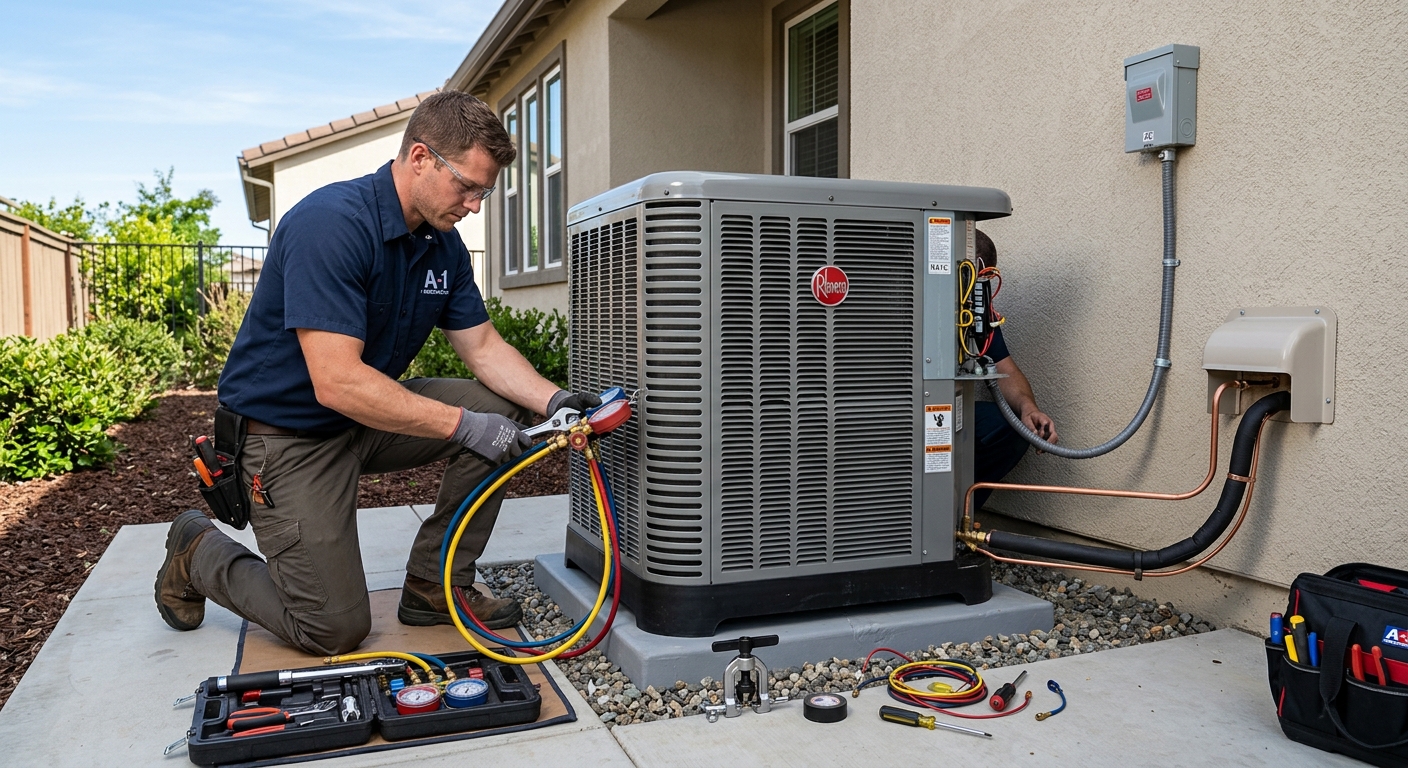
Stowe heating and cooling prices by system type — 2026
In Stowe, most homes are older — almost 90% were built before 1980, and the homeownership rate is just under 50% (U.S. Census Bureau, ACS 2024). This means HVAC work here is far more often a retrofit or a replacement than a new install. Older homes tend to have tight, sometimes leaky ductwork (if they have central systems at all) and electrical panels that may not meet today's higher draw from modern HVAC equipment. If you have intact ductwork, replacing central air or adding a heat pump is straightforward. If not, ductless mini-splits or new ducts might be needed.
Southwestern Pennsylvania, including Stowe, is a heating-dominated market: there are 5,600 heating degree days per year and just 1,050 cooling degree days. Your heating system does the heavy lifting, and decision-making starts there. AC might get you through hot July and August spells, but undersized or leaky ducts become most obvious during January cold snaps. That's why replacement costs here shift so much with the condition of your existing ducts and how your home was wired and built back in the day. Below are realistic price ranges for each system type in Stowe:
| System | Best for | Efficiency | Price range (installed) |
| Central AC replacement (existing ducts) |
homes with sound ductwork |
16–20 SEER2 |
$4,700–$11,500 |
| Air source heat pump (ducted) |
year-round heating and cooling |
8–10 HSPF2 |
$7,500–$16,000 |
| Cold-climate heat pump (ducted) |
heat pump as primary heat |
9–11 HSPF2 |
$12,000–$16,000 |
| Ductless mini-split (single zone) |
additions, rooms without ducts |
20–30 SEER2 |
$3,000–$6,600 |
| Full duct system installation |
homes with no existing ducts |
— |
$8,500–$17,000 |
Installed estimates for a typical Stowe home. Equipment tonnage, duct condition and electrical capacity move these more than brand.
Keeping a Stowe system running
In Stowe, where older ductwork and equipment are the norm, maintenance often matters more than upgrades. The one job nobody should skip is changing the filter on time, using the MERV rating your system’s blower can actually handle—too high and you could starve the system for air, too low and dust coats your coil. For most homes here, a MERV 8 or MERV 11 filter, changed every two to three months, hits the sweet spot.
Next are coil cleaning and clearing the condensate line, especially since our humid summers can quickly clog a neglected drain. If you have central air or a heat pump, always request that the technician checks refrigerant charge with proper gauges—not just “topping off.” If your system lost refrigerant, you have a leak, and just adding more ignores the underlying problem.
As for annual service plans, some Stowe homeowners find them worthwhile for the peace of mind and modest savings on emergency calls, but read the fine print. If the plan is mostly filter swaps and visual checks, you’re often better off paying per visit—especially given our primary heating demand. Schedule major maintenance in spring or early fall, before contractors are swamped handling emergencies in July and January. The money is better spent on a few critical tasks than a broad-brush contract full of exclusions.
The central decision for a Stowe homeowner
For Stowe homeowners, the real choice is between a furnace paired with central AC and one of the modern heat pump configurations. With a winter design temperature of 8 °F and 5,600 heating degree days, our climate is tough on any heating system. Today's cold-climate heat pumps are a different animal from older models—they still heat efficiently below freezing, even around zero. But as temperatures drop, their capacity shrinks, and at or below our design temp, backup or supplemental heat becomes necessary. This is where dual-fuel systems earn their keep: the heat pump runs most of the year, with a gas furnace ready for the worst weeks.
Stowe and the wider county have good access to natural gas, except in some outlying areas where homes may still rely on propane or oil. If your street has gas, the furnace-plus-AC combo is often the straightforward, reliable choice—especially in drafty, pre-1960 homes. Where gas isn’t an option, the math shifts. Heat pumps beat propane and oil for operating cost and comfort, even if the up-front price tag can run higher, especially if duct upgrades or electrical panel work is needed.
A furnace remains the right call in homes with existing, solid gas service, leaky or undersized ducts, or where deep cold spells stretch for weeks. But with the right home envelope and modern ductwork, cold-climate heat pumps—especially in dual-fuel setups—now absolutely hold their own against gas.
| Option | Installed cost | Operating cost here | Best when | Incentive eligible |
| Gas furnace + central AC |
$4,700–$11,500 |
lowest with existing gas |
existing gas service, coldest zones |
usually yes |
| Ducted heat pump (cold climate) |
$7,500–$16,000 |
lower if all-electric, tight envelope |
good envelope, all-electric goal |
often yes |
| Dual fuel (heat pump + gas backup) |
$12,000–$16,000 |
balanced, less gas used |
gas on site, deep cold spells |
incentives possible |
| Ductless multi-zone |
$8,500–$17,000 |
good zone efficiency |
no ductwork, zone control |
yes |
Reading an installation proposal
The best HVAC proposals in Stowe show their work, line by line—because price alone tells you almost nothing. You want to see actual model numbers for both indoor and outdoor units: only a matched pair gives you the rated efficiency. Tonnage should come with a load calculation sheet, not just a glance at your old system’s tag. A good proposal calls out whether your line set (the copper lines carrying refrigerant) gets replaced or reused, if new wiring or a panel upgrade is part of the job, and how condensate will be handled. Permit costs and any inspections go right on the table. Every piece of equipment carries at least two warranties: parts and labor. Read these separately—many “10-year warranties” don’t cover labor past year one.
If a contractor hands you a quote with just a brand and a price, there’s no way to compare apples to apples. Demand detail. Here’s what the specifics should look like, and what’s missing if it doesn’t:
| Line item | What to look for | Red flag if… |
| Equipment |
model numbers, indoor and outdoor matched |
brand name only |
| Sizing |
load calculation attached |
matched to the old nameplate |
| Ductwork |
condition assessed, sealing scoped |
not mentioned |
| Electrical |
circuit and panel capacity confirmed |
assumed adequate |
| Line set |
replaced or documented as reused |
silent |
| Commissioning |
measured airflow and charge, documented |
no startup report |
| Warranty |
labour years stated separately |
manufacturer only |
| Permit |
included and priced |
'not needed' |
Separating installers from equipment sellers
In Stowe, where the contractor market is crowded and nearly every street has an "HVAC guy," installation quality is what matters—not just what name is on the box. A top-brand system installed with poor practices, sloppy air sealing, or ignored duct issues will not outlast or outperform a decent unit put in by someone thorough and experienced.
Verification is straightforward. Pennsylvania requires Home Improvement Contractor (HIC) registration for any job over $500—this is the basic consumer check, not a technical license. Confirm the tech on site is EPA 608 certified if replacing or charging any equipment using refrigerant. Look for proposals that include a full load calculation, list the exact make and model of both the indoor and outdoor units, and spell out what goes into commissioning—measuring airflow and refrigerant levels at startup, documented with a report.
- Check HIC registration online for contractor legitimacy (never just a business card)
- Ask specifically for EPA Section 608 credentials for anyone handling refrigerants
- Look for a load calculation—"Manual J" or similar—attached to your proposal
- Confirm both indoor and outdoor unit model numbers are listed
- Ask about duct assessment and any included sealing or upgrades
- Verify electrical panel and circuit work is addressed, especially in pre-1960 homes
- Line set replacement or documentation of reuse, not just assumed
- Labor warranty terms (in writing), separate from manufacturer warranty
- Full commissioning report offered at job completion
- Permit and inspection included in proposal (should not be “owner’s responsibility”)
- Clear explanation of payment schedule and cancellation rights
- Proof of current workers’ compensation insurance by request
Red flag: In a saturated Pittsburgh metro market, you’ll see more sales-driven outfits. If you get a one-page quote with brand and price, or are rushed to sign “today only” deals, keep looking. True pros don’t need gimmicks—they show their process right on paper.
Duct condition, leakage and sealing
In Stowe’s pre-1960 homes, ductwork is often the biggest wild card during HVAC replacement. Many homes have ducts sized for an old gravity furnace—too small for AC or newer air handlers, never sealed, and often running through crawlspaces or unconditioned attics. Duct leakage is rarely visible but can waste up to a third of your heated or cooled air, making efficient equipment a waste of money if the distribution system is ignored.
A duct blaster test is the gold standard for measuring leakage. This involves temporarily sealing vents and measuring how much air escapes through cracks, joints, or disconnected sections. The results show whether sealing, repair, or full replacement is justified. In homes with undersized or restricted returns—a chronic problem in this era—no equipment upgrade alone will fix comfort or efficiency issues.
If your ducts pass through attics or crawlspaces that freeze and bake with the seasons, insulation and proper sealing become even more important. This is not a place to cut corners: leaks and heat loss here add directly to your utility bills and wear out new equipment faster.
The right move is always to test ductwork before replacing your furnace or AC—not after. Sometimes, a few hundred dollars of targeted sealing will do the job. Other times, old, noisy, or poorly-routed ducts need more extensive work. In any case, don’t let a contractor skip this step or assume old ducts are "fine" just because they’re out of sight.
Permits, licensing and inspections in Stowe
Pennsylvania does not issue a statewide HVAC license for residential work. Instead, regulation is local—each municipality decides what trades require licensing and what permits must be pulled. The Pennsylvania Uniform Construction Code (UCC) sets the standard, and in this area, municipalities have the authority for code enforcement. If you’re in the City of Pittsburgh, a mechanical permit is non-negotiable for any major HVAC install or replacement; in other towns, check directly before work begins.
A written contract is required for any job over $500, thanks to the Home Improvement Consumer Protection Act, and you are always entitled to a three business-day cancellation period. There’s no need to chase after a trade board—the only universal requirement is that your contractor have HIC registration from the Pennsylvania Office of Attorney General. For anything involving refrigerant—air conditioning or heat pumps—EPA Section 608 certification is federal law and applies everywhere, with no exceptions.
If you want to double-check a contractor’s workers’ compensation insurance, the best route is through the WCAIS system. Never take a certificate at face value—verification is quick and protects you if something goes wrong on site.
Frequently asked questions — HVAC installation in Stowe
What is the R-410A refrigerant phase-down?
The R-410A phase-down is a federally mandated transition away from a common refrigerant used in air conditioning and heat pumps, including many units installed in Stowe over the past 15 years. As part of national efforts to reduce greenhouse gases, the EPA is restricting the manufacture of new systems that use R-410A and encouraging the adoption of newer, lower-GWP (global warming potential) refrigerants. For Stowe homeowners considering a replacement, this means new systems installed after 2025 will often use alternative refrigerants. R-410A parts and service will be available for existing units for many years—no need to rush a replacement just because of the phase-down. However, if you're investing in a new central AC (with a typical installed price of $4,700–$11,500), it pays to ask what refrigerant it uses and what long-term serviceability looks like in Pennsylvania.
Are duct sealing and insulation eligible for incentives?
In Stowe, certain energy efficiency programs may offer rebates or incentives for duct sealing and insulation, especially in homes that were never properly air-sealed when first built (nearly 90% pre-1980 locally). Programs shift frequently, but improved ductwork can often qualify if installed to a tested standard. Always confirm that your contractor provides a duct leakage test—some utilities or state-run programs may require it for eligibility. Keep your invoice and test results as proof. Even without an incentive, duct sealing can save enough in wasted heating and cooling—especially with heating bills driving most costs—to justify the work. Duct repair or replacement adds to overall HVAC cost (full new ducts run $8,500–$17,000), so an incentive or rebate can move the value equation.
When is the best time of year to replace HVAC in Stowe?
The best time for HVAC replacement in Stowe is either early spring (March to early May) or early fall (September to October), before you need either heat or cooling every day and contractors aren't yet buried with emergency calls. During these windows, you’ll wait less for a crew, may get better pricing, and avoid being stuck in line behind no-heat or no-cool breakdowns—especially given our region's heavy heating demand (5,600 degree days yearly). If your system has already failed entirely, this may not be an option. For planned projects like replacing a central AC (typical range $4,700–$11,500), off-peak scheduling usually pays off, both on timing and service quality.
How cold does it get in Stowe and does that affect heat pumps?
Stowe winters hit a design temperature of 8 °F and rack up 5,600 heating degree days, making it a genuine cold-weather climate. Today's cold-climate heat pumps are engineered to perform well even below freezing, with some models holding full heating capacity to the mid-teens. However, all heat pumps lose efficiency and output as temperatures approach zero. The best heat pump installations for Stowe are sized carefully for these local conditions—sometimes paired with backup electric or gas heat for the coldest spells. In homes with good insulation and modern ductwork, a ducted heat pump can carry the load (expect $7,500–$16,000), but always discuss supplemental heat with your contractor. Not all systems are equal in real southwest Pennsylvania winters.
How much does ductwork add to an HVAC installation?
In Stowe, full duct system installation will add a substantial amount to your HVAC project—generally between $8,500–$17,000 for a typical single-family home. Most of the local housing is pre-1980, with some built before ducts were standard, so adding or upgrading ductwork is often necessary to achieve safe, efficient operation with new equipment. If your existing ducts are sound and just need cleaning or sealing (often a few hundred to a couple thousand dollars), that's the best outcome. But if your retrofit requires starting from scratch, especially with our older, tight spaces and difficult runs, budget accordingly. Always ask for a duct pressure test before and after to make sure you're getting what you paid for.
Why does my system short cycle?
Short cycling—when your HVAC turns on and off rapidly—can be especially common in Stowe's older homes for several reasons. Common culprits are oversized equipment (not unusual when new systems are sized by old rules), dirty air filters starving the blower for air, or ductwork that’s undersized or leaking. Sometimes, thermostat placement or settings cause frequent cycling, or there’s a refrigerant charge issue if it’s an AC or heat pump. If you’re looking for a fix, start with the basics: change the filter, check supply and return airflow, and make sure your thermostat isn’t stuck in direct sunlight or near a draft. If the problem persists after these steps, it’s worth having a pro check for actual sizing or refrigerant issues—especially if you’ve just paid for a new system, potentially in the $4,700–$11,500 range.
Do I need a permit to replace HVAC in Stowe?
Yes—if you’re inside the City of Pittsburgh or most Allegheny County municipalities, a permit is required for any new HVAC installation, replacement, or significant modification. Stowe follows Pennsylvania’s Uniform Construction Code for residential work, but each municipality enforces those requirements in its own way. Not pulling a permit is risky: you’ll void warranties, risk poor install standards, and create headaches at resale. A reputable contractor will handle the permitting process for you and include the cost in your proposal. The total installed price, including permits, typically falls between $4,700–$11,500 for central AC replacement or higher if new heat pumps or ducts are added. Always ask to see a copy of the permit before work begins.
Is a heat pump a good choice for Stowe winters?
A well-sized, cold-climate heat pump is now a practical option for Stowe's cold winters—much more so than older generations could handle. With a winter design temperature of 8 °F and heavy heating demand (5,600 degree days), the new class of ducted and ductless heat pumps maintains efficiency and comfort most of the year, with a supplemental heat source (electric or gas) used only during deep cold snaps. If you’re aiming for electrification or have no natural gas access, a heat pump often beats propane or oil in both comfort and running cost. Expect an installed price between $7,500–$16,000, not including any necessary electrical upgrades or new ductwork. Ask for load calculations from your contractor to make sure the system is right for your house and not just “one size fits all.”
How much does a furnace replacement cost in Stowe?
A furnace replacement in Stowe, assuming existing ducts are in good shape, normally runs between $4,700–$11,500. The final price moves with your home’s ductwork condition, any electrical or gas line upgrades, and whether you’re pairing it with a new air conditioner or using the old one. Nearly 90% of homes here are pre-1980 construction, often with ductwork that’s never been sealed or sized for AC, so a good contractor will always assess the whole system before giving you a quote. If your ducts need more than cleaning and sealing, budget can rise quickly. Always insist on a load calculation and check what’s covered by warranty—especially labor, which is separate from equipment parts coverage.