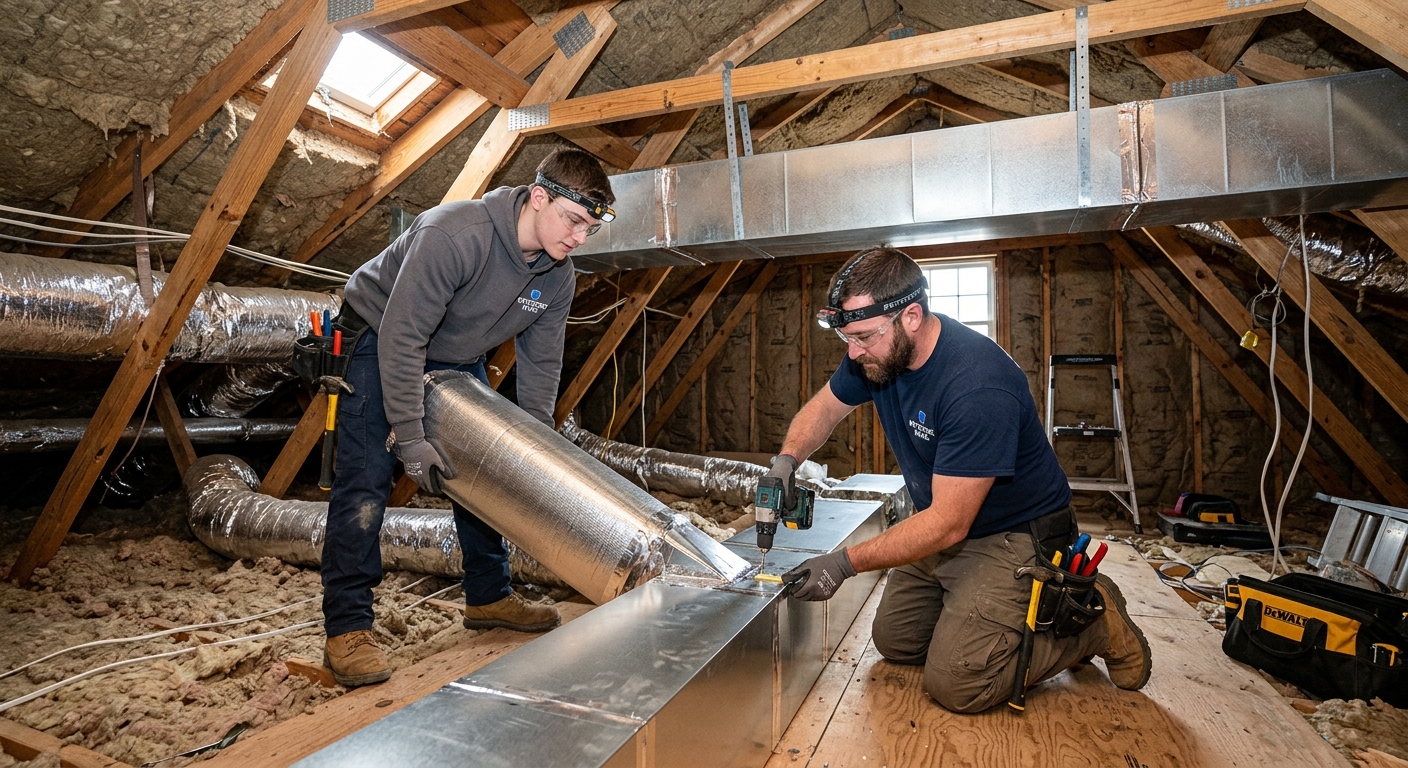
Upper Uwchlan heating and cooling prices by system type — 2026
Upper Uwchlan is a homeowner-dominated market, with a 92.4% ownership rate and most houses built after 1980 (U.S. Census Bureau, ACS 2024). This translates into a steady need for HVAC replacement rather than first-time installation, especially as large areas of Chester County, including many Upper Uwchlan homes, were developed between 1970 and 2000 using forced-air systems. Most houses here already have ducts, which influences both the cost and complexity of new installations.
The moderate southeastern Pennsylvania climate (4800 heating degree days vs. 1450 cooling degree days) means heating is the main driver of comfort and system sizing, although steamy summers make reliable air conditioning essential. For most homeowners, it's replacing aging furnaces, ACs, and heat pumps with more efficient models that fit your existing ductwork. If your home never had ducts or you've built an addition, ductless mini-splits or new ductwork come into play—at a higher price and with different efficiency expectations.
| System | Best for | Efficiency | Price range (installed) |
| Central AC replacement (existing ducts) |
homes with sound ductwork |
16–20 SEER2 |
$6,400–$15,500 |
| Air source heat pump (ducted) |
year-round heating and cooling |
8–10 HSPF2 |
$10,500–$22,000 |
| Cold-climate heat pump (ducted) |
heat pump as primary heat |
9–11 HSPF2 |
$16,500–$22,000 |
| Ductless mini-split (single zone) |
additions, rooms without ducts |
20–30 SEER2 |
$4,100–$9,000 |
| Full duct system installation |
homes with no existing ducts |
— |
$11,500–$23,000 |
Installed estimates for a typical Upper Uwchlan home. Equipment tonnage, duct condition and electrical capacity move these more than brand.
Upper Uwchlan's housing stock and its HVAC needs
Most Upper Uwchlan homes were built after 1980, and only 9.2% pre-date that era (U.S. Census Bureau, ACS 2024). This means the majority of houses already have ductwork, sized by the original builder for both heating and cooling loads. First-generation forced-air systems from the 1970s through 2000 are now being replaced, not installed for the first time. For a typical single-family home here, the original furnace or AC lasted 20–25 years—so if your HVAC system has never been swapped, it's likely running out of time.
Insulation standards in Upper Uwchlan trended up during the housing boom, but older subdivisions may still fall short by today’s standards. Windows tend to be double-pane but aren't always high-efficiency. For anyone thinking about swapping to an all-electric heat pump, electrical panel capacity is often enough in post-1980 builds, but it’s smart to check if the amperage can truly handle a new load.
Ducts are nearly always present in these homes, but their condition varies. Most were sized to handle both heating and cooling, although undersized return air pathways are more common than people realize. Flue and chimney setups for gas equipment are typically compatible with today’s condensing gas furnaces, but unique flue arrangements in older homes can require added work (and cost).
If your house was built during the big development wave, your next HVAC project will likely be a straightforward replacement—though it's worth confirming your ductwork is still solid before investing in new equipment.
The central decision for a Upper Uwchlan homeowner
The big choice in Upper Uwchlan—where heating demands (4800 heating degree days) far outweigh cooling—comes down to picking between a gas furnace with central AC, a ducted heat pump, or a dual-fuel setup. While twenty years ago it was common knowledge that "heat pumps don't work in cold climates," the latest cold-climate models hold 60–80% of their rated capacity in the teens Fahrenheit, making them viable even at the local winter design temperature of 14°F. Still, as temperatures drop, a heat pump loses efficiency and output. That's why dual fuel—using a heat pump for most days, with a gas furnace (or existing furnace) as backup—makes sense in climates like Chester County.
If your home is served by natural gas, found in much of Upper Uwchlan and West Chester but not the rural fringes, a high-efficiency furnace with central AC remains a competitive option. For homes outside the PECO gas coverage, propane or heating oil are the only alternatives to a heat pump, and here, the economics shift strongly toward high-efficiency heat pumps, both for operating cost and comfort.
The holdout case for a furnace over a heat pump: if you're in a particularly drafty house, have truly poor ductwork, or face single-digit overnight lows each winter, a furnace offers the highest guaranteed output and lowest up-front cost.
| Option | Installed cost | Operating cost here | Best when | Incentive eligible |
| Gas furnace + central AC |
$6,400–$15,500 |
moderate—lowest with natural gas |
existing gas service, coldest zones |
some utility rebates |
| Ducted heat pump (cold climate) |
$10,500–$22,000 |
lower with efficient home/weather |
good envelope, all-electric goal |
federal/state incentives often apply |
| Dual fuel (heat pump + gas backup) |
$16,500–$22,000 |
lowest—uses cheapest energy source |
gas on site, deep cold spells |
may qualify for multiple incentives |
| Ductless multi-zone |
$11,500–$23,000 |
room-by-room, higher upfront |
no ductwork, zone control |
some state/federal incentives |
Why your ducts may be the real problem in Upper Uwchlan
It’s common in Upper Uwchlan—especially in large tracts of Chester County housing built between 1970 and 2000—to find aging forced-air ductwork that hasn’t been touched since day one. Duct leakage in homes of this vintage can easily reach 20–30%, which means you’re literally heating or cooling your attic, crawlspace, or basement. A duct blaster test measures precisely how much air is escaping. Modern sealing methods (mastic, aerosolized sealants) can cut these losses dramatically, sometimes for far less than upgrading your equipment.
Many original duct systems were sized just for the volume of air needed by a furnace, but not the larger flows an air conditioner or heat pump wants in a Pennsylvania summer. Undersized return ducts can choke air flow, causing short cycling and higher bills, and it’s rarely visible without measurement.
Ductwork running through unconditioned spaces—a classic in Chester County split-levels and colonials—magnifies both loss and discomfort. In some homes, replacement may make sense, especially if you’re upgrading to a heat pump, but most can see major improvements with thorough sealing and a few targeted repairs.
My honest advice: test and address your ducts before dropping big money on new HVAC equipment. Fixing the ductwork may help your current system perform better and sets you up for the life of the next replacement. Don’t let a new furnace or heat pump cover up the real issue.
What a Pennsylvania HVAC contractor must hold
Pennsylvania does not issue a statewide HVAC license for residential work. Instead, regulation is local: municipalities take the lead on permitting and inspection for residential jobs, and requirements can vary significantly from township to township within Chester County. The key statewide requirement is that any residential HVAC job over $500 must be contracted through an HIC-registered contractor, as required by the Home Improvement Consumer Protection Act. You can check a contractor's registration at the state database referenced above.
For HVAC contractors who handle refrigerants—central air conditioners or heat pumps—EPA Section 608 certification is a federal requirement, unrelated to state or county rules. This ensures only properly trained contractors handle refrigerant changes or leaks, protecting both your system and the environment.
Your HVAC contractor should also carry active workers' compensation insurance if they employ anyone. You can verify legitimate coverage through the state's WCAIS system. Ask about this directly—an ethical contractor will offer proof without hesitation. Mechanical permits and inspections remain a local (municipal) process for major installs like new furnaces, AC units, or full-system replacements. Permits help ensure your job meets the Pennsylvania Uniform Construction Code, keeping you safe and legal.
When an HVAC repair stops being worth it
Not every HVAC problem in Upper Uwchlan calls for a costly replacement. A good rule: repair if the part is minor and your system is under 10 years old. When a repair makes up more than a third of a full system replacement, or your equipment is 15+ years old, replacement usually makes more sense. For reference, many Chester County homes still run builder-grade HVAC from the 1990s or early 2000s—well past typical service life.
The kind of failure matters. Replacing a blower or capacitor is routine. A failed compressor or cracked heat exchanger? The costs soar, and reliability after such a fix is suspect. Another inflection point is refrigerant: older R-22 systems are obsolete, but even R-410A is being phased down, raising service costs for significant leaks.
Efficiency gains may not be dramatic enough in our moderate climate to justify replacement for “better bills” alone, unless your current system is ancient and vastly oversized. Always address duct leaks first before blaming high bills on your equipment.
| Situation | Recommendation | Typical cost | Reasoning |
| Under 10 years, single component failure |
Repair |
$300–$1,200 |
Still early in life, low risk |
| 10–15 years, repair over a third of replacement |
Consider replacing |
$6,400–$15,500 |
Near end-of-life, higher failure risk |
| 15+ years, any major failure |
Replace |
$6,400–$15,500 |
Efficiency, reliability drop at this age |
| Cracked heat exchanger, any age |
Replace immediately |
$6,400–$15,500 |
Safety hazard cannot be ignored |
| Compressor failure past warranty |
Replace |
$10,500–$22,000 |
Cost rivals full system, risk remains |
| Working system, high bills |
Test ducts and envelope first |
$300–$800 |
Hidden losses more likely than failed equipment |
The refrigerant change and what it means for repairs
Residential HVAC manufacturers now ship new systems with lower-global-warming refrigerants such as R-454B (and, to a lesser extent, R-32), as required under US regulations phasing down traditional HFCs. R-410A—the most common refrigerant in systems installed over the past 15 years in Upper Uwchlan—remains perfectly legal to use and service. You are under no requirement to upgrade or swap out your functioning R-410A equipment.
What this means for you: if your system is running fine, nothing changes. However, as fewer manufacturers produce R-410A and supply tightens, the cost for service calls involving refrigerant recharge or major repairs due to leaks will climb in the coming years. That tips the balance toward replacement sooner on systems that develop leaks or need major service, but not before major failure. We are already seeing parts and refrigerant pricing edge up for older equipment; this trend will continue but does not make your equipment obsolete overnight.
Stay aware, but don’t feel pressured into an unnecessary replacement: existing systems can still be repaired and maintained. Only when repair costs crest a meaningful percentage of full replacement should you rethink your options.
Frequently asked questions — HVAC installation in Upper Uwchlan
What MERV filter rating should I use?
A MERV 8 filter is suitable for most Upper Uwchlan homes with forced-air systems. It captures the majority of everyday dust, pollen, and pet dander typical to our region without putting too much strain on your blower. Some homeowners with allergies or respiratory issues step up to MERV 11 or even 13, but be cautious: higher MERV ratings can reduce airflow if your system wasn't designed or adjusted for them. In practice, upgrading your filter will not turn an old system into a high-performance air cleaner—it's just one part of indoor air quality. If you go to higher MERV, check your filter monthly, because Pennsylvania's humid summers can quickly clog a dense filter. Replacement packs usually run less than $300–$800 per season, depending on rating and filter size.
What is commissioning and why does it matter?
Commissioning is the process of verifying that your new HVAC system performs to spec after installation. For Upper Uwchlan homeowners, it means the installer actually measures airflow, checks refrigerant charge, and confirms every control and safety operates as the factory designed. Skipping commissioning leaves your comfort and efficiency to chance—which is particularly unwise given the higher average price tag here (say, $6,400–$15,500 for central AC replacement). In a market where first installs were often rushed during building booms, having your new system properly dialed in can make the difference between 20 years of comfort or constant callbacks. Always ask your HVAC company about their commissioning process and get a copy of the performance report for your records.
How cold does it get in Upper Uwchlan and does that affect heat pumps?
Upper Uwchlan's winter design temperature is 14°F, and most winters bring several nights in the teens. New cold-climate heat pumps keep 60–80% of their rated heating capacity in these conditions, so they’re a real—and now common—option for heating even in Chester County. However, as it drops below freezing, a heat pump’s efficiency falls and the system may need either a boost from electric strip heat or a dual-fuel setup with a gas furnace to avoid higher bills. For many homes, the all-in installed cost for a ducted cold-climate heat pump comes in around $16,500–$22,000. If your current home is well insulated and you want maximum year-round savings or are planning an all-electric house, heat pumps work. In drafty homes or with poor ductwork, a gas furnace still wins for reliability.
What does a ductless mini-split cost in Upper Uwchlan?
A single-zone ductless mini-split system in Upper Uwchlan typically costs $4,100–$9,000 installed. Final price depends on cooling and heating capacity (measured in BTU), whether you’re mounting on an easy exterior wall or need a longer line set, and local permitting. For multi-zone or whole-house ductless systems, costs scale up quickly—expect anywhere from $11,500–$23,000 for three or more heads. Mini-splits are most cost-effective for additions, bonus rooms, home offices, or houses without existing ducts. In Chester County, they’re also becoming popular in older homes where retrofitting ducts would mean major renovations. Just know that upfront price is higher compared to replacing basic central AC, but operating efficiency can be excellent.
Do I need dual fuel in southeastern Pennsylvania?
Dual-fuel systems—pairing a heat pump with a gas furnace—make the most sense in Upper Uwchlan if your home already has natural gas and you want to keep winter costs low during deep freezes. Because our climate has 4,800 heating degree days, you're likely to see nights well below freezing each year that can strain a heat pump running solo. In these coldest spells, the gas furnace kicks in, providing reliable output and protecting your heat pump’s lifespan. Installation of a modern dual-fuel system generally lands between $16,500–$22,000. That premium only pays back in homes with efficient envelopes or when you're actively planning to reduce your carbon footprint but want a comfort fallback—not every house needs it, especially if your heating system is in a mild microclimate or you rarely see deep cold snaps.
Why do HVAC quotes in Upper Uwchlan vary so much?
In Upper Uwchlan, HVAC quotes can easily range from $6,400–$15,500 for a basic central AC swap, or higher for complex jobs. Big reasons include ductwork condition, system size, installation access, and whether electrical upgrades are required; all factor strongly into the final number. The Chester County market is also highly competitive—many companies, wide mix of experience levels, and a lot of post-1990 homes with aging equipment ripe for replacement. Sales-driven firms might push unnecessary upsells or high-margin accessories, whereas reputable installers give line-by-line proposals showing labor, equipment, and expected efficiency. Always ask for a written scope: what’s actually included, what’s not, and what happens if your job runs into hidden issues like undersized ducts or flue problems.
How do I verify an HVAC contractor's insurance?
In Pennsylvania, and specifically for Upper Uwchlan homeowners, you should ask any HVAC contractor to show an active certificate of insurance. Beyond that, use the state's WCAIS verification site to confirm workers' compensation coverage—especially important if the crew is larger than a solo contractor. Not all insurance is equal: you want to see liability coverage and up-to-date workers' compensation, protecting you from claims if someone is hurt on your property. For home improvement jobs over $500, check the contractor’s HIC registration in the state database as well. A reputable firm will supply all this before taking a deposit, and should explain any gaps. Don’t be afraid to walk away if answers are vague, even if their quote is at the low end of $6,400–$15,500.
Why does my system short cycle?
Short cycling—where your system starts and stops too quickly—can plague homes in Upper Uwchlan, especially as many original HVAC installs from 1970–2000 subdivisions were oversized for the real load. Often, undersized or leaky ductwork causes units to trip off before reaching setpoint. Sometimes, it's as basic as a faulty thermostat placement or a clogged air filter. In some houses, poor return airflow is the silent culprit, especially during muggy Pennsylvania summers when your AC or heat pump labors. If you’re paying higher bills or notice comfort swings, diagnostic testing (typically $300–$800) can pinpoint if the root is equipment, ductwork, or controls. Don’t rush to replace the whole unit—it’s often cheaper to fix the real cause.
How is a tax credit different from a rebate?
In Pennsylvania, including Upper Uwchlan, a rebate is typically cash back from a utility or manufacturer, available at the time of purchase, reducing your out-of-pocket on new HVAC systems (sometimes shaving $500–$2,000 off the project). A tax credit, on the other hand, is claimed when you file your federal or state income taxes—meaning you pay up front, then recover part of the cost as a reduction in taxes owed for that year. Keep records of invoices and commissioning paperwork as proof. Tax credits for heat pumps and high-efficiency equipment have expanded, but not all upgrades qualify, and some credits phase out or cap at specified amounts. Always confirm your eligibility with a contractor who tracks current incentives, and consult your tax preparer for details about your situation.