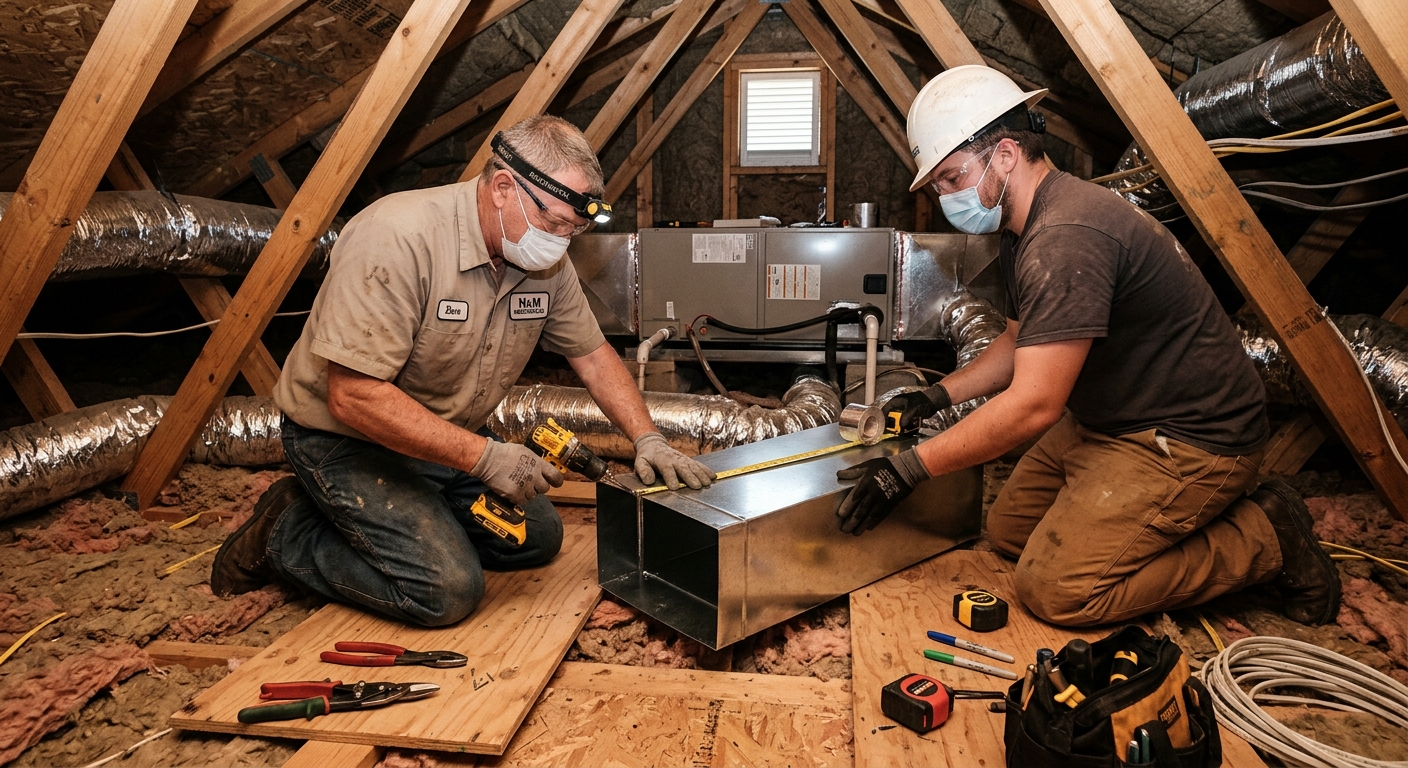
What a new HVAC system costs in Conewago
Conewago’s high homeownership rate and a large number of homes built before 1980 make it typical to see significant variation in installed HVAC systems. A high 83.5% homeownership rate (U.S. Census Bureau, ACS 2024) means most residents are considering the durability and efficiency of what they install, not just the upfront price. With over 40% of homes built before 1980, there is an ongoing mix of full replacements, new duct installations, and ductless projects. Many older houses, similar to those in York City’s large stock of pre‑1940 rowhomes, were never built with central air—leading to a real demand for ductless mini-splits and high-velocity retrofits where running standard ducts isn’t feasible.
Climate-wise, Conewago faces about 5,200 heating degree days and just 1,250 cooling degree days each year. This means you get longer—and often harsher—heating seasons. So decisions about replacing or upgrading HVAC equipment here should focus first on reliable, efficient heating. Cooling is critical on summer’s hottest days, but the bulk of utility bills and comfort issues track to winter. Below, you’ll find ballpark installed costs for common HVAC system types in Conewago:
| System |
Best for |
Efficiency |
Price range (installed) |
| Central AC replacement (existing ducts) |
homes with sound ductwork |
16–20 SEER2 |
$5,000–$12,000 |
| Air source heat pump (ducted) |
year-round heating and cooling |
8–10 HSPF2 |
$8,000–$17,000 |
| Cold-climate heat pump (ducted) |
heat pump as primary heat |
9–11 HSPF2 |
$13,000–$17,000 |
| Ductless mini-split (single zone) |
additions, rooms without ducts |
20–30 SEER2 |
$3,200–$7,000 |
| Full duct system installation |
homes with no existing ducts |
— |
$9,000–$18,000 |
Installed estimates for a typical Conewago home. Equipment tonnage, duct condition and electrical capacity move these more than brand.
Mechanical permits for HVAC work in Conewago
Pennsylvania does not license HVAC contractors statewide for residential work. Instead, contractors must have Home Improvement Contractor (HIC) registration from the Pennsylvania Office of Attorney General for any job over $500—this includes nearly every HVAC installation or replacement. Municipalities across York County, including Conewago, enforce the Pennsylvania Uniform Construction Code (UCC) for residential work based on the International Residential Code (IRC). In other words, you’ll pull a mechanical permit for new central HVAC systems or major replacements, but not for replacing a thermostat or installing a window AC unit. The city of York requires mechanical permits for central system work, while township requirements vary. Always check with the local code office before starting a project.
No one can handle refrigerants legally without EPA Section 608 certification, regardless of state or local licensing. When you hire a contractor, verify current HIC registration at hic.attorneygeneral.gov. You can check that a company carries valid workers’ compensation using the WCAIS system (wcais.pa.gov). Both should be current before signing a contract—required by law for any job over $500. Pennsylvania’s Home Improvement Consumer Protection Act (HICPA) mandates a written contract and gives homeowners a 3-day right of cancellation. If you’re working on a pre-1978 home, confirm the contractor follows the EPA Lead Renovation, Repair and Painting (RRP) Rule.
Repair or replace your Conewago system?
Most coneWago homeowners grapple with whether to fix or replace an HVAC system at some point. Start with age: most central ACs and heat pumps last 12–16 years, furnaces a little longer if well maintained. If your system is under 10 years old and the problem is a blower, capacitor, or pressure switch, it almost always pays to repair. If the repair is more than 30–40% of a full replacement and your system is more than a decade old, it’s worth weighing the new system for reliability, warranty, and efficiency—especially given Conewago’s heating-heavy climate.
Replacement is a must if there’s a cracked heat exchanger (which can leak carbon monoxide into the home) or if your compressor fails after the warranty and the system is beyond its designed life. For everything else, consider how refrigerant costs and availability are changing—R-22 is long gone, and R-410A is now phasing down, so future repairs on older units could get pricey fast. Finally, don’t be upsold on efficiency gains unless the numbers work in your favor. In a climate with 5,200 heating degree days, upgrading ducts and tightening your house may save nearly as much as going from mid to ultra-high efficiency.
| Situation |
Recommendation |
Typical cost |
Reasoning |
| Under 10 years, single component failure |
Repair |
$300–$1,200 |
Service life remaining; repair is a small fraction of replacement |
| 10–15 years, repair over a third of replacement |
Consider replacing |
$5,000–$12,000 |
Big repairs late in service life—consider value of warranty, reliability |
| 15+ years, any major failure |
Replace |
$5,000–$12,000 |
Likely multiple hidden problems; efficiency, reliability suffer |
| Cracked heat exchanger, any age |
Replace immediately |
$5,000–$12,000 |
Safety risk—cannot repair a heat exchanger safely |
| Compressor failure past warranty |
Replace |
$8,000–$17,000 |
Compressor replacement nearly as costly as new system; no new warranty |
| Working system, high bills |
Test ducts and envelope first |
$300–$800 |
Leaks and insulation problems common in older homes |
Reading the yellow label
The yellow EnergyGuide label covers two main efficiency ratings: SEER2 (cooling) and HSPF2 (heating) for heat pumps. SEER2 measures seasonal energy efficiency during cooling; higher means more cooling per dollar spent. HSPF2 measures heating output per unit of electricity used; higher is better for cold weather. Older content may show SEER or HSPF ratings, but federal test procedures changed in 2023—SEER2 and HSPF2 numbers are always a bit lower and can’t be directly compared to the old ratings.
In York County, where houses see 5,200 heating degree days and just 1,250 cooling degree days, heating drives HVAC costs for most homeowners—not summer cooling. That means spec’ing for high HSPF2 (above 9 for a heat pump) usually delivers more payback than chasing the highest SEER2. Middle-of-the-pack SEER2—around 16 to 18—strikes a good balance; ultra-high SEER2 rarely justifies the cost premium unless your cooling bills are huge. For a long, cold winter like Conewago’s, the return on high heating efficiency is usually where the real dollars are saved.
Mini-splits and zoning in Conewago homes
Ductless mini-split systems solve problems central air can’t touch in Conewago—especially in older homes or new additions. If you’ve finished an attic, built a four-season sunroom, or have rooms the main system never reached, a single-zone mini-split delivers precise temperature control without opening up walls for ducts. In homes with plaster or finished basements, avoiding the mess of new ductwork is reason enough to go ductless.
Single-zone mini-splits pair one outdoor unit with one indoor “head,” and tend to outperform multi-zone setups in both efficiency and comfort, even if the upfront cost is higher per room. Multi-zone systems—one outdoor compressor feeding several indoor heads—are more compact outside, but must split capacity if every room calls for heating or cooling at once. Placement of indoor heads matters: each needs an exterior wall or a route for the line set and condensate drain. Some owners object to the appearance, but modern cassettes and slim-line heads help. Every system needs a good condensate solution—go cheap here and you risk a mess later.
There’s a reason York City’s older rowhomes see so many ductless or high-velocity systems installed—retrofitting central ducts is disruptive and costly in these tight, compartmentalized houses. Even in Conewago’s stock of homes from before 1980, many owners are in practice a “ductless market” whether they realize it or not.
Running the numbers on Conewago's climate
Comparing operating costs in Conewago means paying attention to both the climate and your home’s bones. The area faces about 5,200 heating degree days (HDD) but only 1,250 cooling degree days (CDD) each year—so most of your utility costs come from heating, not cooling. The primary electric utility is Met-Ed, a FirstEnergy company, and electricity rates can be found directly on your most recent billing statement under “Price to Compare” or “per kWh” charge.
Here’s the method: First, take your home’s heating load—derived from degree days, insulation, and size. Let’s say your home uses 45 million BTUs per heating season. Divide that load by the system’s HSPF2 (expressed in BTU/Wh) to get your total kWh—for a system rated 9.5 HSPF2, you’d need about 4,736 kWh per season. Multiply by your rate; if your bill says $0.16 per kWh, your seasonal heating cost would be $758. If you upgrade to a higher-HSPF2 model (say 11 HSPF2), that’d drop your use to 4,090 kWh, or $654—saving just over $100 a year on the same run time.
For cooling, similar math applies using SEER2, but the lower number of cooling degree days (1,250) means limited impact unless you run AC constantly. Remember, duct leaks and poor insulation can add hundreds to these totals— a tight duct system and good attic insulation often save more than bumping up efficiency ratings. Always check your actual utility rate and your own bills for accurate ROI.
No table can give numbers that fit every Conewago home, but this method lets you plug in your own rate and usage for a clear picture.
R-410A phase-down: repair or replace?
If you have an R-410A system in Conewago, you do not have to replace it just because new models use R-32 or R-454B. Existing R-410A equipment remains both legal and serviceable under the current refrigerant phase-down rules. However, because newly manufactured residential systems now come with lower-GWP refrigerants, R-410A will get less common—and more expensive—over the next several years as supply tightens and demand drops. That will push up the price of major refrigerant-related repairs, especially after 2026.
Here’s what it means in plain terms: If your R-410A system develops a leak or needs major component work, weigh the repair cost against rising refrigerant prices and the system’s age. For small, one-off fixes on a newer system, repair is usually still the right move. If your system is past half its likely service life and faces a big repair, higher refrigerant costs make replacement look smarter. This isn’t a rush—no law will force you to junk a working R-410A system. But plan ahead so that the transition is on your terms, not the result of an emergency in the middle of winter or during a heatwave.
Frequently asked questions — HVAC installation in Conewago
How do I verify an HVAC contractor's insurance?
In Conewago and throughout Pennsylvania, you should verify both Home Improvement Contractor (HIC) registration and current insurance before hiring for any HVAC job over $500. You can confirm HIC status at hic.attorneygeneral.gov by entering the company’s information. For workers’ compensation coverage—required for all employers—use the WCAIS (wcais.pa.gov) database. Always request a certificate of insurance showing valid general liability coverage. Don’t just take a contractor’s word for it; call the insurer if you’re unsure. These checks are especially important when you’re signing a contract for a big project such as a full central AC replacement, which often runs $5,000–$12,000. A reputable installer will expect the question and provide proof easily.
How much does a furnace replacement cost in Conewago?
Furnace replacement prices depend largely on fuel type and whether you’re changing any ductwork or controls. For natural gas or propane systems (most common in Conewago, given Columbia Gas’s coverage), a straightforward furnace-only replacement will generally land near $5,000–$12,000. Factors include system size, venting needs, and whether any code-required safety upgrades (like shutoff switches or vent changes) are required. Oil furnaces—still seen in rural parts—may be slightly higher due to tank and supply costs. If the project involves converting fuel or adding central air, both contract price and scope grow quickly.
What does a heat pump cost installed in Conewago?
A full air source heat pump system—including the heat pump, new or upgraded thermostat, and all necessary wiring—runs $8,000–$17,000 installed for a typical Conewago home. Cold-climate models, which keep you warm even on the design low of 12 °F, land toward the upper end: $13,000–$17,000. Add more if your home needs all-new ductwork (which can cost $9,000–$18,000 on its own). Keep in mind the key variables: home size, duct condition, and how much electrical work is required for the air handler or backup heat.
Does my utility offer a heat pump rebate in Conewago?
Conewago is served by Met-Ed, a FirstEnergy company. Historically, Met-Ed has offered rebates for high-efficiency heat pumps and mini-splits, but program specifics change each year. Most rebates are for ENERGY STAR® or cold-climate models, with typical amounts ranging from $100 up to around $700. Given a total installed price for a ducted air source heat pump of $8,000–$17,000, rebates help but won’t transform the overall math. Always check your utility’s current website and confirm rebate eligibility with your installer up front—they’ll often handle the paperwork as part of the installation process.
How far ahead should I schedule in Conewago?
Spring and fall offer the greatest contractor flexibility—if you call in May or September, you may only wait 1–2 weeks for a full HVAC replacement. Peak summer or dead of winter sees lead times stretch, especially if you want brands or premium cold-climate equipment that are sometimes backordered. In Conewago’s market—with a saturated contractor field centered on York—you’ll rarely wait longer than 3–5 weeks, but emergency replacements (like a failed heat exchanger, which can run $5,000–$12,000 for a furnace) may still take a few days for permits and inspections. Plan for extra time if you need new ducts or electrical upgrades.
How cold does it get in Conewago and does that affect heat pumps?
Conewago’s winter design temperature is 12 °F, but actual lows can dip below that several times each year. With 5,200 heating degree days, it is a true heating-dominated climate. Air source heat pumps can perform well, especially newer cold-climate models. However, as temperatures drop near design lows, the efficiency and capacity of standard heat pumps drop too. That’s why some homeowners choose backup electric heat (already built into most systems at a small extra cost) or retain a furnace for hybrid operation. A modern cold-climate ducted heat pump (installed at $13,000–$17,000) can keep most houses comfortable without backup except for the rarest cold snaps.
Can a heat pump heat my house without backup?
In many Conewago homes, a cold-climate heat pump—sized and installed correctly—can carry the load down to 12 °F or even a little lower, without needing backup. The keys are insulation, tight ducts, and a well-matched system. Still, most installers recommend including backup electric heat strips or keeping your existing furnace as a safety net, in case of extended cold or utility outages. It’s hardly more expensive up front to do so. A ducted cold-climate heat pump system will typically run $13,000–$17,000 installed, and the extra confidence is worth it once winter hits.
Is an annual maintenance plan worth it?
With Conewago’s intense freeze-thaw cycling and heating-heavy climate, an annual maintenance plan makes sense for most homeowners. Aging ductwork and tight schedules in York County mean early spring or fall service keeps systems efficient, reliable, and covered under manufacturer warranties. Typical plans range from $150–$300 per year, which is a small fraction of the investment for a new system (say, $8,000–$17,000 for a heat pump). Some plans even give discounts on service calls or parts. If your system is under warranty, annual service is wisely viewed as insurance against major headaches.
What size HVAC system does my Conewago home need?
There’s no “rule of thumb” that fits every Conewago home, especially since over 40% of local stock was built before 1980, with varying insulation and duct layouts. Correct sizing requires a Manual J load calculation that takes into account your square footage, insulation, window quality, and orientation. Many homes land in the 2.5–4 ton range for central systems; oversizing leads to higher bills and uneven temperatures, while undersizing leaves you cold in January. Sizing affects the installed price, too—a 2-ton system may run towards the low end $5,000–$12,000, with higher capacities adding cost. Insist your contractor does a proper load calculation—a guess costs you every month for the next decade.