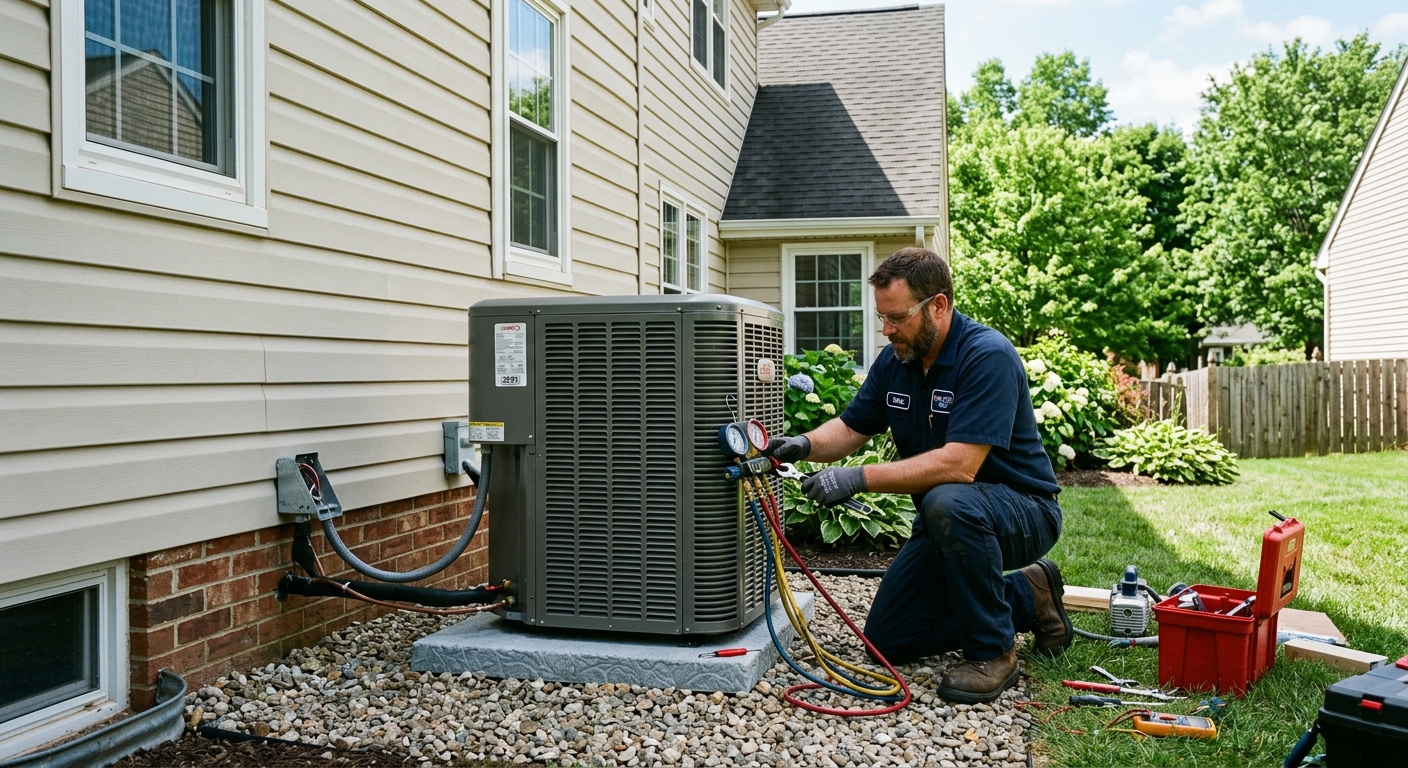
What a new HVAC system costs in Schuylkill
In Schuylkill, HVAC projects are rarely first-time installations. With a homeownership rate of 89.1% and more than half of all homes built before 1980 (U.S. Census Bureau, ACS 2024), most properties have aging heating and cooling equipment, typically forced-air systems installed during Chester County’s housing boom from 1970–2000. These systems—and their ductwork—are now at or past end-of-life, making Schuylkill’s HVAC market primarily a replacement market, not new construction. Replacement jobs here often re-use existing ductwork if it’s still in decent shape, but where ducts are failing or missing, a full duct system install becomes necessary.
Schuylkill’s climate is winter-dominated, with 4,800 heating degree days but only 1,450 cooling degree days: heating is the top priority. The region’s winter design temperature of 14°F drives the need for reliable, correctly sized heat on the coldest days. Central air conditioning matters for comfort through humid Chester County summers, yet the calculus behind your HVAC spend should start with heat—and the biggest part of your bill will come from it.
| System |
Best for |
Efficiency |
Price range (installed) |
| Central AC replacement (existing ducts) |
homes with sound ductwork |
16–20 SEER2 |
$6,400–$15,500 |
| Air source heat pump (ducted) |
year-round heating and cooling |
8–10 HSPF2 |
$10,000–$21,500 |
| Cold-climate heat pump (ducted) |
heat pump as primary heat |
9–11 HSPF2 |
$16,500–$21,500 |
| Ductless mini-split (single zone) |
additions, rooms without ducts |
20–30 SEER2 |
$4,100–$8,900 |
| Full duct system installation |
homes with no existing ducts |
— |
$11,500–$23,000 |
Installed estimates for a typical Schuylkill home. Equipment tonnage, duct condition and electrical capacity move these more than brand.
What size system does a Schuylkill home need?
System sizing is the most critical and most commonly mishandled aspect of an HVAC replacement in Schuylkill. A too-large system isn’t a safe margin—it’s a costly defect. Oversized units short-cycle, fail to dehumidify, send utility bills up, and wear out well before their time. On the other end, undersized systems struggle to keep up, especially when Chester County temperatures drop toward the winter design temperature of 14°F—precisely the condition your system must be able to meet.
The gold standard is a Manual J load calculation. This takes into account your home’s square footage, insulation, air leaks, windows, orientation, occupancy, and even how shaded your property is—guesswork and “rule of thumb per square foot” estimates simply aren’t enough and don’t do justice to the diversity of Schuylkill’s aging homes. If your contractor sizes a new unit merely by matching the old one’s nameplate or by counting vents, they’re just repeating whoever sized it last—which might have been a guess made decades ago.
The only right question for you to ask: “Did you run a Manual J load calculation, and can I see it?” If the answer is no, or if what they show you is just square footage, call someone else. Properly sized equipment lasts longer, runs more efficiently, and delivers more comfort for Schuylkill’s long heating season and humid summers.
What each system actually costs to run in Schuylkill
When comparing HVAC systems in Schuylkill, it’s important to run the numbers for your situation. Start with the region’s climate: 4,800 heating degree days means the biggest expense in your Chester County home will be heating, not cooling. PECO Energy delivers electricity throughout this area, so their rates are what you’ll use for any electric heat pump or air conditioner. Your exact rate appears on your PECO bill—look for the “Price to Compare” for supply, plus distribution and fees, often adding up to $0.16–$0.22 per kWh in recent years, but always check your invoice.
To get an apples-to-apples comparison, you need three things for each system: the efficiency rating (SEER2 for cooling, HSPF2 for heat pumps), your home’s estimated load (driven by those 4,800 heating and 1,450 cooling degree days), and your actual fuel rate. For heating, here’s how it works: figure out your annual heating load in BTUs (using a heat loss calculation or your old bills as a base), divide it by the system’s efficiency to find required energy use, and multiply by your utility rate. For gas or oil, do the same—factor in AFUE (furnace efficiency) and fuel price per therm or gallon.
As an example: a well-insulated Schuylkill home might need 60 million BTUs of heat each winter. At 9 HSPF2, a new heat pump will need about 6,600–7,000 kWh annually. Multiply that by your rate and compare to your old bills. Just know: a leaky duct system or poorly sealed building envelope can erase all the gains of high-end equipment. Never assume advertised efficiency equals real-world savings—be skeptical if your ductwork is old or never tested.
Mechanical permits for HVAC work in Schuylkill
Pennsylvania does not issue a statewide HVAC contractor license for residential work. Instead, the state requires Home Improvement Contractor (HIC) registration for jobs over $500, which covers residential HVAC in Schuylkill. Mechanical permitting and actual code enforcement take place at the municipal level—so in West Chester Borough, for example, the local codes department handles mechanical permits and inspections. Always verify your contractor’s HIC registration at the official state site listed in your contract before any work begins.
Beyond registration, handling refrigerant in any HVAC system—even for replacement or repair—requires federal EPA Section 608 certification. Any technician working on your air conditioner or heat pump in Schuylkill must have this, no exceptions.
Finally, ask to see both insurance and proof of workers' compensation coverage. Every employer in Pennsylvania must cover workers for injuries, and you can verify their coverage online using the WCAIS system noted on state resources. If your property falls within a township or borough with its own code office (as all in Chester County do), expect a mechanical permit and inspection for any full HVAC replacement or new installation; replacing a thermostat may not always require one, but large equipment always does. If a contractor avoids discussion of permits or registration, find someone else.
Maintenance that actually extends system life
Most of the value in HVAC maintenance for Schuylkill homes comes from just a few actions. First: change your air filter at the right interval—typically every 1–3 months in Chester County, depending on pets and dust—and stick to a MERV rating your blower can handle (often MERV 8–11 for older systems without causing airflow problems). Impactful tasks include cleaning the indoor and outdoor coils, clearing the condensate drain, and making sure refrigerant charge is tested, not “topped off.” If your system is losing refrigerant, it has a leak—adding more without finding the leak is not maintenance, it’s avoiding a real problem.
Annual “tune-up” service contracts are common in Schuylkill, and can be worthwhile for verifying charge, testing safety controls, and catching small problems before peak seasons. But be wary of contracts that only include a basic visual inspection; if there’s no guarantee of priority service or no discount on parts and labor, you’re often paying for very little. Look for plans that include proper annual cleaning and real diagnostics, not just a checklist.
Schedule maintenance in early spring or early fall, not the depth of summer or winter, so you’re not competing with emergency outages or paying peak rates. A few simple, regular steps prolong equipment life and reduce costly breakdowns more than any fancy “service package.”
The decision point on an aging system
You don’t always need to replace an old HVAC system in Schuylkill. The key questions: How old is it? What’s failing? And what will it really cost compared to just getting a new, efficient unit?
Systems under 10 years old with a single, fixable part (fan, sensor, start capacitor) are almost always worth repairing. For anything older, if a repair costs more than about one-third the price of a new system, you should consider replacing—especially in Chester County, where many systems are beyond their expected life due to the 1970–2000 construction surge. A compressor failure or cracked heat exchanger is an exception: these require immediate replacement, no matter the age, for safety and practicality. Also factor in refrigerant: if your system uses a refrigerant that’s expensive or hard to find, the cost-benefit tilts toward replacement.
But if you have high utility bills and the system still works, consider duct and envelope testing before buying a new unit. Efficiency gains only pay back if you address the entire system, not just the equipment.
| Situation |
Recommendation |
Typical cost |
Reasoning |
| Under 10 years, single component failure |
Repair |
$300–$1,200 |
Most parts are affordable and system likely has service life left. |
| 10–15 years, repair over a third of replacement |
Consider replacing |
$6,400–$15,500 |
Approaching end of expected life, future issues likely. |
| 15+ years, any major failure |
Replace |
$6,400–$15,500 |
System is likely obsolete, further repairs throw good money after bad. |
| Cracked heat exchanger, any age |
Replace immediately |
$6,400–$15,500 |
Major safety risk; cannot be repaired or ignored. |
| Compressor failure past warranty |
Replace |
$10,000–$21,500 |
The heart of the system is dead; cost exceeds practical repair. |
| Working system, high bills |
Test ducts and envelope first |
$300–$800 |
Inefficiency may come from leakage, not the HVAC unit itself. |
R-410A phase-down: repair or replace?
If your Schuylkill home has a working R-410A system, there’s no need to panic. Under the federal phase-down of high-GWP refrigerants, new residential equipment is shifting to refrigerants like R-454B and R-32. However, R-410A equipment still in service remains entirely legal to use and to repair—you do not have to replace your system because of this change alone.
Here’s where the phase-down does matter: as production of R-410A ramps down, prices and supply for the refrigerant are rising. That means if your system develops a leak or a major issue with refrigerant loss, the repair bill for recharging an older R-410A unit is likely to be higher than a few years ago. For a functioning unit with no leaks, there’s no penalty—service and parts remain available. But if you're deciding whether to invest in a costly repair that involves replacing refrigerant, consider the potential for rising costs and difficulty obtaining R-410A in years to come.
The bottom line for Schuylkill: keep and service your R-410A system if it’s running well. Plan for future replacement if you encounter expensive refrigerant-related repairs, especially as replacement price bands in Chester County typically run from $6,400–$15,500 for central AC. This refrigerant transition is about long-term planning, not forced upgrades.
Frequently asked questions — HVAC installation in Schuylkill
When is the best time of year to replace HVAC in Schuylkill?
Replacing your HVAC system in Schuylkill is easiest (and often less expensive) in the shoulder seasons—April through early June, or September through early November. During these months, HVAC contractors in Chester County are not as booked with emergency calls for heating or cooling breakdowns, so scheduling is smoother and there’s less risk of living without heat or AC when you need it most. If you wait until deep winter or high summer to replace, you may find yourself at the back of the line, rates can be higher due to overtime, and comfort takes a hit. Planning ahead gives you a chance to compare bids and make smart choices, instead of rushing. Expect quotes in the range of $6,400–$15,500 for a new central AC using existing ductwork, depending on your home’s size and condition.
Do I need dual fuel in southeastern Pennsylvania?
In most Schuylkill homes, a dual fuel system—blending a heat pump with a gas furnace for backup—isn’t essential, but it can make sense for some properties. Chester County’s winter design temperature of 14°F means there are weeks where a standard heat pump will become less efficient or rely on expensive electric strip heat. If you have access to natural gas and want the comfort of automatic backup during deep winter, a dual fuel setup offers peace of mind and can keep operating costs in check, especially in homes with higher heat loss. However, cold-climate heat pumps are closing this gap and, for many, the upfront cost of dual fuel isn’t justified unless you really care about maximum efficiency on the coldest nights. Single-source heating, like a high-efficiency ducted heat pump (often $10,000–$21,500 installed), remains the best value for many homes here.
Does my utility offer a heat pump rebate in Schuylkill?
PECO Energy serves Schuylkill and much of Chester County, and they frequently offer rebates for upgrading to high-efficiency heat pumps and central AC. Rebates change annually, so you’ll want to check PECO’s website or talk to your contractor during the estimate. Generally, the rebates are meaningful—sometimes several hundred dollars for systems with specific SEER2 or HSPF2 ratings. This can help bring the installed upfront cost of a ducted heat pump (typically $10,000–$21,500 for a replacement) down a bit, though the savings won’t completely rewrite your budget. Always confirm eligibility; sometimes you need pre-approval or installation by a participating contractor. Your installer should know exactly what’s available for your property in Schuylkill and help with the paperwork.
How long should an HVAC system last in Schuylkill?
In the Schuylkill area of Chester County, most forced-air HVAC systems last 12–20 years, depending on maintenance and original installation quality. Systems from the big housing booms (1970–2000) are now reaching end-of-life, especially if ductwork hasn’t been maintained. Our mixed climate—with very cold winters, humid summers, and moderate freeze-thaw cycles—means corrosion, thermal stress, and dust can take their toll. If your system is approaching 15 years or more, it’s sensible to plan for replacement rather than sink money into major repairs, particularly when a full replacement runs $6,400–$15,500. But with good maintenance, some units do make it past 20 years. Ductless mini-split systems usually land at the upper end of this range due to fewer moving parts.
What MERV filter rating should I use?
For Schuylkill homes, the right MERV filter rating depends on your system’s age and blower strength. Most existing forced-air systems in Chester County, especially those built from 1970–2000, are designed for a MERV 8 to MERV 11 filter. This is the sweet spot for catching household and allergy dust, but not so restrictive as to reduce airflow and strain the blower motor. Higher MERV filters can trap more particles—helpful for allergies—but may restrict airflow, causing cold spots and lowering efficiency if your system can’t handle it. If you have a newer system or a ductless mini-split, your options may be broader. Always check your owner’s manual or ask a contractor during an annual service (often $300–$800 per visit including full diagnostics in Schuylkill) to avoid damaging your equipment.
How much does a furnace replacement cost in Schuylkill?
For a typical Schuylkill home with existing ductwork and natural gas service, a furnace replacement usually falls in the range of $6,400–$15,500 all-in, including installation and removal of the old unit. If your home is in the rural fringes of Chester County relying on propane or oil, setup can be higher due to venting or tank work. The main factors are home size, duct condition, and whether electrical and venting need upgrades. For most homeowners in Schuylkill, the mid-range is around $9,000–$12,000, but always get a written estimate—a cheap price without the right permits or registration isn’t a bargain here.
Does Pennsylvania license HVAC contractors?
Pennsylvania does not have a statewide license just for HVAC contractors working on homes in Schuylkill or Chester County. Instead, the state requires Home Improvement Contractor (HIC) registration for most residential jobs over $500. You can check this status directly before signing any contract. There’s also no single exam or trade board for residential HVAC. However, municipalities like West Chester or Tredyffrin often require separate mechanical permits for each project. Plus, anyone handling refrigerant (for air conditioning or heat pumps) needs a federal EPA Section 608 certification regardless of state rules. Labor and Industry requires workers' compensation, and you can verify this online. So, while a true “HVAC license” doesn’t exist for homes statewide, registration and multiple local requirements do. Installation cost is typically $6,400–$15,500 with all compliance steps included.
Is a high-efficiency system worth the extra cost here?
In Schuylkill, Chester County’s winter-heavy climate (4,800 heating degree days) does reward higher-efficiency systems—especially for heating, which is your largest annual expense. High-efficiency heat pumps and furnaces may cost more up front, with heat pump installs running $10,000–$21,500 depending on features and system size, and furnaces scaling similarly depending on AFUE. Payback depends on how tight your ducts and building envelope are; if ducts are leaky, the benefit shrinks. In most homes here with well-maintained ducts, a high-efficiency system will reduce monthly bills, especially as energy prices rise. But don’t overspend on the very top tier if you plan to move soon or your home’s insulation is poor—addressing the envelope first can yield bigger savings.
Is natural gas available throughout Chester County?
Natural gas is widely available in Schuylkill, West Chester, Tredyffrin, and West Goshen, as these areas are served by PECO Energy’s natural gas distribution network. However, if you’re in the outer or western reaches of Chester County, many homes still depend on propane or fuel oil because gas mains haven’t reached those properties yet—a reflection of the mix of suburban and rural development in the county. This impacts the cost and choice of HVAC system; if your home isn’t on a gas main, you may lean towards high-efficiency heat pumps or dual-fuel systems instead. A full ducted heat pump installation in these cases runs $10,000–$21,500. Always ask your contractor to confirm fuel options based on your address before planning a replacement.