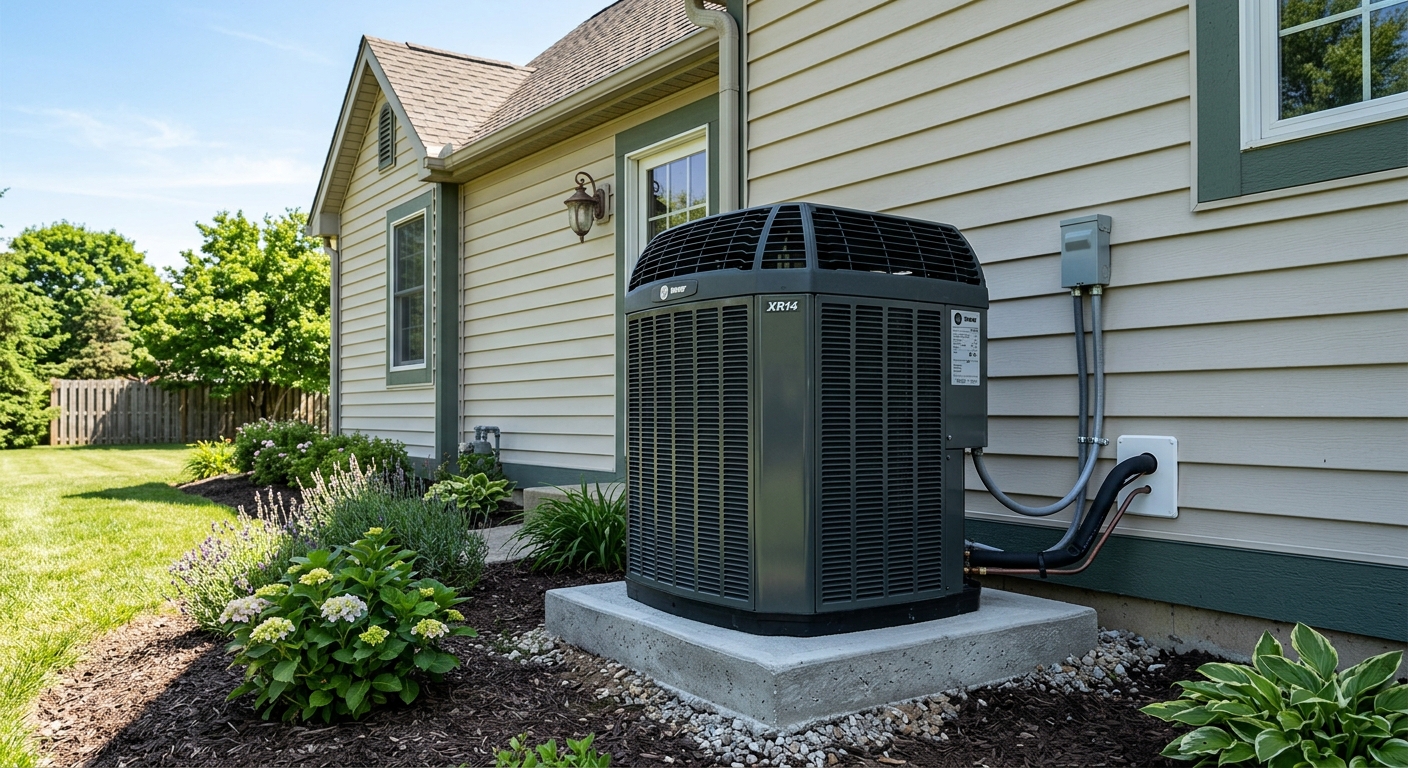
Ellwood City heating and cooling prices by system type — 2026
If you own a home in Ellwood City, you’re in a real-world replacement market. With a homeownership rate above 70% and more than 90% of homes built before 1980 (U.S. Census Bureau, ACS 2024), most houses here are older construction with existing heating or cooling systems—sometimes running well past their prime. Many New Castle homes from 1900–1940, not far from here, were built with tight wall cavities and little attic chase space, so installing or upgrading central air often means difficult, sometimes costly ductwork adjustments or total new runs. Still, the bulk of jobs in Ellwood City involve replacing or working with existing equipment, not first-time installations.
Southwestern Pennsylvania’s climate tilts hard toward heating: with 5,600 heating degree days and just 1,050 cooling degree days, you spend far more on heat than on air conditioning. That’s why, if you’re weighing a ducted heat pump, efficiency in low temperatures matters more than whatever sticker SEER you see on an air conditioner. System choices and prices reflect this dynamic, with heat pumps making more sense lately for all-electric homes or those with expensive heating fuels, while classic forced-air systems with gas or oil still rule in much of Lawrence County.
| System |
Best for |
Efficiency |
Price range (installed) |
| Central AC replacement (existing ducts) |
homes with sound ductwork |
16–20 SEER2 |
$4,500–$11,000 |
| Air source heat pump (ducted) |
year-round heating and cooling |
8–10 HSPF2 |
$7,200–$15,500 |
| Cold-climate heat pump (ducted) |
heat pump as primary heat |
9–11 HSPF2 |
$12,000–$15,500 |
| Ductless mini-split (single zone) |
additions, rooms without ducts |
20–30 SEER2 |
$2,900–$6,300 |
| Full duct system installation |
homes with no existing ducts |
— |
$8,100–$16,500 |
Installed estimates for a typical Ellwood City home. Equipment tonnage, duct condition and electrical capacity move these more than brand.
Duct condition, leakage and sealing
In Ellwood City and throughout Lawrence County, ducts are often the hidden culprit behind high bills and comfort complaints. Older homes—especially those built before 1940 in places like New Castle—frequently have ductwork squeezed between joists, retrofitted after original construction, or none at all. If your house falls in that group, lack of return air pathways, undersized runs, or unsealed joints mean conditioned air can end up in attics, crawlspaces, or leaking outdoors. That’s wasted energy, especially with 5,600 heating degree days per year in our cold Pennsylvania winters.
A duct blaster test measures exactly how much air leaks from your system when pressurized. It takes the guessing out of whether you’re losing 10% or 40% of your airflow. If your ducts run through a cold crawlspace or a hot attic, or you feel drafts and temperature swings, you might see massive efficiency gains from proper sealing—sometimes more than you’d get from upgrading the equipment itself. Undersized or blocked returns are especially common and often invisible to homeowners, but they restrict airflow. “Bigger furnace, same ducts” rarely delivers the right outcome.
If you’re considering a new heat pump, air conditioner, or furnace, always ask for a duct leakage test first, not after installation. It tells you whether seals or a full duct replacement should be part of the project. Throwing a high-efficiency system onto leaky, uninsulated ductwork almost always disappoints.
Permits, licensing and inspections in Ellwood City
Pennsylvania does not issue a statewide HVAC trade license for residential work. Instead, mechanical contractors in Ellwood City must hold Home Improvement Contractor (HIC) registration for contracts over $500, which you can verify at the designated state website. Unlike Philadelphia or Pittsburgh, here in Lawrence County, all trade licensing and code enforcement happens at the municipal level—so your local borough or township code office is who permits and inspects jobs. Central AC replacement or installation in New Castle typically needs a mechanical permit; in Neshannock Township, swapping out a furnace like-for-like without moving the gas lines often does not.
Any contractor handling refrigerants must have federal EPA Section 608 certification—this protects you by ensuring safe and legal refrigerant management, no matter what credentials the contractor has locally. Workers' compensation insurance is mandatory for contractors with employees; always ask for written proof and verify through the state’s insurance verification system, not just an insurance card. Written contracts are required for jobs over $500 under Pennsylvania law, and you have a clear three-business-day right to cancel any home improvement contract. For older homes built before 1978, you can check whether your contractor is certified for lead-safe practices via the EPA website.
What a real HVAC quote contains
A real HVAC quote in Ellwood City is more than a brand, a size, and an “installed” price. Always expect model numbers for both the indoor (furnace or air handler) and outdoor (condenser or heat pump) units—efficiency ratings only count when the two are matched. Make sure the tonnage is based on a written load calculation for your home’s actual size and insulation, not just a copy-paste from your old sticker. Electrical work needs to be spelled out, especially since older houses often have undersized panels or questionable wiring.
Don’t overlook the line set (the insulated pipes that connect indoor and outdoor units)—reusing old ones is not best practice unless they’re inspected and proven clean. New thermostats, code-required emergency shutoffs, proper condensate drainage, municipal permit fees, and a documented commissioning/startup report should all be itemized. Finally, actual warranty coverage: labor and equipment are separate, and you should see both.
| Line item |
What to look for |
Red flag if… |
| Equipment |
model numbers, indoor and outdoor matched |
brand name only |
| Sizing |
load calculation attached |
matched to the old nameplate |
| Ductwork |
condition assessed, sealing scoped |
not mentioned |
| Electrical |
circuit and panel capacity confirmed |
assumed adequate |
| Line set |
replaced or documented as reused |
silent |
| Commissioning |
measured airflow and charge, documented |
no startup report |
| Warranty |
labour years stated separately |
manufacturer only |
| Permit |
included and priced |
'not needed' |
Operating cost, not sticker price
The true cost of any HVAC system in Ellwood City isn’t what you pay up front—it’s what you spend every year to keep your home comfortable. With 5,600 heating degree days each year and a winter design temperature of 8 °F, heating dominates here, not cooling. Your delivered heat or AC depends on two big factors: your system’s efficiency (measured in AFUE, HSPF2, or SEER2) and real-world losses like leaky ducts or poor insulation.
For electric systems powered by Pennsylvania Power Company, you’ll find your kilowatt-hour cost right on your monthly bill. To estimate annual electric heating costs, use: annual heating load (BTUs, based on square footage and degree days) ÷ system COP (or HSPF2) ÷ 3,412 (BTU per kWh), then multiply by your actual rate.
For example, a typical Ellwood City ranch needing 50 million BTUs of heat per season, with a heat pump averaging 9 HSPF2 (that’s 9 BTU/watt-hour), will use 50,000,000 ÷ 9 ≈ 5,555,556 watt-hours, or about 5,556 kWh. If your all-in rate is $0.14 per kWh (check your own bill—rates move), your annual heating cost is about $778. With a leaky duct system losing 30% of delivered heat, real costs rise sharply. For gas, take your therms used and multiply by your utility rate; higher efficiency lowers the amount of fuel per delivered BTU, but good ducts matter just as much.
Don’t trust online calculators unless you adjust for Ellwood City’s climate and your own ductwork condition. An efficient unit with poor ducts is never more cost-effective than a midgrade one with careful installation and sealing.
Repair or replace your Ellwood City system?
Replacement is not always the right call in Ellwood City. Many older homes here are on their third or fourth HVAC system, and sometimes a well-built furnace or central AC only needs one part swapped to keep going for years. If your equipment is under 10 years old and the repair quote is under half the cost of a replacement, repair makes good financial sense—modern systems are costly and rarely deliver dramatic utility savings in our moderate cooling, heavy heating climate. If your repair estimate creeps over a third of a full system’s price, or if the unit is 15 years or older, replacement starts to make more sense, especially with refrigerant changes and potential efficiency gains.
There are two cases where replacement isn’t negotiable: a cracked heat exchanger (carbon monoxide risk) must be addressed immediately, and a failed compressor in a system past warranty or approaching 15 years old is rarely worth fixing. High bills? Test your ducts before you blame the equipment. Duct leakage and envelope losses are usually the cheapest savings.
| Situation |
Recommendation |
Typical cost |
Reasoning |
| Under 10 years, single component failure |
Repair |
$300–$1,200 |
Parts often in warranty, likely years of service left |
| 10–15 years, repair over a third of replacement |
Consider replacing |
$4,500–$11,000 |
Approaching expected life; major investment |
| 15+ years, any major failure |
Replace |
$4,500–$11,000 |
Efficiency and reliability both decline at this age |
| Cracked heat exchanger, any age |
Replace immediately |
$4,500–$11,000 |
Major safety risk—CO hazard |
| Compressor failure past warranty |
Replace |
$7,200–$15,500 |
Core component cost approaches total system |
| Working system, high bills |
Test ducts and envelope first |
$300–$800 |
Major savings from stopping leaks, not replacing units |
The refrigerant change and what it means for repairs
If your Ellwood City home has a working heat pump or central AC that uses R-410A (the common refrigerant since the 2010s), you do not have to replace it. R-410A systems remain legal to service, and refrigerant is still available. However, as manufacturers now build new equipment for lower-GWP refrigerants like R-454B and R-32, the cost of R-410A will likely keep climbing as supplies tighten. This makes it more expensive to recharge an older, leaking system, nudging the balance toward replacement once big leaks or compressor failures turn up—and especially when your system is past midlife. But there is no law against repairing, topping off, or using your R-410A equipment as long as it functions safely and reliably. The regulations affect new equipment production, not your existing home system.
If you’re offered an “upgrade” for refrigerant reasons alone, ask direct questions and weigh the total cost. For working, non-leaking R-410A systems in Ellwood City, keep it running—repair is fine unless major failures or refrigerant costs tip the math.
Frequently asked questions — HVAC installation in Ellwood City
How long does HVAC installation take in Ellwood City?
HVAC installation time in Ellwood City depends primarily on whether your home already has usable ductwork. If you have good ducts and are replacing a central air conditioner or furnace, most installs are completed in one full day. More complex projects—like switching to a heat pump, running an all-new duct system, or retrofitting a 1920s or 1930s home with tight chases—can take up to four days or more. Older homes here, like the ones that make up over 90% of Ellwood City’s housing, often need extra prep and repairs for code compliance and safety. For example, a full duct system installation typically costs $8,100–$16,500 and may add days to the job. Always build in extra time for permit inspections if required by your local code office.
Should I repair or replace my HVAC system in Ellwood City?
It often makes financial sense to repair an HVAC system in Ellwood City if it’s under 10 years old and doesn’t have fundamental failures like a cracked heat exchanger or failed compressor. Homeowners here with older but reliable systems see limited utility savings from new, high-efficiency models because local heating needs dominate and fuel rates are moderate. But if your repair quote is inching above one-third of a new installation—like a quoted $4,500–$11,000 for a full central AC or furnace—you’re better off with replacement, especially if your system is over 15 years old or uses increasingly expensive refrigerants. Always get a second opinion for expensive diagnoses, and test your ductwork before committing—high bills sometimes come from leaks, not the equipment.
Who inspects HVAC work in Ellwood City?
In Ellwood City, mechanical permits and final inspections are handled at the municipal level—not statewide. Your borough or township’s local code office enforces the Pennsylvania Uniform Construction Code for residential HVAC projects. If the installation requires new ductwork or major system changes, expect the code official to inspect connections, clearances, and sometimes the commissioning report before final sign-off. In the city of New Castle, central HVAC replacement with ductwork always needs a mechanical permit and inspection. Permits are usually included in your installation contract, but always ask for proof. A permit line in your quote, usually as part of a total price like $7,200–$15,500, shows the contractor is following local requirements.
How much does a new HVAC system cost in Ellwood City?
A typical new central air conditioner or gas furnace replacement in Ellwood City, using your existing ducts, runs from $4,500–$11,000. For a ducted air source heat pump, prices rise to $7,200–$15,500 because of equipment and installation complexity. If your house needs an entirely new duct system—which is common for homes built before 1940 in this area—expect to spend between $8,100–$16,500 all-in. The average cost falls near $7,200 for a simple AC replacement, but homes with older wiring or no prior central system will be at the top of the range. Get a detailed quote—all real numbers should be from these price bands.
Why are my Ellwood City energy bills high with a new system?
Even with a brand new high-efficiency system, Ellwood City homeowners sometimes see high energy bills due to duct leakage, insufficient insulation, or unsealed windows and doors. The age of local homes—over 90% built before 1980—means ductwork may be poorly sealed or run through uninsulated spaces. Equipment with high SEER or HSPF numbers won’t deliver real savings if 20–40% of conditioned air leaks into attics or crawlspaces. Testing and sealing ducts, which typically costs $300–$800, can lower bills more than upgrading equipment alone. Don’t overlook air sealing and insulation in older houses—new HVAC can’t overcome a leaky or drafty envelope.
How much does ductwork add to an HVAC installation?
Adding or replacing ductwork in Ellwood City usually costs between $8,100–$16,500, depending on home size, access, and whether the job includes sealing, insulation, or significant repairs. For many local homes built in the early 20th century, running new ducts means opening finished walls or building chases, both of which add labor and complications. If your home already has sound, properly sized ducts, you may only need minor repairs or sealing, typically in the $300–$800 range. Full replacement is almost always required for homes that never had forced-air before, which is common for houses from 1900–1940.
How is a tax credit different from a rebate?
A tax credit is money returned to you at tax time by the IRS or the Pennsylvania Department of Revenue if you qualify for energy-efficiency upgrades—reducing the income tax you owe, usually the following year. A rebate, on the other hand, is cash paid to you by the manufacturer, state, or utility—sometimes right after install, sometimes through a simple direct application. For instance, if you spend $7,200–$15,500 on a high-efficiency heat pump, you might get a $2,000 federal tax credit (applied to next year’s taxes) and an instant rebate from your electric utility. In Ellwood City, always check paperwork vibes: tax credits arrive through your taxes, rebates through a check or direct deposit.
What does HSPF2 measure?
HSPF2 (Heating Seasonal Performance Factor, Version 2) measures how efficiently a heat pump heats your home over a standard heating season, taking into account lower outdoor temperatures and real-world cycling losses. It’s tested under new, more realistic conditions than “classic” HSPF. In Ellwood City’s heating-dominated climate with 5,600 heating degree days and a winter design temp of 8 °F, you want a system with a higher HSPF2—ideally 8 or above. That might cost more up front, with a typical installed price around $12,000, but delivers better performance and lower bills in real southwestern Pennsylvania winters.
Is natural gas available throughout Lawrence County?
Natural gas is common in Ellwood City, New Castle, and most nearby townships thanks to service from the regional gas company. However, in outlying northern parts of Lawrence County, access is less reliable—many rural homes there depend on propane or fuel oil for heat. Wherever you’re located, cost calculations shift: in areas with no natural gas, the price of a replacement furnace or heat pump ($4,500–$15,500) might be offset by potential fuel savings if you switch to an electric heat pump. Always ask your contractor what fuel options make sense for your street—not all Lawrence County towns have the same utility infrastructure.