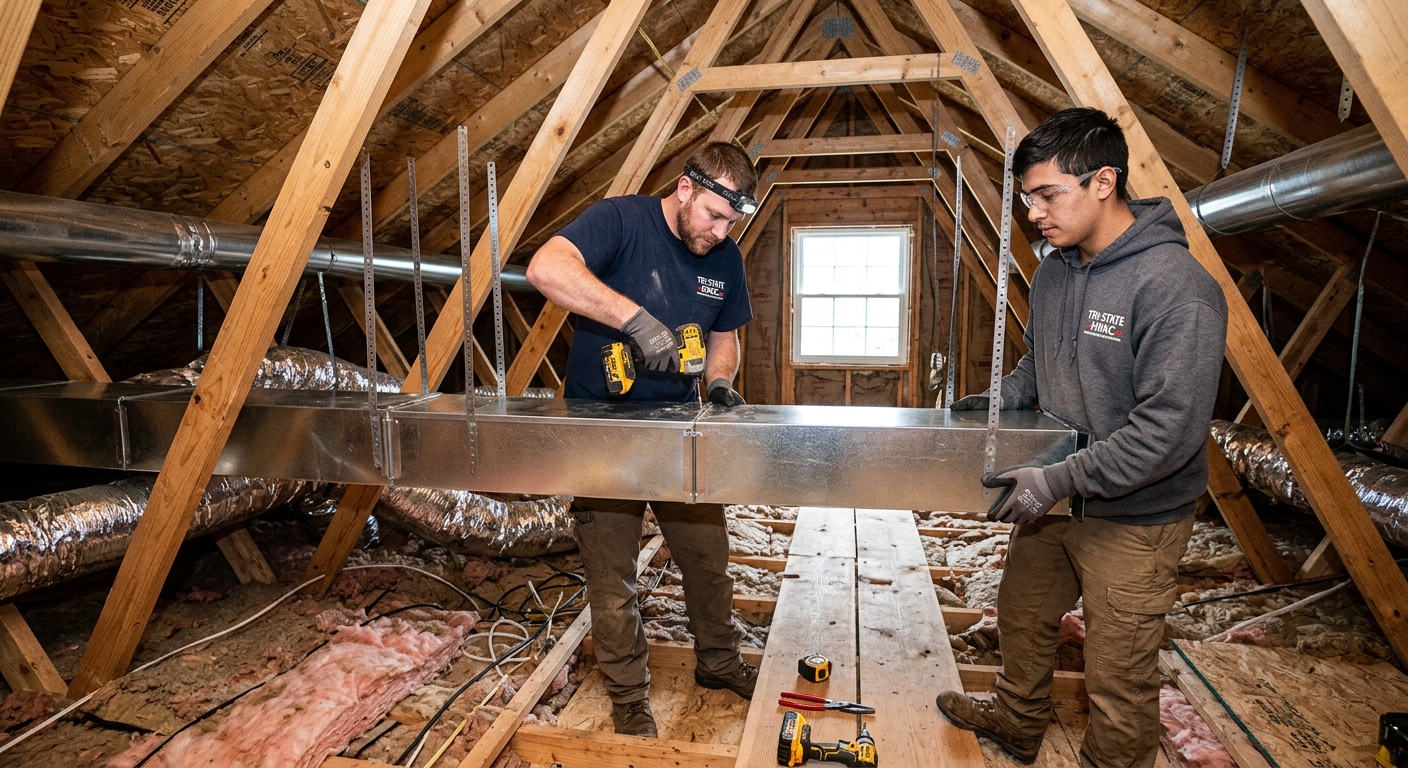
What a new HVAC system costs in DuBois
In DuBois, costs for a new HVAC system depend less on the brand and more on your home’s era and existing infrastructure. Here, 86.5% of homes were built before 1980 (U.S. Census Bureau, ACS 2024), making this a replacement market with a focus on retrofitting older housing stock. A 60.1% homeownership rate means most customers are deciding on long-term upgrades, not short-term fixes. Since many Clearfield County homes were originally heated with oil or coal, you’re likely either upgrading aging equipment or adding modern cooling where it never existed. Expect ductwork quality and presence to vary – homes built pre-1960 often need either significant duct repairs or full new runs.
Our climate is solidly heating-dominated: 6,300 heating degree days vs. 750 for cooling. That tips the scale toward equipment that can reliably heat through long, cold winters. Air source heat pumps, especially cold-climate models, have become more practical, but many households still rely on (and replace) central AC paired with a furnace, or look at ductless mini-splits for spaces where running ducts isn’t realistic. Expect duct upgrades or replacements to drive up the cost, as few older homes have duct systems suitable for today’s high-efficiency equipment.
| System |
Best for |
Efficiency |
Price range (installed) |
| Central AC replacement (existing ducts) |
homes with sound ductwork |
16–20 SEER2 |
$4,600–$11,000 |
| Air source heat pump (ducted) |
year-round heating and cooling |
8–10 HSPF2 |
$7,300–$15,500 |
| Cold-climate heat pump (ducted) |
heat pump as primary heat |
9–11 HSPF2 |
$12,000–$15,500 |
| Ductless mini-split (single zone) |
additions, rooms without ducts |
20–30 SEER2 |
$2,900–$6,400 |
| Full duct system installation |
homes with no existing ducts |
— |
$8,200–$16,500 |
Installed estimates for a typical DuBois home. Equipment tonnage, duct condition and electrical capacity move these more than brand.
Service plans: worth it or not?
Most HVAC service plans sold in DuBois promise “annual tune-ups,” filter checks, and discounts on repairs, but whether they’re worth the money depends on details. For homes with systems running through long, cold winters and muggy summers, the basics still matter most: change your filter as often as your system needs (2–4 times a year for the typical DuBois home), and stick to the MERV rating recommended for your blower — most older ductwork won’t handle high-MERV filters without losing airflow.
Coil cleaning and clearing the condensate line prevents breakdowns. System maintenance should always include a test for proper refrigerant charge using gauges — topping up without finding a leak isn’t just wasted money, it’s a red flag that your tech is cutting corners.
An annual plan makes sense if it gives you priority scheduling and free filter replacements, and if you actually use it. If a contract requires you to join a monthly auto-pay just for a “discounted” checkup, or won’t spell out exactly what’s included, skip it. With the region’s peak season for urgent calls running mid-June through September and again in January, schedule your checkup for late spring or early fall to avoid competing with neighbors needing emergency repairs.
Permits, licensing and inspections in DuBois
Pennsylvania does not issue a statewide HVAC license for residential work. Instead, regulation is handled at the local level: in Clearfield County, and DuBois specifically, municipalities enforce the Pennsylvania Uniform Construction Code (UCC) for residential HVAC work. That means new system installations or ductwork within Clearfield Borough or DuBois require a building or mechanical permit, while routine filter changes in rural townships may not trigger any permit at all.
All contractors must carry a Home Improvement Contractor (HIC) registration from the Pennsylvania Office of Attorney General for jobs over $500. You can verify this registration at hic.attorneygeneral.gov. EPA Section 608 certification is federally required for any technician working with refrigerants — don’t hesitate to ask for proof if your job involves a heat pump or central AC install. Insurance and workers’ compensation are mandatory for any employer and should be verified through Pennsylvania’s Workers’ Compensation Automation and Integration System (WCAIS) at wcais.pa.gov before you sign a contract.
Inspections for residential HVAC installations are carried out by the local code authority — for DuBois, that’s the municipal office, not the state. Make sure your quote includes permitting and inspection fees; unpermitted work can cause trouble with resale and insurance.
Separating installers from equipment sellers
The skill and care of your installer in DuBois makes a far bigger difference than the label on the box. It’s easy to find national HVAC brands at a range of prices, but the same system installed right or wrong can literally mean the difference between a quiet, efficient home and a noisy, underperforming money pit. In Clearfield County’s thin market, many contractors travel from neighboring towns, so prioritizing installer track record matters even more.
Start with credentials: verify HIC registration at hic.attorneygeneral.gov. Confirm the technician connecting refrigerant lines is EPA Section 608 certified. Ask if the quote includes a Manual J load calculation for your actual house — guessing based on “what’s in there now” is not good enough, especially in century-old homes. Insist on quoted model numbers for both indoor and outdoor units, not just brand and tonnage. Proper commissioning should include measured airflow and refrigerant charge at startup, with the results documented and left with you.
- Check HIC registration and insurance
- EPA Section 608 certification for refrigerant work
- Manual J load calculation included
- Full model numbers (indoor and outdoor) on quote
- Ductwork condition included (photo or report)
- Permit and inspection fees detailed
- Line set replacement or documentation
- Compressor and air handler sourced from the same brand
- Startup commissioning report provided on completion
- Separate labor and equipment warranty duration
- References from local DuBois installations, not just out-of-town jobs
Red flags: in a thin rural market like ours, beware outfits quoting “specials” without a site visit, or refusing to show paperwork. Anyone offering to skip permits, or suggesting a friend “pull the permit for cash,” puts you at risk of denied claims and future headaches.
Comparing HVAC estimates in DuBois
Good HVAC quotes in DuBois are detailed enough for real apples-to-apples comparison. Do both the indoor and outdoor units list model numbers? Are they matched for efficiency, as the rating only holds up with a paired set? Is the tonnage based on your home’s actual heat loss, or is it just a rerun of old sizing? Does the estimate cover possible electrical upgrades — for older homes, panel upgrades or new circuits are common? Will the existing line set be reused or replaced? Sump pumps, drains, and high-efficiency condensate options should be in writing. Permit costs, thermostat upgrades, and start-up commissioning should not be afterthoughts.
Pay close attention to warranty terms: labor and equipment warranties are not the same. “Manufacturer’s warranty” covers parts, but not the cost to swap them out if needed. A quote that’s just brand and price hides too much. Ask for detail, or you can’t compare.
| Line item |
What to look for |
Red flag if… |
| Equipment |
model numbers, indoor and outdoor matched |
brand name only |
| Sizing |
load calculation attached |
matched to the old nameplate |
| Ductwork |
condition assessed, sealing scoped |
not mentioned |
| Electrical |
circuit and panel capacity confirmed |
assumed adequate |
| Line set |
replaced or documented as reused |
silent |
| Commissioning |
measured airflow and charge, documented |
no startup report |
| Warranty |
labour years stated separately |
manufacturer only |
| Permit |
included and priced |
'not needed' |
Reducing the net cost of a DuBois installation
DuBois homeowners can reduce out-of-pocket HVAC costs through federal tax credits, utility rebates, and sometimes state-level efficiency programs. Here’s what matters: a tax credit reduces the amount you owe the IRS the following spring, while a rebate is cash returned (or taken off the invoice) after your install — both help, but credits don’t put cash in your hand right away.
Penelec (for electricity) and UGI Utilities (for gas) serve DuBois and much of Clearfield County. Both often offer rebates for ENERGY STAR-rated heat pumps or air conditioners, but these programs change every year — do not trust an article, mine included, for dollar amounts. Always check your utility’s official efficiency rebate page to see what’s currently funded. The ENERGY STAR rebate finder is the next stop: plug in your project and zip code for updated national and utility rebates.
State-level programs sometimes exist, but in Pennsylvania, these roll out and wind down depending on funding. Always verify eligibility before signing — it’s usually the fine print (equipment model, not just brand) that decides whether you qualify. Rely on official program websites, not sales promises. Take any “guaranteed” savings with a grain of salt.
Repair or replace your DuBois system?
If your DuBois home’s heating or cooling system is under 10 years old and only needs a basic part – blower capacitor, igniter, control board – it usually makes sense to repair. The cost is not a big slice of a replacement: think $300–$1,200 instead of several thousand. But for systems between 10 and 15 years old, you face a tougher call. If the repair is over a third of replacement ($4,600–$11,000 is the installed range for a new central AC or furnace), it’s time to seriously consider a swap, especially if refrigerant type is outdated or the part is major (like a blower motor or coil).
If the unit is 15 years or older, and the problem is the compressor, heat exchanger, or anything priced above a few hundred, replacement is the only practical route. Federal safety rules mean a cracked heat exchanger or compressor failure on an out-of-warranty system is a must-replace for both safety and cost. If high energy bills are your main issue, test ducts and your home’s envelope first – poor insulation or leaky ducts are common in old Clearfield County homes, and air sealing for $300–$800 can save more than a new system. Efficiency upgrades are a long game: with our cold climate, you’ll feel the difference in comfort, but savings depend on utility rates and how poorly your old system was running.
| Situation |
Recommendation |
Typical cost |
Reasoning |
| Under 10 years, single component failure |
Repair |
$300–$1,200 |
Low cost, most of life still ahead for system |
| 10–15 years, repair over a third of replacement |
Consider replacing |
$4,600–$11,000 |
Big repair may not justify limited life left |
| 15+ years, any major failure |
Replace |
$4,600–$11,000 |
Out of warranty, improved efficiency in new gear |
| Cracked heat exchanger, any age |
Replace immediately |
$4,600–$11,000 |
Carbon monoxide risk — unsafe to repair |
| Compressor failure past warranty |
Replace |
$7,300–$15,500 |
Compressor cost close to new system |
| Working system, high bills |
Test ducts and envelope first |
$300–$800 |
Air leaks and insulation are common culprits here |
Frequently asked questions — HVAC installation in DuBois
Do I need ENERGY STAR equipment to qualify for incentives?
Almost every incentive available to DuBois homeowners — whether through a federal tax credit or a utility rebate from Penelec or UGI Utilities — requires the equipment to meet certain energy efficiency standards. ENERGY STAR certification is the most common requirement, proving your central AC, heat pump, or mini-split achieves tested energy use goals. That means you can’t just choose any model off the shelf and expect to qualify. Always have your installer include the exact model numbers on your quote, and check these models against the current incentive program rules. Remember, program rules change regularly: for example, a ducted heat pump in DuBois could qualify for a rebate or credit if it achieves particular SEER2 or HSPF2 ratings, with installed costs from $7,300–$15,500. Confirm with your utility and the official rebate program before making your final choice to avoid surprises.
What does a ductless mini-split cost in DuBois?
For a single-zone ductless mini-split in DuBois, expect a typical installed price in the range of $2,900–$6,400, with the majority falling around $4,600. Pricing depends on factors like system capacity, efficiency (SEER2 rating), the difficulty of the installation, and whether you’re adding more than one indoor head. Many older homes here lack ducts, and ductless is popular for additions, sunrooms, or where running new ducts is impractical. Multi-zone setups with several rooms on one outdoor unit will cost more. As always, the quote should break down labor, materials, and include any permit or inspection fee. If someone quotes you far below this range, be wary — low prices often skip essential steps like proper refrigerant charging or commissioning, and that’s where future problems creep in.
Who inspects HVAC work in DuBois?
In DuBois and Clearfield Borough, HVAC installations (such as new central AC, heat pumps, or substantial ductwork changes) are inspected by the municipal code enforcement office. This body implements the Pennsylvania Uniform Construction Code (UCC) based on the IRC. When you have work done, your contractor should pull the permit and schedule inspections as part of the job. The inspector will check for code-compliance, proper installation, and sometimes energy efficiency standards. You should always ask for the inspection results and keep them for your records; issues with permits or failed inspections can complicate home sales or insurance claims. This municipal oversight gives DuBois homeowners better protection compared to rural township work, where fewer inspections are required — one reason quotes for city projects might include extra costs approaching $4,600–$11,000 for full replacements.
Can I service my R-410A system after the refrigerant change?
Yes, you can still service and recharge an existing R-410A air conditioner or heat pump in DuBois. The recent refrigerant phase-down is aimed at manufacturing and importing new systems, not banning maintenance of the many R-410A units already in homes here. Most service techs in the DuBois area are EPA Section 608 certified and have the equipment to handle both older and newer refrigerants. The only practical risk is that as time goes on, R-410A may get more expensive, but for the next decade, service support for these systems will remain common. Typical repair costs for such a system in DuBois remain in the $300–$1,200 range unless you’re facing a compressor or major coil failure. There's no need to panic-swap your system just because of the refrigerant — stick to regular maintenance and address repairs as needed.
Why does my system short cycle?
Short cycling — frequent on/off operation — plagues many DuBois homes, especially those with oversized equipment or ducts modified piecemeal over decades. In our primarily retrofit market, inherited systems are rarely a perfect match for current needs. Common causes in DuBois include a mis-sized system (too large for your house or poorly matched to your ductwork), dirty filters or coils, thermostat issues, or even leaking ducts (a special risk in older, pre-1980 stock). Short cycling reduces comfort and raises utility bills. Before worrying about high replacement costs like $4,600–$11,000, get a technician to check relay function, refrigerant charge, duct static pressure, and thermostat location. Most fixes are low cost, and true short cycling almost always has an underlying cause — fixing it extends system life and cuts energy bills.
What is commissioning and why does it matter?
Commissioning is the process of testing and verifying the performance of your new HVAC installation, not just plugging it in and walking away. In DuBois, commissioning should involve measuring duct airflow, static pressure, refrigerant charge, and system start-up conditions. A proper commissioning check catches installation mistakes — like reversed piping, low airflow, or an incorrect refrigerant charge — before they become long-term problems costing you hundreds in wasted energy or repairs. Our market, dominated by retrofits and older ductwork, especially benefits from this step: mismatched systems and leaky ducts are common culprits for subpar comfort. Always ask for a commissioning report as part of your final paperwork. It may cost a bit more up front (factored into a typical install in the $4,600–$11,000 range), but it protects your equipment warranty and your investment.
Should I repair or replace my HVAC system in DuBois?
The choice to repair or replace in DuBois depends on system age, repair cost, and root cause of the failure. For equipment under 10 years old, repair usually makes sense unless the compressor or heat exchanger has failed. If the required repair approaches a third or more of full system replacement — such as a multi-day coil or major electrical job in the $4,600–$11,000 ballpark — replacement is a better long-term value, especially since most local houses are over 40 years old and likely to see more future breakdowns. Efficiency gains are meaningful in our long heating season, but don’t oversell them: if your house is drafty or your ductwork leaks, replacing the box does less than simple air-sealing upgrades, which cost much less. Always start with a transparent diagnosis and get repair and replacement pricing side by side.
How much does ductwork add to an HVAC installation?
New ductwork is the single largest “hidden” cost in many DuBois installations, especially for homes that once depended on oil, coal, or electric baseboards. Full duct installation in our market typically ranges from $8,200–$16,500, regardless of whether it’s part of a heat pump or central AC project. The main factors affecting cost are house size, number of supply and return runs, whether the basement or crawlspace is usable, and how much the house is already finished. In older homes with tight attic and wall spaces, expect to be on the higher end. For replacements where ducts exist but are leaky or poorly sized, duct sealing and corrections can cost $1,000–$4,000 and are worth every penny — poorly sealed ducts turn new HVAC into just another wasted investment. Never assume “existing ducts” are automatically good enough without a full inspection and pressure test.
Which utility serves DuBois?
Penelec (a FirstEnergy company) is the primary electric utility serving DuBois and Clearfield, including most neighborhoods in and around these boroughs. For natural gas, UGI Utilities supplies the gas mains within DuBois and Clearfield. If you live a few miles outside town or in the surrounding townships, your home may use propane or fuel oil instead — something to confirm before a new furnace, heat pump, or boiler quote. Most local rebate or efficiency upgrade programs, if any, will come through Penelec or UGI Utilities, and it’s their websites you should check for current offers before making a big HVAC investment. Confirming your utility is step one for finding out if your planned upgrade at a cost like $7,300–$15,500 qualifies for any financial incentive.