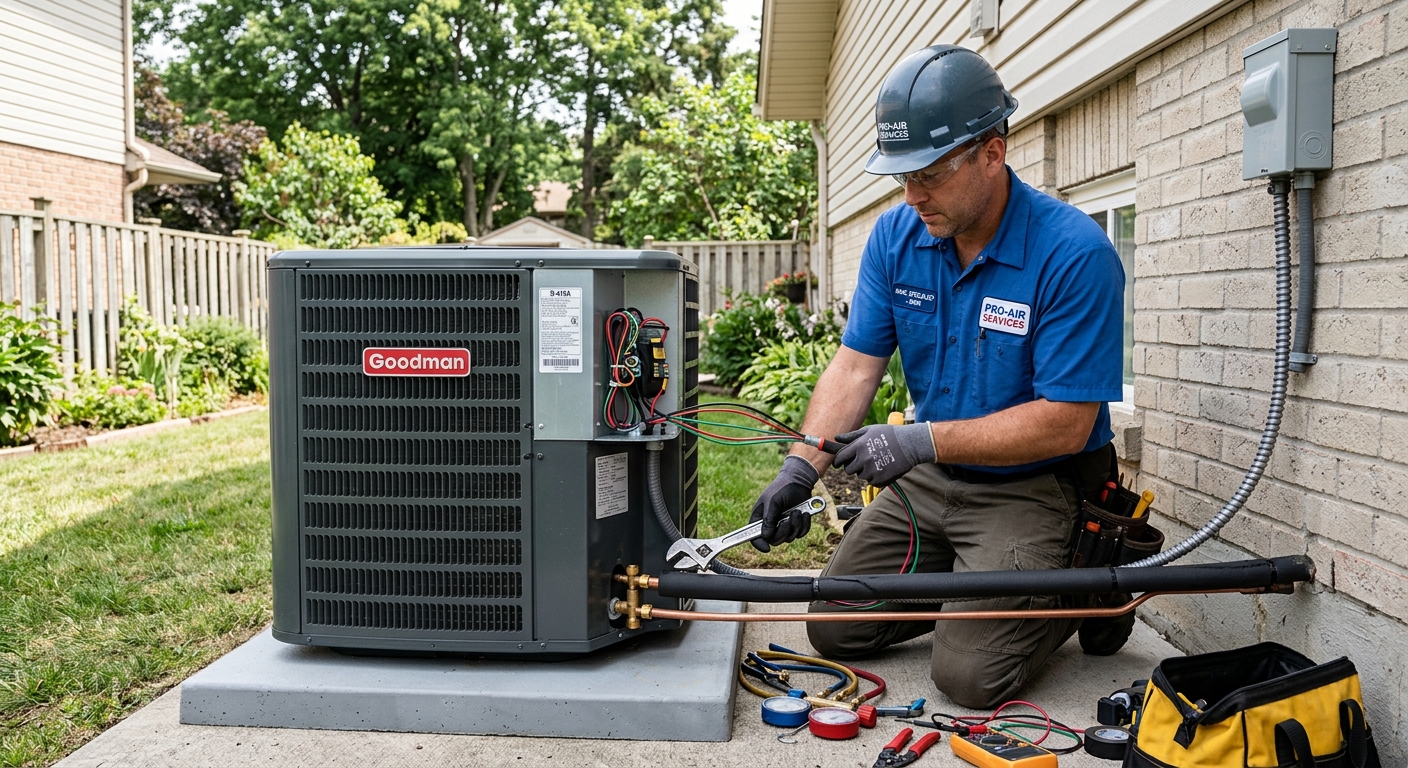
Dunmore heating and cooling prices by system type — 2026
Dunmore’s housing, with 82% of homes built before 1980 and a homeownership rate of 60.5% (U.S. Census Bureau, ACS 2024), means most HVAC projects are either system replacements or ductwork retrofits, not ground-up installs. The core challenge here isn’t just swapping a furnace or AC—it’s integrating modern equipment into older structures, especially in neighborhoods like Scranton and Old Forge with their stubborn pre-1940 rowhouses and duplexes that almost always need ductwork modified or replaced to handle modern airflow. Few Dunmore homes were built with AC in mind, and many still rely on radiators or baseboards for heat.
This region overwhelmingly leans heating-dominated: with 6,100 heating degree days versus just 850 cooling degree days, homes here require robust, reliable heating that covers severe cold snaps (winter design temp is 4 °F) but also tackles sticky, sometimes muggy valley summers. That’s why a heat pump, sized for full winter load or used alongside a furnace, often makes more sense than an AC-only solution. Retrofitting mini-splits into add-ons or sunrooms is common, while upgrading aging ductwork is almost always needed in the classic housing stock.
| System |
Best for |
Efficiency |
Price range (installed) |
| Central AC replacement (existing ducts) |
homes with sound ductwork |
16–20 SEER2 |
$4,900–$11,500 |
| Air source heat pump (ducted) |
year-round heating and cooling |
8–10 HSPF2 |
$7,800–$16,500 |
| Cold-climate heat pump (ducted) |
heat pump as primary heat |
9–11 HSPF2 |
$12,500–$16,500 |
| Ductless mini-split (single zone) |
additions, rooms without ducts |
20–30 SEER2 |
$3,100–$6,900 |
| Full duct system installation |
homes with no existing ducts |
— |
$8,800–$17,500 |
Installed estimates for a typical Dunmore home. Equipment tonnage, duct condition and electrical capacity move these more than brand.
Filtration, humidification and ventilation
Northeastern Pennsylvania’s cold winters mean most Dunmore homes get uncomfortably dry from November to March. That dryness can cause static, cracked woodwork, dry skin, and even nosebleeds. Whole-house humidifiers help, but they come with their own maintenance demands: you have to keep them clean and check for mineral buildup, or you’ll end up with mold in the ductwork or water leaking onto your furnace. In summer, humidity spikes, but an oversized AC—too common in our market—won’t run long enough to pull moisture out, leaving homes clammy and increasing mold risks.
If you want good filtration, don’t assume a thicker or higher MERV (Minimum Efficiency Reporting Value) filter is always better. Many fans in Dunmore’s older systems can’t handle the added resistance of a MERV 13 filter, so ask your installer what your blower can support without sacrificing airflow. High-MERV filters can also mean more frequent replacements—something to budget for.
For newer, tightly sealed homes and recent renovations, mechanical ventilation (usually an HRV or ERV) is worth considering, since opening a window in January isn’t practical. But be wary: UV lights, ozone generators, and “air scrubbers” are heavily marketed but provide little measurable benefit in a standard Dunmore home. Stick to proper filtration, basic humidification, and an honest conversation about ventilation if your house is draft-free. Skip “add-ons” unless a specific need is diagnosed by someone reputable.
Mechanical permits for HVAC work in Dunmore
Pennsylvania does not have a statewide HVAC trade license for residential work. Instead, every Dunmore contractor must hold Home Improvement Contractor registration from the Pennsylvania Office of Attorney General for any job over $500—verify this at hic.attorneygeneral.gov. Municipalities like Dunmore run their own code offices, enforcing the Pennsylvania Uniform Construction Code (UCC), which is based on the International Residential Code. This means mechanical permits for HVAC work are required and always inspected locally, not at the state level. If you live in Scranton or Old Forge, different code offices cover those permits; check before starting any work.
EPA Section 608 certification is required for anyone handling refrigerants, regardless of state or local rules. If a contractor or their technician isn’t certified under Section 608, they cannot legally handle refrigerants—including maintenance and replacement.
Insurance and workers’ compensation aren’t just nice to have—they’re mandatory for all employers. You can verify a contractor’s compliance through the WCAIS system (wcais.pa.gov) for workers’ comp coverage. Always ask for a certificate of insurance before the work begins, and don’t rely solely on decals or paperwork—verify for your own protection. For contracts over $500, Pennsylvania’s Home Improvement Consumer Protection Act requires a written contract and gives you a three-day right to cancel.
Separating installers from equipment sellers
It’s not the brand sticker on your new unit that determines comfort or what you pay to heat and cool your house. In Dunmore, quality HVAC work lives or dies on the precision and care of the install—regardless of which warehouse the equipment came from. The same brand-new heat pump or central air, installed properly versus rushed or corner-cut, can mean the difference between 15 years of low bills and a permanent headache.
Before signing with any contractor, verify their Home Improvement Contractor registration at hic.attorneygeneral.gov and confirm their EPA Section 608 certification for whoever handles refrigerant. Always ask if a proper Manual J load calculation is included; without it, system sizing is just guesswork. Your bid should call out equipment model numbers—not just “3-ton heat pump” but the manufacturer’s model code. At startup, real pros document that they measured airflow, confirmed refrigerant charge, and checked system operation—don’t accept the word “set up” as enough.
- Check HIC registration (hic.attorneygeneral.gov)
- Verify their workers’ comp via WCAIS
- Request Section 608 certification for technicians
- Ask if they performed a Manual J load calculation
- Get your proposal in writing, as required by law
- Insist on detailed model numbers, not just tonnage
- Look for written commissioning/startup checks
- Require proof of liability insurance
- Don’t accept vague “lifetime warranties”—ask for paperwork
- Understand their subcontractor policy
- Demand a clear timeline—unscheduled jobs can drag on
Red flags: In the heavily saturated Scranton–Wilkes-Barre HVAC market, watch for high-pressure upsells, quotes that feel copy-pasted, and any contractor who discourages questions. Trust your instincts—reliable firms in Dunmore aren’t shy about paperwork or process.
What you can actually claim on a heat pump here
In Dunmore and the rest of Pennsylvania, you can stack heat pump incentives from three layers: federal tax credits, possible utility rebates, and state-level programs if available. The federal side (like the ENERGY STAR heat pump credit) works as a nonrefundable tax credit—meaning you claim it when you file next year’s taxes, reducing what you owe dollar for dollar but not lowering your upfront bill. Utility rebates, where offered, come off the invoice, giving more immediate savings; the difference is a rebate helps your cash flow upfront while credits show up at tax time.
Dunmore’s electric is served by PPL Electric Utilities. Their incentive offerings change year to year, so you must check their official “rebates & efficiency” web page for the latest. Gas service, for those who have it, is usually through UGI Utilities in the valley cities; check their program page directly. For state and federal updates, start at the ENERGY STAR rebate finder before committing to a quote—the names, amounts, and qualifying products change regularly and any figure in an internet article is just a starting point, never a guarantee.
No matter the program, they’ll nearly always require documented proof—model numbers, installation invoice, sometimes performance data. If someone quotes a blanket rebate or tax credit without confirming your address and utility, get a second opinion. Even a best-case heat pump project ($7,800–$16,500) depends on careful paperwork to claim anything back.
What size system does a Dunmore home need?
In Dunmore, nothing causes more headaches—and higher bills—than oversizing your heating or cooling system. Oversized furnaces and air conditioners short cycle, wear out sooner, and leave you with muggy summers or drafty winter rooms. The common myth is “bigger is safer,” but in practice, oversizing is a defect: temperature swings, poor dehumidification, noisy startups, and a much shorter equipment life. Sizing by rule of thumb—like square footage or copying the old tag—is just carrying forward yesterday’s mistakes.
The right approach is a proper Manual J load calculation. This isn’t optional in our climate, where the winter design temperature is 4 °F and heating needs routinely spike. Manual J considers insulation, window type, orientation, and even air leakage—no two houses in Dunmore are identical, especially with all the add-ons and sun porches our older homes have picked up.
When interviewing contractors, ask point blank: “Did you run a load calculation, and can I see it?” If not, move on. The difference between a system that fits your home and one that doesn’t can swing thousands over the life of the equipment. Don’t trust anyone whose quote is based solely on the old unit’s tonnage or who shrugs off your unique layout—those shortcuts can mean regret every cold snap or heat wave.
What each system actually costs to run in Dunmore
Running costs depend on three things: system efficiency, how much heating or cooling your house requires, and what you pay your utility. With 6,100 heating degree days and a winter design temperature of 4 °F, most Dunmore homes spend far more on heating than cooling. PPL Electric Utilities posts your electric rate right on your monthly statement—use that for your calculations. For heating, if you use natural gas or electric, check your bill for “cost per therm” or “cost per kWh.”
Here’s how you compare systems: Efficiency ratings (SEER2 for cooling, HSPF2 for heating) show how much usable heat or cooling you get per energy dollar. The climate figures—degree days—tell you the total need. As an example, if you use 10,000 kWh a year for heating and your electric rate is $0.15/kWh, that’s $1,500 annually for heat. Increase efficiency (say, from an 8 HSPF2 to an 11 HSPF2 heat pump) and you could cut that by more than a quarter. But a poorly sealed house, or leaks in old ductwork, will eat those gains—high SEER2 or HSPF2 ratings mean little if half your air leaks into the attic.
If you want to check your own math: take your electric or gas rate and multiply it by usage. Example: 1,500 kWh x $0.15 = $225. If you’re switching fuel type, ask your contractor to run the numbers both ways. Remember, these are estimates: electric and gas rates change, weather is unpredictable, and every Dunmore home—especially those with old or modified ductwork—performs differently. For most, upgrading ductwork ($8,800–$17,500) delivers as much return as new equipment. High efficiency on solid ductwork wins every time over leaky, neglected runs.
Frequently asked questions — HVAC installation in Dunmore
Do I need to be home during installation?
During an HVAC installation in Dunmore, it’s strongly recommended that you’re home at the start and finish—though you rarely need to be there the entire time. At the start, your presence lets you review any questions, layout, and entry requirements with the crew. At the end, a reputable contractor should walk you through the setup, confirm thermostat functions, and answer maintenance questions. Middle-of-the-job work, like running ductwork or wiring, can be done while you’re out. For safety, you may want to secure pets or valuables, especially in older Dunmore homes with tight basements or odd crawlspaces. Always make sure the person letting contractors in understands what work is approved—especially for bigger, multi-day installs such as a full duct system ($8,800–$17,500).
Do I need ENERGY STAR equipment to qualify for incentives?
In Dunmore, most utility and federal incentives for HVAC systems require equipment that meets or exceeds ENERGY STAR specifications—especially for heat pumps and central air units. Federal tax credits typically call out ENERGY STAR or higher efficiency tiers, as found on the program’s website. Utility rebates—like those from PPL Electric Utilities—use ENERGY STAR as a baseline for eligibility but may have their own minimum SEER2 or HSPF2 requirements. Always check program rules directly since qualifying models shift each year. Don’t assume every available system in the $7,800–$16,500 bracket qualifies for a rebate just because it’s new—get the installer to confirm model eligibility and provide the documentation you’ll need to claim the incentive.
Should I close vents in unused rooms?
Closing supply vents in unused rooms seems like a way to save energy, but in Dunmore’s forced-air systems—especially those retrofitted into pre-1980 homes—it can backfire. Most existing ductwork was sized for whole-house airflow; closing vents raises system pressure, which can cause duct leaks, blower motor strain, or even a cracked heat exchanger. In older Dunmore homes with already leaky ducts, closing vents often means air (and heat) leaks into walls or basements instead of the rooms you want to condition. What you gain in perceived savings you may lose in system wear or future repairs. The better route: seal and insulate ducts during a major upgrade ($8,800–$17,500), and use a programmable thermostat to dial back temperatures when entire zones go unused.
What is SEER2 and how is it different from SEER?
SEER2 is the updated efficiency rating for air conditioning and heat pumps, mandated recently to better reflect real-world performance—including the pressure drops caused by ductwork. While SEER (Seasonal Energy Efficiency Ratio) used ideal lab conditions, SEER2 tests under higher external static pressure, which matches what most Dunmore homes see, especially those with older, more restrictive ductwork. So, a SEER2 value is a more realistic estimate of what you’ll get after install. When comparing quotes for central AC replacement ($4,900–$11,500), don’t just chase the highest SEER2—get ductwork looked at first, since poor airflow can drag any system down to subpar performance no matter the rating.
Should I repair or replace my HVAC system in Dunmore?
In a town where most homes were built before 1980, the rule of thumb for Dunmore is this: if your furnace, AC, or heat pump is over 15 years old and needs a costly repair, replacement may be more cost-effective, especially if you’ve got rising utility bills and uneven comfort. Repair makes sense for newer units—or if the fix is minor and the core (compressor or heat exchanger) is sound. Don’t be swayed by pressure sales tactics; get a price in writing. For a central AC with existing ducts, expect $4,900–$11,500 for replacement, but ductwork condition and layout matter more than age. Always ask for an honest assessment of duct leaks and air quality issues—patching old equipment into bad ducts wastes money, no matter how tempting the short-term savings.
Why do HVAC quotes in Dunmore vary so much?
HVAC quotes in Dunmore can feel all over the map because different contractors include (or skip) crucial details. In this Scranton–Wilkes-Barre-centered market, you’ll see some who bid just the box (equipment only) and others who include custom ductwork, electrical, or even immediate permitting. The age and design of local homes, especially those with non-standard layouts or no central ducts, means jobs aren’t interchangeable—retrofits cost more, and old ductwork might need full replacement ($8,800–$17,500). Materials, staffing, warranty details, and the contractor’s reputation all move the quote. The most dangerous quote is the barebones one—lowest price up front, highest risk for patchwork results or “surprise” extras midway through the job.
How much does a furnace replacement cost in Dunmore?
Furnace replacement pricing isn’t in the specific band above, but can be estimated based on similar retrofits. For Dunmore homes with existing ductwork in fair or good shape, expect the total cost to fall close to a central AC replacement: $4,900–$11,500 covers most high-efficiency gas furnace installs, with electric and dual-fuel options moving higher if upgrades are needed. That said, if your ductwork needs reworking—which is common in the area’s older homes—costs can rise quickly. Always insist the quote includes code-required permits, local inspections, and a startup checklist, since shortcut installs lead to higher operating costs.
Which utility serves Dunmore?
In Dunmore, your primary electric utility is PPL Electric Utilities, serving not just Dunmore but the entire valley region, including Scranton and Old Forge. If your home is connected to natural gas service, that’s typically handled by UGI Utilities in the valley cities. In rural parts and smaller outlying boroughs, propane and fuel oil still play a role, but for most, billing and rebate programs run through PPL or UGI. This matters for incentive eligibility and service response times, especially if you’re considering a heat pump (where usage and rates can move your annual cost by thousands—$7,800–$16,500).
What is EPA Section 608 certification?
EPA Section 608 certification is a federal requirement for anyone handling refrigerants used in air conditioners, heat pumps, or refrigeration. In Dunmore and the rest of Pennsylvania, it’s the law—regardless of your contractor’s state or local license. This protects you from both system damage and environmental fines: technicians must pass an exam covering safe handling, leak prevention, and proper recycling. When hiring for any AC replacement ($4,900–$11,500), specifically ask if the installer handling refrigerants is Section 608 certified—and if they can show you their card. Most reputable firms will have it ready. It’s your assurance the job is legal and won’t leave you with compliance headaches during permits or inspections.