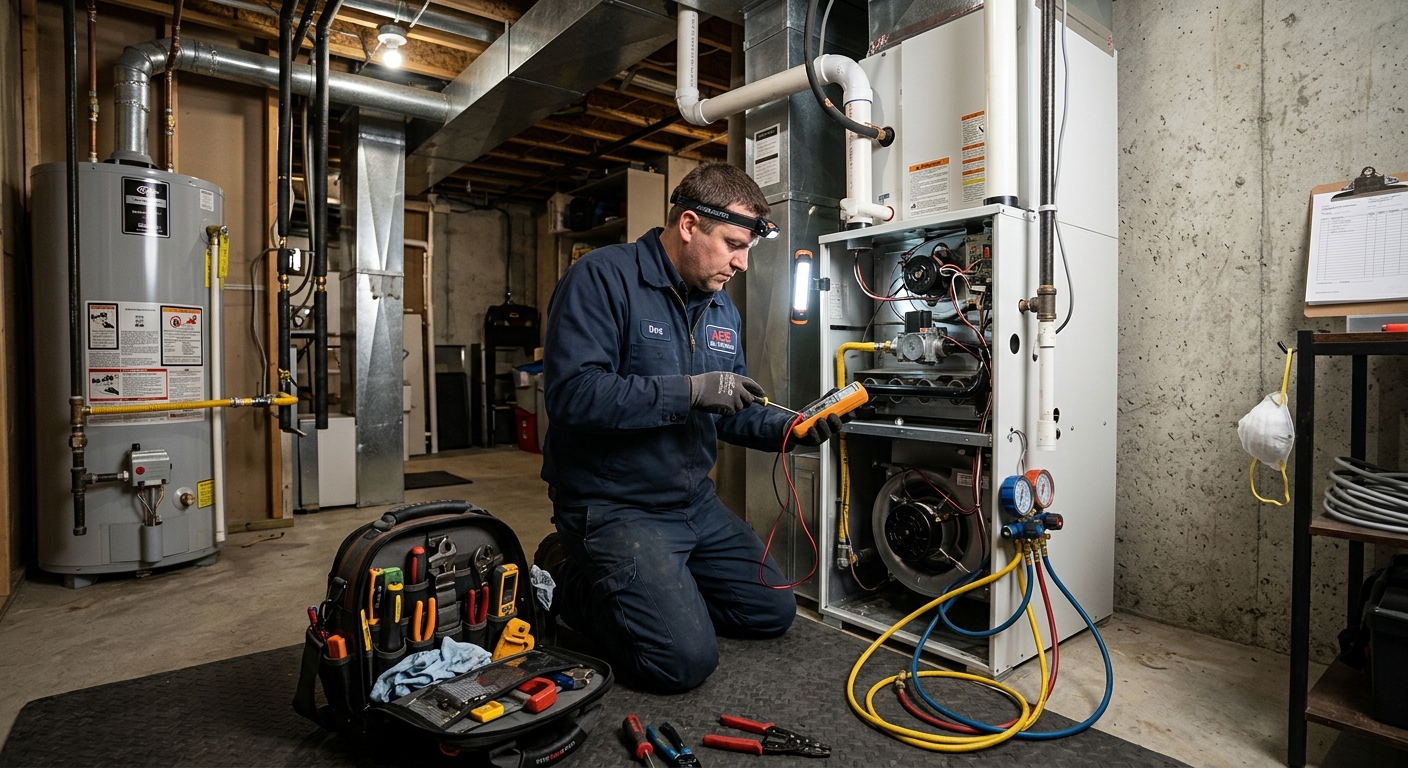
What a new HVAC system costs in Erie
In Erie, where over half of homes are owner-occupied and a striking 88.5% of the housing stock was built before 1980 (U.S. Census Bureau, ACS 2024), most HVAC installations are retrofits rather than first-time installs. Postwar expansion filled the area with homes built before central air was standard, which means plenty of existing ductwork — but that ductwork is often undersized, leaky, or designed for heating only. That drives up demand for duct corrections or even new duct systems during HVAC replacements.
This is firmly a heating-dominated region. With 6,200 heating degree days versus just 800 cooling degree days, winter comfort and reliability take priority over deep summer cooling. Heating loads are persistent, with design temperatures dropping to 5 °F. The system size, configuration, and efficiency you need here often look different than in milder climates a few hours south.
| System |
Best for |
Efficiency |
Price range (installed) |
| Central AC replacement (existing ducts) |
homes with sound ductwork |
16–20 SEER2 |
$4,600–$11,000 |
| Air source heat pump (ducted) |
year-round heating and cooling |
8–10 HSPF2 |
$7,300–$15,500 |
| Cold-climate heat pump (ducted) |
heat pump as primary heat |
9–11 HSPF2 |
$12,000–$15,500 |
| Ductless mini-split (single zone) |
additions, rooms without ducts |
20–30 SEER2 |
$2,900–$6,400 |
| Full duct system installation |
homes with no existing ducts |
— |
$8,300–$16,500 |
Installed estimates for a typical Erie home. Equipment tonnage, duct condition and electrical capacity move these more than brand.
What a Pennsylvania HVAC contractor must hold
Pennsylvania does not issue a statewide HVAC license for residential work. Instead, residential HVAC contractors must register for Home Improvement Contractor (HIC) registration with the state Attorney General for projects over $500, and you can check any contractor's status at hic.attorneygeneral.gov. Municipalities like the City of Erie have their own mechanical permit and inspection requirements for new HVAC installations and replacements — if work involves new equipment or adding/changing ductwork, a city permit is required. There is no statewide trade license or board for residential HVAC, but a mechanical permit from the local authority is always required, and enforcement rests with each municipality or the PA Department of Labor & Industry if a municipality has opted out.
Any technician handling refrigerant — whether installing, servicing, or retiring an air conditioner or heat pump — must hold EPA Section 608 certification. This is a federal law and applies everywhere in the U.S., not just Pennsylvania. It ensures proper handling of refrigerants, which is important for both safety and environmental compliance.
To verify a contractor has workers’ compensation coverage (a requirement for all employers in Pennsylvania, including HVAC installers), check with the state’s WCAIS system (wcais.pa.gov). Never hire an uninsured installer. Proper registration, permits, and insurance are your best protection against shoddy or unsafe work.
Erie’s housing stock and its HVAC needs
Most homes in Erie and its suburbs were built before 1980, which means you’re likely dealing with original or long-retired HVAC strategies. Many houses have ductwork, but it was often sized just for a furnace, not central air. That means if you’re adding or replacing AC, duct corrections are sometimes needed to properly cool upstairs rooms. Insulation in pre-1980 homes is typically below modern standards, and single-pane windows or poorly sealed flues are common, both of which increase heating loads. If your home uses a chimney for furnace or water heater venting, have that checked before swapping equipment — old flues can be unsafe with modern high-efficiency units.
Fully electric heat pumps require adequate electrical panel capacity, which some older Erie homes may lack. Upgrading to a 200-amp panel is an unwelcome surprise if you haven’t budgeted for it. In contrast, suburban Erie developments built since the 1990s usually came with forced air and AC as standard, though first-round builder-grade equipment is likely due for replacement now and may have been slightly oversized — a practice that often causes poor humidity control and unnecessary fuel consumption.
Retrofit needs dominate here: be ready to address duct condition and capacity, insulation, window quality, and electrical readiness before choosing your next HVAC system.
The central decision for a Erie homeowner
In Erie County, the real question is heat. With a typical winter design temperature of 5 °F and 6,200 heating degree days — nearly eight times the cooling degree days — your biggest HVAC decision is choosing reliable primary heat that fits your home and your utility options. Modern cold-climate heat pumps are engineered to deliver capacity well below freezing, mostly overcoming the “heat pumps don’t work up north” reputation. In most Erie winters, a properly sized cold-climate heat pump can keep up all but during the deepest cold snaps, but capacity drops as the temperature plunges. That’s why some homeowners opt for dual-fuel (heat pump with gas backup): the heat pump handles moderate cold and switches to gas only when needed.
Natural gas is widely available in Erie and nearby suburbs, making it the standard for primary heating where available. In rural areas served by propane or heating oil, heat pumps become relatively more attractive, as propane and oil prices often run higher per unit heat delivered. For many single-family homes in suburban Erie, this puts the choice between a gas furnace and heat pump on even footing, influenced by ductwork, electrical panel, and comfort preferences.
If your ductwork is poor, or you want zone-by-zone control (for example, an attic bedroom that bakes in the summer), ductless mini-split systems are worth a look, but a furnace is still the right call when you have reliable gas and long deep freezes. The table below compares your main options:
| Option |
Installed cost |
Operating cost here |
Best when |
Incentive eligible |
| Gas furnace + central AC |
$4,600–$11,000 |
low with gas service, reliable even in coldest spells |
existing gas service, coldest zones |
some utility/efficiency rebates |
| Ducted heat pump (cold climate) |
$7,300–$15,500 |
lowest when electric rates are moderate, best for efficient homes |
good envelope, all-electric goal |
often eligible |
| Dual fuel (heat pump + gas backup) |
$12,000–$15,500 |
optimized for best available fuel at each temp |
gas on site, deep cold spells |
some rebates, check specifics |
| Ductless multi-zone |
$8,300–$16,500 |
high efficiency per zone, but upfront cost is higher for whole house |
no ductwork, zone control |
some rebates by zone type |
Filtration, humidification and ventilation
Erie’s climate delivers long, cold winters and humid, muggy summers. That means your HVAC system faces two seasonal air quality challenges: chronic dryness in winter and sticky indoor air in July. In winter, relative humidity inside drops as heated outdoor air brings little moisture. Whole-house humidifiers can raise comfort, but they require regular maintenance — missing your annual cleaning can lead to mold in ductwork or on the pad. If you have an older home with leaky ducts, adding humidity to the air only to lose it to leaks is a money-waster.
For summer, a correctly sized air conditioner or heat pump does most dehumidification. Oversized ACs are notorious for cycling on and off too quickly, cooling the air but leaving excess moisture behind. Erie homes with older, oversize systems often complain of “clammy” air. When it comes to filtration, going above a MERV 11 or 13 filter makes sense only if your blower can handle it — higher MERV means more resistance, and that can strain older fans and reduce airflow.
Mechanical ventilation (fresh air supplied by a fan or ERV system) matters most in newer, tightly sealed homes. In most pre-1980 Eries, infiltration’s high enough that dedicated ventilation is usually optional. Air scrubbers, UV lights, and high-end “air purifiers” are often oversold; their effect is minor unless you have a specific medical need.
The refrigerant change and what it means for repairs
Most HVAC systems installed in Erie through the early 2020s use R-410A refrigerant. With recent changes in U.S. law, new residential systems are now built with lower-GWP refrigerants like R-454B and R-32. You don’t have to replace a working R-410A unit; service and repairs are still fully legal, and parts availability won’t vanish overnight. The real shift a homeowner will notice is in the cost and future repair calculus: as manufacturers and wholesalers turn to new refrigerants, supplies of R-410A will tighten, and prices for the refrigerant itself could rise. That mainly affects you if your older system develops a leak or requires a major repair — those bills are likely to get steeper in the coming years.
If your current system cools and heats reliably, there’s no law or regulation forcing you to upgrade. But if your R-410A system springs a leak and needs a top-off, it’s worth weighing the rising service costs against the investment in a new, more efficient unit. No technician should tell you your R-410A system is illegal or unserviceable — the industry is supporting repairs for years yet. The refrigerant transition is about new sales and long-term economics, not forced obsolescence.
What size system does a Erie home need?
Getting the right size HVAC system is absolutely critical in Erie’s climate. Oversizing leads to quick on/off cycling (short cycling), poor humidity removal in summer and uneven temperatures. Contrary to popular belief, “a little extra is safer” does harm more than good — you’ll see higher bills, wear out equipment faster, and never get the comfort you paid for.
Proper sizing means running a Manual J load calculation specific to your home: factoring in window quality, insulation, floor area, orientation, air leakage, and especially how much heat escapes on a winter night at Erie’s 5 °F design temp. No two Erie homes are identical, particularly with construction before 1980 so common. Rules of thumb like “a ton per 600 square feet” routinely overshoot or undershoot because they ignore ductwork, attic insulation, or those original single-pane windows still in many older neighborhoods.
The question to ask any contractor is: “Did you perform a Manual J calculation for my house, and can I see the report?” If they size the new gear by copying your old equipment’s rating plate, they’re just repeating whatever the builder or prior installer guessed at — and that original number is often plain wrong.
Right sizing, grounded in the local climate, is more important here than brand or features.
Frequently asked questions — HVAC installation in Erie
How cold does it get in Erie and does that affect heat pumps?
The winter design temperature for Erie is 5 °F, which means your system needs to keep up when the snow is heavy and the mercury drops. Traditional air source heat pumps of an older generation struggled here, but modern cold-climate models are built specifically for our conditions. They deliver usable heat well into the single digits, though their capacity drops as the temperature falls and the backup heat or dual-fuel option may kick in for the coldest nights. The result is that heat pumps are now a real option for many Erie homes, unlike a decade ago. For a ducted, cold-climate heat pump, expect an installed price band of $12,000–$15,500 — often eligible for incentives when replacing oil or propane.
What is SEER2 and how is it different from SEER?
SEER2 (Seasonal Energy Efficiency Ratio 2) is the updated test protocol for measuring an air conditioning system’s efficiency, introduced to more closely represent real-world conditions — including the actual static pressure most duct systems experience. Classic SEER ratings were often a bit optimistic, making older systems look more efficient than they usually performed in the field. For Erie homeowners, where cooling degree days (about 800 per year) are much lower than heating, SEER2 is mostly about getting fair value: a $4,600–$11,000 central AC replacement delivers 16–20 SEER2, which accurately predicts your likely summer energy bills.
How long should an HVAC system last in Erie?
In Erie, most central air conditioners and heat pumps last 12–17 years, with some furnaces running 20 or more, depending on maintenance and installation quality. Our cold winters and heavy heating loads mean systems work harder than in mild areas. Postwar homes with ductwork designed for heating only may strain AC units, lowering their life expectancy. If your system has made it past year 15, start budgeting — a typical Erie AC or heat pump replacement will run $4,600–$15,500, depending on the type and home-specific details.
What is EPA Section 608 certification?
EPA Section 608 certification is a federal requirement for anyone who installs, services, or disposes of HVAC equipment that contains refrigerant anywhere in the country, including Erie. It ensures technicians are trained to handle refrigerants safely and prevent their release, protecting the environment and your system warranty. Contractors in Pennsylvania are not licensed at the state level for HVAC, but Section 608 applies everywhere. Ask your Erie HVAC contractor if everyone handling refrigerant is certified. Whether you’re replacing a ductless mini-split (typical $2,900–$6,400) or a central system, always require this certification.
Can a heat pump heat my house without backup?
In most Erie homes, a modern cold-climate heat pump can cover the majority of your heating needs, even in the dead of winter. However, on super-cold nights (down toward 5 °F), capacity drops off, which is why many Erie homes keep a backup — electric resistance, gas, or dual-fuel. If your home is well insulated and your heat pump is sized right, it might keep up on its own until near-zero, but for most pre-1980 homes, some backup remains smart. A ducted cold-climate heat pump solution falls in the $12,000–$15,500 band installed, depending on panel upgrades and ducts.
How much does a new HVAC system cost in Erie?
For most Erie homeowners, a full system replacement runs between $4,600–$16,500, depending on whether you’re just swapping an air conditioner, adding a ducted or ductless heat pump, or replacing an entire duct system. Most will find the sweet spot around $7,300–$13,000 for a standard-sized single-family home with workable existing ducts. Keep in mind, older homes may need extra work on ducting or electrical to support modern equipment. Always insist on a written contract and a line-itemized quote — both are required by Pennsylvania law for jobs over $500.
How much does a furnace replacement cost in Erie?
For a typical gas furnace replacement in Erie, expect to pay in the $4,600–$11,000 range, which usually includes the labor, permit, and any adjustments to existing ductwork or venting systems. If your ducts are in poor condition, or if you’re dealing with an old chimney flue that’s not compatible with a high-efficiency furnace, some extra work can creep in. This is a heating-dominated market, so most homes opt for a standard gas furnace where gas service is already available.
How long does HVAC installation take in Erie?
For standard replacement (furnace or AC, using existing ductwork), most jobs in Erie take 1 to 2 days, depending on complexity and inspection scheduling. If your project includes new ductwork, equipment relocation, or major electrical upgrades, plan on 3–5 days. Local permit and inspection requirements mean you can’t skip steps. Average total project cost for a system swap: $4,600–$11,000. If a contractor promises same-day complete installs on older Erie homes, be wary — fast isn’t always thorough in these houses.
Does my utility offer a heat pump rebate in Erie?
Most Erie-area electric utilities participate in heat pump rebate programs, particularly for high-efficiency or cold-climate models. These incentives shift year to year, but typically offset a portion of the upfront cost — sometimes $400–$1,000 for qualifying heat pumps in the $7,300–$15,500 installed range. Eligibility depends on installer paperwork and meeting efficiency standards. Before starting your project, check with Pennsylvania Electric Company for specifics and ask your contractor to help process rebate applications. You must use a registered installer for most rebates.