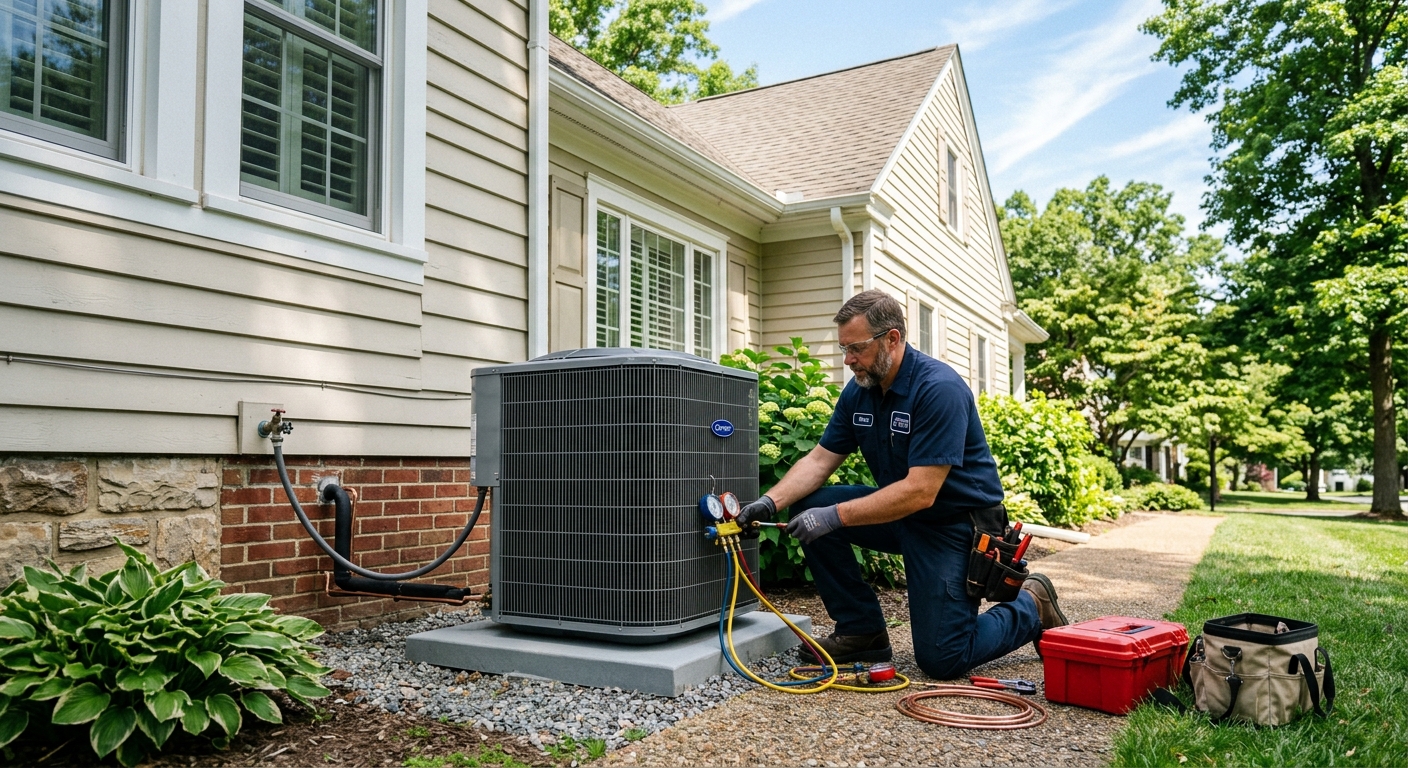
What a new HVAC system costs in Rapho
Rapho is a township of mostly owner-occupied, single-family homes, with a homeownership rate of 83.3% and nearly 40% of housing built before 1980 (U.S. Census Bureau, ACS 2024). That means most HVAC work here is replacing or retrofitting systems in existing homes—not installing in new builds. In many Lancaster city neighborhoods, rowhomes from 1880 to 1930 often need ductless or high-velocity retrofits instead of standard ducted systems, as many older homes weren’t built with ducts or have limited space for new runs. In newer subdivisions around Manheim Township, existing ductwork is more common, making replacements straightforward.
Lancaster County has 5,200 heating degree days and only 1,250 cooling degree days each year, so heating needs dominate the HVAC conversation. Sizing and design should reflect that—if someone tries to upsell you on extra cooling capacity, remember that our region just doesn’t need as much AC as, say, the Southeast. In practice, the biggest cost factors here are whether you need all-new ductwork, and what your current electrical system can handle if switching to a heat pump.
| System |
Best for |
Efficiency |
Price range (installed) |
| Central AC replacement (existing ducts) |
homes with sound ductwork |
16–20 SEER2 |
$5,100–$12,500 |
| Air source heat pump (ducted) |
year-round heating and cooling |
8–10 HSPF2 |
$8,200–$17,500 |
| Cold-climate heat pump (ducted) |
heat pump as primary heat |
9–11 HSPF2 |
$13,500–$17,500 |
| Ductless mini-split (single zone) |
additions, rooms without ducts |
20–30 SEER2 |
$3,300–$7,200 |
| Full duct system installation |
homes with no existing ducts |
— |
$9,300–$18,500 |
Installed estimates for a typical Rapho home. Equipment tonnage, duct condition and electrical capacity move these more than brand.
When an HVAC repair stops being worth it
In Rapho, with many homes already on their second or third HVAC system, knowing whether to repair or replace is a question that comes up often. Here’s a plain approach: unless the repair is a high-ticket part or exceeds roughly a third the cost of a new system, repairs usually make sense—especially if your unit is under 10 years old and has been otherwise reliable. Key to this is understanding which parts have failed. A single component like a capacitor or contactor is worth fixing. Once you’re dealing with a cracked heat exchanger (on a furnace) or a compressor failure on an older system, replacement becomes the only safe or cost-effective option.
The refrigerant type is another trigger—if you have R-22 (phased out), repairs get more expensive and less practical every year. Projections of payback from higher efficiency should be viewed soberly: with our moderate cooling needs, efficiency upgrades in AC alone don’t cover their premium nearly as quickly as heating upgrades can. Long-term, if your air conditioner or heat pump is well past 15 years or needs a compressor out of warranty, replacement is smarter. If your utility bills are creeping up but the system is still running, the first step in Rapho is often a duct or insulation evaluation—not a full replacement.
| Situation |
Recommendation |
Typical cost |
Reasoning |
| Under 10 years, single component failure |
Repair |
$300–$1,200 |
Most parts are still readily available and cost-effective to fix. |
| 10–15 years, repair over a third of replacement |
Consider replacing |
$5,100–$12,500 |
Major repairs in this age range have diminishing returns. |
| 15+ years, any major failure |
Replace |
$5,100–$12,500 |
System likely at end of useful life. |
| Cracked heat exchanger, any age |
Replace immediately |
$5,100–$12,500 |
It’s a carbon monoxide risk—safety issue can’t be delayed. |
| Compressor failure past warranty |
Replace |
$8,200–$17,500 |
Repair isn’t cost effective; time for new equipment. |
| Working system, high bills |
Test ducts and envelope first |
$300–$800 |
Leakage and poor insulation are common in older Rapho homes. |
Filtration, humidification and ventilation
Winters in Rapho are cold (5,200 heating degree days), and that makes winter dryness a real problem—eyes, throats, and furniture all complain when indoor humidity drops. Many homes benefit from whole-house humidifiers, but they require annual maintenance to avoid mold and mineral deposits. In summer, high humidity can creep in during long muggy spells, and if your air conditioner is oversized—common in upgrades where cooling loads are overestimated—it may blast cold air quickly but leave the air clammy, because it doesn’t run long enough to dehumidify. Proper sizing solves this better than adding equipment.
Filtration is another easy upsell, but before jumping for the “highest MERV available,” check your system’s blower capacity: a MERV 13 filter can choke the airflow and harm efficiency if your blower isn’t sized for it. For most Rapho homes, a MERV 8-11 filter balances filtration with airflow. Standalone “air purifiers” or UV lights are widely marketed, but unless you have specific allergies or respiratory illnesses, the improvements over good filtration are marginal for the money.
Newer, tightly sealed homes may need mechanical ventilation to maintain indoor air quality. For older homes with leaks, extra equipment for ventilation is oversold—leakage handles it. The bottom line: invest in a decent filter and maintain basic humidification; save your budget on gadgets with limited benefit.
Separating installers from equipment sellers
In Rapho and Lancaster County, the installer—not the brand—makes the strongest difference in how your HVAC system performs and lasts. Quality varies much more on who does the work than the nameplate on the equipment. Always start by verifying company registration through the Pennsylvania HIC system, which is required for contracts over $500. For refrigerant work, federal EPA Section 608 certification is non-negotiable for anyone actually handling your installation.
Demand attention to detail from the start: a serious quote should include a proper load calculation for your home, not just a fallback to square footage or existing equipment size. Ask for copies of insurance and workers’ compensation—don’t just take verbal assurances; Pennsylvania makes this easy to check through the WCAIS system. The proposal should specify manufacturer model numbers, not just generic “3-ton AC.” Hire an installer who provides commissioning data at completion: measured airflow, line pressures, and refrigerant charge, not just “system starts.”
- Verify HIC registration at hic.attorneygeneral.gov
- Ask for EPA Section 608 credential for refrigerant work
- Require proof of insurance and workers’ comp (WCAIS)
- Insist on a load calculation (Manual J or equivalent)
- Get model numbers, not just system size, in your quote
- Ask about duct sealing and static pressure measurement
- Request commissioning reports with startup pressures and airflow readings
- Avoid any company offering sharp discounts for “today only” signings
- Beware of bids that undercut market rates by thousands—labor and liability cost what they cost here
- Demand written scope, warranty explanation, and permit responsibility in contract
Red flags in Lancaster County’s moderate market: companies selling only one make/model or using only subcontract labor tend to focus on volume over quality. Out-of-area outfits chasing quick installs often skip core setup steps.
Mechanical permits for HVAC work in Rapho
Pennsylvania does not issue a statewide HVAC license. Instead, all residential HVAC replacement, installation, and qualifying repair work is regulated at the municipal level. For Rapho and most of Lancaster County, mechanical permits and inspections are handled by your township’s code office—not by a state agency. The state requires a registered Home Improvement Contractor (HIC) for any contract over $500, and you can easily confirm this at hic.attorneygeneral.gov.
Permits are generally required for any installation or replacement of central HVAC equipment, but not for filter changes or basic thermostat work. Contractors must comply with the Pennsylvania Uniform Construction Code, which is based on the International Residential Code. If your installer will handle refrigerant, federal law requires the technician to carry EPA Section 608 certification—regardless of state licensing.
Always ask your contractor for a certificate of insurance and proof of workers’ compensation; Pennsylvania employers must carry comp coverage and you can verify status at the WCAIS portal (wcais.pa.gov). Never allow HVAC work to start in Rapho without checking that your contractor is properly registered and insured. The enforcement and inspection responsibilities rest with your municipality, not the state.
Retrofit versus replacement in Rapho
Rapho’s housing stock is a mix of older and newer homes, with nearly 40% built before 1980 (U.S. Census Bureau, ACS 2024). That means a lot of houses here either never had central ductwork—or have older, undersized ducts that were originally intended for heating only, not for whole-house cooling or heat pump operation. In these older homes, even the “existing” ductwork may be too leaky, small, or poorly insulated for today’s systems. Retrofitting may mean new high-velocity or ductless options, with full duct installs ranging from $9,300–$18,500.
Older homes can also present surprises: under-insulated attics, dated windows, or a lack of capacity in the electrical panel if you’re switching to an all-electric heat pump. If you’re replacing a furnace, always check the flue or chimney—and see if it’s shared with any other appliances.
If your home is newer (built after 1980), you likely have full ducts in place. But if you’re living in a house from the late 1990s—common in the outer Rapho-Manheim area—original builder-grade HVAC is probably at the end of its service life now. These first-replacement jobs can bring their own issues, mostly around over- or under-sizing by the original builder, and ductwork that isn’t always well sealed. Evaluating actual airflow and insulation as part of the replacement is money well spent.
Heat pump or furnace: what makes sense in Rapho
Heating is the big ticket in Rapho, thanks to a winter design temperature of 12 °F and 5,200 heating degree days. That tips the scales toward equipment that excels at heating, not just cooling. Modern cold-climate heat pumps have improved dramatically—even at single-digit temps, they keep useful output, but efficiency and heating capacity do drop in deep cold. This is where the “dual fuel” setup earns its keep: a heat pump handles most of the load, while a furnace kicks in for the coldest days.
Gas availability splits the market. In Lancaster, Manheim, and East Hempfield, natural gas is common and cheap enough that a gas furnace remains a strong option, especially for older or drafty homes. In more rural western or eastern townships where natural gas isn’t an option, you’re looking at propane, fuel oil, or a heat pump. In that comparison, heat pumps suddenly become much more attractive—operating costs are usually lower than for oil or propane, and you avoid fuel delivery headaches.
If your home already has sound ducts and gas service, a high-efficiency furnace paired with a central AC is still the standard choice for many. For anyone wanting to go all-electric, has no gas, or is retrofitting an older building, a cold-climate heat pump or ductless mini-split makes sense. But if your house is drafty or poorly insulated, fix that first—otherwise, neither system will perform as promised.
| Option |
Installed cost |
Operating cost here |
Best when |
Incentive eligible |
| Gas furnace + central AC |
$5,100–$12,500 |
Low with existing gas |
existing gas service, coldest zones |
Some models |
| Ducted heat pump (cold climate) |
$8,200–$17,500 |
Lower than oil/propane, higher than gas |
good envelope, all-electric goal |
Usually, if above minimum efficiency |
| Dual fuel (heat pump + gas backup) |
$13,500–$17,500 |
Optimized year-round |
gas on site, deep cold spells |
Often, if paired with eligible heat pump |
| Ductless multi-zone |
$9,300–$18,500 |
Good in tight, zoned spaces |
no ductwork, zone control |
Most models |
Frequently asked questions — HVAC installation in Rapho
Is an annual maintenance plan worth it?
Annual HVAC maintenance is a smart investment in Rapho, mainly because our climate works systems hard in both heating and cooling seasons. Most plans include inspection, cleaning, and performance checks that can catch problems like declining airflow, low refrigerant, or furnace safety issues before they become costly. A typical plan runs $300–$800 per year, much less than a single major emergency repair call. For older homes (nearly 40% are pre-1980 here), regular tune-ups also help catch wear and tear from aging ducts or insulation. While you don’t need every “deluxe” package with add-ons, keeping up with minimum maintenance will extend equipment life and keep utility bills in check.
Why do HVAC quotes in Rapho vary so much?
The price difference among Rapho contractors often comes down to who’s doing the installation and how much real prep work they include. You’ll see a wide range—sometimes as much as $5,100–$12,500 for central AC replacement. Factors driving price include whether a full load calculation is done, duct repairs are included, certification and insurance are documented, and if commissioning and permits are handled properly. Some companies in the Lancaster County market will quote bare minimums just to win volume jobs, while others provide a more comprehensive, longer-lasting install. If your home is older or lacks standard ductwork, prices for ductless or retrofit solutions will swing even more.
What is SEER2 and how is it different from SEER?
SEER2 is the updated federal efficiency rating for air conditioners and heat pumps, designed to reflect actual installed performance under more realistic test conditions—especially static pressure in the ductwork. A system rated at 16–20 SEER2 here in Rapho might outperform an older 20-SEER unit measured by the previous standard. For you, this means a more apples-to-apples comparison when shopping equipment, but don’t expect miracle savings—our heating-dominated climate means high SEER2 isn’t the top priority. Instead, focus on a well-balanced system that’s properly sized, as actual seasonal costs in Rapho reflect both heating and cooling. Cost differences for higher-SEER2 units can be a few thousand dollars: $8,200–$17,500 for an air source heat pump.
How do I verify an HVAC contractor's insurance?
In Pennsylvania, you can directly request your contractor’s insurance certificate before any work begins—a must in Rapho. This certificate should show both liability coverage and workers’ compensation if they have employees. For workers' comp, you can cross-check status through the WCAIS system (wcais.pa.gov), which lists all registered insurers and coverage status. For contracts over $500, the contractor must also be HIC-registered (searchable at hic.attorneygeneral.gov). If they hesitate or can’t provide this paperwork, choose someone else—uninsured contractors leave you exposed if there’s an accident or damage on the job.
Is a high-efficiency system worth the extra cost here?
High-efficiency HVAC equipment can pay off in Rapho, but it depends on your usage. With 5,200 heating degree days, efficiency makes the most impact if you’re replacing old oil, propane, or electric resistance heat. For gas furnaces, stepping above a standard 95% model to ultra-high (97–99%) won’t always show big savings—especially in a drafty or under-insulated home. In cooling, our relatively few degree days (1,250) mean high SEER2 units deliver only modest cost reductions. Price-wise, expect $13,500–$17,500 for a top cold-climate heat pump—so weigh the upfront cost against your annual bills and how long you’ll be in your home.
Do I need to be home during installation?
While it's not strictly required for you to be home all day during HVAC installation, being there for start and finish is useful, especially in Rapho where older homes may present access surprises or questions about duct paths and thermostat placement. Installers may need you to confirm equipment locations or answer utility access questions. For a central AC replacement (running $5,100–$12,500), expect a full day’s work at minimum—being reachable means issues get solved before they become delays. If you can’t be home for the whole install, be sure your contractor has your cell number and a way to secure the property after finishing.
Which utility serves Rapho?
PPL Electric Utilities provides electric service throughout most of Lancaster County, including Rapho. If you’re looking into all-electric conversions or upgrading for a heat pump—such as an air source model in the $8,200–$17,500 range—your new system will draw from PPL’s supply. If you’re within range of natural gas service (mostly in Lancaster, Manheim Township, and East Hempfield), UGI Utilities is the provider. More rural or outlying homes tend to use propane or fuel oil for heating, which changes your equipment options.
Do I need ENERGY STAR equipment to qualify for incentives?
In general, most utility or government incentive programs in Pennsylvania require your equipment to meet or exceed ENERGY STAR standards to get rebates or tax credits. However, “ENERGY STAR” is the floor—not all qualifying systems will give you the same payout. For example, a cold-climate heat pump (often costing $13,500–$17,500 installed) may earn more back if it meets even higher efficiency benchmarks than just ENERGY STAR minimums. Always check the specific requirements for your program—PPL and some township incentives look for SEER2 and HSPF2 numbers, not just the sticker.
Is a heat pump a good choice for Rapho winters?
Yes, but with caveats specific to Rapho’s climate. Modern cold-climate heat pumps now perform reliably down to our design temperature of 12 °F—well below freezing. That said, you’ll need a model rated for low-ambient operation and sized for local loads. In older or drafty homes, a heat pump may need to be paired with electric backup or dual fuel to ensure comfort in the coldest weeks. Installation cost for a ducted system runs $8,200–$17,500, so weigh your current heating costs—heat pumps beat propane and oil for efficiency, while savings over natural gas are smaller. Proper sealing and insulation are critical for best results, and you may need an electrical upgrade to support full output in winter.