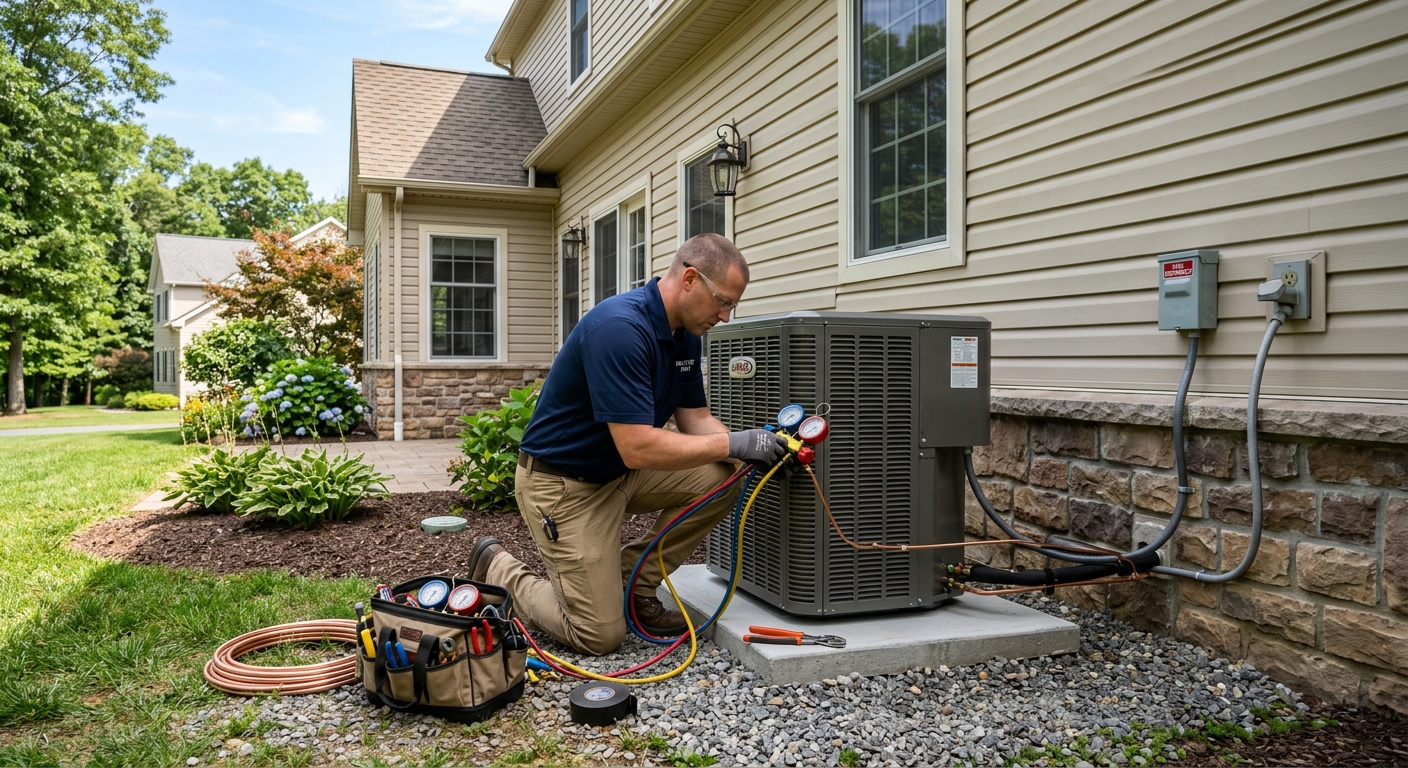
East Norriton heating and cooling prices by system type — 2026
East Norriton’s heating and cooling market is defined by its high homeownership rate and the age of its housing stock. With 71.7% of homes owner-occupied and 65.2% built before 1980 (U.S. Census Bureau, ACS 2024), most HVAC jobs here are replacements or retrofits rather than first-time installs. This is a town where decades-old ductwork may run above finished ceilings, or you’ll find split-levels built to cool only with opening windows—influencing whether replacing equipment is straightforward or means adding ducts and electrical upgrades.
Neighboring post‑1945 suburbs like Abington and Cheltenham face the same realities: much of the original ducting was sized for heat only, not central air, and modern code compliance or comfort upgrades often require modifications. In Montgomery County, a higher heating degree day count (4,800) versus cooling degree days (1,450) means this is a heating-dominated climate. That suggests system selections and upgrades should put more focus on heating efficiency and reliability, though humid, uncomfortable summers do demand well-maintained cooling.
| System |
Best for |
Efficiency |
Price range (installed) |
| Central AC replacement (existing ducts) |
homes with sound ductwork |
16–20 SEER2 |
$5,400–$13,000 |
| Air source heat pump (ducted) |
year-round heating and cooling |
8–10 HSPF2 |
$8,600–$18,000 |
| Cold-climate heat pump (ducted) |
heat pump as primary heat |
9–11 HSPF2 |
$14,000–$18,000 |
| Ductless mini-split (single zone) |
additions, rooms without ducts |
20–30 SEER2 |
$3,400–$7,500 |
| Full duct system installation |
homes with no existing ducts |
— |
$9,600–$19,500 |
Installed estimates for a typical East Norriton home. Equipment tonnage, duct condition and electrical capacity move these more than brand.
Retrofit versus replacement in East Norriton
The story of HVAC in East Norriton starts with when your house was built. With 65.2% of units constructed before 1980, there’s a strong chance your home’s ducts—if they exist—were not originally designed for modern air conditioning. Ducts in pre-1980 houses may be undersized for strong cooling, or were meant to carry just heat, making even simple equipment swaps more complicated. Insulation in attics and walls was also typically below today’s standards, and window quality varies widely. If your panel hasn’t been upgraded, an all-electric system installation may require a heavier service or at least new circuits.
Builder-grade systems in late-1990s subdivisions—common elsewhere in Montgomery County—are likely hitting the end of their expected lifespans, meaning owners are often replacing the first central air or forced air furnace installed. Those original units were often oversized for safety but inefficient by today’s standards.
Chimney or flue condition is another concern for gas furnace replacements in older homes: clay liners may have failed or simply aren’t compatible with high-efficiency condensing units, requiring new venting solutions. If you’re considering a cooling upgrade or a switch to heat pumps, it’s not just about swapping boxes—there’s a good chance you’ll be looking at electrical or duct modifications, particularly in East Norriton’s older neighborhoods. For many owners, the real project is a retrofit, not a drop-in replacement.
The refrigerant change and what it means for repairs
In East Norriton, as everywhere else, newly manufactured central air conditioners and heat pumps have switched to environmentally friendlier refrigerants like R-454B and R-32. This change is driven by the national phase-down of high-GWP HFCs under federal regulation. Most homes with existing systems are still running R-410A, which remains completely legal to service and operate.
If your current system is working well and free of leaks, there's no mandate to upgrade just because of this refrigerant transition. For homeowners with older R-410A equipment, the main impact is future repair costs. As the industry moves away from R-410A, the price per pound of this refrigerant is trending upward, especially as supplies tighten. This mainly comes into play if your unit develops a significant leak. Repairs that require a full charge become less cost-effective, nudging the math toward replacement instead of repeatedly topping off refrigerant.
It's important to be clear: existing equipment doesn’t become illegal or unserviceable. If you get quoted a high replacement price because of the refrigerant phase-down, understand that you’re paying for long-term economics, not for legal compliance. The shift to low-GWP refrigerants affects new installations, and tips the repair-versus-replace decision for failing or leaky equipment—but it does not force anyone in East Norriton to retire a working system.
Mini-splits and zoning in East Norriton homes
Ductless mini-splits are a real solution in East Norriton when there’s no practical way to get ducts into an addition, finished attic, or basement. Likewise, in many rooms of older houses that used to swelter in summer or freeze in winter—because ducts simply don’t run there—a ductless head solves what old technology couldn’t. These setups also make sense for homes where running new ductwork would mean cutting up original plaster or woodworking, a common scenario in Montgomery County’s post‑war suburbs.
Single-zone ductless systems are most economical per zone: one outdoor unit per indoor “head,” good for spot cooling or heating a troublesome space. Multi-zone systems, where multiple heads run off a single outdoor compressor, let you control several rooms independently—but efficiency and comfort drop a notch, since the system can't fully ramp down to each head's individual load. That, and sometimes higher install costs per zone, make separate single-zone systems attractive if you just need relief in a couple of rooms.
Mounting is often wall or ceiling, which draws aesthetic objections—there’s no getting around the visible indoor unit. Condensate removal always needs a gravity drain or a pump. These are the details that matter: installation isn’t just “pick a spot and go.” The market in East Norriton, like Abington or Cheltenham, has a lot of housing built before central AC was common. For these homes, ductless options aren’t a luxury; sometimes they’re the only way to solve spot comfort issues without major demolition.
What a Pennsylvania HVAC contractor must hold
Pennsylvania doesn’t issue a statewide HVAC license for residential work. Instead, contractors must have a Home Improvement Contractor (HIC) registration if they’re signing contracts over $500. This registration is issued by the Pennsylvania Office of Attorney General and is a legal requirement across the state. Mechanical permits for installing or replacing HVAC equipment are enforced locally—each Montgomery County municipality or borough handles its own inspections. In Norristown, for example, a building or mechanical permit is typically required for HVAC installations or replacements that need electrical or mechanical connections.
For refrigerant work, the federal EPA Section 608 certification is always required, regardless of state or local rules, to ensure safe and legal handling of refrigerants. There’s no statewide HVAC license, but you’ll want to see proof of workers' compensation—which is mandatory and can be verified through the WCAIS system—and adequate insurance. Always confirm a contractor's HIC registration at the official state website before signing a contract.
Electrical and plumbing trades are licensed municipally in Pennsylvania. If your HVAC job involves wiring or gas piping, ask how those connections will be handled and inspected locally. Written contracts are required for home improvement jobs over $500, and Pennsylvania law gives you three business days to cancel once you sign. In short: check for HIC registration, check insurance, expect local inspection, and never pay a deposit or sign a contract without those basics in place.
What each system actually costs to run in East Norriton
To get a real sense of operating cost, you need to connect three facts: your system’s efficiency (like SEER2 for cooling, HSPF2 or AFUE for heating), the local climate (how many degree days you need heating or cooling), and the rate on your PECO bill (for electricity or gas). East Norriton faces 4,800 heating and 1,450 cooling degree days each year. That makes it a heating-heavy market—your annual heat expense will generally dwarf your cooling cost.
Say you have a 3-ton (36,000 BTU/hr) heat pump rated at 9 HSPF2. The formula for estimated annual heating output is:
- 4,800 degree days × 24 hours = 115,200 heating degree hours per year
- Assume heat loss ~15 BTU/hr per degree (typical for well-insulated 2,000 sq. ft. home)
- Annual heat needed: 15 BTU/hr × 115,200 = 1,728,000 BTU per year
- At 9 HSPF2, 1 kWh delivers 3,412 BTU × 9 = 30,708 BTU per kWh
- Total kWh needed: 1,728,000 / 30,708 ≈ 56.3 kWh
Multiply your required kWh by the rate listed on your PECO bill for a rough annual cost. For gas furnaces, use AFUE: a 96% AFUE gas furnace turns almost all fuel into heat, so you’d divide your BTUs by that ratio before multiplying by your gas rate. Remember, duct leaks and poor insulation can double real consumption, so these are ballpark numbers.
A super high-SEER2 air conditioner will barely move your bill if your ductwork leaks into the attic, and the comfort improvement will be zero. The most efficient system is only as good as the house and duct system it’s in. If you really want savings, start with tightening the envelope and fixing ducts before splurging on the highest efficiency unit on the shelf.
SEER2, HSPF2 and AFUE decoded
SEER2 is the new standard for air conditioner efficiency, showing how many BTUs the unit moves per watt-hour under stricter test conditions than the old SEER. HSPF2 is the updated rating for heat pump heating efficiency, with a similar "apples to apples" improvement over the old HSPF figures. AFUE, or Annual Fuel Utilization Efficiency, is used to rate gas furnaces—it's the percent of your fuel that actually heats your home, with the rest lost up the chimney.
In Montgomery County's climate, with its 4,800 heating degree days, heating efficiency is a bigger piece of your annual costs than cooling. That means paying for a top-end HSPF2 or high AFUE rating usually offers a real payoff, especially if your system runs hard and long each winter. Ultra-high SEER2 ratings, on the other hand, make less sense here—East Norriton simply doesn’t rack up enough cooling hours for that premium to pay back quickly, if ever.
For most homeowners here, once you reach 16–18 SEER2 and 8–9 HSPF2, the step up in price rarely delivers proportional savings. If a contractor quotes big money for the highest SEER2 unit, ask them to show the payback math using your actual usage. And be aware: SEER2 and HSPF2 numbers aren’t directly comparable to old SEER and HSPF figures, so trust only apples-to-apples ratings when comparing systems.
Frequently asked questions — HVAC installation in East Norriton
Do I need dual fuel in southeastern Pennsylvania?
Having both a gas furnace and a heat pump—the classic dual fuel setup—makes good sense in parts of Montgomery County where you want lower-cost heating for most of the year but still need a reliable backup in deep winter. With the winter design temperature at 14°F and 4,800 heating degree days per year, heat pumps alone can underperform on the coldest nights. If you already have gas service, consider a hybrid: use the heat pump in fall and spring when it’s efficient, then let the furnace take over when it’s truly frigid. The upfront cost is a bit higher than a standalone replacement, typically just above $8,600–$18,000 depending on equipment and integration, but the utility savings plus year-round comfort can justify it for many East Norriton homeowners.
What does a ductless mini-split cost in East Norriton?
Ductless mini-splits are a popular choice in East Norriton homes—especially in older properties with additions or finished attics, where running new ducts would be a major project. For a basic single-zone system, expect a price in the range of $3,400–$7,500 including installation. Multi-zone systems, where one outdoor unit serves several indoor units, can cost more per zone and sometimes sacrifice a little efficiency. The final price will swing most based on placement challenges (like finished basements), electrical upgrades, and pipe runs. If you only need to treat one or two spaces, consider a couple of single-zone units instead of a big multi-zone—often simpler and more reliable in East Norriton’s post-war homes.
Which utility serves East Norriton?
East Norriton’s electric and natural gas service is provided by PECO Energy Company. This is true throughout most of Montgomery County, including the nearest suburbs and the county’s older developments. When you’re figuring out your true HVAC operating costs, you’ll want to check the actual rate on your PECO bill—not just an Internet average—as rates and supply fees shift regularly. Gas is widely available in East Norriton, but in fringe developments or older homes, you might find oil or propane still kicking around. If you’re upgrading or switching fuel types, make sure your contractor confirms what’s available at your exact address to avoid expensive surprises.
Why does my system short cycle?
In East Norriton, a short cycling HVAC system is often due to a combination of older ductwork, improper sizing, or just deferred maintenance. Many homes built before 1980 weren’t designed for modern air conditioning loads, so even a correctly sized new system may shut off too soon if ducts leak or airflow is restricted. Sometimes, earlier retrofits led to oversized equipment “to be safe,” but that can actually make short cycling worse—heating or cooling the house too fast, then shutting down before humidity or temperature is properly controlled. While a tune-up can help, if the core problem is duct sizing or equipment match, it’s not something a quick fix will resolve. A full assessment and proper diagnosis are critical before investing anywhere near $5,400–$13,000 in a replacement.
What is EPA Section 608 certification?
EPA Section 608 certification is a federal requirement for anyone who handles or services systems containing refrigerant—including all HVAC contractors working in East Norriton. No matter what permits or local licenses are involved, Section 608 ensures the technician knows how to handle, recover, and charge refrigerants safely and in accordance with environmental regulations. This matters especially now that equipment is transitioning to lower-GWP refrigerants. In Pennsylvania, where there’s no statewide HVAC license, the Section 608 card is often the only universally recognized technical credential; always ask your contractor to confirm it, especially if you’re investing anywhere from $3,400–$18,000 on new AC or heat pump equipment.
How far ahead should I schedule in East Norriton?
Scheduling lead times depend on season and installation complexity. In March through May (before summer’s first heat), local contractors in East Norriton and throughout Montgomery County can typically put in new HVAC equipment within two to four weeks. But from late June through September, demand spikes—especially during heat waves or when older systems fail unexpectedly in East Norriton’s pre-1980 homes. For complex projects (think retrofit ductwork or full electrical upgrades) allow at least a month, particularly if permitting is required by your municipality. If you want work done for a specific season, calling as soon as your budget allows is wise. System pricing—say $8,600–$18,000 for a typical heat pump installed—remains steady, but delays are common if you wait until the first heatwave.
How much does a furnace replacement cost in East Norriton?
While the most common upgrades in East Norriton are heat pumps and central AC units, gas furnace replacements also remain popular, especially where natural gas is available via PECO. For a simple swap (old-for-new, compatible size and fuel), you can usually expect replacement in the range of $5,400–$13,000 when bundled with other work. If you have an older chimney flue or need duct repairs, costs can climb rapidly. Older homes—of which 65.2% pre-date 1980—sometimes require a new chimney liner or even a full venting upgrade to bring installations up to current Pennsylvania Uniform Construction Code standards. Always get a written quote with a clear scope, as old-house surprises are common.
Does my utility offer a heat pump rebate in East Norriton?
PECO, serving East Norriton, has periodically offered rebates for high-efficiency heat pumps and central air conditioners. These incentives change year to year and sometimes run out mid-season. When evaluating a new system, such as a ducted heat pump costing $8,600–$18,000, it pays to check PECO’s website or call the listed customer support line for current rebate amounts and eligible equipment. Your contractor should supply paperwork showing AHRI certification numbers—required for rebate submission. Some rebates are also available for duct sealing and insulation updates, especially in homes built before 1980. But in every case, rebates should be factored as “maybe” money, not assumed in your project budget, because utility programs can pause or disappear without warning.
What is SEER2 and how is it different from SEER?
SEER2 is the updated efficiency rating for air conditioners and heat pumps, replacing SEER in Pennsylvania and nationwide as of recent code updates. SEER2 ratings are tested under tougher conditions—mimicking more real-world static pressure and system performance—so a 16 SEER2 system may outperform an older “18 SEER” unit from a catalog spec. In East Norriton’s climate, the real-world difference is how much your system costs to run in peak summer, and whether it can keep up when humidity spikes. For most homes in Montgomery County, once you’re at 16–18 SEER2, the next efficiency jump isn’t worth a large premium, since cooling degree days total only 1,450 per year. Always make sure you’re comparing SEER2 to SEER2 when shopping; old ratings overpromise what you’ll see on your PECO bill.