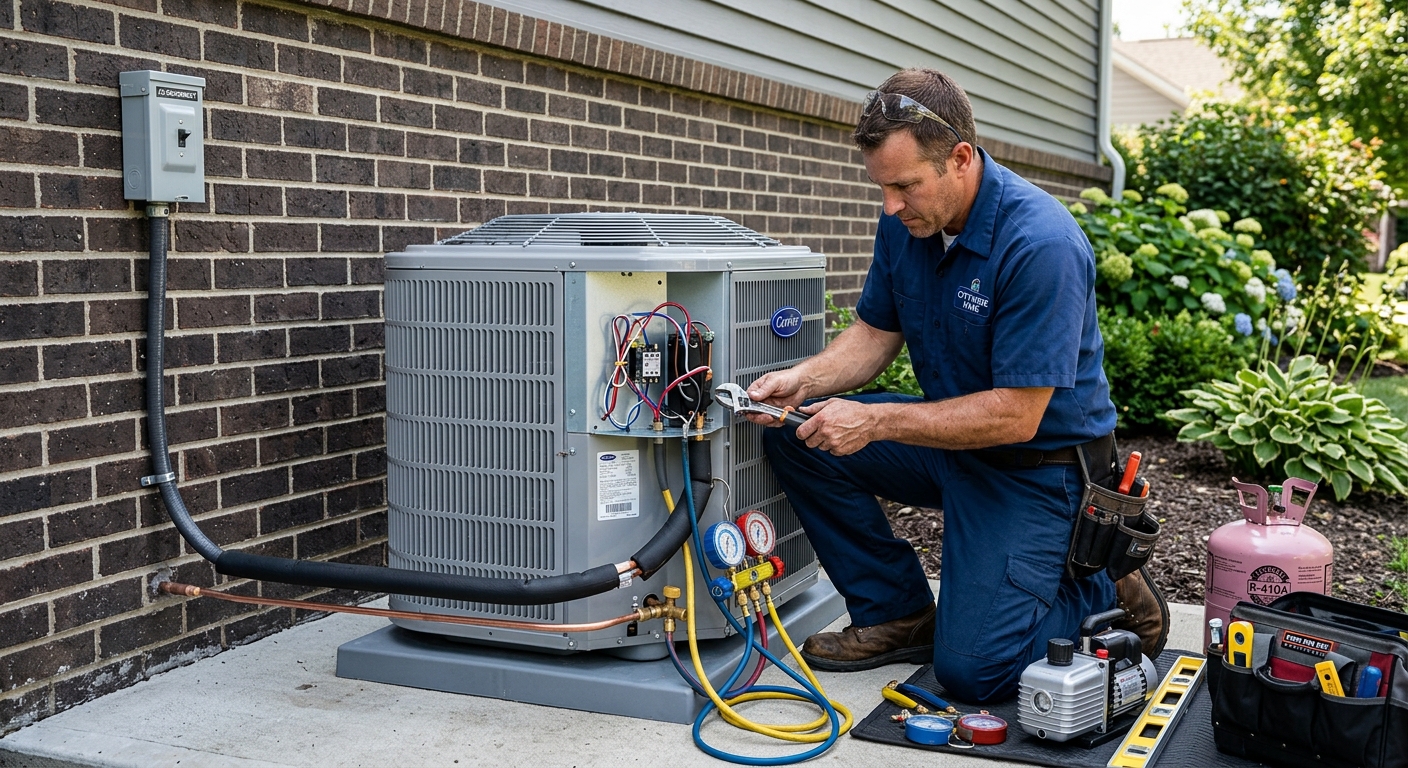
HVAC costs in Newberry — 2026
In Newberry, most households own their homes (92.4%) and nearly half the housing was built before 1980 (43.2%), according to the latest statistics. That shapes the jobs you see here: service calls and replacements on legacy equipment, but also quite a few retrofits to bring modern comfort to older spaces. Many neighborhoods still have homes dating to the pre-central air era, often lacking quality ductwork or with none at all. This mirrors the trend in York City, where pre‑1940 rowhomes are common and drive demand for ductless mini-splits or high-velocity systems suited for older house layouts. Central air replacement is routine in Newberry’s newer housing, but in older properties or additions, mini-splits take the lead where running new ducts is impractical.
The climate in south-central Pennsylvania is solidly heating-dominated. With 5,200 heating degree days and just 1,250 cooling degree days each year, furnace or heat pump capacity is a non-negotiable for comfort. That means when it comes to budgeting for HVAC work, heating and air source heat pumps demand at least as much attention as air conditioning replacements. Here’s a breakdown of what installation costs typically look like in the Newberry area:
| System |
Best for |
Efficiency |
Price range (installed) |
| Central AC replacement (existing ducts) |
homes with sound ductwork |
16–20 SEER2 |
$5,200–$12,500 |
| Air source heat pump (ducted) |
year-round heating and cooling |
8–10 HSPF2 |
$8,300–$17,500 |
| Cold-climate heat pump (ducted) |
heat pump as primary heat |
9–11 HSPF2 |
$13,500–$17,500 |
| Ductless mini-split (single zone) |
additions, rooms without ducts |
20–30 SEER2 |
$3,300–$7,300 |
| Full duct system installation |
homes with no existing ducts |
— |
$9,300–$18,500 |
Installed estimates for a typical Newberry home. Equipment tonnage, duct condition and electrical capacity move these more than brand.
When an HVAC repair stops being worth it
Deciding whether to repair or replace an HVAC system in Newberry should start with three basics: age, cost of the fix, and whether the problem is isolated or systemic. For most homes, especially with the county’s higher-than-average homeownership, it often makes sense to repair rather than replace a unit under 10–12 years old. Typical repairs, like replacing a capacitor or fan motor, are a fraction of the cost of new equipment. When you cross the 10–15 year mark and repair bills start climbing above a third the cost of replacement, it’s worth weighing your options. In this climate—with long, cold winters—unreliable heating can add risk as well as discomfort.
There are cases where the discussion ends: a cracked heat exchanger is a safety hazard and replacement is not optional. The same goes for a dead compressor on a system that’s already aged out of warranty or standard service life. Also, if your system uses a refrigerant that’s getting expensive or hard to source, that can shift the math—though there’s still no law requiring replacement for R-410A systems yet. Many times “high energy bills” can be chased back to leaking ducts or insulation before blaming the system itself. Paying for a proper test usually costs less than the gamble of a full replacement.
| Situation |
Recommendation |
Typical cost |
Reasoning |
| Under 10 years, single component failure |
Repair |
$300–$1,200 |
Parts are available and service life remains |
| 10–15 years, repair over a third of replacement |
Consider replacing |
$5,200–$12,500 |
Better investment if efficiency jump is available |
| 15+ years, any major failure |
Replace |
$5,200–$12,500 |
Comes up on end of expected lifespan |
| Cracked heat exchanger, any age |
Replace immediately |
$5,200–$12,500 |
Carbon monoxide danger, not repairable |
| Compressor failure past warranty |
Replace |
$8,300–$17,500 |
Compressor is half the value of the system |
| Working system, high bills |
Test ducts and envelope first |
$300–$800 |
Fixes the actual cause before major spend |
Mini-splits and zoning in Newberry homes
If you have an addition, converted attic, enclosed porch or a basement that always runs hot or cold, ductless mini-splits are probably the right answer in Newberry. They can heat and cool rooms without needing whole-house ductwork. That’s practical for pre-1980’s construction, which is nearly half the housing here, and it’s even more relevant in certain streets of York City where pre‑1940 rowhomes lack any duct system at all—installing ductless avoids expensive and messy wall or ceiling demolition.
Single-zone mini-splits, with one indoor head for each outdoor unit, are the most efficient and easiest for service. You get dedicated cooling and heating right where you want it, and the cost installed per room is usually less than forcing new ductwork. Multi-zone systems can tie several indoor heads to one outside unit, but these often underserve if you scale them too aggressively—many single-zone systems outperform a larger multi-zone on energy use and comfort. Indoor aesthetics do matter; wall-mounted heads are visible, and condensate handling requires careful routing, especially in older homes with no convenient drain. York’s mix of old and new houses means there’s truly no one-size-fits-all, but if you’re avoiding a major remodel just for AC, mini-splits offer efficiency and comfort without the headache or price tag of running new ducts.
Refrigerant rules and your existing system
In 2026, most newly manufactured HVAC units in Newberry use lower-global warming potential (GWP) refrigerants like R-454B or R-32. This big shift is part of a national phase-down of older, higher-GWP HFC refrigerants, such as R-410A. For homeowners with a system using R-410A, you can continue to operate, repair, and recharge your equipment without breaking any rules. There’s no deadline or law forcing you to replace a working unit just because of the refrigerant inside it.
The practical impact is about service cost. As manufacturers produce fewer R-410A units and supply contracts, the price of R-410A for topping off leaks or major repairs is likely to increase over the next few years. So, if you have a leak or compressor failure on a R-410A system past its warranty, it may accelerate the decision to replace rather than repair—based less on the letter of the law, and more on simple economics. Otherwise, there’s no regulatory reason to replace a working system. If you’re thinking about a new installation or full replacement, it’s smart to specify a system built for newer refrigerants, but there’s no need to lose sleep over an older unit just doing its job. The codes here back up that you are never forced to junk a serviceable system.
How to vet an HVAC contractor in Newberry
The most expensive system, installed poorly, will always underperform the budget unit done right. For Newberry homeowners, it’s vital to judge contractors by their installation and attention to detail—not just the brands they offer. First, check that any HVAC company proposing work in your home carries a valid Home Improvement Contractor (HIC) registration from the Pennsylvania Office of Attorney General, as required for jobs over $500. For refrigerant work, the technician on-site should have EPA Section 608 certification, which is federal and mandatory regardless of local licensing.
Every quality job starts with a load calculation (Manual J), not just a “rule of thumb.” Your quote should have the actual equipment model numbers, not just tonnage. Ask how the contractor measures system airflow, tests refrigerant charge at startup, and documents their commissioning. A saturated local contractor market, especially near York, means you have options—shop for quality and transparency, not just price.
- Confirm HIC registration through the state website
- Ask for EPA 608 certification from the technician
- Insist on a written estimate with detailed equipment model numbers
- Check if a Manual J load calculation is included (not just square footage)
- Question how ductwork and insulation will be evaluated
- Request proof of workers’ compensation insurance—verify via WCAIS
- Look for a commissioning checklist (airflow, refrigerant, startup data)
- Review warranty terms, including who handles labor after install
- Clarify which permits are handled by the contractor
- Ask about training and manufacturer certifications
- Demand physical addresses, not just a PO Box or cell number
- See recent local references for installations in homes like yours
If you see a rushed quote, hesitance to provide documentation, or an offer that undercuts by thousands, proceed with caution—competition is fierce around York, but that’s no place to gamble on safety or comfort.
Gas, electric or both in south-central Pennsylvania
Every HVAC choice is shaped by Newberry’s heating-dominated climate—long, cold winters with a 12 °F design low and 5,200 heating degree days. Modern cold-climate heat pumps now perform in freezing temperatures far better than older generations, making them very practical here. Capacity does dip as temperature falls, so heat pumps may need to run longer or pair with backup heat (known as “dual fuel”). In Newberry and most developed parts of York County, Columbia Gas of Pennsylvania maintains piped gas service, so for those with existing gas lines, a furnace is still a good choice—especially if you value proven reliability or the lowest-possible operating cost when it’s coldest outside.
If you’re in a rural pocket without natural gas, the economics change—propane and fuel oil are substantially more expensive to burn compared to the operating cost of a new heat pump, especially a high-efficiency, cold-climate model. That makes heat pumps far more compelling, both for all-electric new construction and updates to older homes currently using oil or propane.
There are cases where a furnace is still the right play: unreliable electrical service, extremely drafty older houses (high heat loss), or homeowners simply unwilling to roll the dice on electric-only comfort at the coldest extremes. For everyone else, especially those interested in incentives, heat pumps close the gap—especially when paired with upgraded insulation and air sealing.
| Option |
Installed cost |
Operating cost here |
Best when |
Incentive eligible |
| Gas furnace + central AC |
$5,200–$12,500 |
Lower with piped gas; excellent in cold |
existing gas service, coldest zones |
No for gas, sometimes for AC |
| Ducted heat pump (cold climate) |
$8,300–$17,500 |
More efficient at mild temps, electric only |
good envelope, all-electric goal |
Yes, with qualifying models |
| Dual fuel (heat pump + gas backup) |
$13,500–$17,500 |
Lowest bills in mixed-fuel homes |
gas on site, deep cold spells |
Partial (heat pump portion) |
| Ductless multi-zone |
$9,300–$18,500 |
Highest efficiency per room |
no ductwork, zone control |
Some single/dual zone qualify |
Permits, licensing and inspections in Newberry
In Pennsylvania, there’s no statewide HVAC trade license for residential work. What’s required in Newberry is a Home Improvement Contractor (HIC) registration for any job over $500, issued by the Pennsylvania Office of Attorney General. Municipalities—not the state—handle mechanical permits, enforcement, and inspections under the Pennsylvania Uniform Construction Code, which is based on the IRC. So whether you need a permit will depend on the local township’s policy; for full HVAC replacement, most require one, but some work (like thermostat swaps or window ACs) generally does not.
Refrigerant work falls under federal law, meaning any technician doing this must hold EPA Section 608 certification. There’s no separate state or county register for HVAC, electrical, plumbing, or restoration trades outside the big cities mentioned. Always verify an HVAC contractor’s workers’ compensation insurance through WCAIS if they have employees on your job, not just a verbal promise. Written contracts are required by law in Pennsylvania for work over $500, and you have a 3-day cancellation right—these protections are not optional, and a good contractor will never ask you to sign them away or cover your insurance deductible.
Frequently asked questions — HVAC installation in Newberry
How often should I change my filter?
For most Newberry homeowners, changing your HVAC filter every 2–3 months is a safe schedule. If your home is older (like the 43% built before 1980) or you have pets, smoking, or ongoing construction dust, monthly changes are better. Furnace and heat pumps rely on good airflow and older ductwork in York County can clog filters with extra dust. Dirty filters strain the system, increasing both energy bills and wear—common reasons for early replacement, which costs $5,200–$12,500 if ignored too long. Always use the filter size and type your system was designed around; spending more for a “high-efficiency” filter that doesn’t fit correctly can do more harm than good. Make this a calendar event, not an afterthought.
Do I need ENERGY STAR equipment to qualify for incentives?
You do not always need ENERGY STAR-labeled systems to qualify for incentives in Pennsylvania, but many programs use this as their base requirement. For heat pumps and AC systems in Newberry, look for efficiency levels that meet or exceed current ENERGY STAR specs—especially for rebates offered through utilities like Met‑Ed. Qualifying for federal tax incentives or state-level rebates can lower the installed price by hundreds or more, which is a real consideration with projects that often run $8,300–$17,500 for heat pumps. Always check the program details: some accept high-efficiency models that aren’t ENERGY STAR but hit the same metrics.
Why do HVAC quotes in Newberry vary so much?
Price differences in HVAC quotes around Newberry come down to several factors specific to this region’s market and housing stock. Labor rates fluctuate because the York–Hanover area is a saturated contractor market, but the real swings are in the scope of work: old ductwork (common in pre‑1980 homes) may need repair or replacement, electric service may require upgrades, and every brand has models from basic to premium. Some contractors include full commissioning and code-required permits in their quotes, while others add these as surprise extras. Quotes for the same sized heat pump can run $8,300–$17,500 just by changing model, installer, or adjusting for home specifics like access and modifications. Always get a detailed written quote so you’re comparing apples to apples.
What is a Manual J load calculation?
A Manual J load calculation measures your home’s actual heating and cooling requirements based on its size, insulation, window area, and construction—not a rough guess. In Newberry, where a lot of homes were built before tighter energy codes, a proper load calculation can reveal if your HVAC needs are much lower (or higher) than your neighbor’s, even for similar square footage. Reputable contractors should do this as part of an estimate for system replacement, especially on jobs running $5,200–$12,500 or more, so the system is sized to perform efficiently in both mild and extreme conditions. It’s your best guard against wasting money on oversizing or getting stuck with underpowered equipment.
How do I verify an HVAC contractor's insurance?
For any installation project in Newberry, especially those involving central systems at $5,200–$12,500 or more, verify that your contractor has active workers’ compensation and liability insurance. Pennsylvania homeowners can use WCAIS (the state’s insurance verification tool) to look up coverage directly; reputable contractors should provide their policy number, insurer, and expiration date before work begins. If you hire someone without valid insurance, you could be liable for workplace injuries. Don’t accept just a certificate handed across the table—confirm its validity. Local contractors are used to these requests; if someone bristles or dodges, that’s a red flag.
Should I repair or replace my HVAC system in Newberry?
In Newberry, most systems under 10 years old with routine maintenance are worth repairing—most single-part fixes will run between $300–$1,200. If your equipment is over 15 years, especially with a major failure (like a compressor or heat exchanger issue), it’s time to consider replacement. In this heating-heavy climate, reliability counts for more, and newer systems offer much better efficiency. But spend on replacement only when you are gaining peace of mind or efficiency you’d actually use for the region’s long winters and humid summers. A good contractor will talk you through the trade-offs, not just steer you to the most expensive option.
What does a heat pump cost installed in Newberry?
For most homes in Newberry, a ducted air source heat pump installation runs between $8,300–$17,500. The wide range covers differences in system size, efficiency, and whether you’re swapping into existing ductwork or need new ducting. Cold-climate heat pumps, which perform well even in the 12°F design minimum, are toward the higher end but can help offset operating costs if you want to go all-electric. Rural homes moving from oil or propane to a heat pump may pay more upfront but can save substantially in the long term. Always get quotes for your actual home and not just the “average.”
How long does HVAC installation take in Newberry?
Assuming existing, accessible ductwork in good shape, most central AC or heat pump replacements in Newberry are a one-day job—sometimes two if electrical or permit inspections are involved. Complications are common in pre‑1980 homes, where ductwork or access issues can draw the job out to 2–4 days, especially during high-demand seasons. If you’re installing a mini-split or adding entirely new duct systems, expect up to 3–5 days. Permit timing can also mushroom the job in some Newberry townships, especially as many use their own building officials. Labor for a basic install is always included in prices like $5,200–$12,500 but ask if any parts of the project are subcontracted, as this can affect schedule and quality.
Do older Newberry homes need ductwork replaced?
In Newberry, nearly half the homes were built before 1980—some before World War II. Original ductwork in these houses may be undersized, leaky, or built with materials that no longer meet current comfort or safety standards. If you’re replacing your HVAC system, it’s wise to have the ducts inspected; you may only need partial sealing or upgrades, which typically cost much less than a complete new system. Full duct system replacements range from $9,300–$18,500. However, if your ducts are sound and can provide proper airflow, replacement is not necessary. Do not let any contractor pressure you into unnecessary work—get a clear assessment and, if possible, a second opinion.