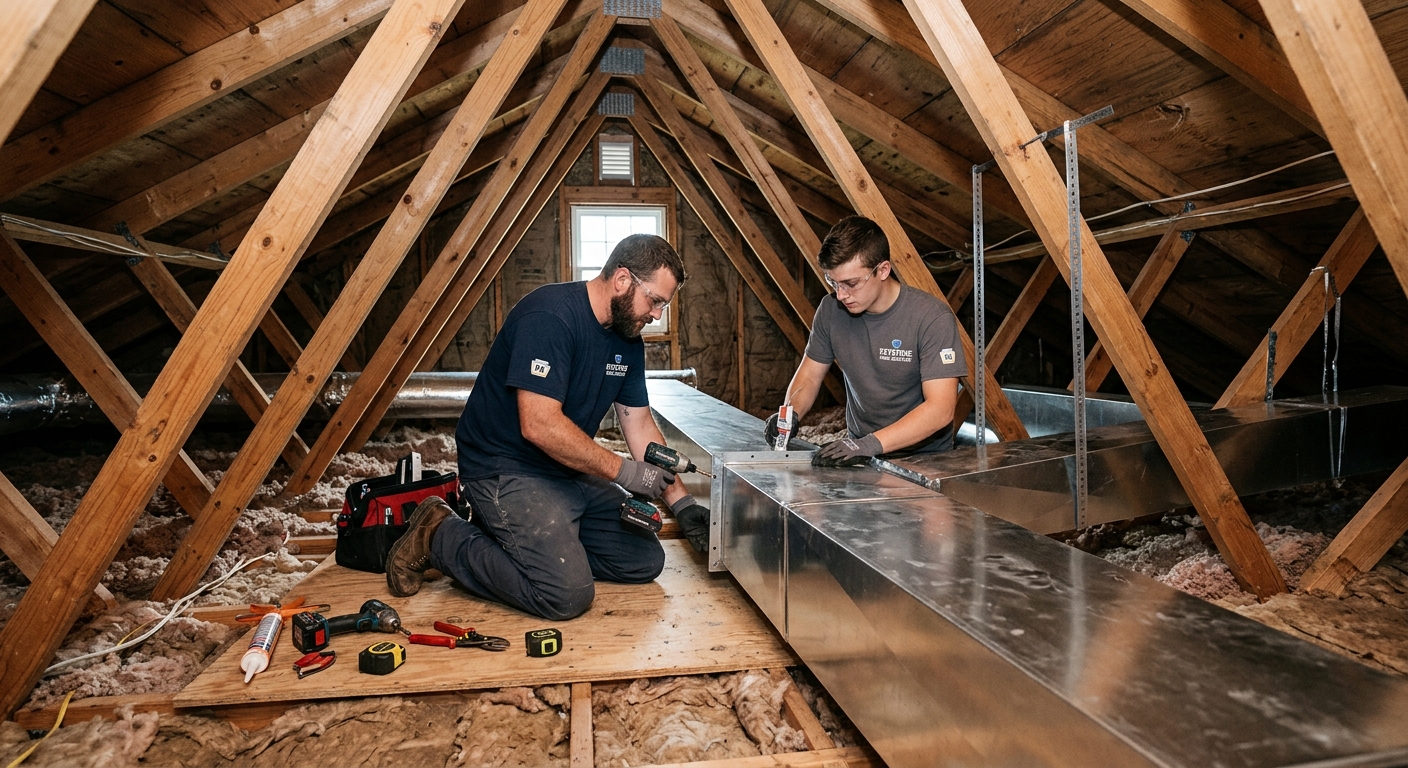
Hatfield heating and cooling prices by system type — 2026
In Hatfield, where 65.4% of households own their homes and over half of the housing stock was built before 1980 (U.S. Census Bureau, ACS 2024), most local HVAC jobs are system replacements or retrofits, not new installs. The dominant housing era—post‑1945 suburban construction seen throughout Montgomery County—means ductwork often exists, but it may not be up to current size or sealing standards, so many projects require duct repair or replacement alongside new equipment.
With 4,800 heating degree days and just 1,450 cooling degree days per year, this is a heating-driven market. That makes furnace and heat pump performance more important to your comfort and operating costs than extreme cooling capacity. For most Hatfield homeowners, the decision is whether to update existing central AC or convert to a heat pump, rather than install new ductwork from scratch—unless you’ve got an addition or an older home built before mid-century.
Here’s what typical installed prices look like for 2026 HVAC systems in the Hatfield area:
| System | Best for | Efficiency | Price range (installed) |
|---|
| Central AC replacement (existing ducts) | homes with sound ductwork | 16–20 SEER2 | $5,300–$13,000 |
| Air source heat pump (ducted) | year-round heating and cooling | 8–10 HSPF2 | $8,500–$18,000 |
| Cold-climate heat pump (ducted) | heat pump as primary heat | 9–11 HSPF2 | $14,000–$18,000 |
| Ductless mini-split (single zone) | additions, rooms without ducts | 20–30 SEER2 | $3,400–$7,500 |
| Full duct system installation | homes with no existing ducts | — | $9,600–$19,000 |
Installed estimates for a typical Hatfield home. Equipment tonnage, duct condition and electrical capacity move these more than brand.
Comparing HVAC estimates in Hatfield
When comparing HVAC proposals in Hatfield, skip any quote that just gives you a brand and a price. Look for the specifics that let you compare apples to apples: Indoor and outdoor unit model numbers should match; mismatched pairs won’t actually deliver their promised efficiency. Sizing should come with a written load calculation, not an assumption based on your old unit’s sticker or square footage.
Pay attention to whether your installer will replace or reuse the refrigerant line set—old lines can introduce contaminants or leak if improperly matched to new refrigerants. If electrical upgrades are needed, clarify whether a panel upgrade is included. Handling condensate (the water your system draws from the air), thermostat replacement, and any smart controls should all appear as line items.
The proposal should state that a mechanical permit and local inspection are included (if required in your borough or township). Finally, commissioning—verifying airflow and refrigerant charge at startup—should be part of the quote, with paperwork to back it up. Labor warranty is separate from the equipment warranty, and both should be listed.
| Line item | What to look for | Red flag if… |
|---|
| Equipment | model numbers, indoor and outdoor matched | brand name only |
| Sizing | load calculation attached | matched to the old nameplate |
| Ductwork | condition assessed, sealing scoped | not mentioned |
| Electrical | circuit and panel capacity confirmed | assumed adequate |
| Line set | replaced or documented as reused | silent |
| Commissioning | measured airflow and charge, documented | no startup report |
| Warranty | labour years stated separately | manufacturer only |
| Permit | included and priced | 'not needed' |
The decision point on an aging system
Most of the time, in Hatfield, you’ll get more for your money by repairing an HVAC system unless it’s truly at the end of its useful life or facing a catastrophic failure. Consider the age of your equipment: systems under 10 years old rarely need full replacement unless there’s a major design or install flaw. Price matters too—if a repair costs more than a third of replacement, think seriously about investing in a new system, especially if efficiency would noticeably improve.
Key factors include whether the failure is a single replaceable part or a compressor or heat exchanger. If your heat exchanger is cracked, or if the compressor fails and the system is outside its warranty or older than 12–15 years, replacement is the only safe move. For every other scenario, weigh the actual numbers, and don’t let a contractor push replacement to pad a slow month.
Efficiency upgrades don’t always pay back fast in our climate, since most of your heating load is in that 14°F winter design temp but summers aren’t severe. If your energy bills are high, get your ducts and home envelope tested before you blame the equipment.
| Situation | Recommendation | Typical cost | Reasoning |
|---|
| Under 10 years, single component failure | Repair | $300–$1,200 | Most parts can be replaced for much less than a full system |
| 10–15 years, repair over a third of replacement | Consider replacing | $5,300–$13,000 | Newer, more efficient system can offer value at this point |
| 15+ years, any major failure | Replace | $5,300–$13,000 | Near or past average service life and components will continue to fail |
| Cracked heat exchanger, any age | Replace immediately | $5,300–$13,000 | Safety hazard—do not use until replaced |
| Compressor failure past warranty | Replace | $8,500–$18,000 | Costly repair with no guarantee other components won't fail soon |
| Working system, high bills | Test ducts and envelope first | $300–$800 | Leaks and insulation often waste more than the equipment itself |
Separating installers from equipment sellers
Choosing an HVAC company in Hatfield is less about the brand and more about the person doing the installation. The best equipment, if paired with a rushed or subpar install, won’t deliver the comfort, efficiency, or reliability you paid for. Thorough vetting matters, especially with Hatfield part of the Greater Philadelphia metro HVAC market, where competition is stiff and some outfits cut corners to get bids lower.
- Verify HIC registration for contracts over $500
- Check for EPA Section 608 certification on any technician handling refrigerant
- Ask for township mechanical permit confirmation
- Look for a detailed load calculation, not just square footage or matching old tonnage
- Insist on both indoor and outdoor equipment model numbers in your proposal
- Check if ductwork condition gets assessed and sealed or replaced if needed
- Expect a written commissioning/startup report on system airflow and refrigerant
- Confirm labour warranty years (typically 1–2) stated separately from equipment
- Verify workers’ compensation coverage through the WCAIS system
- Get proof of liability insurance for your protection
- Demand clarity on electrical panel capacity and permitting for upgrades if needed
- Review contract for full cost breakdown and Pennsylvania’s three business-day right of cancellation
Red flags: In a dense market like Montgomery County, pushy sales tactics, too-low bids with little breakdown, or vague answers to these questions usually point to a company trying to survive on volume instead of quality. The real value is in the install, not the sticker or the advertising.
Running the numbers on Hatfield's climate
If you want to know what you’ll actually pay to keep your Hatfield home comfortable, start with a pencil and your latest utility bill. Our region sees about 4,800 heating degree days and 1,450 cooling degree days a year. The winter design temperature of 14 °F means your system works hard on the heating side—even if you’re using natural gas or PECO electric, how well that energy becomes comfort depends on system efficiency and your home’s insulation.
Here’s how to think about it: Efficiency rating (AFUE for furnaces, HSPF2/SEER2 for heat pumps and AC) tells you how much of your energy dollar turns into useful heat or cool. Degree days measure how much total work your system has to do over the year. Multiply those by your home’s square footage, and you get annual energy use. Finally, multiply by your actual utility rate—found right on your PECO bill—for your cost.
For example: Suppose your Hatfield home uses a legacy central AC (16 SEER2) and electric heat pump (8 HSPF2). On 1,450 cooling degree days, and with a ballpark 2,000 square-foot load, you can estimate annual cooling energy needs, then divide by equipment efficiency, then multiply by your electric rate. If your ducts leak or are poorly insulated, those savings vanish.
The key lesson: Upgrading to high-efficiency equipment pays off only if the ductwork is tight and properly sized. Otherwise, your dollars are quite literally disappearing into the attic, crawlspace, or basement. Rates and climate can change, but duct leakage or poor insulation kills efficiency every year.
Why your ducts may be the real problem in Hatfield
Most Hatfield homes—especially those built during the post‑1945 suburban boom across Montgomery County—have some form of central ductwork. But that old ductwork might be costing you more comfort and money than the HVAC equipment itself. In homes built before serious air sealing standards, it’s common to lose 15–30% of conditioned air before it ever hits a vent, especially if the ducts run through unconditioned attics, basements, or crawlspaces.
A duct blaster test measures how much air leaks through the duct system. A result over 10% leakage is a red flag; it means you’re paying to heat or cool spaces that don’t improve your comfort. Sealing with mastic or foil tape is the first remedy, but some homes—particularly those with retrofitted or undersized returns—may need segments of duct replaced or rebuilt. Undersized returns are a chronic problem in older layouts, restricting airflow so the system can never move enough air to match its own efficiency.
Before you spend thousands replacing your furnace, AC, or heat pump, insist on having ductwork tested. One bad run or a few leaky connections can cripple brand new, high-efficiency units. The honest plan for most Hatfield homes: fix the ductwork first, then consider equipment upgrades, not the other way around.
Mechanical permits for HVAC work in Hatfield
Pennsylvania does not have a statewide HVAC trade license; residential HVAC work is regulated at the municipal level across Montgomery County, including Hatfield, under the Pennsylvania Uniform Construction Code (UCC) based on the IRC. Most permit requirements—like those for new equipment installs or major retrofits—are managed by your local township or borough. For residents of Norristown, a mechanical or building permit is required if new electrical or mechanical connections are part of the project. Filter changes and simple servicing don’t generally need a permit.
EPA Section 608 certification is federally mandated for any technician handling refrigerants, which applies to every AC and heat pump installation—no exceptions, regardless of local licensing rules. On top of this, Pennsylvania requires HIC registration, verified via the state’s contractor lookup, for contracts over $500. It’s essential to check your contractor’s workers’ compensation insurance (using the WCAIS tool) to protect yourself from liability, and your installer should provide written proof of coverage. Always request a contract compliant with the Home Improvement Consumer Protection Act, which gives you the right to cancel within three business days.
Frequently asked questions — HVAC installation in Hatfield
What MERV filter rating should I use?
For most Hatfield homeowners, a MERV 8 filter is the sweet spot. It’s effective enough to trap common dust, pollen, and debris typical to suburban Montgomery County, without adding too much airflow resistance for most equipment. If allergies or respiratory issues are a concern and your ductwork was well-designed (which isn’t always the case in older Hatfield homes), a MERV 11 or MERV 13 filter can help, but check that your blower motor can handle the higher resistance. Remember that post‑1945 Hatfield homes may have ductwork that was never sized for high-filtration: too restrictive a filter starves your equipment for airflow, reducing efficiency and lifespan. A filter upgrade is usually less than a $300–$800 maintenance service. Always ask your HVAC pro to check airflow when changing to a higher MERV.
What does a ductless mini-split cost in Hatfield?
In Hatfield, a professionally installed single-zone ductless mini-split typically runs $3,400–$7,500 in 2026, with the bulk of systems falling near the middle of that range. Price depends on whether the space will need new 240V wiring or a fresh hole through brick or stone, which is common in pre-1980 construction (over half of Hatfield’s homes). Many contractors include electrical and condensate work, but always ask for a complete breakdown in the quote. If ductless heads are serving a sunroom or bedroom addition, count on the lower end. If you need multiple indoor units or long refrigerant lines, the cost will rise. Quality installation, especially sealing the wall penetrations against humidity, keeps the system efficient and quiet.
How cold does it get in Hatfield and does that affect heat pumps?
The winter design temperature in Hatfield is 14°F, which means your HVAC system has to perform reliably down into the teens for several nights every winter. Standard heat pumps start to lose capacity below freezing, but modern cold-climate heat pumps maintain efficient heating well below 20°F—crucial for Hatfield’s 4,800 annual heating degree days. If you’re considering a ducted heat pump replacement, make sure your contractor specifies a model rated for cold-climate performance, which will be in the $14,000–$18,000 price bracket. Homes heated by older, milder-climate systems may also need a backup heat source or upgraded electrical service to ensure constant comfort during cold snaps.
Is a high-efficiency system worth the extra cost here?
In Hatfield, with our moderate summers and more dominant heating season, high-efficiency heat pumps or ACs make sense mainly if your ducts are also properly sealed and insulated. A 20 SEER2 AC or 11 HSPF2 heat pump hits its rated savings only if installation includes correcting leaky or undersized ductwork—a real issue in Hatfield’s older homes. Expect to pay on the upper end of the bands ($8,500–$18,000) for top-tier heat pumps. The payoff in savings may take several years compared to mid-range models. If your home is already drafty or has original ductwork, fix those issues first, then consider if high efficiency is worth it.
How long should an HVAC system last in Hatfield?
In real Hatfield conditions, expect a well-installed furnace, AC, or heat pump to last 12–18 years—sometimes longer with regular maintenance. Older homes built before 1980 often have installation quirks or older ductwork that can shorten the life of newer, high-efficiency systems if left uncorrected. Replacement costs range from $5,300–$18,000 depending on system type and necessary upgrades. Keeping your ducts leak-free and your equipment serviced annually is usually more important for lifespan than brand or model. If recurring breakdowns start popping up after 12–15 years, especially major ones, planning for replacement is wise.
What is EPA Section 608 certification?
EPA Section 608 certification is federal—every technician in Hatfield or anywhere in Pennsylvania who handles refrigerants (like AC or heat pump installs and repairs) must have it, no exceptions. It’s illegal for any unlicensed person to work on refrigerant lines, so you should verify this for anyone touching your system during a $3,400–$18,000 installation. This certification protects your home and the environment by ensuring refrigerants are handled and disposed of safely. Ask your contractor to show this certification before starting any refrigerant-related work; reputable companies will have no issue providing proof.
What HVAC tax credits are available to Hatfield homeowners?
Homeowners in Hatfield can take advantage of federal tax credits for qualifying heat pump, central AC, and furnace upgrades that meet energy efficiency criteria, which may help offset costs in the $8,500–$18,000 range for heat pumps. Credits change annually, so check the current IRS guidelines and make sure your installer knows how to document SEER2/HSPF2 or AFUE ratings for your system. Pennsylvania currently doesn’t add its own HVAC-specific incentives, but PECO sometimes runs rebates for high-efficiency systems. Keep your receipts and certification paperwork—these are required for credit claims.
Is it worth switching from oil or propane to a heat pump?
If your Hatfield home still uses oil or propane for heat, turning to a ducted cold-climate heat pump can save real money over time, particularly as oil prices remain volatile and natural gas is widely available in central Montgomery County. Expect the total conversion cost—including electrical—at the higher end: $14,000–$18,000. The biggest advantages are lower fuel bills and getting both heating and cooling in one unit, especially if you electrify with PECO’s service. Make sure your electrical panel can handle the added load; ask for a full written proposal before starting, and weigh upfront costs against future bill reductions.
Do I need to be home during installation?
For major HVAC work in Hatfield, you or another adult should be present to answer questions about thermostat location, duct access, and equipment placement—even though you don’t have to watch every step. Contractors will often run into quirks in homes built before 1980: hidden ductwork, old copper lines, or power shut-offs that require access or approval. Being available ensures your preferences are respected and avoids costly do-overs. A typical replacement runs one to two days, with a new central AC in the $5,300–$13,000 range usually a full-day project. The peace of mind and better final results are worth your presence.