HVAC costs in Penn Hills — 2026
In Penn Hills, most homes are owned rather than rented, and with over 90% of the housing stock built before 1980 (U.S. Census Bureau, ACS 2024), this is overwhelmingly a market of replacement or retrofit jobs rather than first-time installations. Here, it's very likely your house already has some kind of ductwork—or at least an old furnace or central AC. But like many older Allegheny County homes, tight ducts and the legacy of earlier electrical service can make even straightforward replacements a puzzle.
Penn Hills sits in a heating-dominated climate, with roughly 5,600 heating degree days and just 1,050 cooling degree days per year. That matters: while you want your air conditioner to be efficient, your real utility bills are driven by heating. For many, this tips the scale toward considering air-source or cold-climate heat pumps, and away from pouring money into a high-SEER AC that's only used in the peak of summer.
Upgrades are rarely just a matter of swapping out the box. Full system costs in Penn Hills reflect both the local climate and the constraint of working within solid walls, old basements, and mature landscaping. Below are 2026 installed price ranges to expect:
| System |
Best for |
Efficiency |
Price range (installed) |
| Central AC replacement (existing ducts) |
homes with sound ductwork |
16–20 SEER2 |
$4,700–$11,500 |
| Air source heat pump (ducted) |
year-round heating and cooling |
8–10 HSPF2 |
$7,500–$16,000 |
| Cold-climate heat pump (ducted) |
heat pump as primary heat |
9–11 HSPF2 |
$12,000–$16,000 |
| Ductless mini-split (single zone) |
additions, rooms without ducts |
20–30 SEER2 |
$3,000–$6,600 |
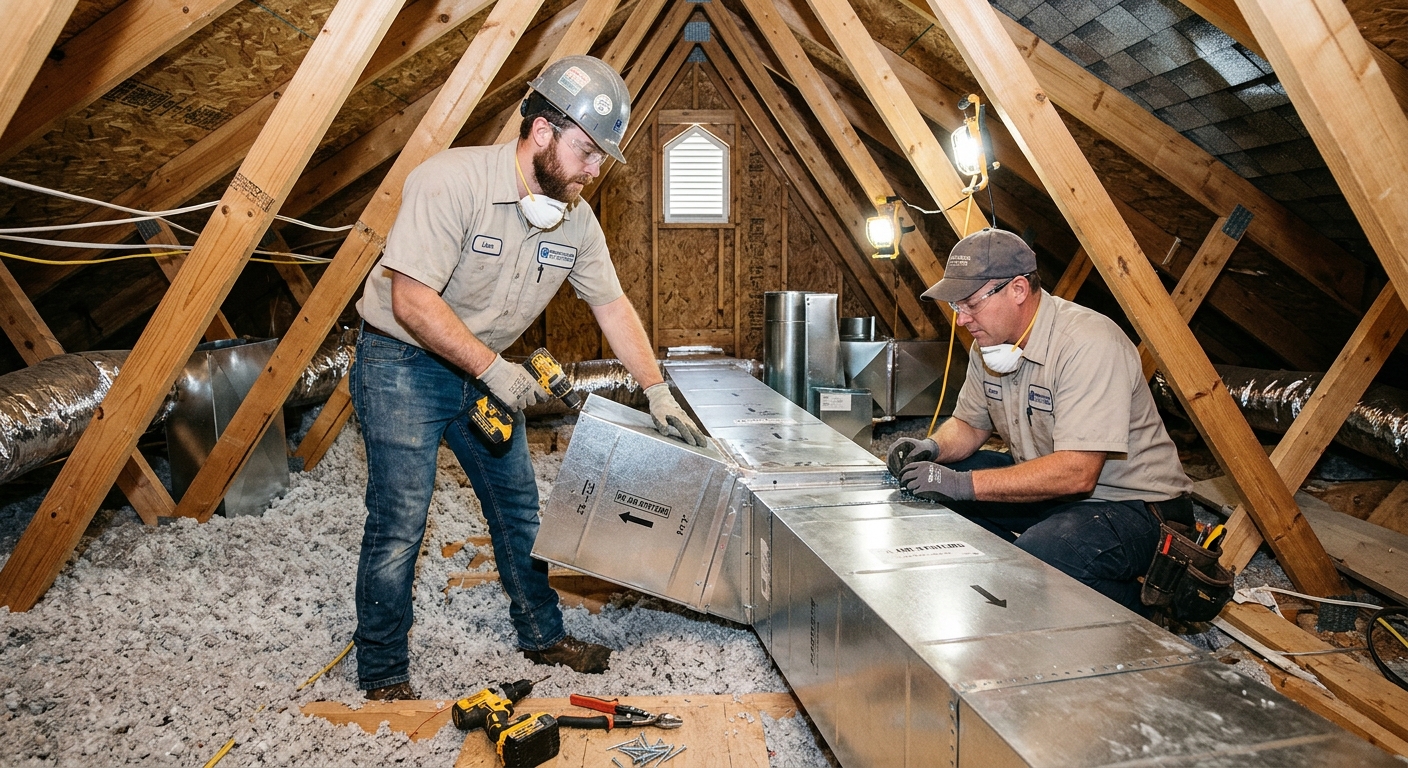
| Full duct system installation |
homes with no existing ducts |
— |
$8,500–$17,000 |
Installed estimates for a typical Penn Hills home. Equipment tonnage, duct condition and electrical capacity move these more than brand.
Mechanical permits for HVAC work in Penn Hills
Pennsylvania does not run a statewide licensing system specifically for HVAC contractors. Instead, for residential projects in places like Penn Hills, regulation falls to the local municipality. Any contractor working on jobs over $500 must be registered as a Home Improvement Contractor (HIC) with the Pennsylvania Office of Attorney General. You can—and absolutely should—verify a contractor’s registration at hic.attorneygeneral.gov before signing a contract.
Mechanical permits are required for new HVAC installations, replacements, or major alterations in the City of Pittsburgh, and most nearby towns, including Penn Hills, have similar rules. That permit process helps make sure the work complies with the Pennsylvania Uniform Construction Code (UCC), which is based on the IRC. This is important because code enforcement happens at the municipal level, not through a statewide inspector.
Any Pennsylvania HVAC installer who handles refrigerants (meaning nearly all of them) must also carry a federal EPA Section 608 certification. This is non-negotiable and applies across jurisdictions.
For insurance, you can verify contractor liability and workers’ compensation using the WCAIS system at wcais.pa.gov. Proper insurance and up-to-date workers' compensation are mandatory for all employers in Pennsylvania. If you’re not shown certificates, don’t proceed—uninsured work puts your home and finances at risk.
SEER2, HSPF2 and AFUE decoded
There are three main numbers to know when comparing system efficiency: SEER2 for cooling, HSPF2 for heat pumps in heating mode, and AFUE for furnaces. SEER2 (Seasonal Energy Efficiency Ratio, version 2) measures how much cold air you get per watt of electricity in a cooling season, under stricter and more realistic test conditions than old SEER numbers. HSPF2 (Heating Seasonal Performance Factor, version 2) does the same for heat pumps in heating mode. AFUE (Annual Fuel Utilization Efficiency) tells you what percentage of your fuel dollar heats your house versus going up the chimney for combustion appliances.
The hard truth in Allegheny County’s 5,600 heating degree day climate: heating bills, not cooling, drive your annual costs. That pushes the value proposition toward high HSPF2 (for heat pumps) or high AFUE (for furnaces) before worrying about fancy cooling ratings. A mid-tier 16–18 SEER2 system is entirely adequate in Penn Hills; pushing to 20 SEER2 or higher almost never pays for itself when you only log about 1,050 cooling degree days per year. Where you should consider stretching your budget is for a heat pump with higher HSPF2, especially if you want electric heating to be your main source.
Note that all these testing standards changed a few years ago—SEER to SEER2, HSPF to HSPF2—so ratings on old articles and sales brochures aren’t apples-to-apples with today’s equipment.
Operating cost, not sticker price
Sticker price matters, but in Penn Hills, how much your system costs to run over time can outweigh the upfront difference, especially in an old house with many heating months. Here’s how to line up the math for yourself:
First, start with the efficiency rating for your system—SEER2 or HSPF2 for heat pumps, AFUE for gas furnaces. Next, convert the rating into how much energy your system uses to deliver heat or cooling. For heat pumps, HSPF2 tells you how many BTUs of heat you get per kilowatt-hour of electricity. If your system delivers 36,000 BTU per hour (a 3-ton unit), and your HSPF2 is 9, then it takes about 4,000 kWh to deliver 36 million BTU over a season.
Then, multiply that energy use by the number of heating (5,600) or cooling (1,050) degree days Penn Hills averages per year. Multiply again by your actual rate per kWh from Duquesne Light Company (found on your monthly bill). For gas, the AFUE rating tells you what fraction of each therm heats your house, then multiply yearly usage by the rate from Peoples Gas.
The result: you can see how a system with a higher HSPF2 saves several hundred dollars over a low-HSPF2 model, if used as primary heat. But remember, your own envelope—insulation, windows, duct leaks—can easily wipe out the savings you’d expect from the highest-rated unit. Patch those first, or you’re paying for lost energy.
Rates change, habits differ, and no formula is perfect. But if you want to stretch your dollar in Penn Hills, don’t just buy the highest efficiency model: make sure the ductwork is sealed and matched to your new system, or the math breaks down.
The refrigerant change and what it means for repairs
If your home in Penn Hills has an air conditioner or heat pump installed in the last 10–15 years, it’s almost certainly running on R-410A refrigerant. That refrigerant is being phased down in new residential equipment in favor of lower global warming potential options, like R-454B or R-32. New rules do not ban R-410A systems from being serviced or operated—they target what goes into new units coming from the factory.
What does this mean if you have a working R-410A system? For now, nothing changes. Servicing, top-offs, and routine repairs are still legal. However, as supply of R-410A tightens and manufacturers stop producing it in bulk, the cost of refilling a leaky system is likely to climb. This doesn’t mean you need to rip out a working AC or heat pump. But it does shift the math when deciding on a major repair: if the leak is large and the system old, paying premium prices for an obsolescent refrigerant starts to make less sense compared to investing in a new model.
Your existing equipment will not become illegal or need to be replaced until it truly fails. The refrigerant change is about environmental rules and manufacturer supply chains—not an automatic mandate for homeowners to upgrade.
Rebates and tax credits for Penn Hills homeowners
There are three main ways Penn Hills homeowners can offset the cost of HVAC upgrades: federal tax credits, rebates from utility companies, and state-level programs. It’s important to know the difference—tax credits reduce what you owe on your next tax return (so the savings arrive next year), while rebates drop the project invoice or put cash back in your pocket more quickly.
Federally, the main program is through the IRS for certain high-efficiency heat pumps, furnaces, and ACs. Yearly limits and qualifying criteria apply, and credit amounts change periodically. For utility rebates, Duquesne Light Company and Peoples Gas offer annual efficiency incentives, generally focused on replacing old, inefficient or electric-resistance equipment. But these programs update frequently, so any number in an article is only a ballpark.
For state or utility rebates, always check your utility's own efficiency or energy savings program webpage, and use the ENERGY STAR rebate finder online for up-to-date offers. Be skeptical of quotes or ads listing guaranteed rebate amounts—those can change or run out of funding, and eligibility depends on the details of your job. The best approach is to review incentives as you plan your project, not after the contract is signed.
Mini-splits and zoning in Penn Hills homes
Ductless mini-splits have found their niche in Penn Hills for a reason: most homes were built before central air was common, and cutting into old plaster, stone, or brick to add ducts is not just costly; it can wreck the charm and character of your space. Mini-splits are a favorite for finished attics, additions, sunrooms, and anywhere the old HVAC never reached.
Single-zone systems—one outdoor heat pump paired with one indoor head—are best for isolated comfort problems or new spaces. They run from $3,000–$6,600 per zone, but deliver excellent efficiency (20–30 SEER2) and allow precise temperature control. Multi-zone systems use one outdoor unit to run several interior heads. While this has advantages for clustered rooms, it spreads the outdoor unit's capacity thinner, meaning a multi-zone system may not heat or cool as consistently as single-zone units sized exactly to their room.
A few Penn Hills specifics: Exterior head units can be less visible when wall-mounted low or with line hide covers, but you’ll still need a plan for handling condensate—gravity drains are best, pumps add cost and maintenance. For many older homes, mini-splits are a less intrusive, more efficient answer than wrestling new ducts into tight spaces, especially for owners with older electric or oil service looking to modernize in steps.
Frequently asked questions — HVAC installation in Penn Hills
Is a high-efficiency system worth the extra cost here?
In Penn Hills, with its cold winters and mild but not extreme summers, higher efficiency can make financial sense—if you're investing where it counts. Top-end SEER2 (cooling) ratings won't usually pay off here due to relatively light summer use, but for heating—either a heat pump with a high HSPF2 rating or a furnace with a high AFUE—the story is different. Our homes rack up about 5,600 heating degree days, meaning most of your annual HVAC spend is on heat, not AC. For many, a mid-range air source heat pump installed in the $7,500–$16,000 range with an above-average HSPF2 will lower bills over time more than splurging for top-tier SEER2. Still, the true payback depends on your insulation, ductwork, and how long you’ll stay in the house. If you’re not planning a long-term hold, or if your ducts or windows are leaky, don't chase the highest numbers—upgrade the basics first.
Why do HVAC quotes in Penn Hills vary so much?
Quotes jump around in Penn Hills because no two homes are quite alike here—most are pre-1980, and many haven’t seen major HVAC or electrical upgrades in decades. Contractors have to price around not just the equipment, but the quirks of your existing ducts, electrical panel, and access. Add to this the wide range in labor costs across the Pittsburgh metro and a fully saturated contractor market: some crews are one-truck outfits, others are large firms with big overhead. If your home needs a full duct system, for instance, bids can span from $8,500–$17,000 based solely on design complexity and what's revealed during teardown. Always compare apples to apples—what’s included, what’s not, and who actually pulls the permits. The cheapest quote isn’t always the best fit for older Penn Hills homes with hidden issues.
How do I verify an HVAC contractor's insurance?
In Pennsylvania, including Penn Hills, all contractors hiring employees are required to carry workers’ compensation. Before hiring, ask to see proof of liability insurance and workers' compensation certificates. You can go a step further by checking the Workers' Compensation Automation and Integration System (WCAIS) at wcais.pa.gov, where you can look up the business by name to see if their coverage is active. This is not just red tape—a contractor working uninsured puts any homeowner at risk of being on the hook for injuries or damages that happen on your job. Legitimate contractors are used to these requests and should provide documentation freely. Don’t just take a copy at face value—call the insurance agent if you have doubts. For any job valued over $500, these are not optional boxes to check.
What size HVAC system does my Penn Hills home need?
Getting the right size system is more complex in Penn Hills than in newer developments because most homes here were built before air conditioning was standard and before modern insulation codes. That means your neighbor's system size isn't always a guide. An accurate load calculation should be based on your home's square footage, number and type of windows, insulation levels, and patterns of use—all things that a decent contractor will check before offering a quote. Oversizing, which is common in older homes, leads to short cycling and poor comfort. Undersizing strains the equipment on the coldest days, especially since the winter design temperature here is 8 °F. A typical central AC replacement runs $4,700–$11,500 and the difference often comes down to sizing and duct condition. Pushing for bigger isn’t better; right-sizing is what delivers comfort and value.
Do I need ENERGY STAR equipment to qualify for incentives?
ENERGY STAR is the most common baseline for rebates and federal tax credits, though not the only qualifying mark. For many incentives available in Penn Hills, especially those tied to Duquesne Light Company or Peoples Gas programs, ENERGY STAR certification is a practical way to know if a system is likely eligible—but the fine print on each program changes yearly. Some require meeting minimum SEER2, HSPF2, or AFUE ratings even above ENERGY STAR. If you're aiming for a federal tax credit, you’ll find most eligible heat pumps or ACs are ENERGY STAR, but double check before buying. It’s still worth the effort; a qualifying heat pump in the $7,500–$16,000 range will offset hundreds on your next year’s taxes, but only if the paperwork matches IRS requirements. Always confirm your chosen model on the rebate or IRS database instead of assuming.
Is it worth switching from oil or propane to a heat pump?
For many Penn Hills homeowners, especially those still on oil or propane—often in older or edge-of-town properties—switching to a heat pump makes strong economic sense. Oil and propane prices are historically volatile and usually higher on a per-BTU basis than natural gas or electricity from Duquesne Light Company. Modern air source and cold-climate heat pumps can deliver three times the heat energy for each kilowatt-hour used, so even at current rates, the operating cost is often lower than running a boiler or furnace on delivered fuels. Installation runs $7,500–$16,000 or even higher for full retrofits, so count on a payback period of several years, but many homeowners find long-term savings and a steadier operating cost advantage. Also, a heat pump offers central cooling—something most oil and propane systems don't provide unless you already have ductwork.
How cold does it get in Penn Hills and does that affect heat pumps?
Penn Hills is a true four-season climate—winter design temperature hits 8 °F and the area averages 5,600 heating degree days each year. Older generation heat pumps struggled at these low temperatures, but today’s cold-climate models are engineered to deliver reliable heat even into single digits. Still, not every heat pump is equal: if the spec sheet doesn’t promise full heating output at or below 8 °F, you may need a backup heat source for the coldest spells. Installers familiar with Penn Hills will recommend the right configuration—sometimes a cold-climate ducted system in the $12,000–$16,000 range or a dual-fuel setup using an existing furnace. Duct sealing and good insulation make a huge difference. Don’t skimp on specifying the system for our real winter, not just the national average.
Is an annual maintenance plan worth it?
For Penn Hills homeowners, especially with older ductwork and equipment working hard each winter, a maintenance plan is usually money well spent. Preventative service can catch small issues before peak season—like refrigerant leaks in an AC or belt wear in a furnace—avoiding breakdowns when you need comfort most. Even newer systems, especially those with electronic controls or advanced refrigerants, benefit from a yearly check. Plans often cost less than a single emergency call and provide documentation if you ever need a manufacturer warranty claim. When a neglected system fails a few years out, repairs can exceed $3,000–$6,600 for mini-split or heat pump units. Think of it as insurance for both efficiency and peace of mind; you’re not just paying for a tune-up, but for the long-term reliability of your HVAC system in a climate that works it hard.
How far ahead should I schedule in Penn Hills?
It's smart to plan at least two months ahead of when you want new HVAC work done in Penn Hills, especially if your job is more involved than just swapping out an old furnace. With a saturated contractor market in Allegheny County, slots during spring and fall can book up quickly—longer still if ductwork or electrical upgrades are needed. Sudden heat waves or cold snaps also tie up every available crew for weeks, so don't wait until your system dies to call around. For a central air replacement in the $4,700–$11,500 range, a good contractor may schedule a home visit within a week or two, but full installations can take a month or longer to source parts and pull permits. The earlier you start, the more options you'll have, and the less likely you’ll settle for whoever answers the phone first.