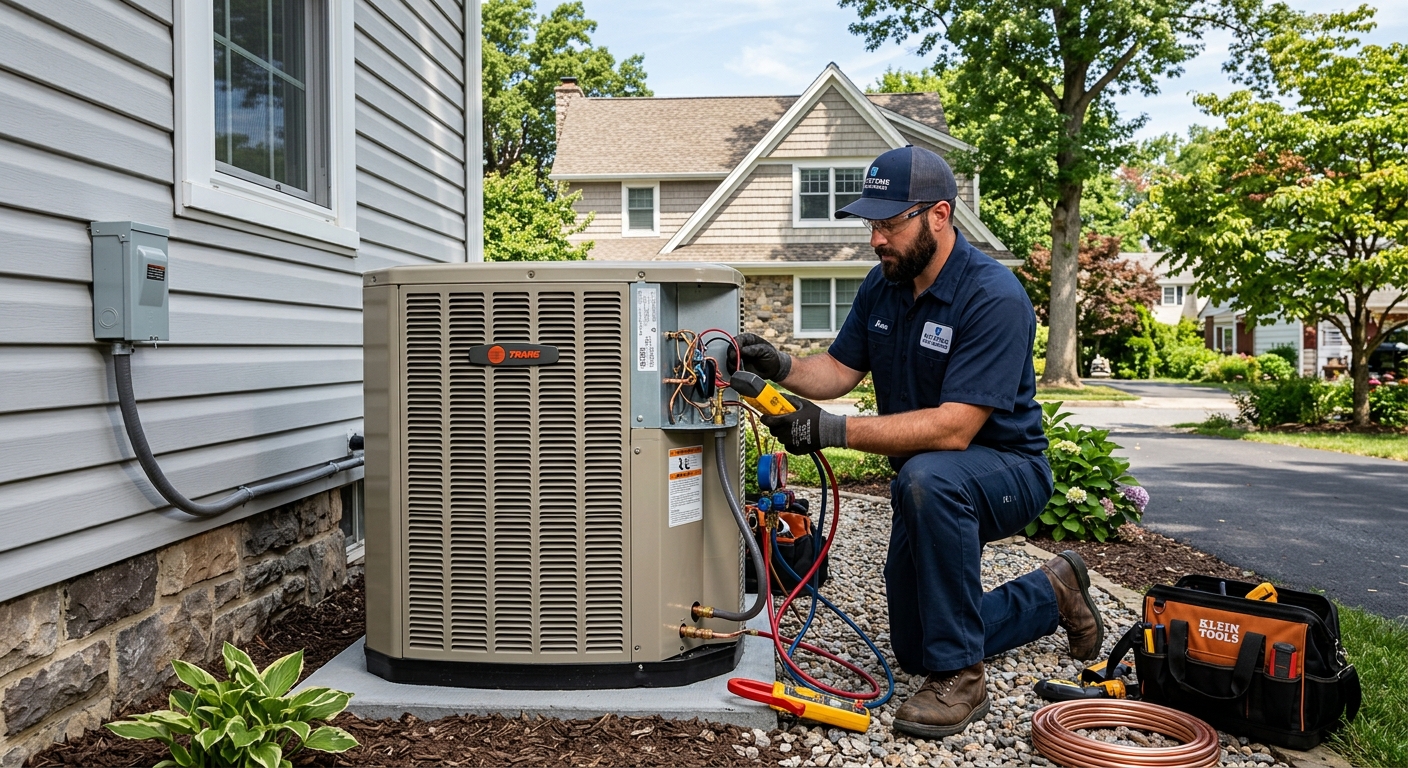
HVAC costs in Hazleton — 2026
In Hazleton, nearly all the housing stock predates the era of central air and forced-air heat—over 90% of homes were built before 1980 (U.S. Census Bureau, ACS 2024)—which means many homeowners are weighing either their first serious HVAC investment or replacing systems added during prior upgrades. A homeownership rate under 50% also means much of the work here is retrofit, not shiny new subdivision installs. Luzerne County’s legacy of 1900–1940 coal-era homes translates to a lot of boiler-to-forced-air conversions, and ductwork is hit-or-miss: some houses have full duct runs, many have none, and the existing ducts can be an unknown until a pro gets eyes on them.
Northeastern Pennsylvania is undeniably a heating-dominated climate. With 6,100 heating degree days and a winter design temperature of 4 °F, your heating system—not your AC—will run hardest and longest. Cooling matters a lot during July and August, but with only 850 cooling degree days, efficiency gains pay off faster in heating upgrades than in bigger AC units. That framing should shape every replacement or upgrade decision you make.
| System |
Best for |
Efficiency |
Price range (installed) |
| Central AC replacement (existing ducts) |
homes with sound ductwork |
16–20 SEER2 |
$4,400–$10,500 |
| Air source heat pump (ducted) |
year-round heating and cooling |
8–10 HSPF2 |
$7,000–$15,000 |
| Cold-climate heat pump (ducted) |
heat pump as primary heat |
9–11 HSPF2 |
$11,500–$15,000 |
| Ductless mini-split (single zone) |
additions, rooms without ducts |
20–30 SEER2 |
$2,800–$6,100 |
| Full duct system installation |
homes with no existing ducts |
— |
$7,800–$15,500 |
Installed estimates for a typical Hazleton home. Equipment tonnage, duct condition and electrical capacity move these more than brand.
What you can actually claim on a heat pump here
If you’re thinking about a heat pump for your Hazleton home, you should know there are usually three categories of savings: federal tax credits, utility rebates, and—some years—state-level incentives. The key difference: a federal tax credit comes back as a reduction to your tax bill the following year, while a utility rebate is a direct cash-back or instant discount, lowering your out-of-pocket cost up front.
Most federal credits tie to specific ENERGY STAR certifications; details and the latest caps can be found at the official IRS or ENERGY STAR sites. Utility rebates, whether you’re with PPL Electric Utilities or UGI Utilities for gas, run through each company’s own energy efficiency program page. These programs can change in both amount and eligibility from year to year, so don’t assume anything you read online—even here—is locked in until you see it in writing from your utility.
There isn’t a specific Luzerne County or Pennsylvania rebate program listed right now. Your best route is to check the efficiency or rebate section of your utility’s website for active offers in 2026. The ENERGY STAR Rebate Finder tool is also helpful for finding manufacturer and regional incentives. Always double-check—these offers rotate, and what’s available at quote time will dictate your final price, not an old article or a national average. Any installer should help you document rebates, but be wary of anyone promising more than what you can independently verify.
Gas, electric or both in northeastern Pennsylvania
The primary HVAC fork in Luzerne County is this: with a winter design temperature of 4 °F and 6,100 heating degree days each year, heating isn’t optional and isn’t cheap to skimp on. Modern cold-climate heat pumps aren’t like the old models—they’ll hold much of their capacity deep into freezing weather—but below 15–20°F, output does drop, and the steepest heating load comes just when efficiency falls off. This is what makes the design temperature so critical: sizing, backup, and costs all hang on it.
Gas is commonly available in Hazleton and Wilkes-Barre through UGI Utilities, but take note: in rural parts of Luzerne County, natural gas is scarce, leaving folks with propane or fuel oil—which flips the cost equation. For those with steady gas service at the curb, a modern gas furnace with a high-SEER2 AC is still a rock-solid choice, especially in homes with existing ductwork. If you’re in a rural township, an electric air-source heat pump may well beat the price and comfort of propane or oil, especially with the efficiency of today’s cold-climate models.
The only place a furnace is still a clear winner? Where gas is on-site, ducts are in serviceable shape, and peak heating demand happens during those 0–10°F cold snaps. Dual-fuel (heat pump plus gas backup) is ideal if you want to trim gas bills but not risk discomfort when winter gets serious.
| Option |
Installed cost |
Operating cost here |
Best when |
Incentive eligible |
| Gas furnace + central AC |
$4,400–$10,500 |
Moderate—lowest cost with gas on site |
existing gas service, coldest zones |
AC sometimes, furnace rarely |
| Ducted heat pump (cold climate) |
$7,000–$15,000 |
Low to moderate with good envelope |
good envelope, all-electric goal |
Yes, with federal/utility programs |
| Dual fuel (heat pump + gas backup) |
$11,500–$15,000 |
Lower than pure gas, especially in shoulder seasons |
gas on site, deep cold spells |
Yes (heat pump rebate only) |
| Ductless multi-zone |
$7,800–$15,500 |
Lowest in single or focused zones |
no ductwork, zone control |
Yes, most zones in single-family homes |
The comfort problem that isn't temperature
Hazleton’s winters mean long stretches of furnace or heat pump operation, pushing indoor humidity down to uncomfortable—and unhealthy—levels. On top of that, our cooling seasons can feel muggy even with only 850 cooling degree days: the issue is less the peak temperature and more the heavy summer air. A properly sized air conditioner or heat pump will dehumidify as it cools, but oversized equipment cycles on and off so fast that air never lingers on the coil, so rooms stay sticky.
Whole-house humidifiers can help in winter but demand regular attention: scale buildup and water panels need cleaning or replacement, or you’ll grow mold inside your ductwork. Mechanical ventilation is rarely found in Hazleton’s older homes, but if you’ve just air-sealed or insulated, it prevents stuffiness and keeps indoor air quality up to par.
High-MERV filters (think MERV 11–13) can trap more dust, pollen, and smoke, but some older or underpowered blowers struggle with these dense filters, cutting airflow and making your system work harder for less. “Air scrubbers,” expensive UV lamps, and high-end whole-house purifiers often do less than claimed, unless someone in your home has a specific medical need. Make incremental fixes: seal ducts, change filters, right-size equipment, and ventilate intelligently before you shell out for the newest gadget.
Mechanical permits for HVAC work in Hazleton
Pennsylvania does not have a statewide trade license for HVAC contractors. For homeowners in Hazleton and Luzerne County, regulation is local: contractors must hold Home Improvement Contractor registration, issued by the Pennsylvania Office of Attorney General, for any job over $500. Always verify this registration yourself at hic.attorneygeneral.gov before signing. In Wilkes-Barre, any replacement or installation of central HVAC equipment—which nearly all upgrades or full installs will require—triggers a mechanical permit and inspection. Plug-in electric space heaters, which are common here, do not need permits.
Refrigerant-handling is always regulated federally through EPA Section 608 certification—meaning whoever installs, repairs, or removes an air conditioner or heat pump must hold this specific credential, no matter their other licenses. For any employer (contractor with workers), workers’ compensation coverage is mandatory and can be verified through the state’s WCAIS system (wcais.pa.gov). Never hire anyone who dances around this question or cannot show proof.
Insist on a written contract, which is required here for jobs over $500, and know that you have 3 business days to back out after signing. The state’s Home Improvement Consumer Protection Act makes these basic rights enforceable. If someone offers to skip your deductible or fudge the paperwork, walk away; it’s not just unwise, it’s illegal.
When ductless is the right answer
Ductless mini-splits make the most sense in Hazleton’s older homes when you’re heating and cooling an addition, basement, attic, or any space your main system never reached. In Luzerne County's 1900–1940-era homes, full ductwork is just as likely to be missing as present—and retrofitting new ducts means disrupting plaster and woodwork you may want to keep untouched. For a single out-of-the-way room, one ductless head and a small outdoor compressor do the job efficiently and inconspicuously; prices for a single zone run $2,800–$6,100, depending on unit size and whether a condensate pump is required.
For multi-zone set-ups, one big outdoor unit connects to several heads. At first glance, it looks cheaper than multiple single-zone systems, but performance can drop if heads are undersized or run simultaneously at different temperatures—leading to less than ideal comfort in real-world use. Some installers will recommend multiple outdoor units as a workaround, especially when rooms see drastically different use. Expect to talk head placement (they matter visually), electrical upgrades, and proper drainage for condensate—fail to plan for these and you’ll end up with paint bubbles or stained window trim.
If you don’t have ductwork—or yours is piecemeal—ductless equipment gives room-by-room control and avoids months of opened walls. In this housing stock, there’s no retrofit solution that disrupts less or works better, especially for folks reluctant to lose old plaster in the name of comfort.
Maintenance that actually extends system life
The two most important maintenance jobs, year in and year out, are changing air filters and keeping coils (evaporator and condenser) clean. Use only the highest MERV-rated filter your system’s blower can handle without bogging down—higher isn’t always better if it cuts airflow and shortens equipment life.
Your condensate drain line can clog, especially in basements—check and clear it at the start and end of the cooling season. For heat pumps and ACs, the refrigerant charge should be verified with gauges whenever there’s a performance drop, not just topped off. If your tech says the unit “just needed some” every year, get a second opinion: you have a leak, not a maintenance item.
Annual service plans can be worth it if they guarantee both a preseason check (so you aren’t jockeying with breakdown calls come July or January) and real parts/labor discounts—not just “next available appointment.” If it’s mostly a coupon book or “priority status,” do the math and walk away. Schedule major cleanings for spring and fall so you avoid the busy season, but change filters every three months minimum unless your installer suggests monthly intervals for heavy use or pets.
Frequently asked questions — HVAC installation in Hazleton
Is an annual maintenance plan worth it?
An annual maintenance plan for your HVAC system can pay off in Hazleton, but only if it includes genuine preventive work—such as coil cleaning, condensate line checks, and a full system inspection—not just a filter change and a tune-up coupon. Many plans run around the price of a single service call, but make sure you’re actually getting a preseason visit (spring for AC, fall for heating) to beat the rush. If the plan includes real labor or parts discounts, it can save you money, especially with an older unit; otherwise, you’re often better off paying as needed. Remember, a sudden failure in January can leave you waiting in line for repairs, so some peace of mind does have value even if your costs are about the same. System replacements in Hazleton,” start at $4,400–$10,500, so regular checks can delay that big spend.
Is natural gas available throughout Luzerne County?
Natural gas is widely available in Hazleton, Wilkes-Barre, Kingston, Pittston, Dallas, and other Luzerne County urban centers, with UGI Utilities as the provider. However, many rural Luzerne County households rely on propane or heating oil because gas lines stop outside town limits. If you’re outside Hazleton’s urban core, check with UGI for specific street-level service—not all addresses qualify for hook-up. For those lacking gas, your real comparison will be heat pump versus oil or propane—not gas versus electric—which can shift both installation and annual operating costs. In homes using these fuels, installing a heat pump (which runs $7,000–$15,000 for ducted) often pencils out better over the long haul than another oil furnace.
What MERV filter rating should I use?
In most Hazleton homes, a MERV 8 to 11 filter provides a good balance between air quality and blower compatibility. Many older forced-air systems here (especially from retrofits into pre-1940 homes) are powered by fans and motors not designed for high resistance, so pushing up to MERV 13 can choke airflow and stress the equipment. If you have allergies or pets, MERV 11 often gets you nearly all the benefit without the risk. Always check your system manual or ask your installer—if you’re uncertain, err on the lower side and change it more often. Filter cost is modest (less than $50–$80 a year for basic models), far cheaper than replacing a scorched blower motor from restricted air.
What is commissioning and why does it matter?
Commissioning is the final, detailed check done by an HVAC professional to ensure your new system in Hazleton is tuned for both safety and peak performance. This process goes beyond just flipping the switch—your contractor will verify refrigerant charge, test airflow, calibrate thermostats, and make sure every duct delivers what’s needed for comfort. In older Hazleton homes with nonstandard ductwork, commissioning matters even more: skipping it risks uneven heating or cooling and spikes in utility bills. A system properly commissioned lasts longer, costs less to run, and is more likely to honor any manufacturer warranty down the road. On a job priced between $7,000–$15,500, it’s a must—not a “nice to have.”
Is a heat pump a good choice for Hazleton winters?
Yes—a correctly sized cold-climate heat pump can reliably handle 90% or more of Hazleton’s winter conditions. Modern models are designed to provide heat well below freezing, making them increasingly practical with our winter design temperature of 4 °F and 6,100 heating degree days. Performance does drop off sharply in single-digit cold snaps, though, so backup electric strips or a dual-fuel setup with a gas furnace is sometimes recommended. Heat pumps cost more up front ($7,000–$15,000 installed) than straight AC, but operational savings—especially for those using propane or oil—can be significant. Stick with a seasoned contractor who does a load calculation, not a “rule of thumb” install, for the best comfort and cost outcome.
How much does a new HVAC system cost in Hazleton?
The cost of a new HVAC system in Hazleton depends on your home’s ductwork, size, and chosen technology. For a straight AC replacement in a house with sound ducts, expect $4,400–$10,500 installed. Upgrading from a boiler to a full forced air system with ductwork can run $7,800–$15,500. A modern heat pump—ducted or ductless—typically costs $7,000–$15,000, depending on efficiency and whether you need one or multiple indoor units. Your actual price is steered far more by duct situation, electrical panel, and access than brand of equipment.
Do I need a permit to replace HVAC in Hazleton?
In Hazleton and greater Luzerne County, almost all installation or replacement of central HVAC equipment requires a mechanical permit and inspection, especially if you’re adding or altering ductwork or anything tied into the building’s wiring or refrigerant systems. Wilkes-Barre’s code office enforces these rules, and you’ll want a contractor with current Home Improvement Contractor registration for any install over $500. If someone offers to do the job “off the books” or says you can skip permits to save time or cost, walk away—it opens you up to fines, voids resale certificates, and can kill warranties. Plug-in space heaters are about the only heating solution you can swap in without a permit here.
Are duct sealing and insulation eligible for incentives?
Sometimes—utility-based and federal incentive programs periodically give rebates for duct sealing or insulation, but these aren’t always active and can vary year by year. In Hazleton, your best bet is to check PPL Electric Utilities’ energy efficiency page and use the ENERGY STAR Rebate Finder for current offers. If a program is active, rebates usually cover a portion of costs for verified improvements, reducing both leaks and winter drafts. Even if incentives aren’t available, duct sealing is rarely wasted money in older Hazleton homes—energy loss from leaky, uninsulated ducts is real, and fixing it can delay bigger investments. Sealing a full duct system here commonly falls alongside a replacement job priced $7,800–$15,500.
Is a high-efficiency system worth the extra cost here?
In northeastern Pennsylvania’s long heating season, a high-efficiency system often does pay off, but only if the rest of the home allows you to capture the gains—meaning decent insulation and properly sealed ducts. If your ductwork is leaky (as many are in Hazleton’s prewar homes), a premium furnace or heat pump won’t reach its rated numbers, and your upgrade dollars are better spent first on air-sealing and minor insulation. The difference in installed price between mid- and high-efficiency equipment can be $1,500–$4,000. Over 10–15 years, that can easily catch up in gas or electric savings—provided your home itself isn’t undoing the investment. Get a home energy audit first, then upgrade equipment.