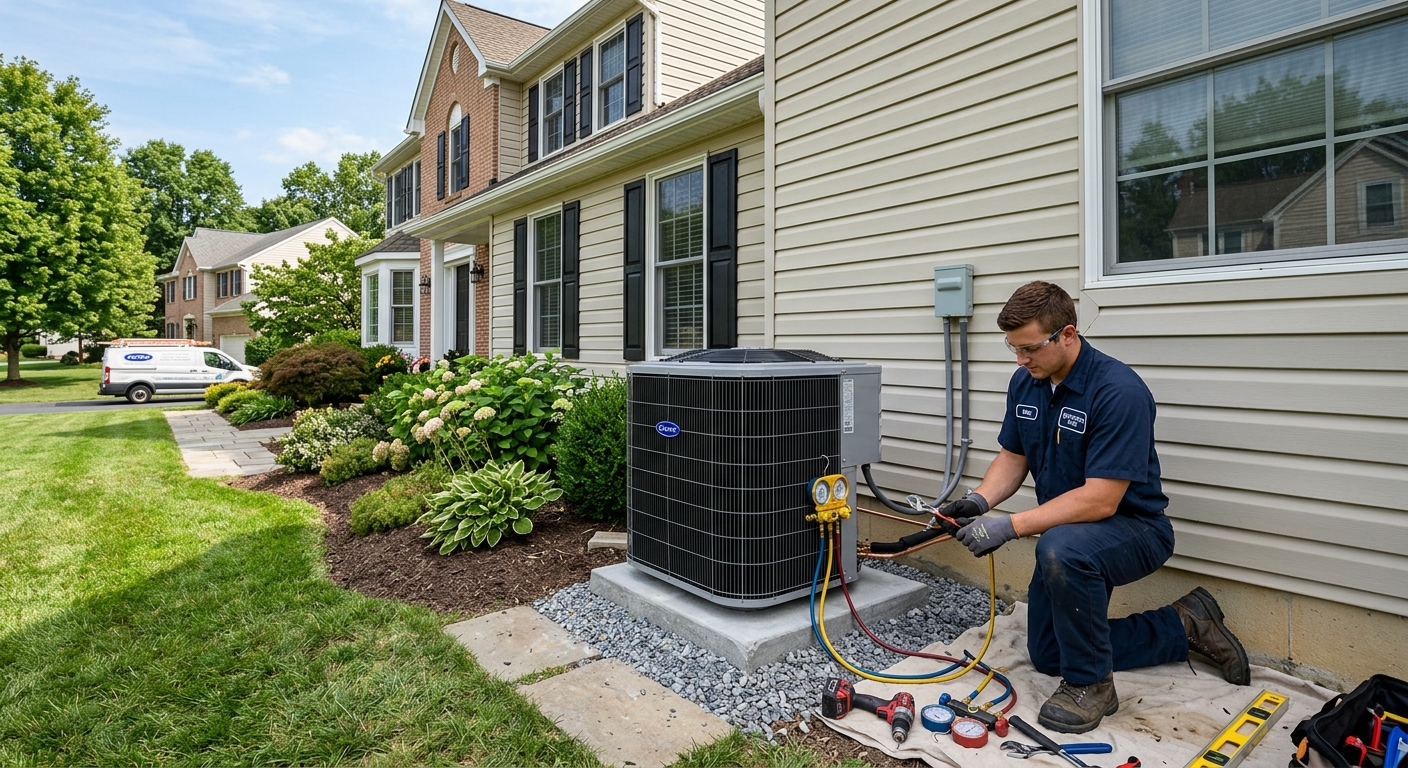
What a new HVAC system costs in New London
In New London, with a homeownership rate of 91.5% and most homes built after 1980 (U.S. Census Bureau, ACS 2024), almost every HVAC installation here is a replacement or retrofit rather than a brand-new install. Much of Chester County’s housing stock, including New London, is made up of large, single-family houses built between 1970 and 2000. These homes were usually outfitted with traditional forced-air ducted systems that are now reaching the end of their practical lives, so many households deal with the question of either repairing or fully replacing central HVAC equipment, often including ductwork replacement or repair.
Climate also drives system selection. Southeastern Pennsylvania, including New London, sees about 4,800 heating degree days and only 1,450 cooling degree days yearly. This means winter heating costs and comfort matter more than summer cooling, so choices about equipment—such as focusing on heating efficiency—will pay you back more than squeezing the last bit out of cooling ratings. For most homes with workable ductwork, a straightforward central AC or heat pump swap is common, but older homes (about one in five built before 1980) sometimes require duct upgrades or ductless solutions due to tight construction or renovations.
| System |
Best for |
Efficiency |
Price range (installed) |
| Central AC replacement (existing ducts) |
homes with sound ductwork |
16–20 SEER2 |
$6,100–$14,500 |
| Air source heat pump (ducted) |
year-round heating and cooling |
8–10 HSPF2 |
$9,800–$21,000 |
| Cold-climate heat pump (ducted) |
heat pump as primary heat |
9–11 HSPF2 |
$16,000–$21,000 |
| Ductless mini-split (single zone) |
additions, rooms without ducts |
20–30 SEER2 |
$3,900–$8,600 |
| Full duct system installation |
homes with no existing ducts |
— |
$11,000–$22,000 |
Installed estimates for a typical New London home. Equipment tonnage, duct condition and electrical capacity move these more than brand.
The decision point on an aging system
Most New London homeowners face the "repair or replace" question at least once. It’s not always a simple answer: a lot depends on how old your current system is, what broke, and what repairs actually cost versus what you'll save in performance or reliability. Forced-air systems installed in Chester County between 1970–2000 were built to last 15–20 years, but many limp along longer with small repairs. If your system is less than ten years old and runs well, routine repairs are typically a better use of your money than full replacement.
If you have an expensive repair (over a third of the cost of replacement) on a system approaching or past 15 years, it’s smart to get replacement quotes, especially if your refrigerant is phased down or if you’re paying more every month to heat and cool than your neighbors with newer equipment. There are two situations where you really don’t have a choice: a cracked heat exchanger is a no-go for safety, and a failed compressor in an old system is rarely worth saving. Efficiency gains often look compelling but in New London’s heating-dominated climate, extravagant upgrades tend to have a slow payback, so test duct leakage and insulation before you leap.
| Situation |
Recommendation |
Typical cost |
Reasoning |
| Under 10 years, single component failure |
Repair |
$300–$1,200 |
Parts still available, minimal downtime |
| 10–15 years, repair over a third of replacement |
Consider replacing |
$6,100–$14,500 |
Older systems are less efficient, future failures more likely |
| 15+ years, any major failure |
Replace |
$6,100–$14,500 |
Near or past expected service life, poor efficiency |
| Cracked heat exchanger, any age |
Replace immediately |
$6,100–$14,500 |
Carbon monoxide risk, not repairable safely |
| Compressor failure past warranty |
Replace |
$9,800–$21,000 |
Cost often rivals replacement, R-410A phasing down |
| Working system, high bills |
Test ducts and envelope first |
$300–$800 |
Duct leaks and insulation are often bigger savings |
What a Pennsylvania HVAC contractor must hold
Pennsylvania does not issue a statewide HVAC trade license for residential work. Instead, mechanical permitting and contractor requirements are enforced by individual municipalities—including those in Chester County. For any HVAC installation or replacement in New London, a contractor must be registered for home improvement contracts over $500, which you can check directly at the website provided by the Pennsylvania Office of Attorney General. There is no state-run trade board or exam for residential HVAC, so hiring a local contractor is about making sure they are registered, can pull the right permits locally, and actually show you sufficient insurance paperwork.
Anyone handling refrigerant on your job must hold EPA Section 608 certification, as this is required federally, not just in Pennsylvania. Permits mean an inspector from your township or borough comes out before the system is sealed up—this protects you if something is missed or installed unsafely. For insurance and workers’ compensation, Pennsylvania requires every employer to carry a policy on employees, not just independent contractors. You can check if a contractor holds a workers’ compensation insurance policy through the verification system at WCAIS. Don't be shy: ask to see both their contractor registration and their insurance, and verify them before you sign a contract or hand over any deposit.
When ductless is the right answer
Ductless mini-splits are a strong solution in New London for specific situations—notably when you’re finishing an attic, converting a basement, adding a sunroom, or dealing with a part of your house where the original forced-air system just never worked right (often the case with additions tacked onto the typical Chester County house). They’re also the best call in older homes where routing new ductwork would destroy original plasterwork or trim.
Single-zone ductless units serve a room or small area extremely efficiently and keep upfront costs contained. Multi-zone systems cost more initially and do offer whole-home potential, but running too many heads off a single outdoor unit can lead to uneven comfort and less-than-expected energy performance—sometimes, two carefully sized single-zone systems outperform a bulkier multi-zone. Proper head placement is crucial not just for airflow but also for aesthetics; a poorly placed wall head can become an eyesore, but recessed and floor-mount models help. Don’t neglect condensate—every mini-split needs a way to drain moisture, usually via small pumps or gravity lines to the outside.
Because most local homes from 1970–2000 were built with forced air and many are now uncomfortable or have never been properly updated, there’s a hidden ductless demand in Chester County whether homeowners realize it or not. If your original ducts can’t be reused or an addition was never heated or cooled, ductless nearly always wins for comfort and cost.
SEER2, HSPF2 and AFUE decoded
SEER2 and HSPF2 are efficiency measures for cooling and heating systems. SEER2 (Seasonal Energy Efficiency Ratio 2) gives you the average cooling efficiency for air conditioners and heat pumps under stricter test conditions than earlier SEER ratings. HSPF2 (Heating Seasonal Performance Factor 2) does the same for heating mode in heat pumps. AFUE (Annual Fuel Utilization Efficiency) measures furnace efficiency as a percentage of fuel turned into usable heat.
In Chester County, with 4,800 heating degree days and only 1,450 cooling degree days annually, heating efficiency is what saves you the most money. Higher HSPF2 ratings on heat pumps pay for themselves far faster than going up another notch in SEER2 for cooling, given our moderate but sometimes muggy summers. If your chosen system offers HSPF2 in the 9–11 range and SEER2 in the high teens, you’re in the efficient sweet spot—pushing to 20+ SEER2 adds cost but only pays back if you run the AC day and night all summer, which isn’t the norm here.
One more point: All modern equipment is now rated SEER2 and HSPF2, not the older SEER or HSPF. Don’t compare numbers between generations—SEER2 and HSPF2 values will always look lower than their predecessors, but they reflect stricter, more realistic test conditions.
The central decision for a New London homeowner
In New London, the main question is whether to choose a modern heat pump or stick with a gas furnace—it's not abstract "preference," but about climate, local fuel options, and your home's needs. Southeastern PA’s winter design temperature is 14 °F, with heating degree days at 4,800—that puts real demands on any heating system and means your choice will be felt every winter.
Today's cold-climate heat pumps can reliably heat to 5–15 °F, so the old belief that heat pumps “don’t work in Pennsylvania winters” is outdated. Still, heat pump capacity drops as it gets colder outside, so in bitter cold snaps, they sometimes benefit from a backup system. That’s where dual fuel systems—a heat pump paired with a gas furnace—come in. For homes with PECO natural gas in the street, a high-efficiency gas furnace with central AC is still low-hassle and proven for deep cold, especially if your home isn’t well-sealed.
But in the rural fringes of Chester County, where you’re stuck with propane or oil, a modern cold-climate heat pump can outright beat those old fuels for comfort and running cost, especially when paired with weatherization. There’s room for both approaches, but if your ducts and house are tight, a heat pump is worth strong consideration.
A gas furnace still makes sense if your house is drafty, you already have gas, or you prefer simpler equipment—especially in the coldest pockets. If you’re looking at an addition or have no existing ductwork, ductless multi-zone mini-splits can also deliver whole-house results.
| Option |
Installed cost |
Operating cost here |
Best when |
Incentive eligible |
| Gas furnace + central AC |
$6,100–$14,500 |
lower with gas service |
existing gas service, coldest zones |
Some utility rebates |
| Ducted heat pump (cold climate) |
$9,800–$21,000 |
low if house is sealed |
good envelope, all-electric goal |
Federal and some utility |
| Dual fuel (heat pump + gas backup) |
$16,000–$21,000 |
lowest overall |
gas on site, deep cold spells |
Federal and some utility |
| Ductless multi-zone |
$11,000–$22,000 |
low in additions or tight homes |
no ductwork, zone control |
Federal and some utility |
R-410A phase-down: repair or replace?
New residential HVAC systems being installed in New London today use next-generation refrigerants like R-454B or R-32, as manufacturers phase down high-global-warming-potential (GWP) HFCs like R-410A. But if your existing system runs R-410A—which is nearly every unit installed in Chester County since the early 2000s—you do not need to rush out and replace it. Servicing and recharging these units is still legal and will remain so for the foreseeable future, and technicians maintain stock of R-410A for repairs.
The real consequence is cost. As R-410A production tightens, the price of a pound of refrigerant has gone up over the past few years and will eventually trickle into repair bills when you need a top-off or leak fix. For a leak on an old system, the repair-versus-replace calculation tips sooner than it used to—if you’re quoted a major repair on a slow-leaking R-410A unit, ask for both a repair and a replacement estimate, then weigh your options. The refrigerant transition impacts long-run service economics, not legality or functionality of your current equipment.
In short: keep your working system until a repair just doesn’t justify the spend, not because of the refrigerant label on the data plate.
Frequently asked questions — HVAC installation in New London
How do I verify an HVAC contractor's insurance?
The easiest way for New London homeowners to verify an HVAC contractor’s insurance is to ask for their certificates of liability and workers’ compensation insurance—then check them. In Pennsylvania, employers must have workers’ compensation by law; you can confirm active coverage using the state’s WCAIS system online. If you're discussing a job over $500, the contractor must also be registered for home improvement under the Home Improvement Consumer Protection Act. This registration is public and searchable at hic.attorneygeneral.gov. Checking these documents isn't just about peace of mind—it can protect you from legal headaches or injury-related costs if a worker is hurt on your property. Any reputable contractor in this part of Chester County handles this paperwork routinely. Remember, full system replacements here cost $6,100–$14,500 or more, so ensuring your contractor is properly covered is too important to skip.
Can a heat pump heat my house without backup?
In New London, a modern cold-climate heat pump can heat most homes without backup, especially if your house is well weatherized. Chester County’s winter design temperature is 14 °F, and today’s cold-climate models are engineered to deliver useful heat well below this. However, as the outdoor temperature drops, heat pump efficiency and output decline too, and in extended deep freezes, supplemental electric strip heat (built into most systems) or a gas backup can keep you fully comfortable. If your house is drafty or poorly insulated, even the best heat pump will struggle to keep up on the coldest nights; then a dual fuel system or conventional furnace is safer. For most New London homeowners in well-sealed houses, a ducted heat pump installed runs $9,800–$21,000 and covers nearly all heating needs.
What MERV filter rating should I use?
For New London homes, a MERV 8 to MERV 11 filter is appropriate for most systems. It balances filtration of dust, pollen, and household particles without putting too much strain on typical residential blower motors—important in Chester County’s mix of older and newer forced-air systems. While higher MERV ratings trap finer particles and are sometimes recommended for allergy or medical concerns, they can also restrict airflow, lowering efficiency and risking freeze-ups or overheating if your system wasn’t designed for them. Your best move is to use the highest MERV rating your HVAC manufacturer recommends (usually printed inside the filter slot), and upgrade to a thicker, 4- or 5-inch media filter cabinet if indoor air allergies are a concern. Filter upgrades are a very cost-effective improvement compared to other air quality options, running well under $300–$800 for most filter cabinet retrofits in New London area homes.
How far ahead should I schedule in New London?
Peak HVAC installation seasons in New London and greater Chester County are late spring through midsummer and during the first cool snaps of fall. Contractors’ schedules fill up fast—sometimes booking two to four weeks out in May through August, especially for full replacements. If you’re replacing a central air conditioner or heat pump, contacting local pros at least a month before you want work started gives you the best scheduling options. For ductwork installation, which is labor-intensive and not particularly weather-dependent, you might get faster service off-peak, like early spring or late fall. Emergency repairs jump the line, but planning ahead nearly always means a lower price and better choice of equipment. Central AC replacements here are typically priced $6,100–$14,500, so securing permits and inspections with enough lead time matters too.
Which utility serves New London?
PECO Energy provides both electric and natural gas service to most homes in New London and Chester County’s urbanized areas, including West Chester, West Goshen, and Tredyffrin. If your address is on the rural edge, especially west of town, you may rely on propane or fuel oil for heating and have fewer choices for gas upgrades. This matters for your HVAC decisions, as gas furnace and central AC replacements in PECO territory cost $6,100–$14,500, and your eligibility for certain rebates or incentives can depend on the utility serving your specific street. Always confirm utility hookups before deciding on an all-electric heat pump, dual fuel system, or sticking with fossil fuels.
How much does a new HVAC system cost in New London?
The total installed price for a new HVAC system in New London depends on what you’re replacing and the condition of your home’s ductwork. For most homes with ducts in reasonable shape, a central AC replacement runs $6,100–$14,500. If you’re upgrading to a full ducted heat pump for both heating and cooling, installed costs usually fall in the $9,800–$21,000 range. Older homes without ducts or with major space constraints may need a new duct system or ductless mini-splits, which shift the price band. Also factor in possible permit fees, electric upgrades, or duct repairs. Most New London projects are replacements rather than first-time installs, based on the local mix of housing age and layout, so prices generally fall near these local bands unless you’re doing a gut renovation.
Why does my system short cycle?
Short cycling—when your HVAC system keeps turning on and off rapidly—is a common complaint in New London homes, especially in Chester County’s 1970–2000 era developments where equipment may be oversized for the space or where the original ductwork isn’t perfectly matched to current loads. Reasons include a mis-sized system, low refrigerant charge (possibly from a small leak), or thermostats located in unstable temperature areas. Dirty filters or blocked returns, both easy to check, can also trigger short cycling. Sometimes, it reflects an expensive control or compressor problem, but often the solution is cheaper: rebalancing dampers, relocating the thermostat, or adjusting fan settings. Quick fixes usually run $300–$800, while deeper repairs—like addressing refrigerant circuit leaks—can lean higher. Addressing short cycling quickly saves wear and tear on high-value systems and keeps utility costs lower over time.
What does a heat pump cost installed in New London?
For New London area homes, a ducted heat pump installed as a whole-house system ranges from $9,800–$21,000, depending on equipment capacity, duct condition, and any electrical upgrades needed. If you’re opting for a cold-climate model to handle all winter heating, you’ll pay at the upper end. Ductless single-zone mini-splits for individual rooms or additions come in much lower, between $3,900–$8,600 installed, and multi-zone ductless for whole-house use with no existing ducts is usually in the $11,000–$22,000 ballpark, especially if you need 3 or more indoor heads. The installation date and local permit process can also move the price if your municipality is strict about inspector scheduling or upgrades.
What HVAC tax credits are available to New London homeowners?
New London homeowners can access federal tax credits on qualifying high-efficiency HVAC systems, including cold-climate heat pumps, central AC units meeting specific SEER2 and HSPF2 ratings, and advanced gas furnaces. The Inflation Reduction Act provides up to $2,000 in tax credits for heat pumps and additional credits for weatherization or electrical upgrades. State or local utility rebates in Chester County, offered by PECO, may further offset the cost of system upgrades, but amounts vary year by year. For example, installing a new cold-climate ducted heat pump priced at $16,000–$21,000 could see $2,000 back on your federal return and possibly more in utility rebates. Be sure to check product eligibility and installation requirements—credits only apply to systems meeting the new SEER2 and HSPF2 thresholds and must be installed by a qualifying contractor in accordance with the Pennsylvania Uniform Construction Code.