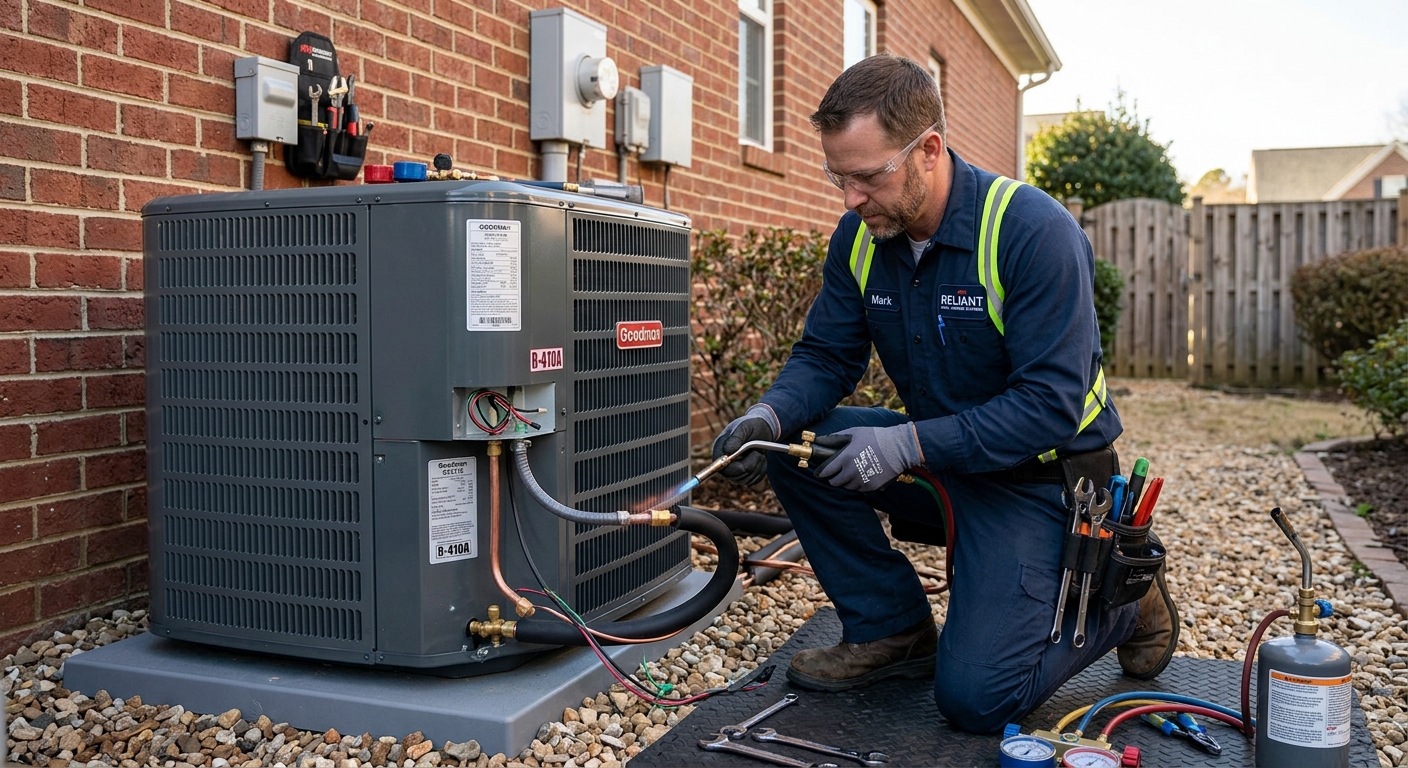
What a new HVAC system costs in South Heidelberg
South Heidelberg homeowners, like those in much of Berks County, tend to replace and retrofit existing HVAC systems rather than install new ones from scratch. With 91.0% of households owner-occupied and 41.2% of homes built before 1980 (U.S. Census Bureau, ACS 2024), there’s a mix of older ductwork—sometimes not sized for modern equipment—especially in homes around Reading and the historic boroughs. This means “replacement” often includes significant updates, not just a swap of the outside unit.
Our climate, with 5,200 heating degree days and just 1,250 cooling degree days per year, makes Berks County a heating-dominated market. For most, winter performance and efficient, reliable heating is more important than maximum cooling. This affects system selection and what you actually pay back on premium equipment. In older homes, or those originally heated with radiators or floor furnaces, adding ducts or switching to ductless systems may be the only option.
Below are 2026 installed price ranges for the most common types of residential HVAC jobs in South Heidelberg. These span basic replacements with existing ductwork to complete new system installs, accounting for what’s typical in this area.
| System |
Best for |
Efficiency |
Price range (installed) |
| Central AC replacement (existing ducts) |
homes with sound ductwork |
16–20 SEER2 |
$5,200–$12,500 |
| Air source heat pump (ducted) |
year-round heating and cooling |
8–10 HSPF2 |
$8,300–$17,500 |
| Cold-climate heat pump (ducted) |
heat pump as primary heat |
9–11 HSPF2 |
$13,500–$17,500 |
| Ductless mini-split (single zone) |
additions, rooms without ducts |
20–30 SEER2 |
$3,300–$7,300 |
| Full duct system installation |
homes with no existing ducts |
— |
$9,400–$18,500 |
Installed estimates for a typical South Heidelberg home. Equipment tonnage, duct condition and electrical capacity move these more than brand.
When an HVAC repair stops being worth it
Not every HVAC issue in South Heidelberg justifies a full system replacement. Older homes and the variable weather here call for a practical “repair or replace” approach. The biggest factors are the system’s age, the type and cost of the failure, whether it uses an older refrigerant, and if efficiency upgrades would actually pay back given our long heating season and moderate cooling needs.
A repair almost always makes sense when the unit is under 10 years old and you’re dealing with a failed capacitor, fan, pressure switch, or other non-catastrophic part. But if the system is 15+ years old, or the needed repair costs more than a third of replacement—and especially if the compressor (on an AC or heat pump) or heat exchanger (on a furnace) has failed—replacement should be considered. For a cracked heat exchanger or a compressor dying out of warranty, replacement isn’t optional due to safety, cost, and reliability concerns.
If your system seems wasteful, start by testing your ducts and air leakage. Duct and envelope problems are common in homes in Reading and rural South Heidelberg alike, and can make a healthy system look bad. Replacement for efficiency alone rarely pays back quickly unless your bills are extreme.
| Situation |
Recommendation |
Typical cost |
Reasoning |
| Under 10 years, single component failure |
Repair |
$300–$1,200 |
Most parts are available and systems have years of life left. |
| 10–15 years, repair over a third of replacement |
Consider replacing |
$5,200–$12,500 |
Approaching end of service life; ROI may favor new equipment. |
| 15+ years, any major failure |
Replace |
$5,200–$12,500 |
Old systems are unreliable and inefficient. |
| Cracked heat exchanger, any age |
Replace immediately |
$5,200–$12,500 |
Safety hazard—carbon monoxide risk. |
| Compressor failure past warranty |
Replace |
$8,300–$17,500 |
Costly repair, typically not justified on aging equipment. |
| Working system, high bills |
Test ducts and envelope first |
$300–$800 |
Hidden leakage or insulation issues often the real problem. |
Permits, licensing and inspections in South Heidelberg
In Pennsylvania, there’s no state-issued HVAC license for contractors doing residential work. Instead, home improvement contractors must have Home Improvement Contractor (HIC) registration for projects over $500, which you can verify at hic.attorneygeneral.gov. Beyond that, mechanical permits, electrical permits, and inspections are regulated not by the state, but locally—so what’s required depends on the township or city. In Reading, for example, mechanical and electrical permits are triggered by most replacements and new system installations, while portable plug-in units generally don’t require a permit anywhere nearby.
If a job involves refrigerant (any AC or heat pump install or repair), the technician must hold EPA Section 608 certification—this is federal law and you can ask to see proof. Insurance matters too, especially workers’ compensation, which is mandatory for all employers in Pennsylvania. You can verify a company’s coverage status through the WCAIS online system at wcais.pa.gov.
A legitimate written contract is required by the Home Improvement Consumer Protection Act for any project over $500, and in Berks County a contractor should never suggest “waiving your deductible”—it’s not allowed. If your home predates 1978, federal EPA requirements apply for any work disturbing paint (including duct or equipment replacement that might cut walls), so confirm your contractor’s credentials if this situation applies.
R-410A phase-down: repair or replace?
New residential central ACs and heat pumps now use lower-GWP refrigerants like R-454B and R-32 instead of R-410A, following a national and global mandate to phase down high-warming-potential HFCs. For South Heidelberg homeowners with an existing R-410A system, this change does not make your unit “illegal” or unserviceable—qualified techs can continue to source and add R-410A for the foreseeable future.
The catch is long-term cost: as new equipment shifts away from R-410A, the price of that refrigerant will increase, especially for charged repairs (like fixing a leak and recharging a system). This raises the break-even point for expensive repairs on older units. If your R-410A system is working, there’s absolutely no mandate or practical urgency to replace it now. But if you’re facing a major repair that includes substantial refrigerant loss and recharging, it’s worth weighing the age of your system and repair bill against the cost of replacement, since future service is slowly getting pricier as R-410A becomes less available.
Otherwise, keep your R-410A system maintained and serviced as needed. This phase-down is about what’s sold new, not what’s already in your home.
Duct condition, leakage and sealing
In South Heidelberg and nearby Reading, many homes predate 1940 or were last updated decades ago, so ductwork is either added much later or may never have been professionally sized, sealed, or insulated. In these older Berks County homes, duct leakage can easily run 20% or more, meaning you might be heating or cooling your attic as much as your living room—and that costs real money in a place with 5,200 heating degree days a year.
A duct blaster test gives a measurable reading of total duct leakage, showing exactly how much air escapes before reaching its destination. If your comfort or utility bills seem off, get this test before replacing the system: there’s no point investing in high-efficiency equipment if your air is blowing into wall cavities or crawlspaces.
Sealing, rather than replacing, ducts is usually the first and most cost-effective fix, especially for homes with accessible basements or unfinished spaces. Undersized returns are a chronic and nearly invisible cause of uneven performance: many older systems were installed for a small furnace in a much leakier, less-insulated house, and now struggle to distribute air evenly.
In some houses—especially where ducts run through unconditioned spaces, or where retrofits hacked together different trunk lines—replacement may be the only real solution. But always test and assess before deciding on major ductwork investments.
Reading the yellow label
Every new HVAC system comes with efficiency ratings, but the two main ones have recently changed: SEER has become SEER2 for cooling, and HSPF is now HSPF2 for heating. Both versions use different test procedures, so numbers aren’t directly comparable with older articles or quotes. SEER2 (Seasonal Energy Efficiency Ratio 2) measures cooling efficiency, while HSPF2 (Heating Seasonal Performance Factor 2) measures heating efficiency—both as an average over the season.
In Berks County, with 5,200 heating degree days versus just 1,250 cooling, most homes here spend much more on heating than cooling. That means paying extra for very high SEER2 (above 18) rarely pays itself back unless your house is unusually large or glassy. For heat pumps, HSPF2 is the rating that matters most. In this area, investing in a mid-to-high HSPF2 ducted heat pump will bring more value than maxing out the SEER2.
A balanced choice: AC systems rated 16–18 SEER2 and heat pumps at 8–10 HSPF2 hit the sweet spot between up-front cost and practical savings. Going higher generally doesn’t pencil out except in rare cases, given our climate.
Filtration, humidification and ventilation
With cold winters and hot, humid summers in South Heidelberg, the two main indoor air quality issues are dryness during heating months and humidity when cooling. Proper equipment choices help, but “add-on” gadgets are not a magic solution for every home.
A correctly sized AC does a good job keeping moisture down in summer, but oversizing (common in older Berks County homes after window upgrades) actually leaves air sticky—big units don’t run enough to wring out humidity. For dry winter air, whole-house humidifiers can help, but they do add maintenance: pads or canisters must be changed annually, and water lines checked for leaks. Many people skip upkeep, leading to mold or mineral buildup.
Better filtration—using higher MERV filters—improves air quality, but anything above MERV 11 should be checked against your system’s blower capability, especially in older ductwork common in Reading-era homes. Too restrictive, and you can reduce air flow and strain the blower.
Finally, if your home is newer or tightly sealed, mechanical ventilation may be smart. But in most South Heidelberg homes, especially pre-1980, significant extra ventilation isn’t critical unless you’ve really tightened up the building envelope. Be wary of “IAQ add-ons” that sound impressive but rarely pay off here.
Frequently asked questions — HVAC installation in South Heidelberg
What does a ductless mini-split cost in South Heidelberg?
A single-zone ductless mini-split in South Heidelberg typically runs from $3,300–$7,300 installed. The lower end covers a basic one-head install in an easy-access room; the higher end covers longer refrigerant pipe runs, electrical upgrades, or a system with higher efficiency or cold-climate specs. Ductless systems are especially suitable for additions or rooms without existing ductwork, which are common in this region since many homes were built before central air became standard. Larger homes or projects requiring multiple indoor units will climb above this range. Always confirm your quoted price covers permits and electrical work, since local municipalities can enforce those requirements.
When is the best time of year to replace HVAC in South Heidelberg?
In South Heidelberg, the shoulder seasons—early spring and fall—are ideal for HVAC replacement. Demand for heating and cooling contractors is lower, meaning better scheduling flexibility and sometimes faster permit processing. During Berks County’s summer or winter extremes, you’ll be competing for appointments and may pay a premium, especially for emergency service. If you’re considering a ductless mini-split or heat pump, aim to schedule before or after those peak periods to ensure enough time for any needed electrical or ductwork modifications. Even in slower seasons, standard replacements can still run $5,200–$12,500 depending on the system type.
How do I verify an HVAC contractor's insurance?
Verifying insurance in Pennsylvania—including South Heidelberg—is straightforward. Workers’ compensation status for all contractors can be checked free online through the WCAIS system (wcais.pa.gov), which lists current coverage and whether a company is properly insured. General liability insurance isn’t monitored by the state, so ask for a certificate directly from the contractor: it’s normal for a legitimate company to email or hand you their insurance binder. For larger jobs, you can request to be named as “additional insured” on the certificate. This level of transparency is standard practice in Berks County and offers protection if anything goes wrong on your property, especially on jobs above $5,200–$12,500 like a full AC replacement.
Is a high-efficiency system worth the extra cost here?
In South Heidelberg, with 5,200 heating degree days and only 1,250 for cooling, most of your energy dollars go toward heating. For a heat pump, investing in higher HSPF2 makes sense, especially if your home lacks natural gas and you heat primarily with electricity. On the cooling side, exceeding 18 SEER2 is rarely cost-effective in this part of Berks County. For most homes, a central AC or heat pump between 8–10 HSPF2 and 16–18 SEER2 hits the payback point without much premium. Expect installed costs in the $8,300–$17,500 range for a ducted system. Anything above this usually only pays back in special cases, like outsize homes or allergy-driven air quality needs.
Are duct sealing and insulation eligible for incentives?
Duct sealing and insulation often qualify for federal or utility rebates, though the exact incentives change year by year. In South Heidelberg, where many homes have leaky or uninsulated ducts (especially in attics and crawlspaces), this is a smart upgrade before investing in new HVAC equipment. Sometimes, even a modest investment—typically $300–$800—produces a noticeable gain in comfort and utility savings. Check with Met-Ed or your township’s website for current programs, and always get verification or “before and after” leakage test results to qualify for incentives.
Can a heat pump heat my house without backup?
Most modern ducted heat pumps installed in South Heidelberg can supply heat all winter—even when outdoor temperatures dip below 20 °F—but backup heat (either electric strip or a furnace) is often included for the rare nights when the temperature drops near the winter design low of 12 °F. Cold-climate heat pumps, which are rated 9–11 HSPF2, maintain output at much lower temperatures and may cost from $13,500–$17,500 installed. If your house is reasonably insulated, it can usually do without backup unless you want extra peace of mind for those coldest weeks. Don’t skip a proper load calculation to avoid being under- or oversold.
How cold does it get in South Heidelberg and does that affect heat pumps?
Berks County’s winter design temperature is 12 °F, and most homes in South Heidelberg will see lows in that neighborhood a few nights a year. This does impact heat pump selection: standard models drop off in output and efficiency below 20 °F, while “cold-climate” models keep working effectively at much lower temperatures. If you go this route, upfront costs can reach $13,500–$17,500, but operating costs are lower compared to electric resistance or older fossil fuels. Many rural homes add backup heat for peace of mind, but insulation and air sealing sometimes matter more than equipment choice.
What is a Manual J load calculation?
A Manual J load calculation is the industry-standard way to determine exactly how much cooling and heating your specific home in South Heidelberg needs. It takes into account square footage, insulation, windows, orientation, air leakage, and occupancy, rather than relying on “rule of thumb” sizing. This is especially important in Berks County where older houses may have been retrofitted several times, sometimes leaving oversized or undersized equipment and ductwork. A proper Manual J ensures you won’t overspend on a system that’s too big (leading to humidity or comfort problems) or too small (underperforming on the coldest or hottest days). Professional contractors will usually include this in the design process on jobs starting around $5,200–$12,500.
Is an annual maintenance plan worth it?
An annual HVAC maintenance plan can be a good idea in South Heidelberg if you tend to forget seasonal checks, want priority service, or need to comply with manufacturer warranties on newer equipment. With our pronounced freeze-thaw cycles, regular inspection and cleaning helps catch issues like clogged condensate lines or heat exchanger rust before they become expensive repairs. The typical cost of scheduled maintenance—often $300–$800 per year—may seem like an extra, but it pays for most homeowners by extending system life and maintaining efficiency. For homes running older equipment, it can also act as an early warning for major failures, helping you budget repairs or replacements strategically.