Harrison heating and cooling prices by system type — 2026
In Harrison, where the homeownership rate sits at 73.9% and 85.5% of homes were built before 1980 (U.S. Census Bureau, ACS 2024), most HVAC work is replacement or retrofit—not new installs. These older homes usually have tight or limited ductwork, and it's common to run into electrical service that dates back decades. While some houses have serviceable duct systems, many don't, and retrofitting can quickly become complex and cost-sensitive.
This is a heating-dominated region. With 5,600 annual heating degree days, winters are long and cold—far more demanding than the relatively brief cooling season (1,050 cooling degree days). It means your choice of HVAC should focus first on reliable, efficient heat, with cooling as a strong but secondary concern.
| System |
Best for |
Efficiency |
Price range (installed) |
| Central AC replacement (existing ducts) |
homes with sound ductwork |
16–20 SEER2 |
$4,700–$11,500 |
| Air source heat pump (ducted) |
year-round heating and cooling |
8–10 HSPF2 |
$7,500–$16,000 |
| Cold-climate heat pump (ducted) |
heat pump as primary heat |
9–11 HSPF2 |
$12,000–$16,000 |
| Ductless mini-split (single zone) |
additions, rooms without ducts |
20–30 SEER2 |
$3,000–$6,600 |
| Full duct system installation |
homes with no existing ducts |
— |
$8,500–$17,000 |
Installed estimates for a typical Harrison home. Equipment tonnage, duct condition and electrical capacity move these more than brand.
The refrigerant change and what it means for repairs
Recently, the HVAC industry has shifted new equipment to low-GWP (global warming potential) refrigerants like R-454B and R-32, phasing down high-GWP HFCs such as R-410A. If you have an R-410A system running in your Harrison home, you can still legally service or recharge it—there is no forced upgrade. Existing equipment does not become illegal or unrepairable just because new units are using something different.
The main consequence is economic: as manufacturing focuses on R-454B and R-32, R-410A supply will drop and costs will rise. This mainly matters if your air conditioner or heat pump develops a refrigerant leak. In that scenario, the price of R-410A may push an older system closer to the threshold where replacement makes more sense than repair—especially if any other part is failing.
For now, the vast majority of service parts and refrigerant are readily available. Technicians will continue to maintain R-410A systems in Harrison for years, but the shifting cost landscape is worth watching. If your system is running well with no leaks or major problems, there’s no need to replace it simply because of the refrigerant. Make your repair-versus-replace decision based on the equipment's age, condition and total repair cost, not the headline about refrigerant changes.
Running the numbers on Harrison's climate
Harrison’s winters are harsh and long, with 5,600 heating degree days and a winter design temperature of 8°F to size against. The cooling season is far milder, with just 1,050 cooling degree days. With electric supply from Duquesne Light Company, the biggest bills most households see are for heat—especially if the system isn’t sized or installed right.
The math boils down to three things: efficiency rating, degree days, and your utility rate. For example, to estimate annual heating cost for a heat pump: first, look at the HSPF2 rating (says how efficiently it turns electricity into heat). Multiply your home’s estimated annual heating load (found through a Manual J calculation or past utility bills) by local degree days. Divide by the system’s efficiency, and multiply by your cost per kilowatt-hour (check your electric bill for the rate from Duquesne Light).
Example: If your heating load is about 40 million BTUs per year, and you have a heat pump rated at 9 HSPF2, you’ll use roughly 4,445 kWh to cover that load. At 16¢ per kWh, that’s about $711 annually. With natural gas, the calculation would use the AFUE of your furnace, gas price per therm, and a similar approach. But remember, this is just a model—older homes in Harrison are often leaky, and badly sealed or undersized ductwork can sap performance so much that a “high-efficiency” system is only as good as its weakest link.
The real takeaway: use your actual utility rate and an honest look at your home’s insulation and ducts to make decisions. Do not trust an efficiency comparison if it ignores duct losses or is based just on equipment sticker ratings.
What size system does a Harrison home need?
If there’s one thing that will make or break comfort and utility bills in Harrison, it’s getting the system size right. Oversizing doesn’t provide a safety margin—it causes short cycles, uneven temperatures and humidity problems, and shortens equipment life. It’s a real defect, not just wasted money.
A proper Manual J load calculation is the gold standard and essential for our climate. It accounts for actual window sizes, insulation, airtightness, and sun exposure—whereas the old rule of ‘X tons per square foot’ or sizing to match your old system just repeats old mistakes. Even in the same neighborhood, one home may need 2.5 tons while the one next door is better served with 2, thanks to window upgrades or insulation the builder never dreamed of in 1950.
The winter design temperature here is 8°F, and that’s what a good contractor will use to size your system: what will keep you warm during a true cold snap, not just a typical January night. If a technician can’t show you a Manual J or skips it, you’re letting them gamble with your comfort. Don’t be afraid to ask “Did you do a load calculation—and can I see it?” Accept nothing less, especially given Harrison’s stock of older, draftier homes.
Mini-splits and zoning in Harrison homes
Many Harrison homes, especially those built before 1960, were never designed for central air. Adding ductwork can mean tearing open finished plaster walls, ceilings, or floors—an expensive and invasive project. This is why ductless mini-splits are not just an upgrade but the practical answer for additions, attic bedrooms, basements, or any room your main system never seems to reach.
Single-zone ductless mini-splits (one indoor head per outdoor unit) are efficient and cost-effective for targeted spaces. Multi-zone systems run multiple indoor heads from a single outdoor unit, but spreading one compressor too far reduces efficiency and means one failure can take down an entire level’s comfort. It can be cheaper up front—but comfort and energy savings are best with separate outdoor units where possible.
Head placement and condensate drainage matter. While wall-mounted heads are common, they’re not always a fit aesthetically—though ceiling cassettes cost more and require more access. Always plan condensate lines so they don’t risk interior leaks, especially in older homes.
If you have an older Harrison house, don’t let anyone sell you on tearing the whole place up for ductwork unless you’re already opening walls for other reasons. For targeted comfort and major energy savings—especially at the single-room level—a ductless system at $3,000–$6,600 is often the logical retrofit.
Duct condition, leakage and sealing
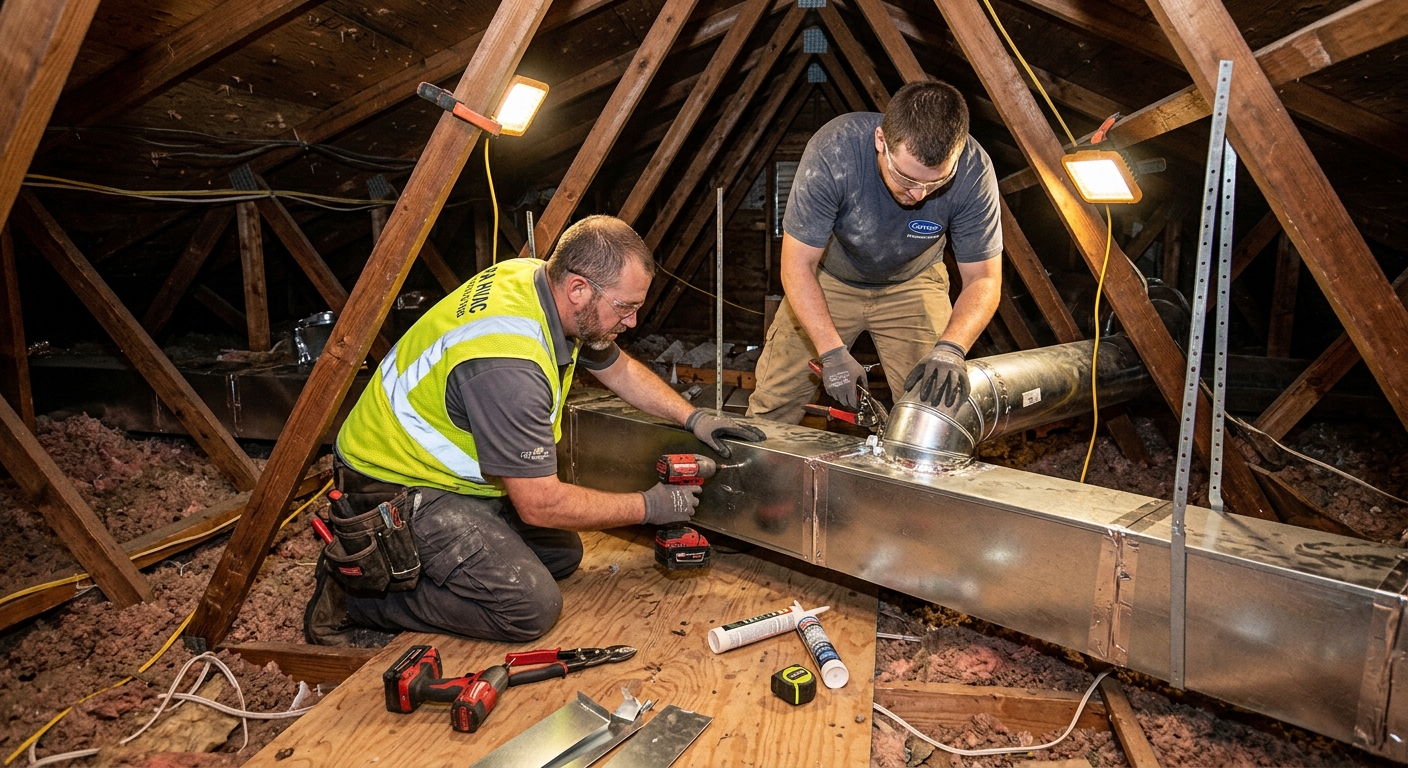
Older Harrison homes almost always have leaky supply ducts and undersized return runs—if they have ductwork at all. That means a fair chunk of your heated or cooled air is slipping into the basement, attic, or crawlspace before it ever gets to you. Here, the duct system can affect comfort and energy bills more than the equipment itself.
A duct blaster test (blower fan pressurizing ducts with all registers temporarily sealed) will tell you exactly how much is leaking out. If your home was built before 1960 and you’ve never had the ducts sealed or sized, expect significant loss. Sealing (via mastic or aerosol) often makes more sense than a full replacement unless the ducts are rusted, asbestos-wrapped, or hopelessly undersized.
Returns are a chronic problem nobody sees—they tend to be too small for modern systems or even partially blocked. And if you have duct runs routed through unconditioned attics or crawlspaces, you could see comfort issues year-round along with condensation and moisture problems.
Test and seal before replacing your equipment. Upgrading to a high-efficiency furnace or air handler on a leaky, undersized duct system is like putting a new engine in a car with flat tires—it won't deliver what's promised no matter how good the numbers look in the brochure.
Mechanical permits for HVAC work in Harrison
Pennsylvania does not have a statewide license specifically for HVAC contractors. Instead, anyone working on residential systems in Harrison must hold a Home Improvement Contractor (HIC) registration for jobs over $500. You can verify this registration online before signing a contract. At the federal level, anyone handling refrigerant—such as for air conditioner or heat pump installation—must have EPA Section 608 certification, which applies everywhere, including Harrison.
Mechanical permits are enforced by the local municipality for new installations, replacements, and major alterations. In cities like Pittsburgh, an inspection is required for code compliance. Always verify that your contractor carries both general liability insurance and workers' compensation. Pennsylvania employers must provide workers’ comp and you can check coverage through the WCAIS database. Do not proceed without written proof—insurance protects you if someone is injured on your property, and proper registrations are required by law.
Plumbing, electrical, and HVAC work beyond basic like-for-like replacements are also regulated locally, with permits and inspections varying by town. Get everything in writing, and ensure your contractor meets all registration and permit requirements before starting work.
Frequently asked questions — HVAC installation in Harrison
What is SEER2 and how is it different from SEER?
SEER2 is the second-generation Seasonal Energy Efficiency Ratio standard adopted throughout Harrison and the rest of the U.S. It's a more realistic measure of how efficiently an air conditioner or heat pump runs under actual (higher-pressure) conditions that match what installers see in older duct systems like those in Harrison’s pre-1960 homes. While SEER was used for years, SEER2 testing raises the static pressure to better account for how systems work in real houses, not just in a lab. So, a unit with a 16 SEER2 rating is notably more efficient than the same number under the old SEER scale, making it easier to compare apples to apples. When you see ductless mini-splits listing 20–30 SEER2 for $3,000–$6,600, you’re seeing a more honest picture of performance in the field.
Should I replace the furnace and AC at the same time?
It's not always necessary, but there are strong arguments in Harrison’s older homes to consider it. Many homes here have aging ductwork and matched furnace–AC systems; replacing both at once helps ensure correct airflow, matching refrigerant requirements, and updated efficiency across the heating and cooling seasons. You may also save on labor costs and avoid compatibility headaches by swapping both together. If your furnace is still relatively young and in excellent shape, you may keep it—just be aware that a new, high-efficiency air conditioner or heat pump paired to an old furnace can limit your comfort, efficiency, or warranty protection. For reference, full central AC replacement runs $4,700–$11,500. For the most value in Harrison, upgrade the full system if both are nearing the end of their life.
Does my utility offer a heat pump rebate in Harrison?
Some utilities in Pennsylvania may offer rebates for high-efficiency heat pumps, but these change frequently and depend on the equipment and current program funding. Duquesne Light Company, which serves the Harrison area, has at times provided heat pump rebates, but you’ll need to check the latest updates via their website or ask your contractor to look up current offers. It’s common to see rebates on ENERGY STAR® certified systems, particularly cold-climate models. Keep in mind, equipment that costs $7,500–$16,000 installed for a high-performance heat pump, may net a few hundred to over a thousand dollars in credits if you qualify. Always verify before you sign a contract—rebates are never guaranteed and may have paperwork requirements.
Why do HVAC quotes in Harrison vary so much?
You’ll see a big swing in HVAC quotes in Harrison because of the age and condition of the area’s housing stock. Over 85% of homes here were built before 1980, often with ductwork, electric service or plumbing that needs upgrading before a new system—costs can balloon quickly. Some contractors quote only the bare minimum to ‘replace’ equipment, while others bid the job you actually need, including duct repairs or code-required upgrades. Material costs, workmanship, equipment quality, and permit fees all factor in. For example, prices for a full duct system installation range from $8,500–$17,000 depending on the house's layout and access. Make sure every quote you get details what's included and what's extra so you can make a true apples-to-apples comparison.
When is the best time of year to replace HVAC in Harrison?
The slowest demand for HVAC contractors in Harrison is in spring and early fall, when you’re not relying on heat or cooling daily. Scheduling your system replacement in these shoulder seasons often means shorter wait times, more accessible appointments, and sometimes even off-season discounts. Given how much work in Harrison is retrofit, booking early can help you avoid emergency pricing and get the permits and electrical work lined up before the weather turns. For reference, a ducted air-source heat pump installation ranges $7,500–$16,000, and scheduling well ahead means you’re not paying a premium for urgent “first cold snap” work.
Does Pennsylvania license HVAC contractors?
Pennsylvania does not require a statewide trade license for HVAC contractors working on residential systems in Harrison, but almost every job over $500 requires a Home Improvement Contractor (HIC) registration number, which you can look up yourself. Local municipalities may require permits, code compliance, and their own registration. For refrigerant work, a federal EPA Section 608 certification is required no matter where you are. Don’t assume all contractors in Harrison are regulated equally—always ask to see a valid HIC registration before signing any contract over $500.
How much does a new HVAC system cost in Harrison?
For a typical single-family home in Harrison, central air conditioning replacement with your existing ducts starts at about $4,700 and can go up to $11,500 for larger or more complex jobs. A ducted air-source heat pump system will usually run from $7,500–$16,000, while ductless single-zone mini-splits are generally between $3,000–$6,600. Full new ductwork with a system is the largest investment at $8,500–$17,000. Prices depend on duct and electrical upgrades, home size, and equipment efficiency—not just the brand name. Always get a specific, written quote to match your home’s actual needs.
How long should an HVAC system last in Harrison?
With regular maintenance, most central air conditioners and heat pumps installed in Harrison will last 12 to 18 years; furnaces sometimes edge closer to 20 years. The older the system, the more the pre-1960 housing can introduce new variables—outdated ductwork, marginal wiring, or other factors can trim the expected lifespan. Replacement costs are significant (e.g., $7,500–$16,000 for a ducted heat pump), so plan ahead if your system is over a decade old and repairs are rapidly adding up. Warranty coverage is another reason to consider replacement once parts and labor are no longer covered and out-of-pocket repairs grow frequent.
How cold does it get in Harrison and does that affect heat pumps?
Harrison gets genuine winter, with a winter design temperature of just 8°F—meaning heat pumps used as a primary heat source need to be rated for cold climates to maintain comfort and efficiency. Older standard heat pumps might struggle below 20°F and may need electric or gas backup heat. The latest cold-climate models, recommended for our area, can produce reliable heat well below freezing, though they come at a premium: installation typically costs $12,000–$16,000. Always ensure your contractor sizes and specifies equipment for true local extremes, not just ‘average’ winter temperatures.