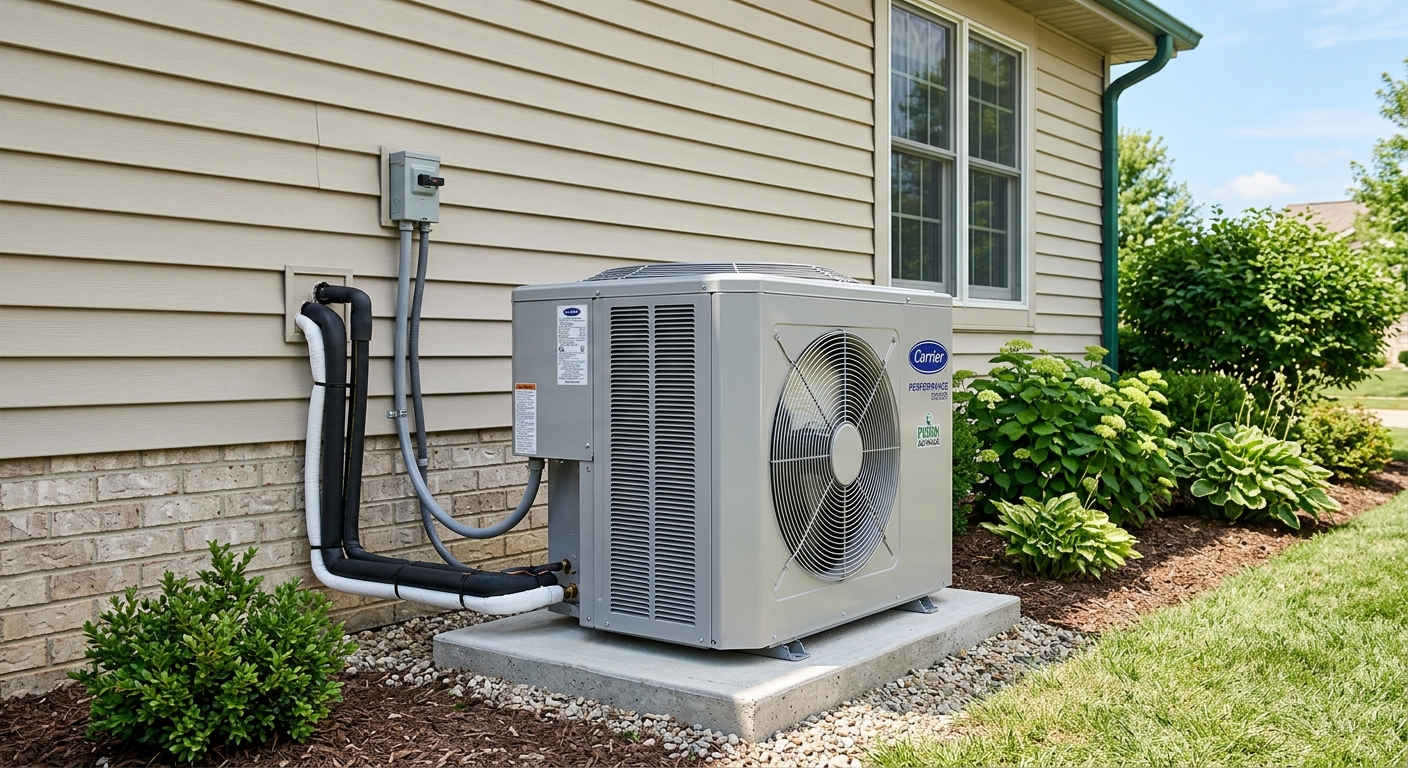
What a new HVAC system costs in Ephrata
Ephrata’s unique housing profile drives which types of HVAC systems make the most sense here. With 64.6% of homes built before 1980 and just 53.8% homeownership (U.S. Census Bureau, ACS 2024), this is a market where ductless and high-velocity retrofits are common—especially since many older homes, including Lancaster city rowhomes from 1880–1930, were not built with central ductwork in mind. That means adding or reworking duct systems is often part of the project cost, not just swapping out a unit.
Our local temperature swings and 5,200 heating degree days versus 1,250 cooling degree days put the emphasis on reliable, efficient heating first and cooling second. That’s different from southern states where air conditioners are the primary concern. For many Ephrata homeowners, deciding how to replace or retrofit their HVAC means matching a system to an older house, evaluating whether the ducts are in good shape—or exist at all—and dealing with real winter cold.
| System |
Best for |
Efficiency |
Price range (installed) |
| Central AC replacement (existing ducts) |
homes with sound ductwork |
16–20 SEER2 |
$4,800–$11,500 |
| Air source heat pump (ducted) |
year-round heating and cooling |
8–10 HSPF2 |
$7,700–$16,500 |
| Cold-climate heat pump (ducted) |
heat pump as primary heat |
9–11 HSPF2 |
$12,500–$16,500 |
| Ductless mini-split (single zone) |
additions, rooms without ducts |
20–30 SEER2 |
$3,100–$6,700 |
| Full duct system installation |
homes with no existing ducts |
— |
$8,700–$17,500 |
Installed estimates for a typical Ephrata home. Equipment tonnage, duct condition and electrical capacity move these more than brand.
The central decision for a Ephrata homeowner
Choosing between a furnace and a heat pump in Ephrata hinges on our local climate. The winter design temperature sits at 12°F, and with 5,200 heating degree days each year, homes here see a real winter—not the mild season you’d get further south. Modern cold-climate heat pumps perform impressively, maintaining useful heating capacity well below freezing. The “don’t work in cold climates” reputation is mostly outdated. Still, as temperatures drop closer to that design minimum, heat pump output does fall, which is why backup or dual-fuel setups are common, and system sizing really counts here.
Gas service is widely available in places like Lancaster city, Manheim Township, and East Hempfield, but less so further afield in Lancaster County. Where natural gas is already at the house, a gas furnace is still a cost-effective, reliable option—especially during the coldest weeks. But for homes outside gas service, the alternative isn’t a simple furnace-versus-heat-pump choice; it’s often propane or fuel oil, both of which are less efficient and more expensive to run than a modern heat pump. That changes the calculation: if gas isn’t an option, moving toward a heat pump makes both economic and comfort sense.
A furnace is still the right answer if you already have gas service and want lowest up-front cost and a proven product during deep freezes. Otherwise, a heat pump or dual-fuel may be a better fit for efficiency and long-term cost, especially in our heating-heavy climate.
| Option |
Installed cost |
Operating cost here |
Best when |
Incentive eligible |
| Gas furnace + central AC |
$4,800–$11,500 |
lower if gas is at the meter |
existing gas service, coldest zones |
possible for AC upgrades |
| Ducted heat pump (cold climate) |
$7,700–$16,500 |
lower than oil/propane, higher than gas |
good envelope, all-electric goal |
usually |
| Dual fuel (heat pump + gas backup) |
$12,500–$16,500 |
lowest in well-split seasons |
gas on site, deep cold spells |
yes |
| Ductless multi-zone |
$8,700–$17,500 |
lowest with zone control |
no ductwork, zone control |
yes if replacing resistance heat |
Reducing the net cost of a Ephrata installation
Three main avenues can lower your out-of-pocket cost for HVAC installation in Ephrata: the federal tax credit, local utility rebates, and, if available, state initiatives. A federal tax credit lowers what you owe in taxes for the next year, while utility rebates come directly off your invoice or arrive as a check—so rebates help cash flow immediately, while a credit is claimed at tax time.
PPL Electric Utilities and UGI Utilities serve most Ephrata households, but rebate eligibility and amounts change frequently. For the latest utility offers, check your electric or gas company’s efficiency program page directly. The ENERGY STAR rebate finder is another solid resource, always up-to-date nationwide.
Be cautious of articles quoting specific rebate amounts—they date quickly. Use them as a starting point, not a guarantee. Sometimes installer-submitted rebates are simpler to claim, but always ask before signing. Federal incentives for high-efficiency heat pumps and central air systems can be significant, especially if you’re replacing resistance heat or going all-electric, but be sure to check forms and requirements at the IRS website before factoring them fully into your budget.
R-410A phase-down: repair or replace?
Starting in 2025, newly manufactured residential HVAC units have largely transitioned away from R-410A toward lower-global-warming-potential refrigerants like R-454B and R-32. This is part of a nationwide effort to phase down high-GWP HFCs, but it does not make R-410A systems illegal or unserviceable in Ephrata or anywhere else. If you have a working R-410A air conditioner or heat pump, you can keep using it and, for now, it can be repaired and recharged when needed.
The practical difference is economic, not legal. As manufacturers build fewer systems using R-410A, supplies of that refrigerant will gradually tighten, especially over the next several years. That drives up the cost of a recharge or leak repair. It means, in simple terms, the “replace or repair” tipping point for an aging unit with a refrigerant leak will shift—you might choose to replace the system sooner than you would have when the refrigerant was cheap and easy to find.
If you have a minor service need or routine maintenance, don’t feel pressured to swap out your R-410A equipment. Just be prepared that repair costs related to refrigerant will keep rising, and for systems already at the end of their lifespan, this new price environment may push you toward replacement.
Comparing HVAC estimates in Ephrata
Comparing quotes in Ephrata is about details, not just the bottom line. Every proper estimate should include model numbers for both indoor and outdoor units—mismatched pairs perform below their advertised efficiency and sometimes void warranties. You want to see equipment tonnage justified with a load calculation, not just matching what’s there now. Ductwork should be inspected and called out for sealing or repairs if needed.
Make sure the quote discusses whether the line set (the piping carrying refrigerant) is reused or replaced, and specifies any electrical work up to and including necessary panel upgrades. Good installers also include condensate management, thermostat, a permit (if required), and commissioning steps with real measurements, not just start-up. The labour warranty should be its own entry, separate from the equipment warranty.
If you get two “quotes” and one just lists a brand and a price, throw it out—you can’t compare that to anything meaningful. If your installer won’t break things out, keep shopping.
| Line item |
What to look for |
Red flag if… |
| Equipment |
model numbers, indoor and outdoor matched |
brand name only |
| Sizing |
load calculation attached |
matched to the old nameplate |
| Ductwork |
condition assessed, sealing scoped |
not mentioned |
| Electrical |
circuit and panel capacity confirmed |
assumed adequate |
| Line set |
replaced or documented as reused |
silent |
| Commissioning |
measured airflow and charge, documented |
no startup report |
| Warranty |
labour years stated separately |
manufacturer only |
| Permit |
included and priced |
'not needed' |
Retrofit versus replacement in Ephrata
Ephrata’s housing leans older, with nearly two-thirds of homes built before 1980. In these houses, you’re often working with duct systems—if there are any at all—that weren’t designed for air conditioning. Many have minimal insulation and drafty windows, so heating and cooling loads are higher and more unpredictable. Electrical panels might not have the spare capacity needed for a modern heat pump, and if you’re keeping a gas furnace, you’ll want a tech to look at the chimney or vent to be sure it’s safe.
Some newer suburban developments, particularly from the 1990s, are now needing their first replacement as builder-grade HVAC equipment reaches the end of its life. While these homes mostly have central ducts, those ducts may be sized generously for the original furnace but not ideal for high-efficiency cooling or heat pump conversion.
Retrofitting in Ephrata typically means solving for missing or leaky ducts, electrical panel updates, and older windows and insulation. If you’re living in one of the older rowhomes or small single-families, expect that a straight swap is unlikely—ductless mini-splits or high-velocity systems are often the practical approach.
Mechanical permits for HVAC work in Ephrata
In Pennsylvania, there’s no statewide mechanical license for HVAC contractors working on residential jobs. Instead, the Pennsylvania Uniform Construction Code (UCC), rooted in the International Residential Code, sets standards—enforced at the township or city level in Lancaster County. In Ephrata and across the county, mechanical permits and inspections are handled by local authorities, not the state. If anyone tells you you don’t need a permit for central AC or furnace work, check with your township’s code office before signing anything.
Anyone who handles refrigerant must have EPA Section 608 certification, which is federal and mandatory on every HVAC job involving refrigerant here—so always ask your installer to provide their certification.
For residential jobs over $500, a contractor must be registered as a Home Improvement Contractor (HIC) with the Pennsylvania Office of Attorney General, and show proof of workers’ compensation insurance if they employ anyone. You can look up registration at hic.attorneygeneral.gov and confirm insurance through WCAIS (wcais.pa.gov).
Bottom line: local permit, EPA cert, HIC registration, and insurance verification. Any reputable contractor should produce all of them on request.
Frequently asked questions — HVAC installation in Ephrata
Is a high-efficiency system worth the extra cost here?
High-efficiency HVAC systems often make sense in Ephrata, but only in homes that can take real advantage of the technology. Remember, with over 5,200 heating degree days per year, the bulk of energy bills in Ephrata come from heating—meaning a higher efficiency heat pump or furnace can pay off faster here than somewhere with mild winters. In homes with older, leaky ducts or poor insulation, fixing those is sometimes a better investment before spending on top-tier equipment. Upgrading to a high-SEER2 heat pump might take your installed cost from $7,700–$16,500, but utility incentives and the federal tax credit can help offset that. The payoff grows if you’re retiring an old oil or propane system, not just natural gas. Always start with a load calculation; otherwise, efficiency is just a sticker on a box, not real savings in your home.
What is the R-410A refrigerant phase-down?
The R-410A phase-down is a regulatory shift gradually reducing the use of this refrigerant because of its high global warming potential. In Pennsylvania, including Ephrata, it means that starting in 2025, new residential HVAC systems are moving to refrigerants like R-32 or R-454B. You do not need to swap out a working R-410A system, and you can still have it serviced for years. What changes for Ephrata homeowners is the cost—R-410A prices will creep up, so the repair-or-replace tipping point for an aging AC or heat pump will come a bit sooner. If your system is otherwise reliable, keep it running; if it has a refrigerant leak and is nearing end-of-life, weigh that cost against a new installation, which will run $4,800–$11,500 or more.
Why does my system short cycle?
Short cycling, where your air conditioner or furnace turns on and off rapidly without reaching the set temperature, is a common issue in Ephrata’s older homes. Many older houses here have ductwork sized for a furnace, not modern central air, or no ducts at all—forcing systems to work harder and less efficiently. Oversized equipment is a frequent culprit; a unit too big for your home will short cycle regardless of brand. Other causes include dirty air filters, thermostat placement in a draft, or leaky ducts common in Ephrata’s pre-1980 houses. If short cycling continues, get a pro to review your load calculation. Replacement, when needed, ranges from $4,800–$11,500 for central AC to $7,700–$16,500 for a heat pump, but sometimes just fixing ducts and correcting sizing solves the issue.
Do I need a permit to replace HVAC in Ephrata?
Yes, most central HVAC replacements or new installations in Ephrata require a mechanical permit, just like in the city of Lancaster and nearby townships. Only routine maintenance—like changing a filter or basic thermostat programming—is generally exempt in Lancaster County. Always check with your township code office. Permits protect both you and your installer, ensuring work is up to code and systems are safe. The permit should be clearly listed and priced on your quote, not skipped to cut corners. Expect this requirement whether you're installing a $3,100–$6,700 mini-split or a full $16,500 heat pump with new ducts.
What does a heat pump cost installed in Ephrata?
In Ephrata, a ducted heat pump system typically falls between $7,700–$16,500 fully installed, depending on the size of your home, the complexity of existing ductwork, and whether you need additional electrical upgrades. If you’re opting for a cold-climate model—which is common here due to low winter temps—expect the price to land in the upper half of that range. Ductless mini-splits, popular in homes without central ducts, start at $3,100–$6,700 for a single zone. Remember, older homes, especially those built before 1980, may require more prep, adding to total cost. Always ask for a detailed estimate that includes load calculation, duct assessment, and new electrical work if needed.
Which utility serves Ephrata?
Ephrata and most of Lancaster County are served by PPL Electric Utilities for electricity and UGI Utilities for natural gas. Whether both are available at your specific home depends on your exact location; gas service is common in Lancaster city and Manheim Township, but less so in rural areas—so always confirm before planning an HVAC upgrade that depends on utility supply. If you’re considering a gas furnace plus AC (typical install: $4,800–$11,500), natural gas availability makes a huge difference to running costs and equipment choices compared to propane or oil.
Are duct sealing and insulation eligible for incentives?
Yes, both duct sealing and insulation improvements may qualify for utility rebates or federal tax credits in Ephrata, especially if they’re part of a wider heating or cooling upgrade. PPL Electric and UGI Utilities sometimes offer incentives for duct sealing as it directly saves energy—a big deal in older Ephrata homes where leaky ducts are common. Check your utility’s efficiency site for specifics, as program names and amounts change each year. The cost for ductwork sealing or upgrades can push a project into the higher end of a price range—adding as much as a few thousand dollars to something like a $8,700–$17,500 full duct install, but rebates can help offset these investments.
How long does HVAC installation take in Ephrata?
Most standard HVAC replacements, such as swapping out a furnace and central AC combo, take one to two full days in Ephrata, provided your ductwork and electrical are ready. Installing a completely new duct system, typical for rowhomes or pre-1930s properties, may stretch to three or four days. Ductless mini-splits can sometimes be installed in a single day for one zone; multi-zone mini-splits or complex heat pump jobs take longer, especially if new wiring or wall work is involved. Factor in time for mechanical permits and inspection (required in Ephrata), which can add a day or two, especially in busy summer or winter seasons. Labor and logistics are priced into every estimate, whether it’s a straightforward $4,800 AC swap or a more intricate $17,500 full retrofit.
Should I repair or replace my HVAC system in Ephrata?
This decision depends on your system’s age, the cost of repairs, and the changing landscape for equipment and refrigerant. If your R-410A unit is more than 12-15 years old and needs a major repair—especially a refrigerant-related fix—the rising price of R-410A may tip you toward replacement. For relatively simple issues and newer gear, repair is often fine. Older homes in Ephrata often have under-ventilated, outdated equipment, and new high-efficiency systems can lower bills given our heating-heavy climate. Replacement costs range from about $4,800–$11,500 for basic central AC to $16,500 for premium cold-climate heat pumps with duct upgrades. Always ask for a clear breakdown of replacement parts, labor and refrigerant cost, and compare that to the installed price of a new unit with modern incentives.