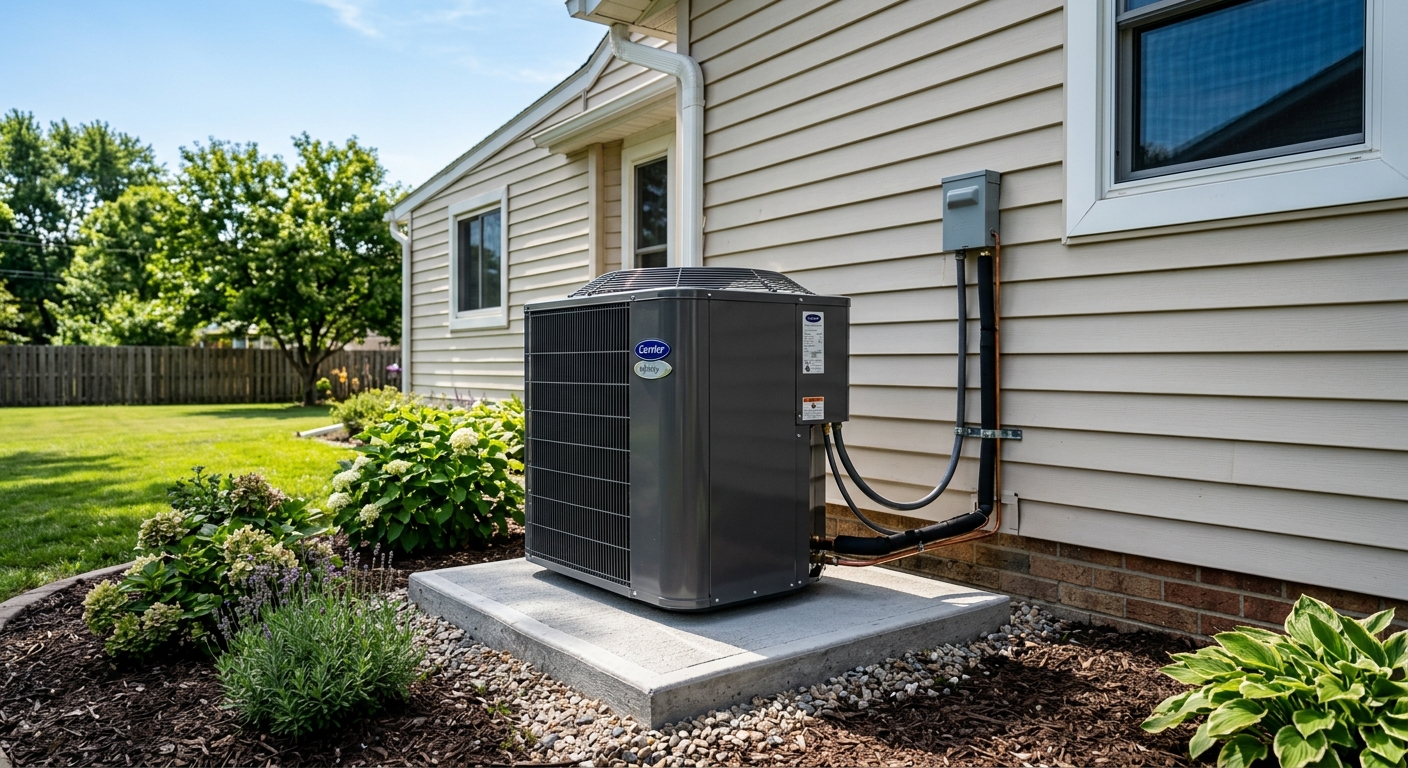
New Britain heating and cooling prices by system type — 2026
In New Britain, where owner-occupied homes make up 83.4% of households and nearly half the housing was built before 1980 (U.S. Census Bureau, ACS 2024), most work is full-system replacement—not just first-time installs. Many of these homes were built during the suburban development waves that shaped Bensalem and Middletown, bringing standard forced-air ductwork into the majority of houses. That leaves us with a local HVAC market focused on retrofitting older systems and upgrading ductwork to today’s performance standards.
New Britain’s climate has 4,800 heating degree days and 1,450 cooling degree days each year. That makes this a heating-dominated market: your equipment decision should prioritize reliable, efficient heat, not just cold air. Central AC and heat pumps are both common, but sizing and selection should always address the local weather realities and existing ductwork. Here’s what you can expect to pay in 2026:
| System |
Best for |
Efficiency |
Price range (installed) |
| Central AC replacement (existing ducts) |
homes with sound ductwork |
16–20 SEER2 |
$5,800–$14,000 |
| Air source heat pump (ducted) |
year-round heating and cooling |
8–10 HSPF2 |
$9,300–$20,000 |
| Cold-climate heat pump (ducted) |
heat pump as primary heat |
9–11 HSPF2 |
$15,000–$20,000 |
| Ductless mini-split (single zone) |
additions, rooms without ducts |
20–30 SEER2 |
$3,700–$8,100 |
| Full duct system installation |
homes with no existing ducts |
— |
$10,500–$21,000 |
Installed estimates for a typical New Britain home. Equipment tonnage, duct condition and electrical capacity move these more than brand.
Humidity and air quality in New Britain homes
With New Britain's humid summers and cold winters, local HVAC solutions have to do more than just heat and cool. Our region faces winter dryness as much as muggy, sticky August afternoons. Dehumidification in summer is critical; too many central AC systems are oversized in an attempt to “cool faster,” but an oversized AC short-cycles and leaves air clammy instead of dry—so don’t let anyone sell you a bigger unit “just in case.”
In winter, dry indoor air is common when the heat’s on for months. Whole-house humidifiers can add comfort, but they require regular cleaning to avoid scale buildup and mold. If nobody has kept up with maintenance, they do more harm than good. For air filtration, a higher MERV filter sounds great, but if your blower isn’t sized for the added resistance, your system will strain or even fail. Tightly sealed newer homes can trap pollutants inside; mechanical ventilation (like an energy recovery ventilator) is useful here, but rarely cost-effective in a typical loosely constructed home.
Be skeptical about expensive IAQ add-ons such as standalone UV lights or premium “air scrubbers”—they’re often oversold. Improvements like good duct sealing, right-sized filtration, and regular system maintenance deliver more measurable benefit than most pricey gadgets the catalogs push.
Mechanical permits for HVAC work in New Britain
HVAC licensing in Pennsylvania works differently than in many places. There is no statewide HVAC trade license for residential work, but contractors must have a Pennsylvania Home Improvement Contractor (HIC) registration for any job over $500—so any real HVAC contract. Municipalities handle mechanical permits and code enforcement for residential work; the state’s Uniform Construction Code gives the framework, but you’ll need a permit from your local township if you’re replacing or installing central HVAC equipment. Thermostat swaps that don’t touch new wiring typically do not require a permit, but anything with major electrical, duct, or refrigerant lines almost always does.
By federal law, anyone handling refrigerant must carry EPA Section 608 certification. Ask to see a copy or card; if your contractor can’t show it, they shouldn’t be working on your AC or heat pump. For insurance protection, request proof of workers’ compensation coverage—every Pennsylvania employer is required to carry it, and you can confirm this on WCAIS (wcais.pa.gov). Verifying HIC registration is straightforward: check the state’s public site at hic.attorneygeneral.gov. In Bucks County, each township runs its own permit office, so requirements and inspections can differ from one municipality to another even a mile apart.
Rebates and tax credits for New Britain homeowners
There are three main ways local homeowners can lower the cost of an HVAC upgrade: federal tax credits, rebates from your utilities, and occasional state programs. Start with the federal side—energy-efficient equipment like air source heat pumps and high-SEER central ACs may qualify for a direct tax credit. This reduces what you owe the IRS after you file, not the price you pay upfront. A rebate, on the other hand, comes from your utility or state and is typically taken off your invoice or sent by check, so it helps with cash flow right away.
For New Britain, PECO Energy Company provides electric and natural gas service and routinely runs efficiency rebate programs. However, names and exact amounts change from year to year. Instead of trusting any article’s static numbers, check your most accurate, up-to-date information on PECO’s efficiency program website, or use the ENERGY STAR rebate finder. State-level offerings also vary—go straight to your utility’s program page and look for the current application process. That’s much more reliable than anything in print. Tax credits and rebates can stack, but the paperwork can get tricky, especially for bundled systems, so ask your contractor for itemized specs and receipts if you plan to claim both.
Ductwork: the part nobody quotes properly
In New Britain and across Bucks County, nearly half of homes were built before 1980, when duct leakage and sizing standards were less strict than today. The hidden culprit in too many underperforming HVAC systems is leaky or undersized ductwork—especially returns that were installed for furnaces only, not for high-volume cooling. A duct blaster test measures your system’s actual air leaks: it pressurizes your ducts to spot where conditioned air escapes, often showing 20–30% loss in older homes.
Sealing ductwork with mastic or aerosol can cut those losses, but if your ducts run through an unconditioned attic or crawlspace, replacing or re-routing may be more effective. Post-1960 suburban tract homes in Bensalem and Middletown often have full runs of original builder ducts, but these were rarely sized for modern multi-stage cooling and almost never sealed end-to-end. If rooms are stuffy or a utility room roars while bedrooms barely blow, undersized returns are likely the root issue.
The cost of a complete new duct installation runs $10,500–$21,000 in this region, so know what you have before you leap. The honest advice: have your ducts tested before replacing the equipment. Otherwise, you risk buying a perfectly efficient new unit only to let the air leak into every wall and attic void before it reaches you.
Retrofit versus replacement in New Britain
With 47.6% of New Britain homes built before 1980 (U.S. Census Bureau, ACS 2024), the local housing stock is a mix of mid-century and newer subdivisions. Most post-1960 homes have at least basic ductwork, though typically sized for a single-stage furnace—not modern cooling demands. Older homes sometimes lack return ducts in key rooms or run all their ductwork through unconditioned space. Insulation is usually spotty, and storms have sent many original windows to the dump, but if yours remain, expect drafts that stress your heating bill.
Electrical panel capacity becomes a concern if you’re thinking about switching to an all-electric heat pump system: many older panels simply can’t take the extra load. If staying with gas, check the condition of any flue or chimney—liner replacement may be needed for a high-efficiency furnace install. For late 1990s and early 2000s subdivisions, you’re likely facing the first true replacement: builder-grade heating and cooling systems (often 15–25 years old) are at or past their design life, and right-sizing is key—originals were often oversized “just to be safe.”
Efficiency ratings and what they mean for your bill
When shopping for new HVAC, you’ll see efficiency rated as SEER2 for cooling and HSPF2 for heat pumps, both updated versions of older SEER and HSPF tests. SEER2 measures seasonal cooling efficiency, while HSPF2 measures seasonal heating efficiency. The higher the number, the less energy used per unit of output.
But how high is worth paying for? In New Britain, our 4,800 heating degree days and 1,450 cooling degree days mean that heating runs longer and harder, so you get more payback from a higher HSPF2 than from a very high SEER2. Spending extra for a cooling efficiency above 20 SEER2 rarely pays back here unless cooling is your main concern or you have special needs. For most homes, a central AC around 16–18 SEER2 or a heat pump around 9–10 HSPF2 does the sensible job without stacking years onto the payback period.
If you’re reading older articles or product labels, numbers may look higher—because SEER2 and HSPF2 ratings are stricter than older SEER and HSPF. Always compare apples to apples when weighing options and price tags.
Frequently asked questions — HVAC installation in New Britain
Does my utility offer a heat pump rebate in New Britain?
New Britain’s primary electric and gas utility is PECO Energy Company. PECO frequently runs rebate programs for high-efficiency heat pump installations, but the specific amounts and qualifying equipment change from year to year. For example, incentives may apply to a ducted air source heat pump (in the $9,300–$20,000 installed price range), reducing your out-of-pocket expense. Since listings and details change, don’t rely on a fixed rebate figure from an article. The most reliable way to check is to visit PECO’s official efficiency program webpage and search for current residential equipment offers. If you have an independent or third-party supplier, or if your area has different utility arrangements, you may also want to use the ENERGY STAR rebate finder for up-to-date listings. Always confirm eligibility and application steps before starting your project.
How much does a new HVAC system cost in New Britain?
The cost of a new HVAC system in New Britain depends heavily on what you’re replacing or installing. For a typical central AC replacement using existing ductwork, you’re looking at $5,800–$14,000. A full ducted heat pump system (which provides both heating and cooling) ranges from $9,300–$20,000. If your house needs completely new ductwork—common in homes built before the housing boom or in major remodels—the price for duct installation alone runs $10,500–$21,000. These numbers reflect Bucks County’s price bands for 2026, influenced more by equipment size, home condition, and local permits than by “brand.” Always insist on a written, detailed quote and remember that in our area, old return ducts or mismatched sizing can mean extra costs beyond the sticker price.
Is it worth switching from oil or propane to a heat pump?
Switching from oil or propane to a ducted air source heat pump can make sense in New Britain, especially if your home already has ductwork and the electrical panel can support the load. Heating with oil or propane is typically more expensive per BTU than with a modern heat pump, and New Britain has the right mix of moderate winter design temperatures (14°F) for well-matched cold-climate models. Upfront costs for a full ducted heat pump installation typically range from $9,300–$20,000, but rebates and tax credits can help offset this. If ducts are in poor shape or don’t exist, factor in an additional $10,500–$21,000 for ductwork. The payback is best when you have high oil or propane costs, moderate insulation, and replace both heating and cooling equipment together. Get a load calculation before making the switch to confirm your house’s suitability.
Is an annual maintenance plan worth it?
For most New Britain homeowners, an annual maintenance plan is a solid investment—especially since nearly half our homes were built before 1980 and aging systems are less forgiving. Routine checks catch things like refrigerant leaks, failing blower motors, and dirty coils before they become costly or emergency calls. These checkups are generally priced reasonable compared to repair visits, and many contractors credit part of your maintenance fee toward repairs if something does come up. While you might pay a bit more up front, the reduced risk of a summer or winter breakdown—when HVAC companies are swamped—often makes it worth it, particularly with replacement prices in the $5,800–$20,000 range. At minimum, keep up with annual service if your equipment is under warranty, as missed maintenance can void coverage.
Why do HVAC quotes in New Britain vary so much?
Quotes in New Britain can vary widely because every house comes with its own duct layout, system sizing needs, and municipal permit requirements. Much of our local housing is a patchwork of original builds, additions, and remodels—meaning one home might need full duct replacement ($10,500–$21,000), another just a basic AC swap ($5,800–$14,000). Labor costs shift depending on accessibility, existing wiring, or permits demanded by different Bucks County townships. Some contractors pad bids for “standard” problems that your home may not even have—especially in a saturated market like southeastern Pennsylvania. Insist on a load calculation and ask for itemized estimates, and don’t be afraid to question the numbers if a price seems unusually high or low for your specific scope.
What does HSPF2 measure?
HSPF2 stands for Heating Seasonal Performance Factor 2. It measures the overall heating efficiency of a heat pump over the course of a typical cold-weather season, now using stricter, more realistic test procedures than the older HSPF rating. In climate-driven places like New Britain—with 4,800 heating degree days yearly—a higher HSPF2 means more heat delivered per kilowatt-hour. For our region, a heat pump with an HSPF2 of 9–11 is worth considering; it translates to lower winter utility bills, especially if you’re replacing both your heating and cooling equipment, which can put you in the $9,300–$20,000 range depending on house and system size. Always compare HSPF2 ratings, not the older HSPF numbers, to make a fair evaluation.
Do I need to be home during installation?
It’s generally recommended that someone is home during HVAC installation in New Britain, especially for the walkthrough and final approval of work. Most contractors can handle routine work (like system swaps that fit existing ductwork) if you’re away, but if major duct or electrical changes are needed, you may be called for quick decisions or code inspections. Installers will require access to indoor and outdoor units, electrical panels, and often your thermostat location. For projects in the $5,800–$21,000 range, minor surprises (like hidden duct issues) aren’t uncommon. Plan to be there at the start and finish, at minimum, to review the job and make sure everything matches your expectations and the local municipal inspection process.
What is EPA Section 608 certification?
EPA Section 608 certification is a federal requirement for anyone who installs, maintains, or repairs HVAC equipment that could release refrigerants into the atmosphere. That means every technician handling your New Britain AC or heat pump must have this certification—regardless of Pennsylvania’s lack of a specific HVAC state license. It helps ensure proper handling, recovery, and disposal of refrigerants, which protects both homeowners and the environment. If someone installs your new mini-split (in the $3,700–$8,100 range) or charges your heat pump without the proper card or certificate, they’re breaking federal law and may put your equipment and warranty at risk. Don’t hesitate to ask your contractor to show their EPA card before work begins.
Which utility serves New Britain?
In New Britain and surrounding Bucks County townships, PECO Energy Company is the primary electric and natural gas utility, covering developed areas such as Bensalem and Bristol as well. If you need a new system (say, a central AC in the $5,800–$14,000 band), PECO is the company to contact for service, meter upgrades, or to check for available rebates. In more rural northern areas, propane or fuel oil may still be common, but for New Britain’s suburban neighborhoods and most residential installations, PECO is the utility you’ll deal with for electricity and gas. If you’re unsure about your specific address, PECO’s website and customer service are a good starting point for verification.