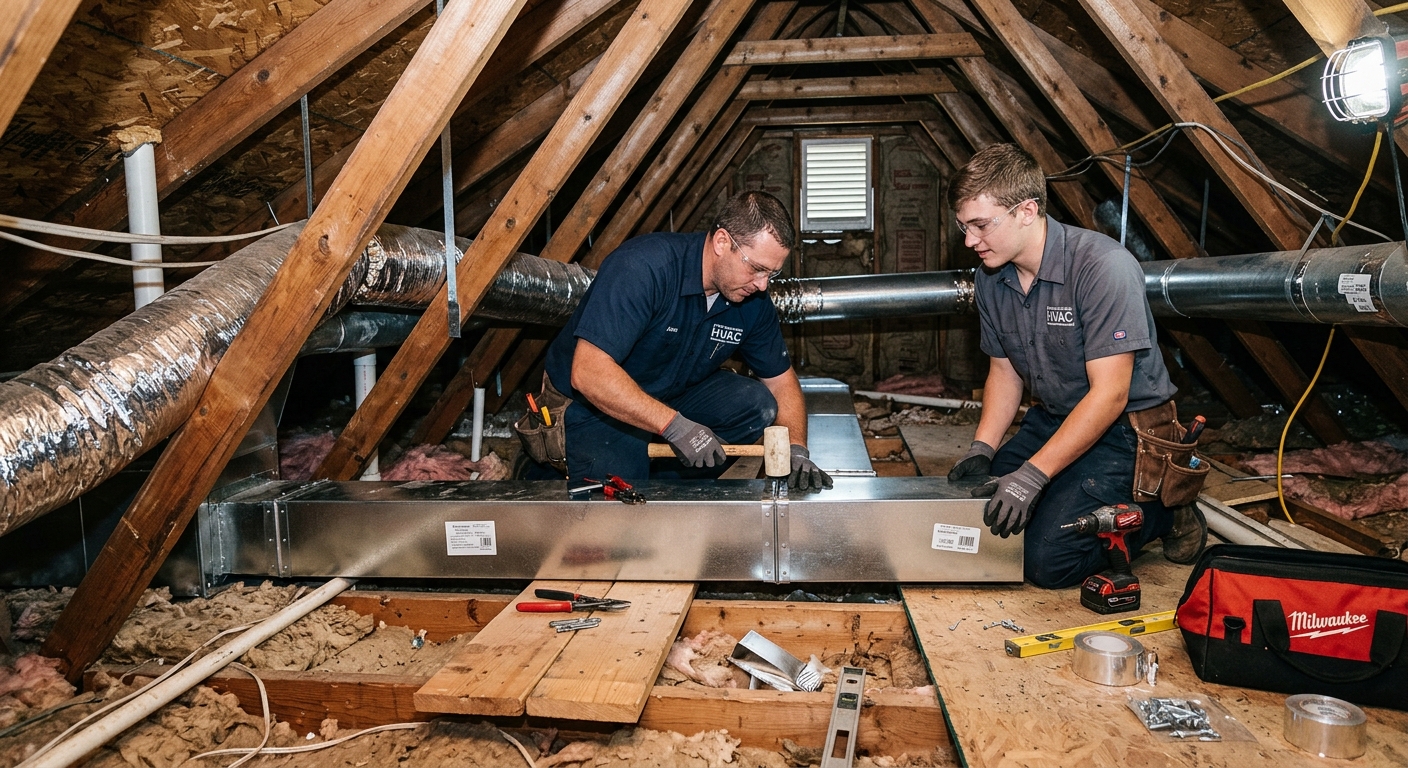
What a new HVAC system costs in Swatara
Swatara Township homeowners generally face a replacement market, not a new installation market. With 68.4% of households owner-occupied and 60.3% of the housing built before 1980 (U.S. Census Bureau, ACS 2024), most houses here already have aging split-system air conditioners and ductwork. The post‑1950 suburban housing wave in Swatara and around Colonial Park means you’re likely replacing an old central AC or furnace rather than installing from scratch. Most systems are retrofit jobs, where existing ductwork heavily influences what you can or should do.
Our region is heating-dominated: 5,200 heating degree days compared to 1,250 cooling degree days. Winters are long and cold, with winter design temps down to 12 °F, so decisions here lean more on heating ability. While central AC replacements are common, households increasingly consider air source heat pumps for year-round efficiency or even ductless options for additions or problem spaces. High homeownership rates and steady incomes (median $72,588) drive investment in upgrades, but value and reliability matter most.
| System |
Best for |
Efficiency |
Price range (installed) |
| Central AC replacement (existing ducts) |
homes with sound ductwork |
16–20 SEER2 |
$4,900–$11,500 |
| Air source heat pump (ducted) |
year-round heating and cooling |
8–10 HSPF2 |
$7,800–$16,500 |
| Cold-climate heat pump (ducted) |
heat pump as primary heat |
9–11 HSPF2 |
$12,500–$16,500 |
| Ductless mini-split (single zone) |
additions, rooms without ducts |
20–30 SEER2 |
$3,100–$6,800 |
| Full duct system installation |
homes with no existing ducts |
— |
$8,800–$17,500 |
Installed estimates for a typical Swatara home. Equipment tonnage, duct condition and electrical capacity move these more than brand.
Refrigerant rules and your existing system
Swatara homeowners with air conditioners or heat pumps likely have equipment using R-410A refrigerant, especially if the system was installed after 2010. As of 2025, manufacturers are switching over to newer, lower-global-warming-potential (GWP) refrigerants such as R-454B and R-32 for newly produced equipment. This transition is part of a federally directed phase-down of high-GWP hydrofluorocarbon (HFC) refrigerants.
If you have a working R-410A system, nothing in the new rules makes it illegal or unserviceable. You can keep running and repairing your system as needed. However, as the supply of new R-410A tightens in the coming years, the price of that refrigerant for large repairs (especially those involving leaks or major recharging) will likely continue to rise. This means that for a failed compressor or a large leak on an older system, the cost-benefit equation is shifting. There will come a point where replacement is more sensible than a major repair, simply due to escalating refrigerant prices and the decreasing value of older equipment.
Routine service, cleaning, and even basic repairs are unaffected. Be wary of anyone trying to push a full system replacement just because of the refrigerant transition if your existing unit is still performing well. There’s no “ban” forcing replacement—the change mainly affects newly sold systems and long-term planning for older equipment with chronic refrigerant issues.
How to vet an HVAC contractor in Swatara
In Swatara, the difference between a poor installation and a good one has much more to do with the crew than the sticker on the equipment. The most efficient system will underperform if it's installed badly or too big. Because central Pennsylvania is a saturated market, you have options—so vet your contractor carefully.
Start by checking for up-to-date Home Improvement Contractor (HIC) registration through the Pennsylvania Office of Attorney General. Any contract over $500 requires this. Next, the technicians that handle refrigerants should hold an EPA Section 608 certification—this is federal law, not a local extra. Ask whether a Manual J load calculation is included in your proposal; the best contractors do this as standard, not as an upcharge. Insist that your written quote lists actual equipment model numbers and not just sizes or brand names. True commissioning means measured airflow and proper refrigerant charge, checked at startup and left with a copy for your records.
- Verify HIC registration at hic.attorneygeneral.gov
- Confirm technicians handling refrigerants have EPA Section 608 certification
- Request proof of general liability and workers' compensation insurance (WCAIS)
- Insist on a Manual J load calculation and ask to see it
- Get a written contract (required over $500 in PA)
- Quotes should specify model numbers, not just tonnage
- Ask for commissioning data after install—airflow, charge, thermostat test
- No waiving insurance deductible: it's illegal under PA law
- Check permit requirements with the local code office
- For pre-1978 homes, ask about EPA Lead RRP certification
- Beware of vague warranties or high-pressure offers
Red flag: In Dauphin County’s crowded HVAC market, legitimate outfits won’t try to rush you into a same-day decision or dodge your insurance questions. Too many competitors for that to fly here.
Manual J and the tonnage question
Sizing your new HVAC system is the most critical technical decision your contractor makes, and in Swatara, it’s easy to get wrong. Oversizing—a system that’s too big for the house—is not a safety margin. It leads to short cycling (which wears components), uneven temperatures, poor humidity control, noise, and higher energy bills. It can even shorten the system’s lifespan. For central Pennsylvania’s climate, where winters are cold and summers are humid but shorter, these defects really show in comfort and cost.
A Manual J load calculation is the right way to size a system. This method models your home’s true heating and cooling needs based on square footage, insulation, window quality, air leakage, house orientation and more. Rule-of-thumb “tons per square foot” is simply not accurate—especially for post‑1950 Swatara houses retrofitted with insulation and new windows. Always ask: “Did you run a Manual J load calculation, and can I see the report?” If a contractor sizes your system by just replacing the existing unit with something similar, they might be copying an error made by another installer decades ago.
The Manual J calculation accounts for the winter design temperature here (12 °F), which ensures your system provides reliable heat even in the coldest conditions. Skipping this step risks either comfort problems or a system that’s more expensive than it should be. Don’t pay more for worse results.
Retrofit versus replacement in Swatara
Swatara and Colonial Park are classic examples of post‑1950 suburban growth, with more than half the single-family housing built before 1980. That usually means most homes already have some form of ductwork, laid out for forced air heating or early central AC, but insulation and electrical panels may be outdated.
The first big question for homeowners is whether ducts are in place and what condition they’re in. Ducts from the 1960s or 1970s may have been right-sized for heating but not for modern high-efficiency air conditioning, and original install quality was highly variable across subdivisions. Insulation levels and window quality both influence what size and type of HVAC system fits—upgrades here can shrink your equipment needs and save money. For all-electric conversions (to a heat pump), check your electrical panel’s capacity; the original panel may not support the needed amperage.
If you’re replacing builder-grade equipment from the late 1990s, it’s often at the end of its expected service life. These first-wave systems were often oversized, so insist on a load calculation rather than replacing “like for like.” For existing gas furnaces, check the condition of the chimney or flue, as these older systems sometimes rely on venting configurations that may not meet today’s mechanical code or efficiency standards.
What a Pennsylvania HVAC contractor must hold
In Pennsylvania, there is no statewide HVAC license for residential work. Residential contractors must be registered as Home Improvement Contractors (HIC) with the Pennsylvania Office of Attorney General for any job over $500. This registration can be checked online. Mechanical permits for installation or replacement—such as central AC or a heat pump—are handled by the local municipal code office, not at the county or state level, so requirements can differ across Dauphin County municipalities.
Anyone handling refrigerants (like for an air conditioner or heat pump installation) must hold an EPA Section 608 certification—this is a federal rule and there are no exceptions. Mechanical permits and inspections are required in cities like Harrisburg before work starts and after completion, and often also in Swatara Township; always verify locally before hiring any contractor.
Homeowners should also verify a contractor’s general liability and workers' compensation insurance using WCAIS, the state’s insurance system. For homes built before 1978, federal law requires EPA Lead RRP certification for any work disturbing painted surfaces.
Gas, electric or both in south-central Pennsylvania
In south-central Pennsylvania, heating is a big part of the equation, with 5,200 heating degree days and a winter design temperature of 12 °F. Deciding between gas, electric (heat pump), or a dual fuel system depends on your specific circumstances. Modern cold-climate heat pumps retain usable heat output down into the teens, making them a realistic primary heat source for many homes around Swatara—but their capacity does taper off as the temperature drops further. For those with well-insulated homes and a good envelope, heat pumps can handle most winter days with only a small electric backup or no auxiliary heat at all.
The gas-versus-electric question comes down to utility access. In Swatara and much of Dauphin County, natural gas from UGI Utilities is widely available, making gas furnaces an affordable and familiar option. In rural outer townships, if natural gas isn’t on site, homeowners are comparing heat pumps against pricier propane or oil heat. In those cases, heat pumps nearly always win on running cost and convenience. Dual fuel systems—which pair a heat pump with a gas furnace for deep cold—make sense when gas is on site but you still want to use electric heat for shoulder seasons or lower emissions.
A gas furnace still makes sense in homes with existing, reliable gas service and a drafty envelope where low temperatures could push heat pump performance. For everyone else, heat pumps and ductless systems (especially for additions or rooms without ducts) deserve close attention.
| Option |
Installed cost |
Operating cost here |
Best when |
Incentive eligible |
| Gas furnace + central AC |
$4,900–$11,500 |
lower with existing gas |
existing gas service, coldest zones |
some utility rebates |
| Ducted heat pump (cold climate) |
$7,800–$16,500 |
lower if home is well-insulated |
good envelope, all-electric goal |
federal/state incentives |
| Dual fuel (heat pump + gas backup) |
$12,500–$16,500 |
efficient in mixed weather |
gas on site, deep cold spells |
often yes |
| Ductless multi-zone |
$8,800–$17,500 |
low in targeted zones |
no ductwork, zone control |
usually |
Frequently asked questions — HVAC installation in Swatara
Who inspects HVAC work in Swatara?
For most Swatara homeowners, mechanical permits and inspections are managed by your local municipal code enforcement office. In Harrisburg, for example, the City Codes Administration Office oversees these permits and inspections. In Swatara Township and other Dauphin County municipalities, the township office typically handles inspection. For a central AC replacement (which most homes here with existing ductwork would need, typically costing $4,900–$11,500), you’ll need a final inspection before occupancy or use. Always ask your contractor to confirm which office will sign off, and request to see the permit and final inspection paperwork with your warranty packet. Pennsylvania does not do countywide or statewide inspections for residential HVAC—responsibility always falls to the local level.
What does a ductless mini-split cost in Swatara?
A ductless mini-split is a great solution for Swatara homes with additions, sunrooms, or finished basements that don’t have existing ductwork. For a single-zone system (serving one large room or area), installed costs typically run $3,100–$6,800, depending on line set length, electrical upgrades, and how accessible the install site is. Multi-zone setups covering several rooms will cost more. In older homes where extending ductwork isn’t practical, these systems are especially popular. Expect to pay toward the higher end if the electrical panel is outdated or service entry is tricky, as can be the case in pre-1980 housing (which is over 60% of Swatara stock). Always compare written quotes—not just brands, but also labor, warranty, and commissioning.
What does a heat pump cost installed in Swatara?
In the Swatara area, a modern air source heat pump with ductwork will land between $7,800–$16,500 fully installed. The big drivers are equipment tonnage, brand, duct condition, and whether your electrical panel can support an all-electric upgrade. Cold-climate models or dual fuel (heat pump plus gas backup) hit the higher end, especially when extras like improved thermostats or new high/low voltage wiring are required. This upfront price is increasingly offset by federal and state incentives for energy-efficient equipment. Well-maintained homes with insulation and good windows can size systems smaller—and save accordingly. Always insist on a Manual J calculation before accepting any price.
Which utility serves Swatara?
Most of Swatara Township and the surrounding Dauphin County area get electricity from PPL Electric Utilities and natural gas from UGI Utilities. This is important when weighing equipment choices, as both rates and available utility rebates might shift your decision. If you’re offered a gas furnace and central AC combo (usually $4,900–$11,500 installed), confirm whether natural gas is indeed available on your street. If not, you’re looking at propane or all-electric options, and the economics change. The installer should always confirm utility connection and panel sizing as part of the proposal.
What is commissioning and why does it matter?
Commissioning is the process of checking and documenting that your new system in Swatara was installed correctly—this means verifying airflow, refrigerant charge, safety controls, and thermostat operation. The best contractors measure and document these at startup, not “by feel.” If you’re spending anywhere from $4,900–$16,500 for a replacement or new installation, having commissioning data proves your equipment is working at peak efficiency and protects your warranty. Most comfort complaints and early breakdowns trace back to missed steps here. Always ask for written commissioning results; this sets real pros apart in the highly competitive Dauphin County market.
How is a tax credit different from a rebate?
A tax credit is an amount you can subtract from your federal or state tax bill after you’ve paid for eligible upgrades like a heat pump (often costing $7,800–$16,500). You file for it when you do your taxes. A rebate is generally a cash-back offer from a utility or manufacturer—sometimes instant at the time of purchase, sometimes mailed back after the fact. In Swatara, you may qualify for both on the same project, but the paperwork and payout timing are very different. Your installer should guide you on documentation for each, but know that tax credits reduce your tax liability (after filing), while rebates are direct cash or bill credits.
What is the R-410A refrigerant phase-down?
The federal government is gradually phasing down the use of high-GWP (global warming potential) refrigerants like R-410A, which have been standard in Swatara homes since the early 2010s. New systems are switching to lower-impact refrigerants such as R-454B and R-32, but your existing R-410A equipment remains legal to repair and operate. Availability and price for R-410A will rise as supply tightens, which means repairs—like fixing a major leak—on old systems (typical AC replacement runs $4,900–$11,500) might become less economical. But you won’t be forced to upgrade until you’re ready, and there is no ban on continued use for existing systems.
Is an annual maintenance plan worth it?
An annual maintenance plan for your HVAC system in Swatara, usually costing far less than a full repair bill, pays for itself by preventing breakdowns, spotting early signs of trouble, and keeping efficiency up—especially important in homes built before 1980 where small issues can go hidden. Considering total replacement could cost $4,900–$16,500, regular service can easily extend the life of your current system and keep utility bills in check. If your installer offers detailed inspection reports and priority service, it’s usually worthwhile, but avoid plans that upsell you on unnecessary add-ons or neglect real documentation.
Do I need dual fuel in south-central Pennsylvania?
Dual fuel systems—in which a heat pump handles your heating until the coldest weather, with a gas furnace as backup—are popular in Swatara because of our deep winter temperatures (design temp of 12 °F and 5,200 heating degree days). You don’t have to go dual fuel, especially if your home is well-insulated and sealed. However, if you already have natural gas and want the energy savings of a heat pump but worry about true sub-freezing days, a dual fuel setup makes sense. A full dual fuel installation is at the higher end, usually $12,500–$16,500. For all-electric or propane-only neighborhoods, a cold-climate heat pump alone may be better. Ultimately, dual fuel offers flexibility without giving up peace of mind.