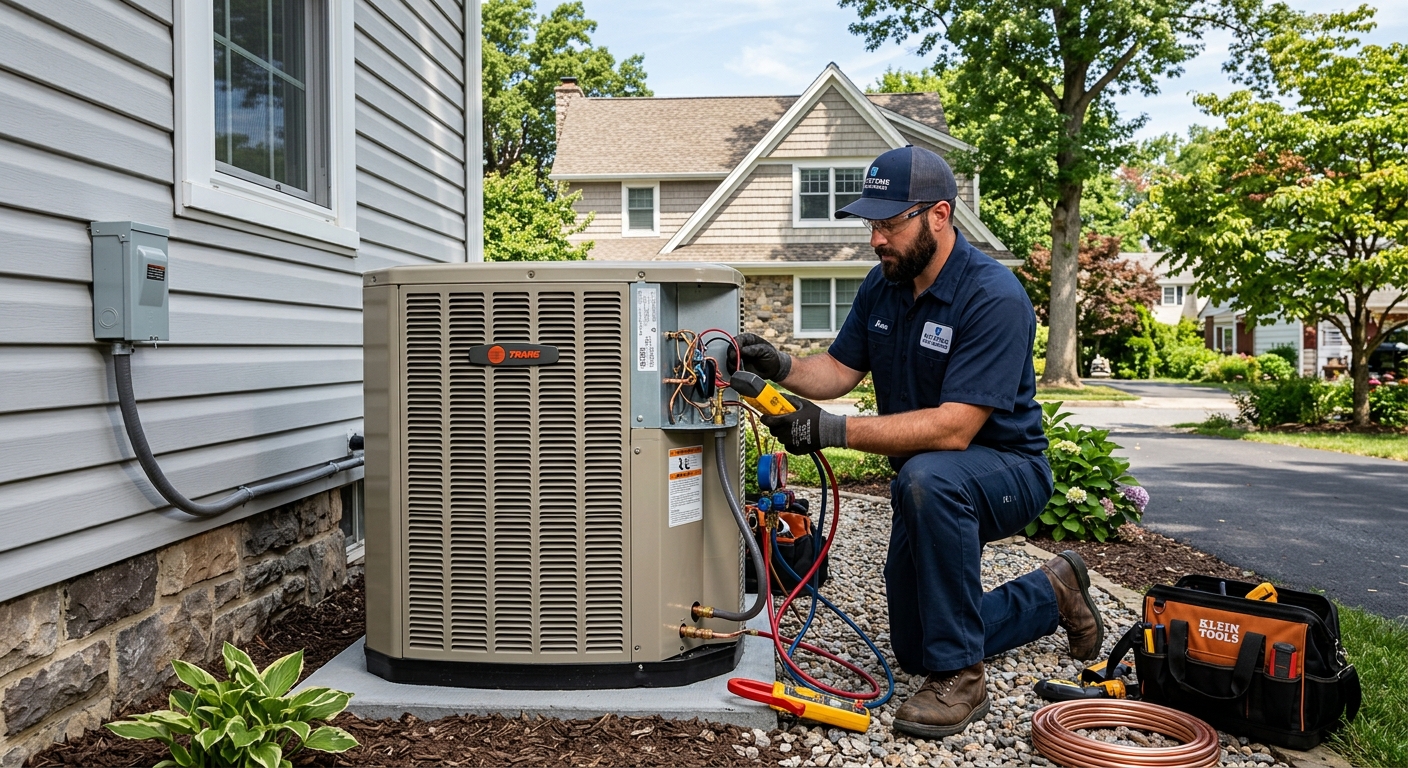
What a new HVAC system costs in North Coventry
North Coventry’s heating and cooling costs are shaped as much by its houses as its climate. With a 73.2% homeownership rate and nearly 68.5% of homes built before 1980 (U.S. Census Bureau, ACS 2024), most projects here are replacements, not first installs. Large tracts across Chester County—North Coventry included—were built between 1970 and 2000 with forced-air systems that are now reaching the end of their service life. If your home already has ducts, their age and condition will play a central role in what needs to be replaced versus repaired.
This area of southeastern Pennsylvania experiences about 4,800 heating degree days per year, about triple the 1,450 cooling degree days. That means heating is the bigger load, and a reliable furnace or cold-climate heat pump is more important than maximum air conditioning capacity. For homes with functioning ducts, a central AC or ducted heat pump installation is straightforward. If your ducts are in bad shape, or non-existent (more common in the oldest or custom homes), a ductless mini-split or full new duct system may be called for—which carries a different price tag.
| System |
Best for |
Efficiency |
Price range (installed) |
| Central AC replacement (existing ducts) |
homes with sound ductwork |
16–20 SEER2 |
$5,500–$13,000 |
| Air source heat pump (ducted) |
year-round heating and cooling |
8–10 HSPF2 |
$8,800–$18,500 |
| Cold-climate heat pump (ducted) |
heat pump as primary heat |
9–11 HSPF2 |
$14,500–$18,500 |
| Ductless mini-split (single zone) |
additions, rooms without ducts |
20–30 SEER2 |
$3,500–$7,700 |
| Full duct system installation |
homes with no existing ducts |
— |
$9,900–$20,000 |
Installed estimates for a typical North Coventry home. Equipment tonnage, duct condition and electrical capacity move these more than brand.
The comfort problem that isn't temperature
Here in southeastern Pennsylvania, you can almost set your watch by the comfort issues that surface each season. With winters that average around 4,800 heating degree days, dryness sneaks up—leaving rooms stuffy and sinuses raw. In humid summers, it’s a different story: air may feel clammy even with the AC running. The reason is often an oversized system. When the air conditioner is too large for the space, it cools fast but shuts off before it removes enough moisture, leaving you cool but sticky. Sizing matters as much for comfort as for efficiency.
If you’re considering a whole-house humidifier to address winter dryness, remember they require maintenance: pads need replacing, and sitting water can cause scale or microbial growth if neglected. Adding higher MERV-rated air filters can help with dust and pollen, but overly restrictive filters can choke airflow and overwork the blower in older North Coventry furnaces. In newer, tightly sealed homes, mechanical ventilation may be worthwhile to keep indoor air fresh, but most local housing stock predates today’s strict energy codes, so this is less often justified here. Whole-home air purifiers and UV lights are commonly upsold, but for most households they offer a limited benefit compared to diligent filter changes and addressing obvious sources of dust and moisture.
What you can actually claim on a heat pump here
For North Coventry residents considering a heat pump, there are generally three levels of incentives to look for: federal tax credits, utility rebates, and sometimes state programs. The federal tax credit comes back to you when you file your taxes; it reduces the tax you owe, but does not lower your contractor’s invoice up front. In contrast, utility rebates—offered by local providers—act as direct discounts or post-installation cash rebates, offering real savings at or shortly after install.
PECO Energy serves most of Chester County with both electric and natural gas. Start your search on PECO’s efficiency program page for their current rebates. Because these change year to year, and some are only available for select high-efficiency equipment, the only way to get an up-to-date figure is right from the source. For federal incentives, the ENERGY STAR rebate finder is the best starting point; you’ll also find details on qualifying equipment for the tax credits.
If you see online articles or ads quoting rebate or credit amounts—treat these as rough references, not guarantees. Program names, amounts, and rules change yearly. Always confirm with your utility and the official ENERGY STAR site before signing any contract.
Mechanical permits for HVAC work in North Coventry
Pennsylvania does not issue a state-level HVAC contractor license. For residential jobs like furnace, heat pump, or central AC installation, regulation happens at the municipal level. In North Coventry—like most of Chester County—you’ll be working with local code officials for mechanical permits, plan reviews, and inspections. The Pennsylvania Uniform Construction Code covers residential HVAC, but enforcement may occur town-by-town or by the PA Department of Labor & Industry in communities that have opted out of local enforcement.
Contractors must register as Home Improvement Contractors (HIC) for contracts over $500, issued by the Pennsylvania Office of Attorney General. You can check a contractor’s status at hic.attorneygeneral.gov. There’s no state-issued HVAC license, but anyone who handles refrigerant must carry current EPA Section 608 certification. For larger households using subcontractors, Pennsylvania also mandates workers’ compensation coverage—this can be verified on WCAIS (wcais.pa.gov).
Before signing, ask your contractor to show these credentials and proof of insurance up front. Good firms are ready to provide them. Minor jobs like switching a thermostat (if not running new wires) rarely require a mechanical permit, but installation or full replacement of HVAC equipment almost always does in Chester County towns.
The refrigerant change and what it means for repairs
The HVAC industry is shifting to new, lower global warming potential (GWP) refrigerants. For new central air conditioners and heat pumps, that now means R-454B or R-32, rather than yesterday’s R-410A. This is part of a national phase-down—older HCFCs like R-22 have been off the market for a decade, and R-410A is now following suit for new installs.
If your North Coventry home’s current system uses R-410A and is still running fine, you don’t need to rush out and replace it. Servicing existing systems with R-410A stays legal, and those supplies will be available for years. But the price trend is up—once production slows, the cost of topping off R-410A after a leak may jump, just as it did for R-22. What this means for you: a $500 repair is still a repair, but a major refrigerant leak on a 15-year-old system may tip the scales toward full replacement instead of a costly recharge. New refrigerant types aren’t backward-compatible—your current equipment can’t simply be switched over—so the main decision is economic, not legal or regulatory.
There’s no penalty or code requirement pushing you to replace a functional R-410A system ahead of its time. The refrigerant transition mainly impacts new equipment purchases and long-term service costs for older units—nothing more than that.
Heat pump or furnace: what makes sense in North Coventry
With a winter design temperature of 14 °F and high heating degree days, North Coventry is clearly a heating-driven market. Modern cold-climate heat pumps have changed the rulebook—they deliver useful heat well below freezing. Most cold-climate models will keep up with demand as outside temperatures dip into the teens, and variable-speed compressors maintain efficiency and comfort without frequent on-off cycling. However, even the best heat pump loses capacity as it gets colder; backup heat, whether electric or gas, is often used to bridge the gap on the coldest nights.
If you have PECO gas service (common in more built-up parts of Chester County), a high-efficiency gas furnace paired with a standard AC remains cost-competitive and reliable for the coldest spells. In rural or western outlying parts of the county, where natural gas is unavailable, the choice is between a heat pump and delivered fuels like propane or oil. Here, heat pumps shine: cleaner, easier, and often cheaper to run than burning fuel oil or filling a propane tank each season.
Dual fuel (a heat pump alongside a gas furnace) offers the best of both worlds, letting the heat pump handle mild weather and the furnace kick in during deep freezes. A furnace is still the obvious call if your ductwork or home’s envelope isn’t up to the demands of a heat pump—or you want peace of mind for those rare single-digit cold snaps.
| Option |
Installed cost |
Operating cost here |
Best when |
Incentive eligible |
| Gas furnace + central AC |
$5,500–$13,000 |
moderate |
existing gas service, coldest zones |
limited |
| Ducted heat pump (cold climate) |
$8,800–$18,500 |
lower with good insulation |
good envelope, all-electric goal |
yes |
| Dual fuel (heat pump + gas backup) |
$14,500–$18,500 |
lower, balances both |
gas on site, deep cold spells |
yes |
| Ductless multi-zone |
$9,900–$20,000 |
efficient per zone |
no ductwork, zone control |
yes |
Retrofit versus replacement in North Coventry
North Coventry’s housing stock is a mix of pre-1980s single-family homes and newer suburban development, with 68.5% of homes built before 1980 (U.S. Census Bureau, ACS 2024). In many of those older houses, forced-air furnace systems were installed when cooling was an afterthought—so existing ductwork may be undersized for a modern central air system, or may leak enough air to undercut efficiency. Insulation levels and window quality also tend toward the average for their era. If you’re upgrading to a heat pump, check your electrical panel’s capacity; older panels may be maxed out, requiring an upgrade to handle a properly sized heat pump or backup electric strip heat.
For homes built during Chester County’s 1970–2000 growth, most are on their first or second generation of HVAC equipment. If your furnace, AC or heat pump dates back to the builder’s original install in a late-90s subdivision, you’re likely at or past the expected life. Sizing for these systems was frequently generous, sometimes oversized, so commissioning and airflow balancing during replacement matter—a straight “like-for-like” swap can carry over problems you can fix if you take the opportunity now.
Always weigh the real state of your existing ductwork and insulation before investing in a higher-efficiency system. Spending money to fix leaky ducts, boost attic insulation, or swap an unsafe flue is often better value than the flashiest new equipment.
Frequently asked questions — HVAC installation in North Coventry
What size HVAC system does my North Coventry home need?
Sizing your HVAC in North Coventry isn’t about square footage alone. Most local homes were built before 1980 or during the big 1970–2000 wave, meaning insulation and window quality vary widely. A proper load calculation looks at wall and attic insulation, window area, air leakage, and even orientation to the sun. Oversizing is a common builder mistake—especially with replacement central AC units—so don’t let anyone quote you just "X tons per 1,000 square feet." Typical installs range from 2.5 to 5 tons, but the safest path is a Manual J calculation for your actual home. If you guess too large, humidity and comfort both suffer. Ballpark installed cost for standard central AC in this area: $5,500–$13,000.
Should I repair or replace my HVAC system in North Coventry?
If your system is over 15 years old (common for late-90s builder installs), and you’re facing a major repair or refrigerant leak, replacement is usually worth considering. The price of R-410A refrigerant is rising as supplies tighten, especially for older systems. Factor in higher repair costs and missed efficiency if your unit is oversized or the ducts are leaky. However, if the repair is minor and the rest of the system is in good shape, keeping it running another year or two can make sense. Typical replacement costs run $5,500–$13,000 for AC and more for full heat pump conversions.
Why does my system short cycle?
Short cycling—where your furnace or AC turns on and off rapidly—often means your system is oversized for your home. In North Coventry, where many replacements are made on older homes, a too-large AC cools too quickly, never running long enough to remove summer humidity. It could also stem from a failing thermostat, clogged filter, or airflow problems caused by duct restrictions or low refrigerant. Besides comfort issues, short cycling wears out components faster and raises bills. If this sounds like your system, ask for a correct Manual J load calculation before the next replacement or major repair. Full system replacement costs here start at $5,500–$13,000.
How much does a new HVAC system cost in North Coventry?
Total costs for a full replacement in North Coventry depend on your home’s age, duct condition, and energy needs. If you already have sound ductwork, a central AC install runs $5,500–$13,000, while a high-efficiency heat pump system goes from $8,800–$18,500. Homes needing new ductwork or major upgrades see prices closer to $9,900–$20,000. Most owner-occupied homes are replacement jobs, not brand-new installs, and prices have risen with material and labor demand since 2020.
What is commissioning and why does it matter?
Commissioning is the careful testing and adjustment of a new HVAC system after installation. In North Coventry—especially where many systems were oversized in older homes—it makes the difference between a system that just runs and one that’s truly efficient and comfortable. Proper commissioning includes checking airflow at each register, verifying refrigerant charge, calibrating controls, and ensuring correct thermostat operation. This process can catch duct leaks, poor insulation, or other issues that undercut a new system’s performance. Skipping it means you could pay full price (often $8,800–$18,500 for a ducted heat pump) and still be uncomfortable or waste energy year after year.
How does southeastern Pennsylvania's climate affect system sizing?
Southeastern Pennsylvania, including North Coventry, faces long, cold winters (about 4,800 heating degree days) and muggy summers. Sizing a system just for AC or just for heat will only solve half the problem. Over- or under-sizing leads to short cycling, poor humidity control, and uneven comfort. For most homes, the heating load drives the selection, given how much more demand there is over the year. Using a cold-climate heat pump that can handle a design temperature of 14 °F means fewer compromises through winter, but always confirm that the backup heat, duct size, and electrical service can support peak demand. Expect a typical ducted heating/cooling system to run $8,800–$18,500 fully installed.
How is a tax credit different from a rebate?
For North Coventry homeowners, a tax credit is claimed when you file your return—it reduces the federal income tax you owe the next year. It doesn’t make your system any cheaper at installation, which matters if you’re managing cash flow. A rebate, on the other hand (typically from PECO Energy), kicks in during or right after installation as a direct discount or cash-back—it’s more like an immediate coupon. If you buy a ducted heat pump with a quoted incentive, that might mean a $8,800–$18,500 install cost, less the rebate at close. Tax credits help with long-term value but don’t change what you write on the check to your contractor.
Does Pennsylvania license HVAC contractors?
Pennsylvania does not issue a statewide HVAC license for residential work. Instead, North Coventry and most Chester County towns handle registration locally—your mechanical permit and inspection come from the township, not the state. The only required registrations are the Home Improvement Contractor (HIC) certificate for contracts over $500, and EPA Section 608 certification for handling refrigerants. Always look up contractor HIC status at hic.attorneygeneral.gov and verify workers’ compensation at WCAIS. It’s smart to ask for current credentials before signing for major projects, which routinely run $5,500–$13,000 and up.
How much does a furnace replacement cost in North Coventry?
If you’re swapping out an old gas furnace, especially in a typical North Coventry home with working ductwork, expect costs in the $5,500–$13,000 range installed. Pricing depends on furnace efficiency (80% vs. 95%+ AFUE), duct condition, and whether you replace the AC together. Labor and permit costs are competitive due to the dense HVAC contractor market in Chester County. If you heat with propane or oil, a heat pump often becomes more attractive at comparable or lower running expenses, despite a higher up-front price.