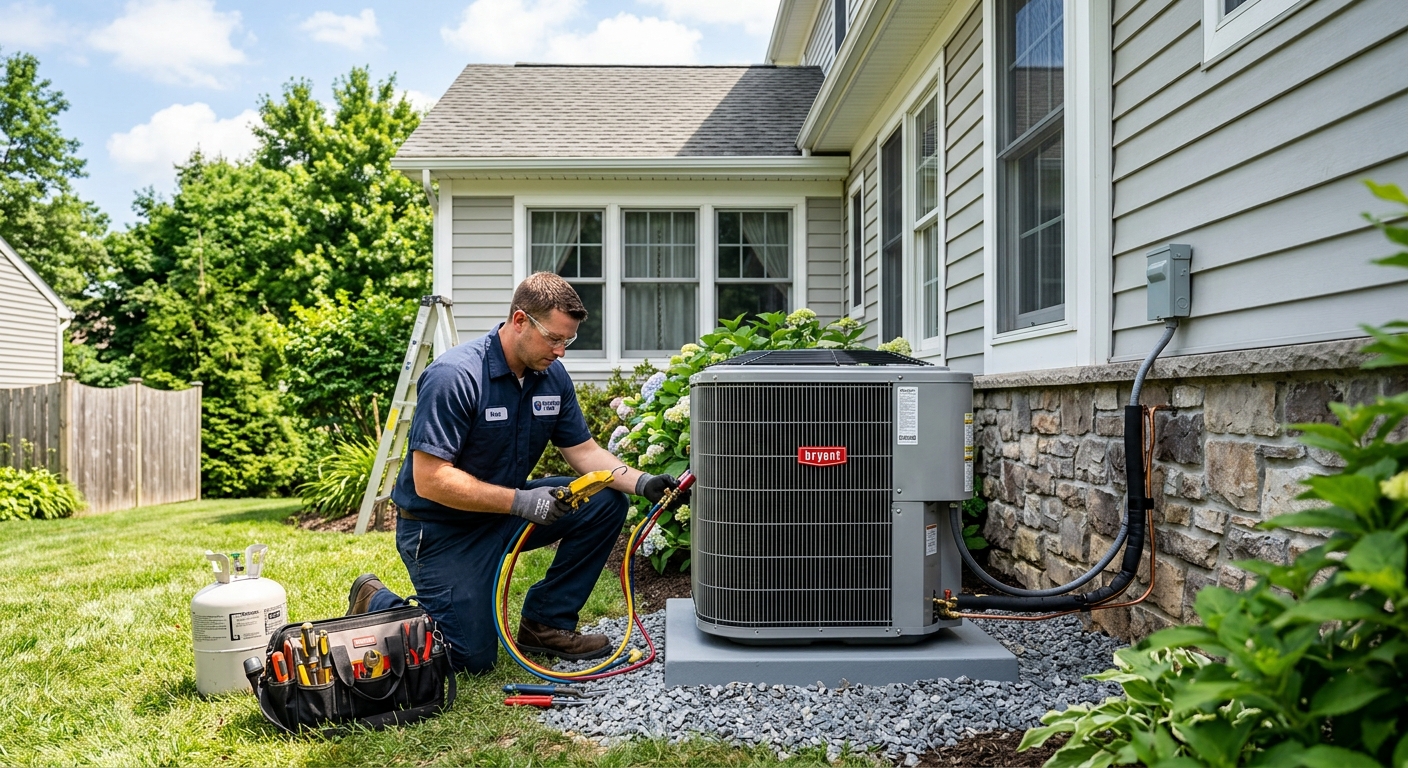
HVAC costs in West Earl — 2026
In West Earl, most houses are single family homes (75.9%) with a high homeownership rate of 78.9% (U.S. Census Bureau, ACS 2024). This means HVAC decisions here are typically about replacing or upgrading existing systems. While much of nearby Lancaster city deals with older rowhomes from the 1880–1930 period that often lack proper ductwork—driving demand for ductless mini-splits or high-velocity systems—in West Earl, roughly 40.7% of homes were built before 1980, so retrofits remain a consideration, especially where ductwork wasn’t originally installed.
Our south-central Pennsylvania climate brings around 5,200 heating degree days and 1,250 cooling degree days each year. Simply put, it’s a heating-dominated market: winter demands reliable, cost-effective heat, while summer means moderate but growing air conditioning loads. Most West Earl residents with functional ductwork will weigh new central AC or heat pump options, but older or rural homes—sometimes without gas service or existing ducts—must budget for duct or mini-split installations.
| System |
Best for |
Efficiency |
Price range (installed) |
| Central AC replacement (existing ducts) |
homes with sound ductwork |
16–20 SEER2 |
$5,200–$12,500 |
| Air source heat pump (ducted) |
year-round heating and cooling |
8–10 HSPF2 |
$8,300–$17,500 |
| Cold-climate heat pump (ducted) |
heat pump as primary heat |
9–11 HSPF2 |
$13,500–$17,500 |
| Ductless mini-split (single zone) |
additions, rooms without ducts |
20–30 SEER2 |
$3,300–$7,300 |
| Full duct system installation |
homes with no existing ducts |
— |
$9,400–$18,500 |
Installed estimates for a typical West Earl home. Equipment tonnage, duct condition and electrical capacity move these more than brand.
Running the numbers on West Earl's climate
To estimate your annual HVAC operating costs in West Earl, start with the local climate: about 5,200 heating degree days and 1,250 cooling degree days yearly. PPL Electric Utilities delivers power to most homes here, so your electricity bill is central to these calculations. Here’s the simplified approach: Efficiency ratings (like SEER2 for ACs or HSPF2 for heat pumps) tell you how much heating or cooling you get per unit of electricity. Degree days translate West Earl’s climate into the total “work” your equipment must do each year. Multiply your home’s actual load (in BTUs) by the efficiency to get annual kilowatt-hours needed, then multiply by your rate (in $ per kWh, found on your bill) to get dollars per year.
Say you have a 2,000 square foot home and want to compare a standard 8 HSPF2 heat pump to an older furnace. If you need 35 million BTUs of heat for the year (rough average for area homes), divide by 2.93 (BTUs per watt-hour) and by the HSPF2. Multiply by your rate—for illustration, if it’s $0.14 per kWh, you’ll pay around $1,700. The biggest variable is your real price per kWh. The same principle applies to AC: annual cooling BTUs divided by SEER2, times kWh price.
But these are estimates. Real costs swing with weather, your home’s tightness, and—most overlooked—the condition of your ductwork. A leaky duct system loses as much as 30% of the energy you pay for, wiping out the benefits of a high-efficiency unit. In short: A middling system on well-sealed ducts can outperform top-tier equipment hooked to poor ductwork in West Earl’s mixed, heating-driven climate.
Mechanical permits for HVAC work in West Earl
Pennsylvania does not issue a statewide HVAC license for residential work. Instead, all home improvement contracts over $500 require the contractor to hold a Home Improvement Contractor (HIC) registration from the Pennsylvania Office of Attorney General. In West Earl and much of Lancaster County, municipalities manage their own permitting—so you’ll need to check the township or city office where the property lies. In Lancaster city, for example, a permit is required for most central HVAC work, and you can expect both a mechanical permit and an inspection before work is considered final. Other county townships follow similar processes for new and replacement installations.
Anyone working with refrigerant (installing or charging an AC or heat pump) must have EPA Section 608 certification; this is mandatory nationwide. To protect yourself as a homeowner, always verify that your contractor carries active workers’ compensation insurance (unless they’re a solo operator), which in Pennsylvania can be checked via the Workers’ Compensation Automation and Integration System (WCAIS). Contractor HIC registration can be confirmed through the state’s online verification portal. Be wary of contractors who urge you to skip permits or avoid documentation; legal requirements protect both parties, including your right of cancellation for up to three business days on written contracts over $500 under the Home Improvement Consumer Protection Act.
Humidity and air quality in West Earl homes
With more heating than cooling degree days, West Earl’s biggest indoor air challenge is dryness in winter and high humidity each summer. During cold months, forced air heat drops indoor humidity to uncomfortable—and at times damaging—levels. Whole-house humidifiers can help, but they need frequent cleaning and proper water management to avoid mold and mineral buildup. In summer, a properly sized AC is your best dehumidifier. If it’s too big, it cools the house too quickly and doesn’t run long enough to pull out moisture, leaving the air clammy even when the temperature is low.
Good filtration is important. MERV-11 to MERV-13 filters catch most airborne particles, but pushing this higher can overburden blowers not sized for extra airflow resistance. Unless you suffer allergies, super-premium filters rarely justify their pressure drop or added cost. For newer, tightly sealed homes, mechanical ventilation—such as ERV or HRV units—can keep air fresh, but older West Earl homes rarely need this due to natural leakage. Add-ons like UV lights or ionizers may get oversold; in regular West Earl homes, investing first in well-chosen filters and good duct sealing does more for air quality than most gadgets on the market.
Gas, electric or both in south-central Pennsylvania
In Lancaster County—including West Earl—heating is where most of your energy dollar goes, thanks to a winter design temperature of 12°F and 5,200 heating degree days per year. Modern cold-climate heat pumps now deliver useful output well into the teens, but as temperatures approach that design minimum, their efficiency drops and backup heat is often needed. The old “heat pumps can’t handle Pennsylvania winters” argument mostly doesn’t hold, but whole-home load and backup methods still matter.
Natural gas service is widely available in Lancaster, Manheim, and East Hempfield, but out in rural areas—including some parts of West Earl—many homes use propane or fuel oil. If your house already has natural gas, a gas furnace provides inexpensive, reliable heat, often paired with a central AC for cooling. Where gas is unavailable, especially in older or retrofitted homes, heat pumps (or dual fuel) become the most viable alternatives. A furnace is still the best choice if your ducts are sized for high airflow, you use AC in summer, and you already have natural gas onsite. Otherwise—especially if you’re looking at a major retrofit or all-electric conversion—a cold-climate or dual fuel heat pump performs well here, with lower long-term energy exposure than oil or propane.
| Option |
Installed cost |
Operating cost here |
Best when |
Incentive eligible |
| Gas furnace + central AC |
$5,200–$12,500 |
Low if gas on site |
existing gas service, coldest zones |
Some utility rebates |
| Ducted heat pump (cold climate) |
$8,300–$17,500 |
Moderate, depends on envelope |
good envelope, all-electric goal |
Federal and utility incentives |
| Dual fuel (heat pump + gas backup) |
$13,500–$17,500 |
Low to moderate |
gas on site, deep cold spells |
Federal programs |
| Ductless multi-zone |
$9,400–$18,500 |
Room by room |
no ductwork, zone control |
Utility and federal incentives |
Repair or replace your West Earl system?
In West Earl, most HVAC systems can be fixed for less than the cost of a new one, especially if they’re under 10 years old and failure is limited to a single part like a capacitor, control board, or fan. If your equipment is 10–15 years old and you are quoted a repair that’s over a third of full replacement—especially for refrigerant leaks or blower motor replacements—it’s time to weigh whether the investment is wise, especially given changes to refrigerants and regulations. For systems 15+ years old, any major failure—such as compressor burnouts or heat exchanger cracks—usually means replacement is more prudent. Two cases where replacement is not a choice: a cracked heat exchanger in any age furnace (due to carbon monoxide risk) and a dead compressor once out of warranty, as both repairs are so costly or unsafe that replacing the whole system is the sensible step. High energy bills on a working system? Test your ducts and house envelope before assuming you need a new unit. Efficiency gains alone aren’t always enough to cover replacement in West Earl’s moderate cooling season.
| Situation |
Recommendation |
Typical cost |
Reasoning |
| Under 10 years, single component failure |
Repair |
$300–$1,200 |
Cheaper than replacement; full service life not reached |
| 10–15 years, repair over a third of replacement |
Consider replacing |
$5,200–$12,500 |
Major investment may not offer long-term value |
| 15+ years, any major failure |
Replace |
$5,200–$12,500 |
Outdated efficiency, risk of further breakdowns |
| Cracked heat exchanger, any age |
Replace immediately |
$5,200–$12,500 |
Carbon monoxide hazard; repair not safe |
| Compressor failure past warranty |
Replace |
$8,300–$17,500 |
Repair cost outweighs remaining value |
| Working system, high bills |
Test ducts and envelope first |
$300–$800 |
Leaks and drafts often the bigger problem |
Manual J and the tonnage question
Load calculation—getting the correct size—is the most critical part of HVAC installation in West Earl, and the most common thing contractors shortcut. Oversizing is no safety net. Instead, you get short cycling (equipment turns on/off too often), poor humidity control, uneven temperatures, and a shorter system life. Sizing by “square footage” rules of thumb is never enough, especially in an area where home age, insulation, and envelope tightness vary widely—as they do with West Earl’s roughly 40% pre-1980 homes.
Manual J is the industry method: a room-by-room calculation based on window size, insulation values, wall construction, orientation, occupancy, and more. The local winter design temperature here is 12°F—that’s the coldest your system must reliably handle—so Manual J tailors equipment sizing to that need, not just a general average. Ask your contractor directly if they performed a Manual J calculation and request to see it. If their bid is based on your old unit’s tonnage—even if the old system “worked”—they’re probably copying someone else’s error forward. In this regional mix of new and old homes, a tailored load calculation is worth its weight in gold and almost always cheaper than correcting a bad guess after the fact.
Frequently asked questions — HVAC installation in West Earl
Is natural gas available throughout Lancaster County?
No, natural gas isn’t available everywhere in Lancaster County. While Lancaster city, Manheim, and East Hempfield Township generally have access to natural gas service, many rural areas (including parts of West Earl) rely on propane or oil instead. If you’re in a spot without gas, you’ll likely be weighing the cost of systems like heat pumps or considering a propane furnace. This affects total installation costs significantly—if you’re moving from oil or propane to a heat pump, expect a price range of $8,300–$17,500 for a typical ducted installation.
How much does ductwork add to an HVAC installation?
Adding a full duct system is one of the bigger HVAC expenses in West Earl, particularly in older homes that weren’t built with central air in mind. For a typical job, full ductwork installation (including supply, return, and registers) runs $9,400–$18,500 beyond the price of the central unit. Home layout, finished basements, and attic access all factor in. If your house already has solid ducts, replacing just the unit could save you thousands, with replacements generally in the $5,200–$12,500 range. Always have existing ducts checked for leaks or code compliance before reusing.
When is the best time of year to replace HVAC in West Earl?
In West Earl, the best time to schedule HVAC replacement is during the “shoulder seasons”—early spring and fall. Contractors tend to be less busy, which can mean quicker scheduling and sometimes lower pricing as compared to peak summer and deep winter, when emergency calls spike. If you’re planning ahead, spring is a good choice: you’ll be set for the summer cooling load and won’t run into installation backlogs. For a standard central air replacement, expect costs between $5,200–$12,500, and you’ll have more flexibility with timing if work isn’t weather-dependent.
How much does a furnace replacement cost in West Earl?
The cost to replace a furnace in West Earl (including basic installation) typically falls within $5,200–$12,500 when paired with a compatible central air system. The price varies based on system efficiency, whether any ductwork repairs are needed, and local permit fees. Older homes with limited access around the existing furnace can see higher labor costs. If you only need the furnace (and not a full system replacement), it may trend toward the lower end of that range, but it’s rare for a homeowner here to swap just the furnace without evaluating the full system.
Who inspects HVAC work in West Earl?
In West Earl and the rest of Lancaster County, municipal offices handle inspection of HVAC installations. There’s no statewide residential HVAC license or centralized inspection team—your township’s code office or, in the case of Lancaster city, the Bureau of Code Compliance, manages permits and inspections. For permitted work like new central air or furnace installations, expect a final inspection to verify code compliance and safety. A standard central AC or heat pump installation (typically $5,200–$12,500) requires this process. Routine filter changes and thermostat programming do not require inspection or permits here.
How is a tax credit different from a rebate?
A tax credit is an amount you claim on your federal or Pennsylvania tax return that directly reduces the tax you owe. It doesn’t lower the up-front cost—the benefit comes when you file. In contrast, a rebate is cash given back to you after your purchase by a utility or manufacturer, sometimes even instantly credited on your invoice. For example, if you install a qualifying heat pump at $13,500, you might get a rebate from your electric utility and a federal tax credit later. Tax credits depend on your tax situation, while rebates are often available up front and not limited by tax liability.
What size HVAC system does my West Earl home need?
There’s no universal answer for West Earl homes—the correct size depends on square footage, insulation, windows, sealing, and more. In practice, most 2,000–2,500 square foot homes here require a unit in the 2.5–4 ton range, but “rule of thumb” sizing can miss by a ton (literally). The only way to know for sure is with a Manual J load calculation, tailored to local winter lows (design temperature is 12°F). If you’re seeking a ducted heat pump or central AC, expect sizing and costs in the $8,300–$17,500 ballpark. Always ask to see the contractor’s calculation before you sign.
Is a heat pump a good choice for West Earl winters?
Modern cold-climate heat pumps are a solid option here—West Earl’s design temperature of 12°F means a high-efficiency system keeps most homes comfortable through winter. A ducted cold-climate heat pump installation usually ranges from $13,500–$17,500. While capacity drops on frigid nights, these systems now provide steady heat down to the teens, and you can add backup electric or gas heat for deep cold snaps. Homes with good insulation and air sealing will get the most efficiency; older, drafty homes may see rising electric bills if leaks aren’t addressed first.
Is an annual maintenance plan worth it?
An annual HVAC maintenance plan isn’t required, but it can be worthwhile for many West Earl homeowners. For a typical central system—costing $5,200–$12,500 to install—a good plan (usually $150–$300 per year) covers both seasonal cleanings and basic repairs or prioritized service. You’ll get better system reliability and can catch warranty issues before they become expensive breakdowns. If you’re comfortable changing filters and monitoring performance yourself, skip the plan and just book a tune-up every couple years. But for older systems, bundled maintenance or early-detection programs often pay for themselves with extended life and lower total repair costs.