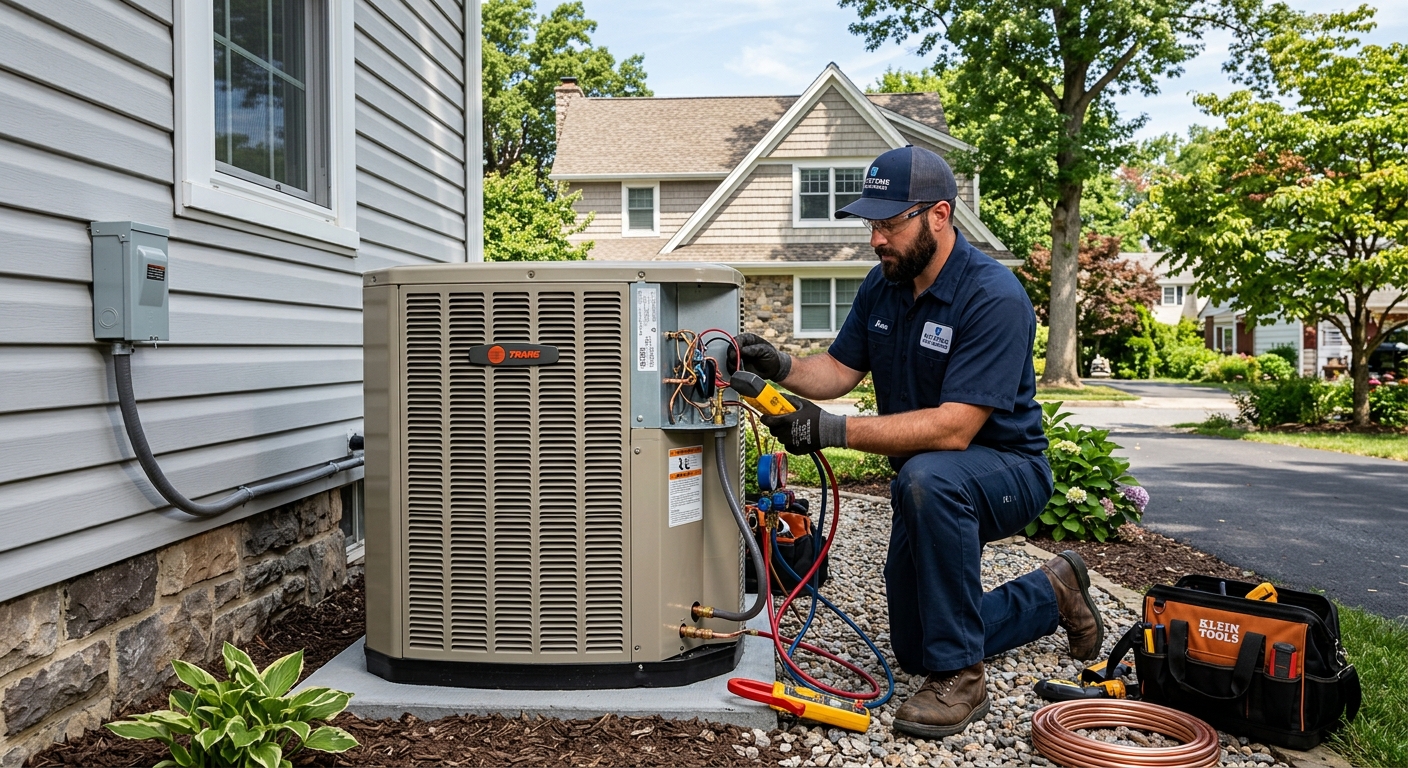
North Whitehall heating and cooling prices by system type — 2026
North Whitehall’s homes are mostly owner-occupied (88.5%) and three-quarters are single-family houses built before 1980 or during the rapid suburban expansion from 1960–1990 (U.S. Census Bureau, ACS 2024). For these homes, HVAC work is almost always a matter of replacing or reworking existing systems, not new installations. The dominant jobs are change-outs, not installs from scratch—especially in South Whitehall and Upper Macungie, where tracts from past decades often have ductwork that’s ready for central air or heat pump upgrades, provided it’s still in decent shape.
Our Northeastern Pennsylvania climate is sharply tilted toward heating: we average 6,100 heating degree days and only 850 cooling degree days per year, so efficiency and comfort in winter matter even more than cool summers. System choice here often means deciding if a heat pump can handle the main heating load, or if a furnace and central AC setup still makes sense with your available utilities. If you’re considering ductless systems, most people install them for rooms where ducts aren’t practical—not the whole house.
| System |
Best for |
Efficiency |
Price range (installed) |
| Central AC replacement (existing ducts) |
homes with sound ductwork |
16–20 SEER2 |
$5,400–$13,000 |
| Air source heat pump (ducted) |
year-round heating and cooling |
8–10 HSPF2 |
$8,600–$18,500 |
| Cold-climate heat pump (ducted) |
heat pump as primary heat |
9–11 HSPF2 |
$14,000–$18,500 |
| Ductless mini-split (single zone) |
additions, rooms without ducts |
20–30 SEER2 |
$3,400–$7,500 |
| Full duct system installation |
homes with no existing ducts |
— |
$9,700–$19,500 |
Installed estimates for a typical North Whitehall home. Equipment tonnage, duct condition and electrical capacity move these more than brand.
Mechanical permits for HVAC work in North Whitehall
In Pennsylvania, HVAC contractors working on residential projects must have Home Improvement Contractor (HIC) registration if the job exceeds $500. There is no statewide trade license specifically for residential HVAC work—the regulations and permits are handled by each municipality, not by the state. In North Whitehall and other townships surrounding Allentown, this means mechanical permits for central system installation or replacement are typically required. The specific permit and inspection process depends on the township office, so always confirm current requirements before hiring a contractor.
Pennsylvania Uniform Construction Code (UCC), based on the IRC, is the residential code framework here. Beyond local permitting, all contractors working with refrigerants—meaning any AC or heat pump installation—must hold EPA Section 608 certification, which is federal and applies across all states. This credential ensures safe refrigerant handling, which is non-negotiable for legal and safety reasons.
Homeowners should always verify two things: HIC registration (for consumer protection, contracts and legal compliance) and a contractor’s workers’ compensation insurance, which is mandatory for employers in Pennsylvania. You can check HIC status at the Pennsylvania Office of Attorney General’s website and workers’ compensation coverage at the WCAIS system. Never assume verbal assurances—these verifications protect you from financial liability and shoddy workmanship.
When an HVAC repair stops being worth it
It’s rarely a simple yes-or-no when to replace versus repair HVAC in North Whitehall homes. For many repairs, especially on systems under 10 years old, fixing makes sense—especially if only a single component is involved and costs are reasonable. Repairs over a third the price of full replacement, or on systems approaching or past 15 years, shift the math. At that point, you’re often putting good money into equipment near the end of its expected lifespan.
A cracked heat exchanger (on a furnace) is a non-negotiable replacement; it’s a safety hazard. Same goes for compressor failure on an older AC or heat pump—costly and often not covered by warranty, making replacement the practical option. Efficiency gains matter, but in North Whitehall’s climate, unless you’re jumping several ratings, most energy savings don’t come close to offsetting full replacement if the system is otherwise healthy. If your system works but your bills are high, duct sealing and weatherization might be a better spend before replacing major equipment.
| Situation |
Recommendation |
Typical cost |
Reasoning |
| Under 10 years, single component failure |
Repair |
$300–$1,200 |
Modern systems are designed to last well over a decade; small fixes don't justify full replacement. |
| 10–15 years, repair over a third of replacement |
Consider replacing |
$5,400–$13,000 |
Big spend as unit ages doesn’t pay back—newer equipment may offer better efficiency and reliability. |
| 15+ years, any major failure |
Replace |
$5,400–$13,000 |
Systems this old are prone to more failures; replacement is usually safer and more cost-effective. |
| Cracked heat exchanger, any age |
Replace immediately |
$5,400–$13,000 |
This is an immediate carbon monoxide risk—no safe repair option. |
| Compressor failure past warranty |
Replace |
$8,600–$18,500 |
Cost to fix often exceeds the value left in the system, especially if matched components can't be sourced. |
| Working system, high bills |
Test ducts and envelope first |
$300–$800 |
Losses in ductwork and attic insulation are very common in North Whitehall’s housing stock. |
Sizing: why bigger is worse
Getting the size right on your HVAC system in North Whitehall is the difference between comfort and constant frustration. It’s a myth that bigger is always better—oversized systems short cycle, leaving the air clammy in summer and causing temperature swings in winter. They don’t run long enough to pull moisture out of the air, wear out blower motors and compressors early, and can even reduce the lifespan of your ductwork from repeated start/stop cycles. “Bigger” as a safety margin isn’t extra comfort, it’s a real flaw.
Proper sizing uses a Manual J load calculation: a detailed measurement of how much heating and cooling your home truly needs, based on your insulation, windows, air leaks, house orientation, and square footage. Do not let anyone size a new unit based solely on your old system’s sticker—errors get copied forward, and the 1960–1990 tracts around North Whitehall may have been oversized originally to “play it safe.” Our winter design temperature is 4 °F, so load calculations here have to account for real Lehigh County cold.
Your best question to any contractor is: “Did you run a Manual J load calculation, and can I see the numbers?” If you hear only about tonnage per square foot, or get a quote based on a glance at your old equipment’s nameplate, keep looking. The small extra effort here is what makes or breaks humidity control and comfort in our climate.
Humidity and air quality in North Whitehall homes
Northeastern Pennsylvania’s long heating season brings dry indoor air, while our humid summers can leave homes muggy if cooling equipment isn’t properly matched and operated. With 6,100 heating degree days, winter dryness is a real issue. If a central AC or heat pump is oversized, it will run in short bursts and never remove enough humidity—making July and August less comfortable and potentially setting the stage for mold in tighter homes built more recently.
A whole-house humidifier can help in winter but comes with a maintenance burden; missed cleanings often lead to mineral scale and even mold in the unit. For air quality, it’s best to use the highest MERV air filter rating that your system’s blower can safely handle; pushing too high without a matching blower just strains the equipment. Newer, tightly-sealed homes may need mechanical ventilation to exchange stale indoor air for fresh, especially if you notice condensation or stuffy rooms.
Be skeptical of every UV light, high-priced purifier, or “advanced” air scrubber pitched to you here—the measurable benefits above a good MERV filter and basic humidifier/dehumidifier are marginal. The best money is usually spent on right-sizing, filtration, and tackling uncontrolled air leaks, not premium add-ons.
R-410A phase-down: repair or replace?
The move away from R-410A refrigerant has changed what’s on offer in new HVAC equipment for North Whitehall homes. From 2024, manufacturers have started supplying AC and heat pumps charged with lower-GWP refrigerants such as R-454B or R-32. But the critical point for owners of an existing R-410A system: your system can still be legally serviced and maintained. There’s no law rendering R-410A units obsolete or unrepairable.
Here’s the real impact: as the supply of R-410A tightens under the phase-down, the price of this refrigerant will rise—especially if your system has a leak or needs a major recharge. For small repairs with no refrigerant loss, this change is no big deal. But if you need a refrigerant-related repair on an older R-410A system, rising costs will tip the scales more quickly toward full system replacement. If the system is running well with no leaks, there is no reason to replace it simply for being R-410A.
Focus replacement decisions on age, condition, and upcoming repair needs, not the refrigerant label. This change is about future economics—not about making your current system illegal.
Reading the yellow label
Every new HVAC system sold in North Whitehall comes with a yellow energy guide—typically listing SEER2 (Seasonal Energy Efficiency Ratio 2) for cooling, and HSPF2 (Heating Seasonal Performance Factor 2) for heat pumps. The higher these numbers, the more efficient the unit. SEER2 rates cooling efficiency over an entire season, while HSPF2 shows how much heat is delivered per unit of electricity. Both ratings recently changed from the old SEER and HSPF scales, so numbers from older articles aren’t directly comparable.
With 6,100 heating degree days and only 850 cooling degree days a year in Lehigh County, heating efficiency is worth more than squeezing out a couple extra summer SEER2 points. In other words, don’t overpay for ultra-high-SEER2 unless you run the cooling constantly—energy savings generally don’t justify the $1,000+ premium above about 18–20 SEER2. On the heating side, HSPF2 matters more: consider the upgrade to a cold-climate heat pump with a 10 or 11 HSPF2 versus a standard 8–9.
In most North Whitehall homes, “middle of the pack” SEER2 and HSPF2 ratings are where the payback is. Top-end ratings make sense only if you plan to stay long-term and your usage is high. Otherwise, that extra capital is better spent on smart thermostats or duct and air sealing.
Frequently asked questions — HVAC installation in North Whitehall
Does Pennsylvania license HVAC contractors?
Pennsylvania does not issue a statewide trade license specifically for residential HVAC work. For homes in North Whitehall and the rest of Lehigh County, regulation happens at the municipal level: local townships or cities require mechanical permits for system installation or replacement. What the state does require is Home Improvement Contractor (HIC) registration for jobs over $500, and this serves mainly for consumer protection (paperwork, contract rights, and complaint processes). Always ask for a contractor’s registration number and verify it with the state registry. Also, contractors handling refrigerant must be certified under EPA Section 608—this is a federal requirement. For any central AC replacement in North Whitehall, expect the price range to be $5,400–$13,000, but be sure your contractor has the correct permits and insurance.
Are duct sealing and insulation eligible for incentives?
In North Whitehall and across Pennsylvania, duct sealing and attic insulation are often eligible for incentives from utilities or energy programs, especially because both can make a bigger impact than replacing mechanical equipment alone—particularly in homes built before 1980, which make up 42.3% of our local stock. That said, programs change year to year, and requirements can get specific about the level of work or type of contractor. Check with PPL Electric Utilities or UGI Utilities about any active offers. Putting $300–$800 toward duct testing and air sealing can, in many cases, produce bill drops that outpace more expensive equipment upgrades—so check for incentives before you replace your whole HVAC system.
How much does a furnace replacement cost in North Whitehall?
For a straightforward furnace replacement in North Whitehall—with good existing ductwork and access to natural gas—the installed cost usually falls in line with the region’s central AC replacement band, generally between $5,400–$13,000. The price depends on system size, whether ducts need work, and any upgrades to venting or controls. Homes relying on propane or fuel oil (seen more in outlying Lehigh County townships) may run higher, especially for upgrades or conversions. Always ask for a written, itemized estimate matched to your specific equipment and duct condition. Avoid allowances or open-ended “$XX per additional run” language unless you clearly understand where you might pay more.
When is the best time of year to replace HVAC in North Whitehall?
The best time to schedule HVAC replacement in North Whitehall is usually the shoulder seasons—early spring or mid-fall—when contractors are less busy, and you avoid being stuck without heat in January or without cooling in July. In our area, large owner-occupied developments mean that lots of neighbors may schedule replacements simultaneously to get ahead of weather shifts. Planning ahead, especially if your system is nearing 15 years old, avoids the rush and sometimes affords better scheduling or small savings. No matter when you book, expect the cost for a central system change-out to range from $5,400–$13,000 depending on complexity and equipment.
Is a heat pump a good choice for North Whitehall winters?
Newer cold-climate heat pumps are a legitimate choice for North Whitehall’s chilly winters, which see winter design temps down to 4 °F and 6,100 heating degree days per year. Ducted cold-climate models with 9–11 HSPF2 ratings can handle primary heating for most modern or reasonably insulated homes. Outlying areas using propane or oil can especially benefit from switching to heat pumps to lower heating costs, particularly with natural gas less available. Expect an installed price of $14,000–$18,500 for cold-climate ducted models. If your home is drafty or lacks adequate insulation, invest in tightening up first to maximize the benefits of a heat pump system.
How long should an HVAC system last in North Whitehall?
Most HVAC systems in North Whitehall can be expected to last 15 to 20 years, with regular maintenance and prompt repairs when issues pop up. The average home here—especially the 1960–1990 construction found in South Whitehall and Upper Macungie—is likely ready for a change-out in that age window, with ductwork sometimes in need of repair or resealing as well. Outdoor weather and local installation quality play a big role in lifespan. If your system is getting close to two decades and repairs start passing a third of the replacement cost (say, over $5,400–$13,000), replacement is usually the long-term value play.
Is natural gas available throughout Lehigh County?
Natural gas is widely available in Allentown, Bethlehem, and their surrounding suburbs, including North Whitehall. However, some more rural or outlying townships in Lehigh County rely on propane or fuel oil since gas mains do not reach every area. If you’re considering a switch to a gas furnace, first confirm with UGI Utilities whether your address is eligible for service and what the extension costs might be if not already hooked up. Where natural gas is available, furnace and AC system replacements typically run $5,400–$13,000, including all needed hookups, provided your existing ducts are in good condition.
What size HVAC system does my North Whitehall home need?
Don’t let anyone size your HVAC system in North Whitehall just by “square footage” or the old unit’s sticker—those rules of thumb don’t work, especially in housing stock built over several decades with variable insulation and duct conditions. The right method is a Manual J heat load calculation, which considers window quality, attic insulation, orientation, and leakage—critical, given our 4 °F winter design temperature and 42.3% of homes here built before 1980. Oversized systems cause short cycling and discomfort, while correctly sized equipment delivers steady, even comfort year round. The price for a central AC change-out (at the correct size) generally falls in the $5,400–$13,000 range, but don’t skip the load calculation.
What does a ductless mini-split cost in North Whitehall?
Installing a single-zone ductless mini-split in North Whitehall typically runs $3,400–$7,500 fully installed. These systems are ideal for additions, finished basements, sunrooms, or any area where running new ductwork is impractical or too expensive. All manufacturers and contractors locally must meet EPA Section 608 certification requirements for refrigerant handling, ensuring proper installation. While the upfront price may seem high for just one room, mini-splits are extremely efficient (SEER2 ratings of 20–30) and can offset window-unit fatigue or uneven temperatures in homes with older duct systems.