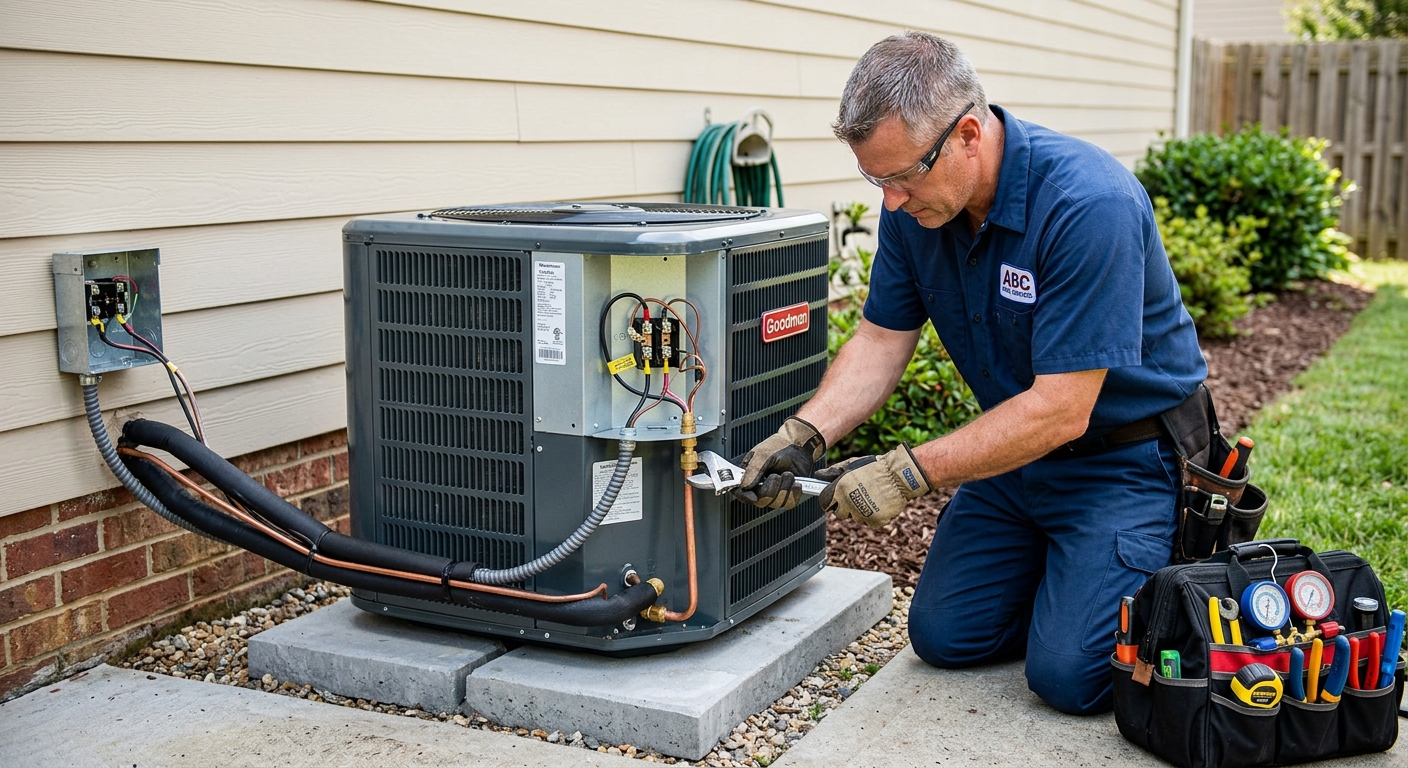
What a new HVAC system costs in Springfield
Springfield’s high homeownership rate and the fact that more than 90% of local houses were built before 1980 make this overwhelmingly a replacement and retrofit market. Older construction dominates, and many homes still have the original ductwork (if they have ducts at all). For houses built with radiators or no AC, installing central air isn’t just about the equipment—it often means adding new ducts or turning to ductless options. In neighborhoods like Upper Darby and Haverford, those 1920–1950 rowhouses and twins often have limited space for modern ducts, making ductless mini-splits or high-velocity retrofits the practical solution for cooling updates.
With 4,800 heating degree days and only 1,450 cooling degree days a year, southeastern Pennsylvania is a heating-dominated climate. That strongly favors systems that excel in winter, like cold-climate heat pumps or hybrid setups with gas backup. Air conditioning is still essential for comfort during humid summers, but it drives system choices less than heating performance does. For most Springfield homeowners, expect central AC or heat pump swaps to run between $5,600–$19,000 depending on your existing ducts and whether you want high-efficiency or year-round heating from your system.
| System |
Best for |
Efficiency |
Price range (installed) |
| Central AC replacement (existing ducts) |
homes with sound ductwork |
16–20 SEER2 |
$5,600–$13,500 |
| Air source heat pump (ducted) |
year-round heating and cooling |
8–10 HSPF2 |
$9,000–$19,000 |
| Cold-climate heat pump (ducted) |
heat pump as primary heat |
9–11 HSPF2 |
$14,500–$19,000 |
| Ductless mini-split (single zone) |
additions, rooms without ducts |
20–30 SEER2 |
$3,600–$7,900 |
| Full duct system installation |
homes with no existing ducts |
— |
$10,000–$20,500 |
Installed estimates for a typical Springfield home. Equipment tonnage, duct condition and electrical capacity move these more than brand.
The comfort problem that isn't temperature
In Springfield, the biggest comfort issues aren’t always heating or cooling—it’s dry winter air and humid summer air. Winters here are long enough and cold enough to dry out even a tight home, while summers are muggy. This mix means you must think about more than just temperature when weighing HVAC options.
Oversized air conditioners—commonly sold to “make sure it’s big enough”—rarely work out well for humidity. If your unit cools too quickly, it doesn’t run long enough to remove moisture from the air. That leaves you with a cold but clammy house. Proper sizing is your best defense against this, not more expensive equipment.
Whole-house humidifiers can absolutely help with winter dryness, but they require annual cleaning to prevent mold and scale. Many folks buy one and then skip the maintenance, trading dry air for musty smells or water leaks. The same goes for higher MERV filters; using MERV 13 when your blower is rated for MERV 8 can actually reduce airflow and stress your system, so check what your equipment was designed to handle.
Mechanical ventilation is important, especially for newer or recently retrofitted homes with tight building envelopes, but it’s frequently sold where opening a window or installing a simple bathroom exhaust fan would do more for less money. Whole-home air purifiers and UV lights often carry price tags far out of proportion to any actual benefit in Springfield’s air.
Maintenance that actually extends system life
Most of the HVAC maintenance that truly matters in Springfield comes down to keeping things clean and avoiding shortcuts. The single most important task is changing your air filter—how often depends on local dust and whether you have pets, but for most households, every one to three months is about right. Always match filter MERV rating to your system’s blower specs. Too much restriction will wear out the fan early.
Keeping the indoor and outdoor coils clean makes a real difference, as dust and debris reduce efficiency and force the compressor to work harder than it should. Clearing and checking the condensate line in spring—especially before summer humidity ramps up—prevents backups, leaks or water damage near furnaces or air handlers.
Refrigerant should never be “topped off” annually. If the charge is low, there’s a leak. Responsible contractors in this region will test for the source, not just add refrigerant and move on. That applies to any system, even new ones.
Annual service plans can be worthwhile if they actually include a true inspection and preventive cleaning, and if you’re the type who won’t remember to schedule otherwise. However, plans that only cover a basic visual once-over or require add-on charges for filter swaps are not worth paying for. In Springfield, schedule major maintenance in spring or early fall—you’ll avoid the logjam when everyone is down during the first heat wave or deep freeze.
Reading an installation proposal
A complete HVAC installation proposal should give you more than a brand and a price. At a minimum, you want model numbers for both indoor and outdoor units—rated efficiencies only count if the pair is matched. Tonnage should always come with a load calculation attached, never just “matching” the old system’s size. If your existing ductwork is being reused, a good proposal will say what condition it’s in and whether any sealing, repairs or modifications are needed.
Electrical requirements matter. Replacing heating or cooling equipment sometimes calls for a heavier circuit or even a panel upgrade, and that work should be explicitly included if needed. The quote must say whether the existing refrigerant line set will be reused or if a new one is included—reusing old lines isn’t automatically bad, but it should be discussed and justified.
Expect your contractor to outline what’s being done with the condensate drain, what type of thermostat you’re getting (or if you’re keeping yours), and whether a permit and final inspection are included. Commissioning—testing and documenting airflow and refrigerant charge—should be spelled out. Finally, clarify whether the labor warranty covers anything beyond the manufacturer's parts guarantee.
| Line item |
What to look for |
Red flag if… |
| Equipment |
model numbers, indoor and outdoor matched |
brand name only |
| Sizing |
load calculation attached |
matched to the old nameplate |
| Ductwork |
condition assessed, sealing scoped |
not mentioned |
| Electrical |
circuit and panel capacity confirmed |
assumed adequate |
| Line set |
replaced or documented as reused |
silent |
| Commissioning |
measured airflow and charge, documented |
no startup report |
| Warranty |
labour years stated separately |
manufacturer only |
| Permit |
included and priced |
'not needed' |
Permits, licensing and inspections in Springfield
For residential HVAC work in Springfield and elsewhere in Delaware County, there is no statewide HVAC license in Pennsylvania. Instead, contractor oversight is handled by municipal governments or, in some cases, by the state if a municipality has chosen not to enforce the code itself. All contractors taking jobs over $500 must have Home Improvement Contractor (HIC) registration issued by the Pennsylvania Office of Attorney General. You can verify this directly at hic.attorneygeneral.gov before signing anything.
EPA Section 608 certification is federally mandated for any technician who will handle refrigerants—so every job involving replacement or recharging of AC and heat pump systems should have a technician with this credential, regardless of local licensing rules.
In Upper Darby Township and most surrounding areas, you’ll need a mechanical permit for any central HVAC equipment installation or full system replacement. This means passing an inspection when the job is complete, ensuring the install actually meets code. Workers’ compensation coverage is also required for any company with employees. Before you let a contractor start, verify their workers’ compensation via the WCAIS portal (wcais.pa.gov) and check their insurance certificates.
For Springfield homeowners, skip anyone who refuses written contracts—they’re required by law for jobs over $500, and you have a three-day right to cancel.
Separating installers from equipment sellers
In Springfield, with tight competition among dozens of qualified outfits, the way a system is installed matters far more than the badge on the outside unit. Even the top equipment can underperform or fail early if it’s sized wrong or hastily dropped in without testing. Look for installers who focus on workmanship: proper layout, thorough commissioning, and respect for your existing home construction.
Doing your diligence starts with checking HIC registration at hic.attorneygeneral.gov. Always ask who will actually handle the refrigerant work—EPA Section 608 certification is required for that person. Any real professional here will be prepared to show documentation or point you to their number in the registry.
Insist that the proposal states the model numbers (not just “3 ton Goodman,” for example), and that sizing is based on a Manual J load calculation—not what was there before. You’ll want commissioning included: that means measurable verification of correct airflow and refrigerant levels when the job is done, with a report you can see.
- Verify Home Improvement Contractor (HIC) registration at hic.attorneygeneral.gov
- Check EPA Section 608 certification for refrigerant-handling technicians
- Ask for model numbers, not just brand and tonnage
- Request a Manual J load calculation with your proposal
- Ensure commissioning (startup testing and documentation) is included
- See proof of current workers’ compensation coverage via WCAIS
- Demand a written warranty, with labor and equipment time frames separated
- Confirm permit fee and inspection are spelled out
- Ask how ductwork will be assessed and if sealing or repairs are included
- Check for hidden “miscellaneous” or “allowance” charges—press for details
- Make sure the quote covers any necessary electrical work (panel, circuit, disconnects)
- Decline any company that offers to “waive your insurance deductible” (illegal under state rules)
With local contractors densely clustered and little rural travel, any unwillingness to answer these questions or provide documentation is a strong sign to move on—there are plenty of reputable choices in the Springfield market.
Duct condition, leakage and sealing
In Springfield’s housing stock—especially in those 1920–1950 rowhouses and twins of Upper Darby and Haverford—the state of your ductwork is often the limiting factor in comfort and efficiency. Many older homes never had central AC; they were built with ductwork sized for furnace heat only, or with no ducts at all. Where ducts are present, they are rarely sealed, and what you can’t see can cost you.
A duct blaster test is the gold standard for measuring leakage. This test temporarily pressurizes your ducts and quantifies exactly how much air is escaping before ever reaching its intended room. In older Springfield homes, leakage rates can easily be high enough to waste 20% or more of your heating or cooling output.
Sealing—using mastic or specialized tapes applied at all accessible joints—can fix much of this loss in most cases. If your returns are undersized, as often happens with retrofits, your system will be starved for air and may run noisily or shut down early. Duct runs through attics or crawlspaces (found in some additions or converted spaces) suffer even more loss, as unconditioned spaces rob heat or add unwanted humidity.
If you’re considering new equipment, test your ducts first—not after. Many comfort and efficiency complaints tie back to leaky, undersized, or poorly insulated ducts, not the heating or cooling unit itself. In homes with no central ducts—very common in Springfield’s pre-1980 houses—consider whether adding a high-velocity system or ductless mini-splits makes more sense than running full-size trunk lines.
Frequently asked questions — HVAC installation in Springfield
Do I need dual fuel in southeastern Pennsylvania?
Dual fuel means pairing a heat pump with a furnace or boiler, so your system automatically switches between electricity and gas (or oil) for the most efficient or affordable heat. In Springfield and the rest of southeastern Pennsylvania, with cold but not extreme winters (winter design temp 14 °F), this option is worth considering if you want lower operating costs, already have natural gas via PECO, and see a lot of usage. For many, a cold-climate heat pump is enough on its own, especially in a well-sealed house, but homes with modest weatherization or high winter usage may want the backup for peace of mind. Expect a complete dual fuel system to cost a bit more than a standard setup—think in the $14,500–$19,000 range, especially if controls are integrated for automatic switchover.
How much does ductwork add to an HVAC installation?
Ductwork is typically the biggest variable in system pricing in Springfield’s older homes, since so many houses built before 1980 never had AC ducts to begin with. If your house needs a full duct system added—trunk, branches, supply and return, all sized for modern airflow—expect that alone to cost between $10,000–$20,500 installed. For many, this figure rivals or exceeds the equipment itself. In cramped rowhouses or where space is limited, high-velocity ducts or ductless mini-splits may be a better investment. Existing ductwork in decent shape will need inspection, cleaning and possible sealing, but that’s a far smaller cost unless major resizing is required.
Why do HVAC quotes in Springfield vary so much?
Springfield sits in a dense, competitive contractor market, so labor rates can be lower than nearby rural counties, but quotes often differ by thousands. Major pricing swings come down to: whether ductwork is being reused or replaced ($5,600–$13,500 for just a central AC swap with solid ducts vs. over $20,500 for all-new high-end installs); equipment efficiency levels; inclusion of electrical work; and most importantly, level of detail and code compliance. Some quotes purposely omit permits, load calculations or commissioning to appear cheaper up front. Always insist on proposals that spell out every included item and warranty. The cheapest quote is rarely all-inclusive for a Springfield retrofit.
How does southeastern Pennsylvania's climate affect system sizing?
With 4,800 heating degree days and just 1,450 cooling degree days, Springfield’s weather puts more stress on heating systems than cooling. This makes undersized or “just big enough” heat pumps and furnaces far more noticeable in winter. However, you must still be careful not to oversize cooling equipment—too much capacity leaves summertime humidity uncontrolled. A Manual J load calculation that factors in your home’s age, insulation and window area is essential. Installing a too-large AC will waste energy and fail to dehumidify, especially with our humid summers. Most good contractors in Springfield will provide proper sizing as part of a proposal for any system—from a $3,600–$7,900 single-zone mini-split to a whole-house system.
How is a tax credit different from a rebate?
For Springfield homeowners, a tax credit is money you get back when filing your federal or state income taxes: it reduces the amount you owe, but you only benefit after the tax year is over. A rebate is immediate—often coming as a check, instant discount, or utility bill credit, sometimes right at purchase. Tax credits may apply to high-efficiency heat pumps (for example, a $14,500–$19,000 cold-climate install), but they don’t lower your upfront cost. Utility rebates (via PECO for electric or gas upgrades) often show up sooner, but tend to be smaller. Always confirm you qualify for a rebate before you commit, as paperwork or installation steps can’t always be done retroactively.
What is a Manual J load calculation?
A Manual J load calculation is an engineering assessment of your home that determines the correct size (capacity) for your heating or cooling system. It accounts for building size, insulation, age, windows, orientation, and air leakage. In Springfield, with homes mostly built before 1980, skipping a load calculation and just matching your old equipment’s “tons” is asking for problems—especially as insulation is upgraded or spaces are finished. All quality proposals, whether for a $5,600–$13,500 system or a more complex job, should include a Manual J worksheet or at least a clear summary of the results. This is the single best way to avoid chronic comfort and humidity complaints down the road.
Should I close vents in unused rooms?
It’s a common myth in Springfield and across Pennsylvania that closing supply vents will save energy. In reality, it often backfires. Your system is sized and balanced for the total space in your home. Closing too many vents raises pressure in your ductwork, increases leakage at joints, and can even cause your furnace or AC coil to freeze or overheat. This can increase both operating costs and wear on the blower. In extreme cases, the system’s safety controls may even shut it down. If certain rooms are always over-conditioned, you’re better off discussing zoning or having your contractor rebalance airflow during a maintenance call. Otherwise, keep your vents open—especially given the leakage and return sizing concerns in local pre-1980 ducts. Blocking a vent won’t change your $5,600–$13,500 central AC bill, but can easily lead to repair costs.
What is commissioning and why does it matter?
Commissioning means fully testing your new HVAC system upon completion—measuring every critical performance number: airflow, refrigerant charge, and temperature drop—so you know it actually delivers what the equipment’s ratings promise. In Springfield’s retrofit-heavy market, commissioning is the step that separates quality installs from slapdash jobs that leave you paying for lost performance. You should receive a commissioning report and see the tech use digital gauges and airflow meters. On a $9,000–$19,000 ducted heat pump install, commissioning often catches hidden duct leaks, miswired controls, or incorrect refrigerant levels before they become comfort or reliability problems. If a contractor skips this, your system could run poorly for years before anyone knows.
How do I verify an HVAC contractor's insurance?
In Pennsylvania, and especially in Springfield, it’s your right to verify that your contractor has both liability coverage and workers’ compensation if they have employees. Ask directly for a certificate of insurance—any reputable company will supply this promptly. For workers’ comp, you can check status at wcais.pa.gov, the state’s public database. This protects you if anyone is injured on your property during the installation. For any contract over $500—which includes every HVAC installation from a $3,600 ductless mini-split up—insurance isn’t just a nice-to-have, it’s a basic legal requirement. Never rely on a verbal “we’re covered;” insist on seeing proof before you sign. If a contractor hesitates or refuses, move on to one of the many local companies who won’t bat an eye at your request.